
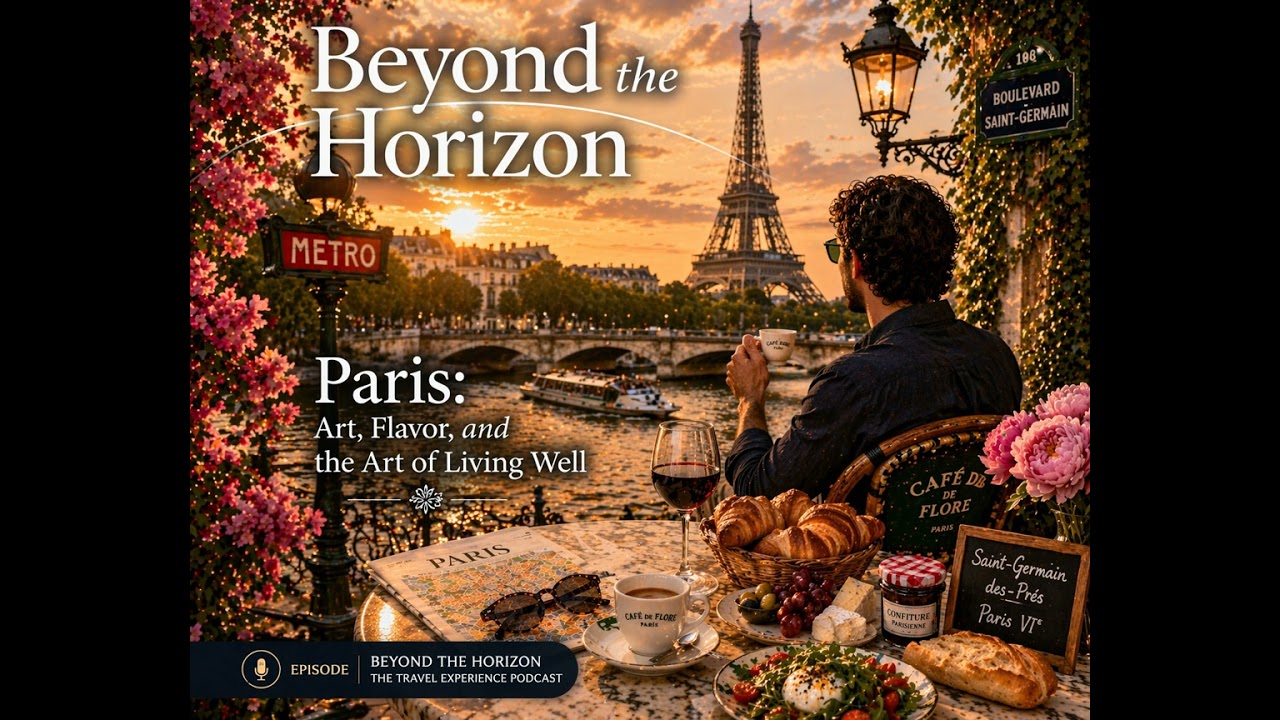
In this episode, we explore Paris, the most written about, painted, photographed, and visited city in the world.
A place that somehow continues to exceed its own reputation, where every arrondissement contains a different version of the city. Where the food, the museums, the architecture, and the particular quality of the light on the Seine at dusk combine into something that has been drawing people across continents for centuries and shows no sign of losing its hold on the human imagination.
We cover everything you need to know before planning a visit, including:
* What makes Paris immediately feel different from every other European capital, from the Haussmann boulevards and their uniform stone facades that give the city its visual coherence, to the arrondissement system that organizes Paris into twenty distinct villages each with its own character, and the particular French relationship with daily pleasure, food, coffee, and the art of doing nothing in a cafe for two hours, that makes the city feel like a lesson in how to live
* The neighborhoods worth knowing: the Marais for its medieval streets, Jewish quarter, gay village, and the finest concentration of independent galleries and fashion boutiques in the city, Saint-Germain-des-Prés for the literary cafe culture of Les Deux Magots and Café de Flore and the best bookshops in France, Montmartre for the village-within-a-city atmosphere and the view from Sacré-Coeur over the entire Paris basin, the Canal Saint-Martin for the most genuinely local and unhurried version of Paris that most tourists never find, Belleville for street art and some of the most exciting restaurants in the city, and the Left Bank around the Panthéon and the Luxembourg Gardens for the Paris of students, academics, and long afternoon walks
* The Louvre and how to approach it honestly: why it is simultaneously the greatest art museum in the world and the most overwhelming, why the Winged Victory of Samothrace and the Vermeer rooms matter as much as the Mona Lisa, how to use a focused two to three hour visit rather than an exhausting full day, and why booking the first entry slot of the morning is non-negotiable in any season
* The Musée d’Orsay as the finest Impressionist collection in existence, the Pompidou Centre for modern and contemporary art in a building that was itself a provocation when it opened in 1977, the Musée de l’Orangerie for Monet’s Water Lilies as one of the most meditative art experiences in Europe, the Rodin Museum and its garden for a slower and more intimate afternoon, and the Musée Picasso in the Marais for the most comprehensive survey of a single artist’s development available anywhere
* The Eiffel Tower and how to experience it without the worst of the crowds: why the view from the Trocadéro esplanade at dusk is the essential photograph, why climbing the stairs to the second floor is worth the effort, and why the tower at night, lit and sparkling on the hour, is one of those experiences that genuinely delivers despite every expectation
* Notre-Dame de Paris and its reopening in December 2024 after the fire of April 2019: what the restored cathedral looks like today, what was lost and what was saved, and why visiting it now carries a particular weight that no previous generation of travelers has experienced
* The food culture that defines the city and the country: the Parisian bistro and the dishes that belong to it including steak frites, duck confit, French onion soup, and crème brûlée, the boulangerie culture and why the croissant and the baguette are worth eating at every opportunity, the covered passages of the 2nd arrondissement as the most undervisited and most atmospheric food and shopping experience in Paris, the market streets of Rue Mouffetard and Rue de Bretagne, and where to find serious modern French cooking in a city where the restaurant scene has quietly become one of the most exciting in the world
* The Seine and how to use it: the Pont des Arts and the bridges of the Marais for the finest walking in the city, a river cruise at dusk as the most efficient way to see the major monuments in sequence, and the Paris Plages summer beach installation as one of the most enjoyable urban interventions in Europe
* The day trips that extend Paris into the wider France: Versailles and its gardens as one of the most extraordinary royal landscapes in the world and why a full day barely covers it, the cathedral of Chartres as the finest Gothic building in France and one of the most moving experiences available within two hours of the city, the Champagne region and Reims an hour and twenty minutes by TGV, Giverny and Monet’s garden from late April through October, and the medieval town of Provins for those who want a UNESCO World Heritage site without the crowds
* When to visit: why June and September are the two months that give you Paris at its most alive without the peak summer density, what August actually means for a visit wh…