
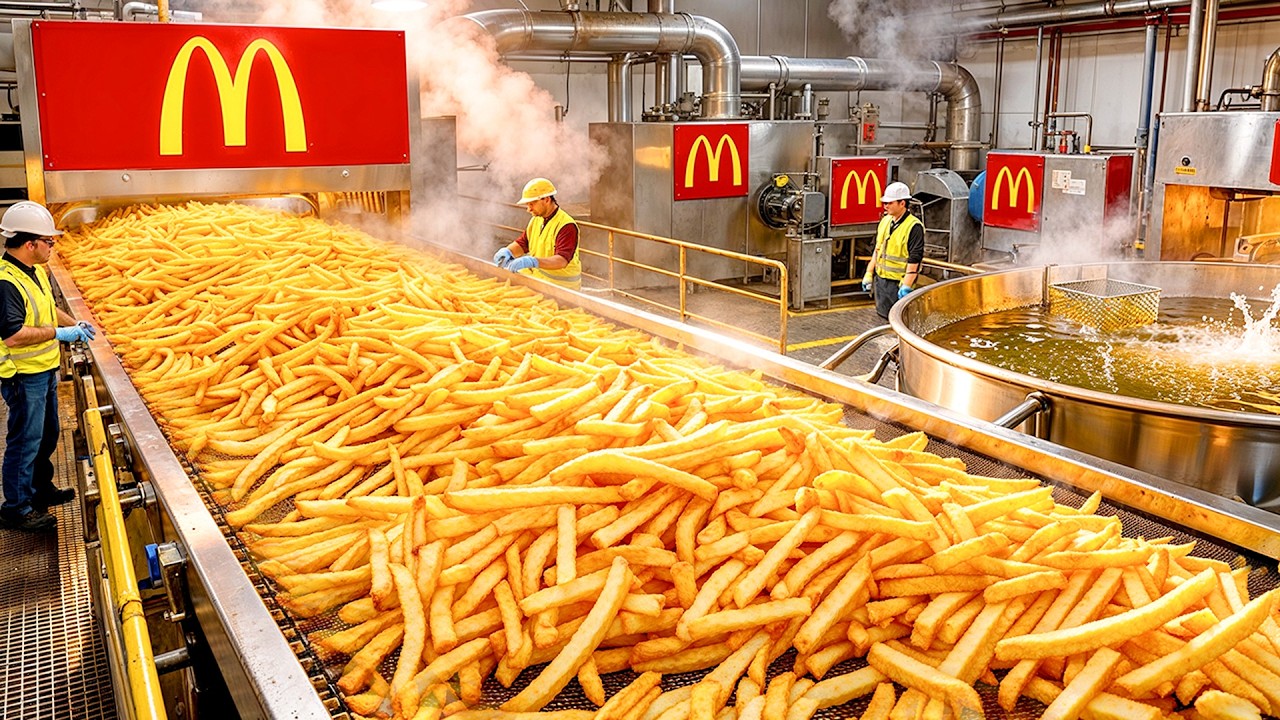
A fresh potato can begin turning brown within 15 to 30 minutes after it is cut.
Yet frozen french fries can sit in storage for up to two years at 0°F and still cook evenly.
That difference is not luck, and it is not simply preservatives. It comes from a tightly controlled industrial system that manages heat, moisture, and timing at every stage. Inside large facilities, potatoes are blanched to stop oxidation, partially fried to set structure, then flash-frozen to lock in texture before shipping.
The same precision governs stuffed Hot Pockets, pre-assembled sandwiches, and sliced Smithfield Bacon, where temperature swings of just a few degrees can change safety and consistency.
So how do factories keep fragile ingredients stable through cutting, cooking, freezing, and reheating without losing structure?
Captain Discovery steps inside the system behind that reliability.
👉 Like, subscribe, and hit the bell 🔔 to keep exploring the sweet side of the world with Captain Discovery!
If you are the owner or if you want to be featured please contact us at: captaindiscoveryus@gmail.com
We will follow your request as soon as we receive your message.
Copyright disclaimer section 107 of the Copyright Act 1976. “Fair use” is allowed for purposes such as criticism, comment, news reporting, teaching, scholarships, and research.
We are not affiliated with the businesses whose products are shown in this documentary!
#howitsmade #frenchfries #captaindiscovery
4 Comments
You’re watching this with fries, aren’t you?
There’s barely any filling in these hot pockets. They rip you off. They ain’t worth the money anymore.
Is a Hot Pocket a sandwich? A calzone? A pasty? 🤷🏼♂️
I grew up in Southeastern Virginia, spitting distance from Smithfield, on Smithfield pork🐖 products. Their very distinct pork🐖 handling always produced those products that you could only get locally, for decades. After marrying a man from the farming Midwest, and relocating at 20 to Indiana in 1977, once he was discharged from the Air🛫 Force, I could of course tell immediately the distinct differences between their local meat products from those on which I grew up!
We made it a point as often as possible to take a cooler home with us when visiting family, so we could bring some of the hometown meat products back with us, so we could continue to enjoy them.
Over the years, the quality seemed to shift, and the variety changed also.
One of my favorites used to be "Smithfield Ham Sausage", a roll sausage product they made which included their hams in addition to other meats common to sausage. The combination was delightful, and I used it in many different products, including my own meatloaf, and recipe for southern style Hoppin' John, making the ham sausage the only meat products in the combination of cooked white rice and canned, seasoned black eyed peas, if available. (If not, I cooked dried black eyed pea🫘s myself, with various spices and seasonings I devised on my own)plus other spices and chopped vegetables precooked before addition.
My husband loved 🥰it, as I had easily "southerfied" him while he was stationed at the Air Force Base, where we dated just before I 🎓graduated from high school, got 💍 engaged in the following November, and married💒 the next July.
I had no problem cooking for him as he lived in the barracks for single airmen, and either ate out in fast food restaurants, or at the Chow Hall for free. My cooking was definitely preferable according to him, plus at some of the restaurants I introduced him to while we were dating, engaged and after we were married. We didn't have kids for several years, so we could pretty much do as we pleased!
Anyway, after several years, and two kids, we continued visiting my family, and transferring the ham sausage to my own freezer by way of our cooler each trip. I had taken to ordering it by their catalog and from its website when that became available. Before that, I would send my sister some money, and ask her to buy several rolls of it in advance of our next trip, and store it in her freezer for me. That saved a trip to the grocery while we were there, and wanted to spend our time taking our kids and my siblings out to historic places, and places to eat, since Williamsburg, Jamestown, and Yorktown are right around there, and were very interesting to them at the time. Plus Lion King/Lion Country Safari, and others.
Unfortunately, there came a time when the ham sausage suddenly disappeared from the meat coolers in the grocery stores, and from their catalog which offered their products by paper catalog, and internet website when the internet finally became a "thing." We had started this annual pilgrimage to gather ham sausage in the later 1970's, after we married and moved to Indiana. This was now in the late 1990s or early 2000s. No ham sausage to be found!😮 Direct contact to the sales office in Smithfield confirmed it was no longer made or offered for sale. No real reason for its disappearance from them. I was 😢very upset by the disappearance of my favorite item, besides their traditional smoked hams. When the whole company was bought out by a Chinese company, it lost all its real "handmade"process production, and its original packaging, and other kinds of products. It was a sorrowful loss at the time. I still miss it. The peanut🥜 fed hogs🐖 were the standard of the brand, and being made with peanut🥜 fed hogs🐖 was one of their particular processes that made them what they were. Too bad….