
Book a table:
Shop Michel BRAS equipment:
https://michel-bras-cote-japon.com/
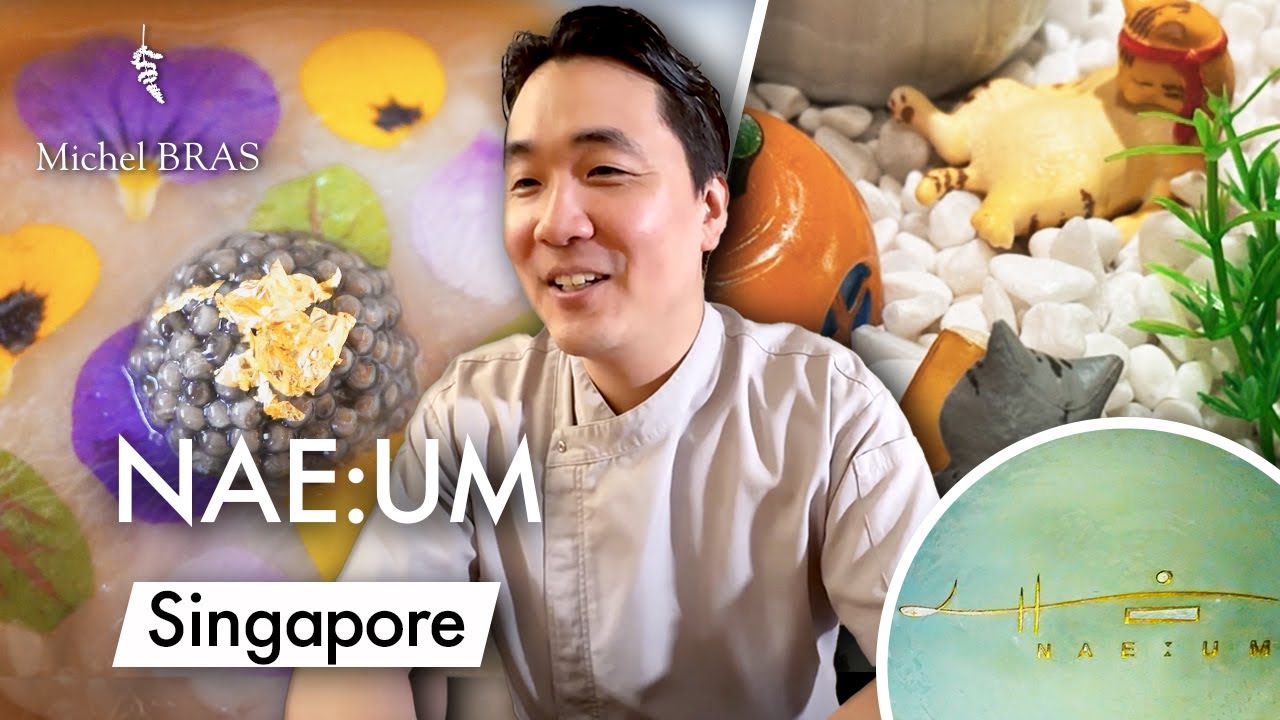
Louis Han, who started his first restaurant with the Korean name meaning “fragrance that evokes memories,” earned his first Michelin star a few years later at the age of 32. He is off to a good start. He grew up in Gangnam, Seoul, to a lawyer mother. He went to culinary school with a firm determination to become a chef, overcoming his mother’s expectations of him to become a doctor or lawyer.
Surrounded by a large and kind family, he followed the path his heart led him. He studied French and Italian cuisine, gained experience in the Middle East, and immersed himself in his native cuisine when he landed in Singapore. He honed himself under Sun KIM of META, a senior chef in Singapore and a senior Michelin 1-star chef, and explored what he wanted to do and what kind of chef he wanted to be.
What Louis pursues is the euphoric feeling of euphoria when memories come bubbling up from within the body. The question for him is how much he can offer this feeling in the time from when he opens the door of the restaurant until he leaves, focusing on the aroma that precedes the food and the food that follows it. This is his challenge to himself.
Singapore will provide a great deal of freedom for such a challenge. It is Korean food, but it is not Korean food, nor is it French or Italian food. How much of the recipe is intentional and how much is unconscious? It is a recipe based on the hope and expectation that we want to spend happy times together, that he will remember those times, and that we will have a relationship that will one day bring us back.
Today, at the age of 34, Louis will continue to boldly rework his memories and improve his skills in creating “memory-inspiring scents. But he will also continue to be a chef who protects and develops the most important things, which are more important than technique.
Everyone, whoever comes to my restaurant,
I treat them as my family.
That’s why the restaurant design is also a bit like home.
I have had a very good experience in Japan always,
all the chefs are very sincere and they are really
focused and passionate in what they are doing.
I also try to talk to every customer every
day, at least I try to introduce myself,
because they come here to try my food so I also
need to put my effort to talk to them one by one.
Hi I’m Louis Han, chef-founder of restaurant
NAE:UM in Singapore. NAE:UM serves contemporary
Seoul cuisine. The meaning in Korean is “fragrance
that evokes your memories”, so all of our menu are
based on episodes that I want to share from
my memories. My memories of the mountains, my
memories of the sea, my memories of watching the
sunset, or having a barbecue in front of my home.
I play with Korean flavors but use Western
techniques. All the Singapore diners are
actually traveling a lot, they try typical
Korean food in Korea and Japanese food in Japan,
French food in France so they have a very
good standard of the originality. Most of
them say that it’s very hard to find this
flavor and this kind of food in Korea.
One of our signature dishes is the memilmyeon
which is a Korean style, buckwheat noodle. The
combination that I use is very Korean in flavor,
but actually I also never tried this flavor in
Korea before. Even Koreans comment and say it’s
very familiar yet they never tried it before.
Today all the dishes I made come
from Episode 6: After Work Hideaway.
So now I’m talking about the
Korean culture where after work,
we always go out, gathering, and enjoy
with friends and de-stress for the day.
The first dish I cooked was rolled ocean
trout. We slice it very thinly and season
evenly with kombu powder, and salt/pepper, some
citrus – like sometimes lemon, sometimes yuzu,
sometimes lime. We roll it and we very slowly
cook it in the water because the texture will
be softened and it will bring a good taste.
Then we wrap it in zucchini, that we cook in
a dashi broth, so it’s going to bring Umami and
crunchiness. The sauce is made of chili, garlic,
ginger, shallot, chives, Korean chili paste and
vinegar that gives an Umami and complex flavor to
the fish. Also Ossetra caviar, we also have yuzu
juice to open up the palate it’s very appetizing.
Sometimes if using the big mandolin
for the zucchini the outcome is
sometimes big, sometimes small, but this
one (from Michel Bras) gives us very
consistently one size(of slices). I was very
impressed that blade is very sharp and then
no matter what strength I use it comes
out the same, yeah it was very awesome.
I never trained in Korean food before, I never
learned before. I only saw how my mom cooked,
how my grandmother cooked and then learned
from that. Mostly my (mentor) chefs are all
French or Italian, it’s mostly European
Cuisine that I learned, I’m very happy
the dishes can’t be found anywhere else,
they only can be seen in our restaurant.
For the second dish we cooked quite a
traditional dish, gamja jeon with
yukhoe. Yukhoe is like Korean style beef Tartare,
and the gamja jeon is a Korean style potato
pancake. So for the potato pancake, we
make it in a very traditional way and
we cut it and then for the beef Tartare,
we marinate it with a Bulgogi sauce, one
of the most popular Korean marination and after,
at the bottom we put some pickled bell pepper,
it gives hints of sourness and spicy taste
to the beef, so it’s going to balance it out.
The (Michel Bras) grater has a lot of options
to use. When I make the pancake I wanted to
cut (the potatoes) in Julienne. Actually they can slice
both ways: once going down once going up.
Actually that saves a lot of time, and they
are convenient. The blade is also very sharp,
it’s very safe, very consistent, everything
comes out the same size, each time.
The third dish that I cooked today was
the sashimi dish. I was inspired from the
Korean fresh marinated sashimi. I make the
vegetable salsa. It’s very typically used
for the Korean style salad, which is onion, Minari
which is Korean water parlsey, kkaetnip which is
a perilla leaf , leek, cucumber. These I make
into a salsa. Hamachi which is a yellowtail
we slice. Inside we put some Minari, which is
the water parley because it is very fragrant
and we always eat it with fresh seafood. It
also has a texture, it’s very crunchy. The
daikon we cure in salt water and after this
we thinly spread it out, put some flowers to
make it more floral and the Daikon itself
is very sweet and sometimes has spicyness:
it’s a good combination with seafood, and we add
some Ossetra caviar and gold leaves for garnish.
The sauce is actually made of lemon
and soy sauce so it’s citrus and Umami,
and it’s going to balance out any fishiness
from the fish, and bring up more appetite.
The knife was actually very sharp and very
good to hold. They have wedges and the handle
and everything was quite comfortable. The size
is just nice to use, the blade is also gorgeous
and it’s a very unique color and everything.
My mom is a working mom, so only on Sundays
she would cook for me; some simple Korean food,
some noodles or some kimchi stew. Actually,
I made our signature noodle dish based on my
memory of having the noodles from my mom, even
though now when I go back home and I ask my mom
to cook the dish, it’s mostly my grandmother and
my auntie that cook for me. I’m the only child,
only guy in my family so they always cook
the things that I want to eat. Whenever
I go back to Korea, the first thing
I’m having is my grandmother’s food.
The next dish that I do is abalone, the
inspiration came from the traditional
marinated jelly, also we (Koreans) eat a lot
of acorn jelly or mungbean jelly but this one
is our own version we make. At the bottom
we put some pine nut cream so nuttiness,
and we add some vinegar to cut down the
fattiness also, and some chive oil for
the flavor and then beef and spring onion
we sauteed together with sweet soy sauce
and then we put the pickled nori so this
gives a very umami and seafood-y taste
and then we put braised Korean abalone, the
Korean abalone that we dusted with seaweed
powder and then we put some nasturtium (leaf)
and coriander flower to get more flavor. When
the customers eat it all together these flavors
are blending well and are very balanced, yeah.
The fourth dish that I cook is deep-fried
turbot. I was actually thinking about fish and
chips and then thinking about the different
ways I could try to make it very Korean,
because Korean food also was influenced from
some Chinese flavors: when we eat fried food,
sometimes we eat them with a sweet-sour sauce.
We actually brine the turbot with kombu,
and the meat is more firm and equally seasoned.
We make a very light dough so we deep fry,
and then we make a parsnip puree and a roast bell
pepper (puree). So the parsnip puree gives the
sweetness and savouryness and the roasted
bell pepper (puree) has garlic and a tone
of spiciness. We also have a grilled sweet
cabbage, for the texture and the grilled flavor,
and then the sauce we made from the fermented
beans and vinegar, soy sauce, fermented fungus
and charred leek. So naturally there is the
smokiness, sweetness, sourness that comes from
the ingredients, so it gives the dish a
very complex taste. The meat itself is
very plain, the deep fried fish, but there are
a lot of components to enjoy separately, yeah.
Now, the restaurant NAE:UM is
going to be 3 years old. I mean,
now it’s been 2 years and 7 months. I
try to be here every time, even 5 years,
10 years later, people still can
come here and remember I’m here,
always. And aside, we try to open some casual
restaurant so many people can enjoy my food.
The first dessert I cooked was apple. At
the bottom we put the fromage blanc cream,
and after that we have braised apple, we
braise it with lemon and ginger, sugar,
syrup. After that, we add some winter melon
pickles and honeycomb that give us sweetness
and texture. Then there’s the sorbet that
we make with Shiso and apple. It gives very
good refreshing and very herby taste and then we
slice some fresh Apple to give more freshness.
The last dish I cooked is one of our signature
dishes as well. We make two types of cream,
so at the bottom we have one which is Jujube,
which are Korean red dates, truffle to make the
cream, the other one is the Medjool dates which
are Arabic dates to make the pastry cream. The
pastry cream gives more richness, and then the
Jujube truffle cream gives more flavor. After
that we make the Korean style wafer which adds
crunchiness we shave some winter Black truffle
to get strong truffle notes. For the sorbet,
we made it with white chocolate, like sweet
but not that overly sweet, light and balanced.
Everything together is very savory yet very sweet.
There’s all the things that I cooked today.
The Michel Bras utensil equipment
is very nice, I will have some too!
If any of you have a chance to visit Singapore,
please visit our restaurant so I can share
my memories with you guys, thank you!
1 Comment
Wow, the passion in this restaurant. Thanks for sharing! I hope to visit someday!