
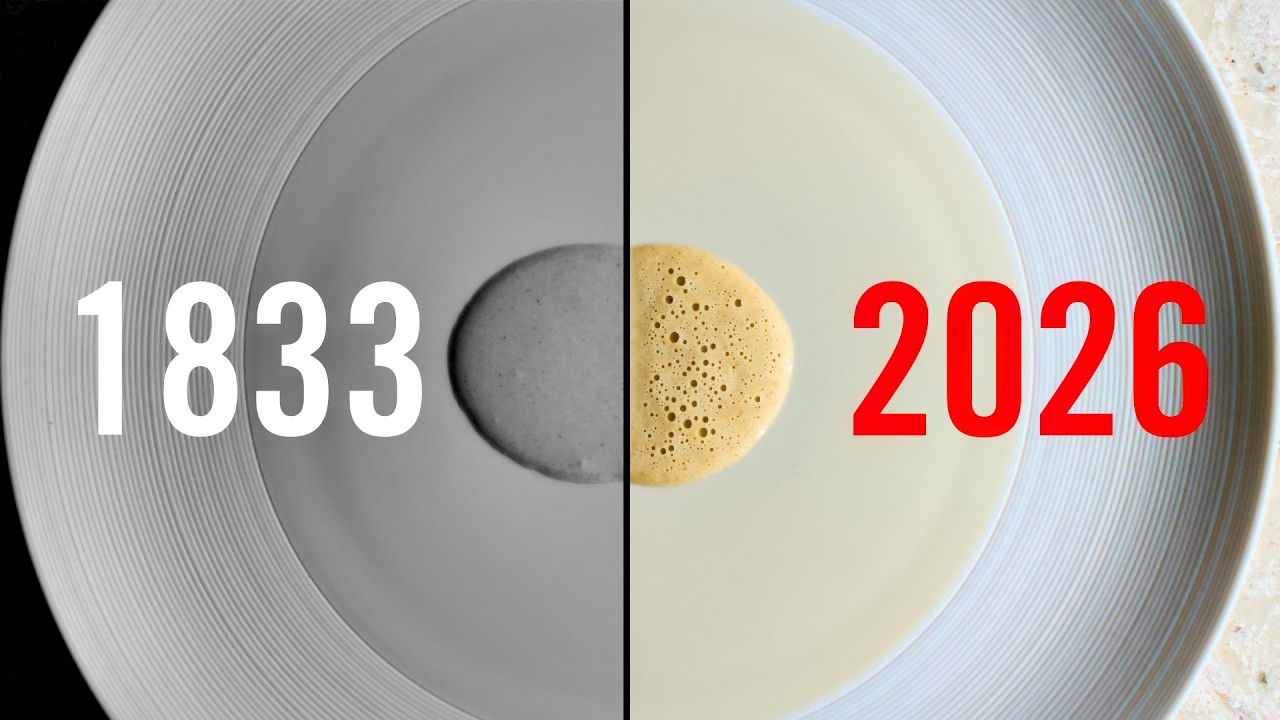
Marie Antoine Carême’s Mother Sauces were first published in 1833. A lot of time has passed since then and chefs today no longer use them to the extent that we used to. We have new sauces. We have evolved sauces with new techniques and new equipment. And one sauce should never have been a Mother Sauce in the first place! (trust the English to ruin French cuisine without even turning on a hob).
Huge credit to @FrenchGuyCooking for his incredible work into the history of the Mother Sauces. Just wow. Mother Sauces: https://www.youtube.com/playlist?list=PLURsDaOr8hWX1T2WSXhPwL110La-GxjYY
Images at the beginning credit: 70s Dinner Party: The Good, the Bad and the Downright Ugly of Retro Food by Anna Pallai
Music:
Bisiesto by Hiracutch @ch
Bisiesto by Hiracutch / hiracutch
Creative Commons — Attribution 3.0 Unported — CC BY 3.0
Free Download / Stream: https://www.audiolibrary.com.co/hirac…
Music promoted by Audio Library • Bisiesto – Hiracutch (No Copyright Music)
Evasion by KV @icprod
Music: Evasion by KV / kvmusicprod
License: Creative Commons — Attribution 4.0 International — CC BY 4.0
Free Download / Stream: @ion
Music promoted by Audio Library: • Electronic, Retro, Groove (No Copyright Music)
Download here! @ds/
47 Comments
Great video. Careme viewed stocks as more fundamental than sauces 'foundations of cooking', grande (latterly mother) sauces were a complementary buffer for the stocks in the "small sauces".
Thank you for another great, instructive, video. I’ve learned so much from you already. And thanks for avoiding jump-cuts and other silly tricks. I love the straightforward style. You know what you have to teach, and that you’re giving us great value without mucking it up.
so exited for the upcoming serie of sauces !
Where's teriyaki?
They aren’t outdated, they aren’t being taught and cooking skills are being lost. If you choose not to use older methods that is fine but newer chefs not knowing or having traditional skill makes them poorer at doing their work . It’s like learning to do a job only knowing the shortcuts or cheat methods. If you never master anything you will never master anything. I’ve seen too many failed apprentices. It’s as much about the skills of making those sauces and the application of techniques as it is about the sauces themselves. I’ve seen people split or destroy food because they have to throw ingredients out because they cannot use a whisk and a bowl and cannot get anything accomplished without an immersion blender a robo coupe a blow torch and a kg of agar agar.
Have it your way, mayonnaise is a mother sauce. But it still isn't an instrument.
Thank you. I always found the "mother sauce" list to be completely nonsensical.
Personally I have to disagree with a few of your choices. You're ignoring the variety of other starch based sauces outside of wheat flour based roux. Some examples are corn, potato, tapioca, and rice starches and flours used in Chinese cooking.
Also for stocks, they really are their own broader category of ingredients. If they are used directly as sauces, they are usually used in the reduced form of a demiglace thickened with collagen aka gelatin. Also, vegetarian alternative non-starch gelling agents such as agar agar and xanthan gum are more commonly used nowadays too.
Your style is way worse – no one wants to eat foam
3:16 You are absolutely wrong. Fruits are the sexual reproductive organs of the plant. Even if they don’t contain lots of sugar they do not give the same dietary benifits as a vegetable. Vegetables are only the stalks and leaves. Would you call a potato a vegetable just because it is part of a plant? I don’t play games and try to fool myself that I have eaten vegetables when I have eaten fruits and my body needs vegetables. Now I’m questioning the precision of your kitchen.
What’s wrong with fruit on salad? I have been enjoying one I learned to make in the 1990’s that has cashews, pineapple, chow-mien noodles and garlic grilled chicken on a bed of lettuce lightly dressed with poppyseed dressing.
Espagnolay?
Where would ketchup, mushroom ketchup, soy sauce, and worchestershire sauce end up? Some "umami" sauce category? Or are they not relevant bc they're pre-prepared?
Great video, but I just wanted to say you lowkey look like matt Damon if he was bald
I wonder if burre blanc and roux can somhow be combined into a single category.
"People in the 50s were insane about food so why do we assign any value to older recipes?"
Even if this is better than "mother sauces" your complete disdain for history has turned me off of your channel.
Really glad that TastingHistory and Townsends are blowing your channel out of the water.
"That's made roux-m on our list." 5:14
Very good video. I think about Alex's mother sauce video all the time (when he was still French Guy Cooking I believe). I think those flour thickened sauces are very important for home cooks. I don't know if you've ever had a great chicken fried steak with gravy from Texas or a gumbo made with a very dark roux from Louisiana (or maybe you've made them at home), but I'd eat either of those any day of the week. They're quite simple to make even though they're probably a weekend project. I don't know why you don't have more subscribers. I have two more of your videos already lined up to watch. You have a good one.
So a lemon tart is just cooked mayonnaise???
Mayonnaise doesn't require egg, just sufficient viscosity to suspend oil droplets in water. You'd be shocked by how well soy milk mayo works. Stick blenders allow stable high-ratio emulsions with fewer emulsifiers, as they incorporate less air which can otherwise wreck emulsion formation.
Little known fact. Little Feather was married to Biggus Dickus.
Wow…TEN years…/s
I feel like we can modernize the mayonaise naming to be emulsions.
Add mole in there and I'm in! Lol, great video!!!
Some nobody who doesn't actually show the sauce? Neat. Go end it now baldy
great video, as some one that works in kitchen for the past 10 years that always put me off. Your catogorization is way better.
A stock is not considered a sauce because it is NO sauce. It’s as simple as that. Stock is a flavored liquid to give sauces their final flavor profile if they are used in that sauce.
So the thought here was to define the sauces by technique rather than any specific recipe or ingredient and I think it missed the mark a bit. I might have gone with “purées” instead of vegetable, with “emulsions” which would cover off mayonnaise, beurre blanc and roux-based sauces, “reductions” which would cover off many stock-based sauces as well as things like gastriques, and sure “vinaigrettes” for non-emulsified oil and vinegar sauces.
Where do the basic sauces of soy sauce, mole, and chimichurri sit on this list?
Of course we need to move on based on the new knowledge and progress!
When I'm in an insufferable clickbait title competition and this guy is my opponent:
I love that mayonnaise is finally getting the respect it deserves. Always nice to see Alex get a shout out too, hope he's doing well!
I agree with rethinking the place of the rue and much of what your update proposes, but not wholly onside with stock being categorized as a sauce. In the words of Escoffier, stock is the “fond de cuisine” upon which sauces (and soups) depend (with some exceptions). But so far as veloutés and espagnole they are off-spring of the stock.
Blah blah blah blah
I think this is a necessary evolution. There is so much about studying cooking that feels not just antiquated but out of synch with what so many modern chefs do and a combination of logic and scientific scrutiny met with artistic sensibility along with the knowledge and talent to better how we think about cooking and it's real DNA feels like it's filling in a gap everyone is ignoring but that you learn too far along the path to actually teach it to others. By the time you get it your too busy practicing it. The truth about hollandaise is the perfect example of how much we need to rethink how we present the fundamentals that make no sense. Add a little bit of logic into the art and suddenly it stops seeming like a magical secret you can't grasp and instead brings confidence that you can understand it way more than you may think to create from a solid foundation. Brilliant idea and honestly kind of a relief to know there are people thinking about this.
I thought mayonnaise being a mother sauce was common.
The quality in your videos chef's kiss, can't wait to see more 🙂
Preserving rhubarb via vacuum bag for a sauce? Is this fermentation? I'm currently making extract syrup (Korean cheong) with some rhubarb via vacuum seal bags and curious as to the process and outcomes of what your using. Looking forward to everything in the future!
Stfu non of that crap was popular. It might have been in a magazine or on a show but don't talk utter tripe.
I'm more content with stock being distinct from a sauce
American mother sauces are elite: bbq, buffalo, ranch, ketchup, nacho
I have long agreed with this analysis and frequently use all these sauces. We use super powerful Vitamix blenders too, and fine chinois are essential. Good video. Channel is getting better and better.
wait, what about aoili? it's oil and garlic, it doesn't fit under any mother sauce. it's most similar to mayonnaise, but that requires egg.
To be clear, stocks are viewed as separate from sauces because they are the foundation of classic french cooking (stock is "fond" in french and literally means foundation).
They are so important that they are in their own category.
They are infused with the flavour of the ingredients that cooked within and serve as a cooking ingredient and as a base to future sauces.
In classic french cooking, you start a dish focusing on the stock, and you finish it with a sauce and garnishes.
Furthermore, a sauce has to have texture (the "nappage") but a stock isn't meant to: it is only once the stock is done that you can start reducing it and turning it into an ingredient for a sauce.
The reason we talk about mother-sauces is because there are so many other named sauces derived from them. They offer a rather plain background, in 4 different colours (blond, white, red and brown) plus one emulsion, that a chef can flavour and texturise at will.
Edit-
A further note on classification:
For a long time, and I would even argue until now, sauces were classified according to the base liquid (milk, oil, butter, wine, stock,…) while the roux was a thickening method (other methods could be using egg yolk, blood, gelatin, cream, other starches, emulsion, etc…)
I imagine that having only 4 or 5 mother-sauces was a shortcut meant to speed the work in a busy kitchen and help a young cook start to memorise recipes, but it is a very reductive way to approach sauces because it seems to imply that nearly all sauces need flour, which is definitely not the case.
DEBATE!
This video is a jump off point. Seems the consensus is that a modernised categorisation based on technique is the way to go. I'd like to know how you would do it. What do you agree with in the video, and more importantly, what do you disagree with? I've been hitting the books this past week to develop the list, and I've a few changes already 😉 and would love to hear yours. Thanks to everyone who has already shared their lists and opinions, keep 'em coming
Fruit has a botanical meaning, and a culinary meaning. Culinarily a strawberry is a fruit, botantically it is not, what we call seeds are the fruit, and the actual seeds are smaller structures inside the fruit, which is again the thing we call the seed. In botany a fruit is a structure formed from the ovary after flowering. What is and is not a fruit according to botany is a deep rabbit hole, because plants have evolved to have all sorts of parts of the flower besides the ovary to carry seeds. Whereas the term vegetable only has a culinary meaning, it's any part of a plant which an animal, such as humans, eat for sustenance, its not defined in terms of the plant itself, but its relation to animals. There is no contradiction in something being both a botanical fruit and a culinary vegetable, or in the case of a plantain culinarily a fruit or a vegetable depending on preparation.
It doesn't change a lot, but mother sauces are from Escoffier, generally from the english version of his 1907 Culinary Guide.
Yes e glish version, in the original version, hollandaise is not a mother sauce, but mayonnaise is for cold sauces.
Carême also made a list of what he calls "great sauces" and "little sauces", the four great sauces are Spanish, German, Veloute and Bechamel.
The small ones are Poivrade (Pepper sauce), Hollandaise, Mayonnaise, Supreme (a very badass name for a Veloute thickened with heavy cream 😅) abd tomato sauce.
As a french who's doing a cuisine degree, we never talked about hollandaise as a mother sauce, I found it veey weird the moment you mentioned it 😅
"I don't understand why stocks aren't considered mother sauces"
Because they're not sauces? 😅
Stocks are elements of a sauce, like the roux or the flavourings, but they're not the sauce itself, in classic cuisine (and even today) you'd never serve a stock to the customer.
The closest thing that you'd serve is a jus, but even then it's often reduced and thickened, it's not your final product.