
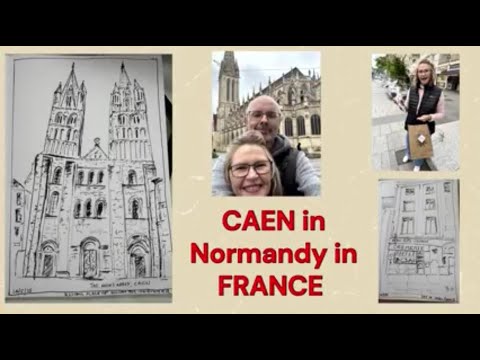
DAY 15 CAEN
DAY 15 was spent exploring Caen in Normandy, including its wonderful street café culture. Part of our exploration took as to the Place Saint-Sauveur situated in the old city centre of Caen.
Within the Place Saint-Sauveur we saw many historical structures, including the church of Old Saint-Sauveur whose oldest parts date back to the end of the 11th/12th centuries.
The Place Saint-Sauveur was almost entirely spared during the bombings of 1944. It is a superb example of the classical period of urban planning. Here the Caen market of the 12th century was held.
During the Battle of Caen in 1944 the eastern part of the city centre was destroyed by bombing. Following the war, the city centre was extended somewhat, and social facilities such as a school and swimming pool were constructed where once there had been ruins.
During the 2010s redevelopment of public spaces included the redevelopment of the Place Saint-Sauveur in 2012
Statue of Louis XIV
By simply wandering around this fabulous city, we came across many amazing historical sights, including this important statue of Louis XIV, situated in the department of Calvados.
The sculpture is the work of Louis Petitot and was installed in the former Royal Square in1828, being relocated to its current position in the Place Saint-Sauveur in 1961. It replaced a previous 17th century statue of Louis XIV which was destroyed during the French Revolution.
Hotel Fouet
Directly behind the Statue of Louis XIV is the Hotel Fouet. The hotel was built in 1740 by a wealthy draper from Caen, Monsieur Fourt. It is a private mansion also located on Place Saint-Sauveur in Caen.
The hotel is adorned with an ornate balcony along its entire façade, and sculpted faces representing allegories of Death and Time.
St Pierre Roman Catholic Church, Caen, Calvados department, Normandy, France
During our wanderings around Caen, we saw the beautiful St Pierre Roman Catholic Church. It has been a listed “historical monument” since 1840.
During the 1800s two earlier high-medieval churches were found. The west façade of this church was completed during the 1300s, whilst the nave and aisles date from the 1400s.
Towards the end of World War II Caen city and its churches were heavily bombed, causing extensive damage. In the 1950s reconstruction took place.
The church was built from local limestone.
Place Saint-Sauveur Today
Place Saint-Sauveur regularly has cultural events including markets and festivals, and both historical and modern sculptures enhance this marvellous part of Caen.
Church of Saint-Sauveur is a remarkable piece of Gothic architecture, founded at the end of the Carolingian era. Along with its ornate Gothic and Renaissance details and finely chiselled windows, it has a sculptured feature representing the education of the Virgin by Saint Anne which is under the bell tower.
Before 1802 the Church of Saint-Sauveur was called Notre-Dame-de-Froide-Rue, but since 1802 has been dedicated to “the Holy Saviour”.
Although the history of the church’s foundation is not clear, the first certain mention of the church is between 1152-1153 when Pope Eugene II mentioned it. It was built on three stages with the bell tower and easternmost nave erected in the 14th century.
Interestingly, an earthquake struck Caen on 30 December 1775 when stones falling from the church injured two people.
The church is currently closed to the public.
Le Chateau de Caen
Now we come to the Castle of Caen, built in c 1060 by William the Conqueror (sometimes called “William the Bastard”) and situated in this Norman city of Caen. Caen Castle was recaptured by the French Crown in 1204.
The castle is in the middle of Caen city and is one of the largest castles in Western Europe. It is now a museum, and the dry moat still provides a circuit for walkers. The top of the ramparts offer splendid views of Caen and the sculpture garden of the Castle.
L’Atelier du Chocolat of BAYONNE in CAEN
A big highlight – supremely handcrafted selection of gourmet chocolate treats made in Bayonne in France! The L’Atelier du Chololat chocolatier was founded in Bayonne in 1951 by Joseph and Madeleine Andrieu and is the most incredible chocolate I have ever tasted! Alex surprised me with one of the famous chocolate bouquets! One of many favourite moments in France.
Incredibly, wonderfully delectable and delicious!