let’s dive deep into this one, because “Crème brûlée” (which is what you mean by “crem bu le”) has one of the most fascinating, debated, and intertwined origin stories in the world of desserts. It’s not just a fancy restaurant dish with a hard caramel top — it’s a cultural artifact that’s been shaped by France, England, and Spain, each of which claims to have invented it. Let’s unpack everything step by step.
—
🍮 What is Crème Brûlée?
Crème brûlée literally means “burnt cream” in French. It’s a dessert consisting of:
A rich, smooth custard base (usually made from cream, egg yolks, sugar, and vanilla), and
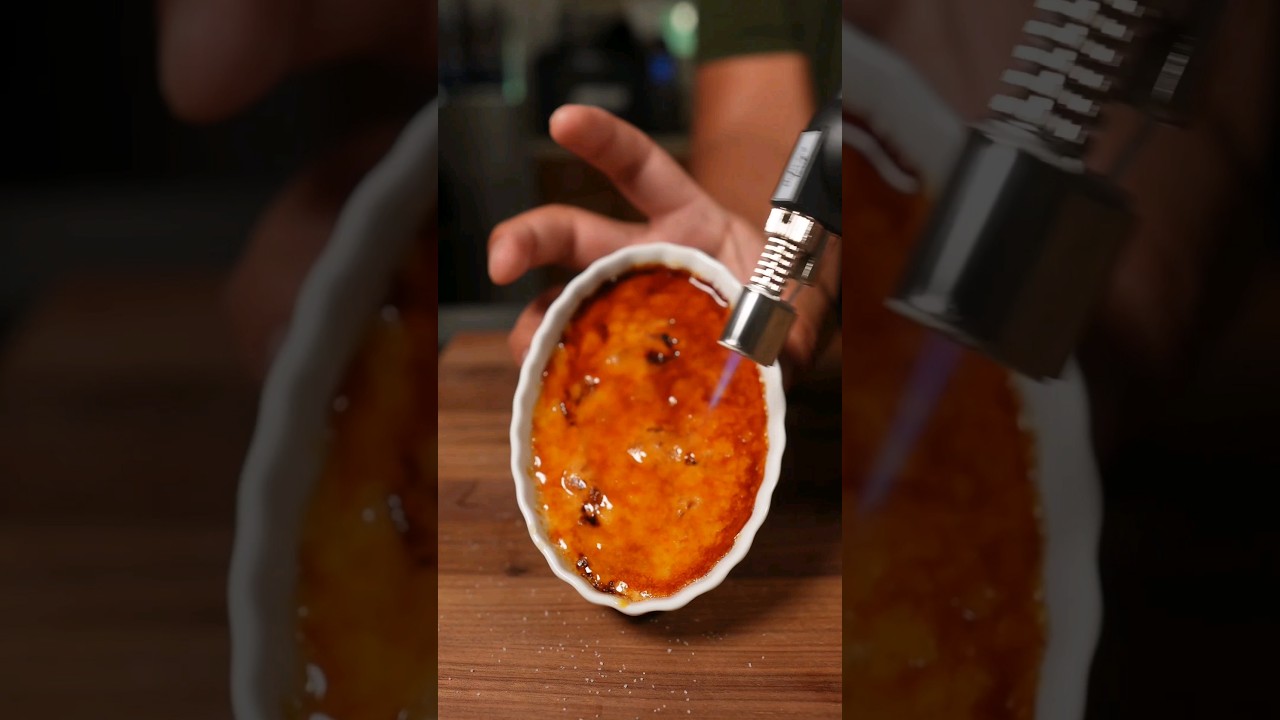
A hard caramelized sugar crust on top that’s achieved by sprinkling sugar and then “burning” it with a torch or under a broiler.
When done perfectly, you crack through the thin caramel layer with your spoon, revealing a silky custard underneath. The contrast between the crisp sugar shell and the soft cream is what makes crème brûlée legendary.
—
🕰️ EARLY HISTORY OF CUSTARD
To understand crème brûlée’s origins, you need to know where custard itself comes from — because the custard base predates the dessert by many centuries.
Custard-like dishes existed as far back as ancient Rome. Roman cooks would thicken milk with eggs and honey, creating early forms of flan-like desserts. After the fall of Rome, these recipes spread across Europe, where they evolved differently in each country.
By the Middle Ages, custard was everywhere:
In England, it appeared in pies and tarts.
In France, it was served in both savory and sweet forms.
In Spain, it evolved into things like flan and crema catalana.
So crème brûlée’s roots are in medieval custards — but the caramelized sugar top is what makes it distinct.
—
🇫🇷 The FRENCH Claim: Crème Brûlée
The French version — and the one that became globally famous — likely originated in the 17th century.
The first known French reference to something called crème brûlée appears in François Massialot’s 1691 cookbook, "Cuisinier Royal et Bourgeois". Massialot was a chef at the court of Versailles, cooking for French aristocrats and royals like the Duke of Orléans.
His recipe for crème brûlée described:
> “A milk-based custard flavored with vanilla or orange blossom, baked, then sprinkled with sugar and burned with a hot iron to caramelize the top.”
Sound familiar? That’s almost exactly how it’s made today — except back then, chefs used a red-hot metal rod to scorch the sugar instead of a butane torch.
So, according to France, crème brûlée was invented in the royal kitchens of Versailles in the late 1600s.
—
🏴 The ENGLISH Claim: Trinity Cream / Cambridge Burnt Cream
But the English also have a very strong claim.
In Trinity College, Cambridge, there’s a long-standing tradition of serving a dessert called “Trinity Cream” or “Cambridge Burnt Cream.”
According to the college’s own records, this dessert was created in the early 1700s — specifically around 1879 (though some historians argue earlier). It was essentially the same concept: rich custard with a caramelized sugar crust.
The story goes that the college branded the custards with the college crest using a hot iron, literally “burning” the sugar with the logo — which makes it one of the earliest documented uses of caramelization for presentation.
Some culinary historians suggest that English cooks might have adapted the French version, as French cuisine was highly influential in aristocratic English society. Others say it was an independent invention, as custard desserts were already popular in England.
Either way, “Trinity Cream” is basically crème brûlée’s English twin.
—
🇪🇸 The SPANISH Claim: Crema Catalana
Now enter Spain, specifically Catalonia, which claims that they invented the idea of custard with a burnt sugar top even earlier.
Crema catalana dates back to at least the 14th century, appearing in medieval Catalan cookbooks like the “Llibre de Sent Soví.” That’s over 300 years before Massialot’s French version.
Crema catalana is made with milk instead of cream, thickened with cornstarch, and flavored with lemon or cinnamon — but the key feature is the burnt sugar crust on top, achieved using a hot iron (similar to the French method).
So if you’re talking chronology, the Spanish arguably did it first.
However, crema catalana and crème brûlée have distinct differences:
Crema catalana = milk-based, lighter, flavored with citrus and cinnamon.
Crème brûlée = cream-based, richer, flavored with vanilla.
So, while related, they’re not quite the same dessert.
—
⚖️ So Who Really Invented It?
That’s the million-dollar question — and the answer depends on how you define “crème brûlée.”
Country Name Key Traits Date Claim
🇪🇸 Spain Crema Catalana Milk-based, lemon/cinnamon, burnt sugar 14th century Earliest known ancestor 🇫🇷 France Crème Brûlée Cream-based, vanilla, caramelized sugar 1691 (Massialot) First modern recipe 🏴 England Trinity Cream Same idea, branded top with iron 1700s Independent reinvention / variation
Most modern food historians credit France as the true origin of the modern crème brûlée, since Massialot’s recipe is the first written version that matches today’s dessert. However, Spain’s crema catalana remains its spiritual ancestor, and England’s Trinity Cream its parallel cousin.
—
🔥 The Technique: Burning Sugar
The signature feature — the “brûlée” part — was achieved differently over the centuries:
1700s: Chefs used a heated metal disk or branding iron to burn sugar on top of the custard.
1800s: Broilers or salamanders (iron tools heated in fire) became popular in professional kitchens.
1900s–today: Small butane torches made it easy to caramelize sugar tableside in restaurants — the famous “crack” moment that diners love.
That burnt sugar layer wasn’t just aesthetic — it sealed the custard, keeping it fresh longer and adding texture.
—
🍽️ Crème Brûlée’s Revival in the 20th Century
Interestingly, crème brûlée wasn’t consistently popular throughout history. After the 18th century, it faded from fashion for nearly 200 years.
It made a huge comeback in the 1980s, particularly in French and American restaurants, when French nouvelle cuisine became trendy again. Chefs loved it because it could be prepared in advance, stored easily, and caramelized right before serving — giving it a sense of theater and sophistication.
By the 1990s, crème brûlée became a symbol of fine dining — so much so that it was sometimes mocked as the “ultimate yuppie dessert.” But its popularity has endured, and it remains a staple in luxury restaurants worldwide.
—
🧠 Fun Facts
Vanilla became the standard flavor only in modern times. Early versions often used orange blossom, cinnamon, or lemon zest.
Trinity College, Cambridge still serves Trinity Cream today in their dining halls.
Crema catalana is traditionally eaten on Saint Joseph’s Day (March 19) in Catalonia.
The phrase “burnt cream” is actually older than the term “crème brûlée.”
The first crème brûlée torch for home use was marketed in the 1990s — part of why the dessert exploded in home cooking shows.
—
🧭 In Summary
If you’re asking “Where is crème brûlée from?”, the most accurate and historically balanced answer is:
> Crème brûlée is a French dessert originating from the late 17th century, first documented by François Massialot in 1691. However, it was likely inspired by earlier Spanish crema catalana (14th century) and similar English custards, such as Trinity Cream (18th century). The dessert we know today — rich vanilla custard with a hard caramelized sugar top — was perfected in France and popularized worldwide in the 20th century.

21 Comments
I think it's Philippines
That's flan not crem brulee
♥️👨🍳❤
"kinda like you" What???
Is catalonian from Catalonia(Spain)
C'EST FRANÇAIS JE VEUX RIEN SAVOIR JE NE SUIS PAS OUVERT AU DÉBAT
Jesus man ✊🏽
Salmonella entered the chat
let’s dive deep into this one, because “Crème brûlée” (which is what you mean by “crem bu le”) has one of the most fascinating, debated, and intertwined origin stories in the world of desserts.
It’s not just a fancy restaurant dish with a hard caramel top — it’s a cultural artifact that’s been shaped by France, England, and Spain, each of which claims to have invented it. Let’s unpack everything step by step.
—
🍮 What is Crème Brûlée?
Crème brûlée literally means “burnt cream” in French. It’s a dessert consisting of:
A rich, smooth custard base (usually made from cream, egg yolks, sugar, and vanilla), and
A hard caramelized sugar crust on top that’s achieved by sprinkling sugar and then “burning” it with a torch or under a broiler.
When done perfectly, you crack through the thin caramel layer with your spoon, revealing a silky custard underneath. The contrast between the crisp sugar shell and the soft cream is what makes crème brûlée legendary.
—
🕰️ EARLY HISTORY OF CUSTARD
To understand crème brûlée’s origins, you need to know where custard itself comes from — because the custard base predates the dessert by many centuries.
Custard-like dishes existed as far back as ancient Rome.
Roman cooks would thicken milk with eggs and honey, creating early forms of flan-like desserts. After the fall of Rome, these recipes spread across Europe, where they evolved differently in each country.
By the Middle Ages, custard was everywhere:
In England, it appeared in pies and tarts.
In France, it was served in both savory and sweet forms.
In Spain, it evolved into things like flan and crema catalana.
So crème brûlée’s roots are in medieval custards — but the caramelized sugar top is what makes it distinct.
—
🇫🇷 The FRENCH Claim: Crème Brûlée
The French version — and the one that became globally famous — likely originated in the 17th century.
The first known French reference to something called crème brûlée appears in François Massialot’s 1691 cookbook, "Cuisinier Royal et Bourgeois".
Massialot was a chef at the court of Versailles, cooking for French aristocrats and royals like the Duke of Orléans.
His recipe for crème brûlée described:
> “A milk-based custard flavored with vanilla or orange blossom, baked, then sprinkled with sugar and burned with a hot iron to caramelize the top.”
Sound familiar? That’s almost exactly how it’s made today — except back then, chefs used a red-hot metal rod to scorch the sugar instead of a butane torch.
So, according to France, crème brûlée was invented in the royal kitchens of Versailles in the late 1600s.
—
🏴 The ENGLISH Claim: Trinity Cream / Cambridge Burnt Cream
But the English also have a very strong claim.
In Trinity College, Cambridge, there’s a long-standing tradition of serving a dessert called “Trinity Cream” or “Cambridge Burnt Cream.”
According to the college’s own records, this dessert was created in the early 1700s — specifically around 1879 (though some historians argue earlier).
It was essentially the same concept: rich custard with a caramelized sugar crust.
The story goes that the college branded the custards with the college crest using a hot iron, literally “burning” the sugar with the logo — which makes it one of the earliest documented uses of caramelization for presentation.
Some culinary historians suggest that English cooks might have adapted the French version, as French cuisine was highly influential in aristocratic English society. Others say it was an independent invention, as custard desserts were already popular in England.
Either way, “Trinity Cream” is basically crème brûlée’s English twin.
—
🇪🇸 The SPANISH Claim: Crema Catalana
Now enter Spain, specifically Catalonia, which claims that they invented the idea of custard with a burnt sugar top even earlier.
Crema catalana dates back to at least the 14th century, appearing in medieval Catalan cookbooks like the “Llibre de Sent Soví.”
That’s over 300 years before Massialot’s French version.
Crema catalana is made with milk instead of cream, thickened with cornstarch, and flavored with lemon or cinnamon — but the key feature is the burnt sugar crust on top, achieved using a hot iron (similar to the French method).
So if you’re talking chronology, the Spanish arguably did it first.
However, crema catalana and crème brûlée have distinct differences:
Crema catalana = milk-based, lighter, flavored with citrus and cinnamon.
Crème brûlée = cream-based, richer, flavored with vanilla.
So, while related, they’re not quite the same dessert.
—
⚖️ So Who Really Invented It?
That’s the million-dollar question — and the answer depends on how you define “crème brûlée.”
Country Name Key Traits Date Claim
🇪🇸 Spain Crema Catalana Milk-based, lemon/cinnamon, burnt sugar 14th century Earliest known ancestor
🇫🇷 France Crème Brûlée Cream-based, vanilla, caramelized sugar 1691 (Massialot) First modern recipe
🏴 England Trinity Cream Same idea, branded top with iron 1700s Independent reinvention / variation
Most modern food historians credit France as the true origin of the modern crème brûlée, since Massialot’s recipe is the first written version that matches today’s dessert.
However, Spain’s crema catalana remains its spiritual ancestor, and England’s Trinity Cream its parallel cousin.
—
🔥 The Technique: Burning Sugar
The signature feature — the “brûlée” part — was achieved differently over the centuries:
1700s: Chefs used a heated metal disk or branding iron to burn sugar on top of the custard.
1800s: Broilers or salamanders (iron tools heated in fire) became popular in professional kitchens.
1900s–today: Small butane torches made it easy to caramelize sugar tableside in restaurants — the famous “crack” moment that diners love.
That burnt sugar layer wasn’t just aesthetic — it sealed the custard, keeping it fresh longer and adding texture.
—
🍽️ Crème Brûlée’s Revival in the 20th Century
Interestingly, crème brûlée wasn’t consistently popular throughout history.
After the 18th century, it faded from fashion for nearly 200 years.
It made a huge comeback in the 1980s, particularly in French and American restaurants, when French nouvelle cuisine became trendy again.
Chefs loved it because it could be prepared in advance, stored easily, and caramelized right before serving — giving it a sense of theater and sophistication.
By the 1990s, crème brûlée became a symbol of fine dining — so much so that it was sometimes mocked as the “ultimate yuppie dessert.”
But its popularity has endured, and it remains a staple in luxury restaurants worldwide.
—
🧠 Fun Facts
Vanilla became the standard flavor only in modern times. Early versions often used orange blossom, cinnamon, or lemon zest.
Trinity College, Cambridge still serves Trinity Cream today in their dining halls.
Crema catalana is traditionally eaten on Saint Joseph’s Day (March 19) in Catalonia.
The phrase “burnt cream” is actually older than the term “crème brûlée.”
The first crème brûlée torch for home use was marketed in the 1990s — part of why the dessert exploded in home cooking shows.
—
🧭 In Summary
If you’re asking “Where is crème brûlée from?”, the most accurate and historically balanced answer is:
> Crème brûlée is a French dessert originating from the late 17th century, first documented by François Massialot in 1691.
However, it was likely inspired by earlier Spanish crema catalana (14th century) and similar English custards, such as Trinity Cream (18th century).
The dessert we know today — rich vanilla custard with a hard caramelized sugar top — was perfected in France and popularized worldwide in the 20th century.
ВОНА НЕ ЗОЧЕ КРЕМ БРЮЛЕ БО В НЕЇ Є ОЛЕГ!!
Yummy
Do 325f for 38 minuets. I did HIS recipe. It was bogus didn’t even cook at all. I have sweet sludge that moved like a liquid still
In Mexico this is jericalla
Don't put a raw egg in your mouth
Guess u don't know where it came from
How much sugar
From france, the other one from spain is crema catalana
5 hours of prep for only 3 spoon bites 🤦🏿♀️
France
crème brûlée as we know it, rich vanilla custard with a crunchy caramelized top is French, but it shares roots with Spanish and English cousins.
ℕ𝕠𝕨 𝕥𝕣𝕪 𝕝𝕖𝕔𝕙𝕖𝕡𝕝𝕒𝕟
This creme brulee comes from Paris