
(13 Apr 2018) LEADIN:
It’s better known as a French gourmet delicacy, but one man in Egypt is determined to put foie gras back on the menu in Egypt.
Foie gras – the liver of a force-fed duck or goose – has its origins in ancient Egypt five-thousand years ago.
Now its making a comeback on a farm in Luxor.
STORYLINE:
Force-feeding a duck or goose to make foie gras is a controversial practice that is banned in many countries like the UK.
But here on the West Bank of Luxor, at the foot of the famous Valley of the Kings, Belgian expatriate Michel Mosser is reinventing the ancient tradition that has long been forgotten in Egypt.
Although foie gras is known as a French traditional dish, it has its origins in ancient Egypt, just like wine and beer.
Mosser’s passion for ancient Egypt led him to visit the country on many occasions. In 2011, driven by its economic and cultural value, he had the idea of making foie gras in Egypt.
A few years later in 2014 he left his job as an adviser to the Minister of Environment in Belgium and took a course in the Department of Gers in the south of France to learn the art of making foie gras.
“The story of foie gras started in Egypt 5000 years ago. On the banks of the Nile, the ancient Egyptians would observe the geese stuffing themselves to prepare for migration. They reproduced the process and there is proof on the bas-relief of tombs in Saquarra, 2450 BC, at the times of the pyramids,” says Mosser.
Carvings on a limestone relief on the Mastaba of Sopduhotep in Saqqara depict the inside of an aviary where a man is force-feeding a crane and another is feeding a duck or goose.
Back in Mosser’s aviary, the ducks are panting. Their oversized livers are compressing their lungs making them short of breath. This is a signal that they will soon be ready for slaughter.
“Foie Gras is delicious. It’s a product we like everywhere in the world. It is very famous and has a high added value so economically it is an interesting project. There is a lot of sense in doing this in Egypt and this is also what was interesting to me, to re-create a local product that is linked to the geography and the Egyptian culture in its original country after having lived its life elsewhere for the last 2000 years,” says Mosser.
He adds that, in the year 1 B.C, the Romans were the first to treat foie gras as a defined food. They called it Lecur (liver) Ficatum (fig), meaning fig-liver because the ducks were fed with dry figs.
Nowadays ducks are fed with pre-soaked corn. However Mosser has ideas to make his foie gras more authentic to the local region.
“I would like to try feeding with dry dates. If it’s possible to feed with dry figs then it must be possible with dry dates. It is plentiful in Egypt and it could give a real character and colour to the foie gras and it would definitely re-become an Egyptian product,” he says.
Mosser does not breed his birds, so the main problem he faces is his supply.
In France there is a whole industry to supply foie gras makers with ducks but here in Luxor he can sometimes struggle to get a new batch. Bird flu is common in Egypt and Mosser’s ducks can be affected. However, he says since a new vaccination treatment the situation is now under control.
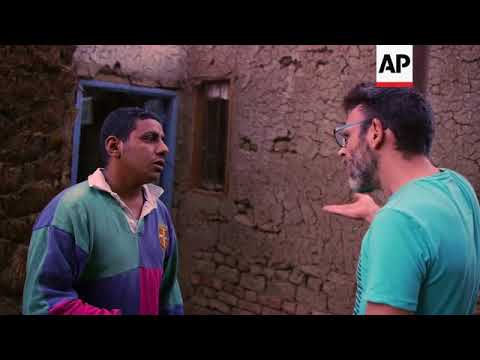
Mosser has three local staff members and has trained one of them, Jahalan Haraj, to force-feed the ducks. Haraj works two short shifts per day to feed the ducks, at dawn and at dusk.
Haraj says: “The first time I saw this I was afraid that the ducks would die. Sticking a pipe down it’s throat got me worried the duck would die. But now that I am more experienced at this it is quite easy.”
Find out more about AP Archive: http://www.aparchive.com/HowWeWork
Twitter: https://twitter.com/AP_Archive
Facebook: https://www.facebook.com/APArchives
Instagram: https://www.instagram.com/APNews/
You can license this story through AP Archive: http://www.aparchive.com/metadata/youtube/7e3ac3ee24c9202dfe1afe12d2e8c3a7
[Applaudissements] thouars du foie gras en egypte elle commence il ya 5000 ans au bord du nil les anciens égyptiens observer les oies qui se gavent pour se préparer aux migrations ils ont reproduit le processus on a des preuves dans les bas-reliefs des tombes de saqqara 2450 avant jésus-christ l’époque des pyramides le faudra parce qu’il faudra c’est bon d’abord c’est un vrai produit qu’on aime qu’on aime partout dans le monde qui est extrêmement connue qui a une très forte valeur ajoutée donc économiquement c’est un projet qui est intéressant et puis ça a beaucoup de sens de le refaire en egypte et c’est ça qui m’intéressait aussi c’est recréer un produit du terroir qui est en lien avec la géographie la culture égyptienne dans son pays d’origine alors qu’il est parti qu’il a vécu sa vie depuis à peu près de milan moi j’aimerais bien tester le gavage aux dattes séchées si on peut garder aux figues séchées n’y a pas de problème que les dattes séchées il y en a partout en egypte et ça pourrait donner un vrai caractère et une vraie couleur au foie gras qui serait définitivement redevenu égyptienne je me suis pas bien pas mal le talent est là bas [Musique] [Musique] [Musique] [Applaudissements] [Musique] trop cher 2 la gravona bourse ma ouais les espadrilles et un bras d’honneur au pouvoir avoir été un petit peu de cuisine française par tous c’est très différent sont pas moi mon groupe en mai retrouvez un petit peu laxiste de chimie projet c’est vrai que le foie gras est en france un produit relativement cher quand on va voir un tout cas un minimum de qualité et on a tendance à en consommer c’est vrai à des occasions un peu spéciale du coup alors qu’ici on a la chance non seulement d’avoir en fait un bon produit de qualité et puis surtout un prix qui est tout à fait abordable je pense à peu près le prix d’un pâté moyen en france [Musique] lion’s terre battue