
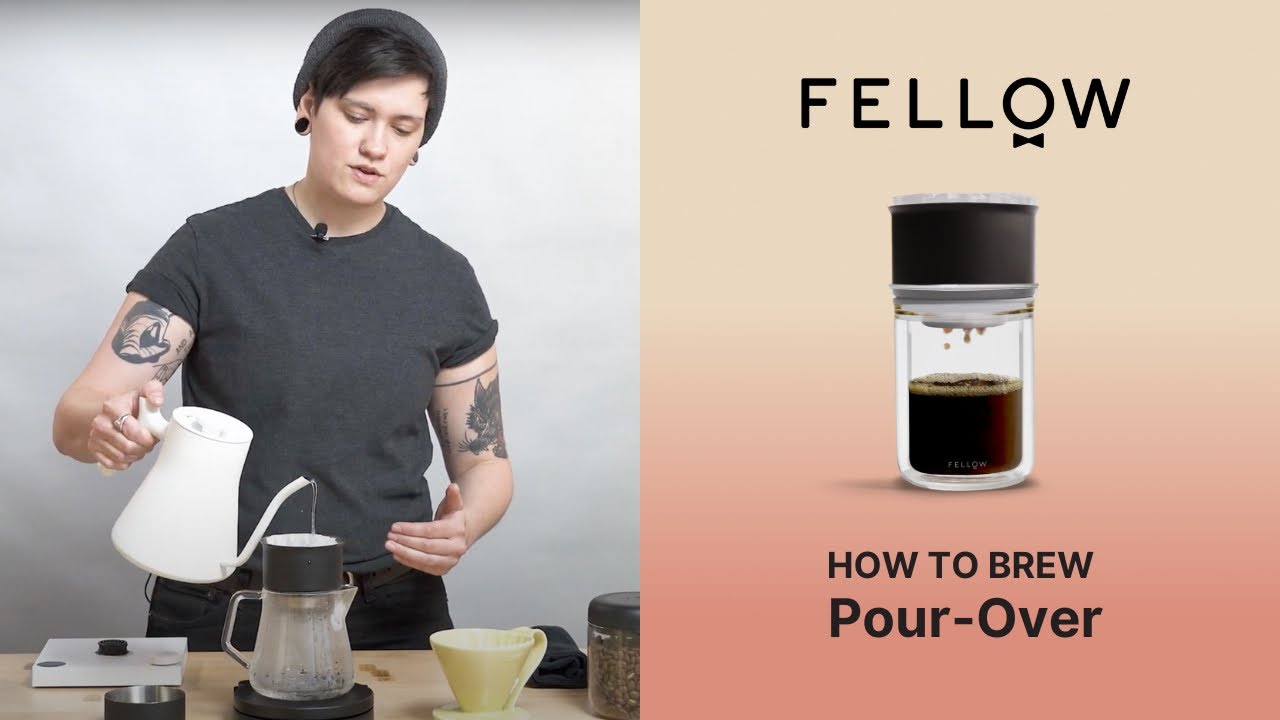
Pour-over is perfect if you’re brewing for one or two, you have a few minutes to focus, and you’ve got a fresh bag of coffee that you want to enjoy every last note of.
This way to a brighter, less boring morning ⤵️
Shop Fellow.
https://fellowproducts.com/
We’re on Instagram!
https://www.instagram.com/fellowproducts/
You’re here because you want to make delicious pourover coffee and you want an A toz on making delicious pourover coffee and I’m here to teach you let’s do it hello fellow fans and coffee lovers everywhere my name is Haley I am your local resident Q grader and an ex
Barista with eight plus years experience in the specialty coffee industry and I’m here to teach you you the A to Z an intro to Brewing the most delicious pourover and how to troubleshoot your brewing and what to look for and just everything about making a delicious cup
Of pourover coffee you may be thinking why would I want to brew my coffee as pore over Haley why would I want to do this instead of making say a French press or is po over right for me first let’s get into what pourover is pourover coffee AKA R coffee or sometimes called
Filter coffee is a gravity dependent Brew method made by putting coffee into a filter which then goes into what we call a dripper and then usually that dripper is placed on a vessel of your choice I mean it should be otherwise the coffee just drips out onto your counter
Which is not preferable and that’s the whole method right so you’re pouring your water over the coffee in the filter that is in the dripper on top of a vessel pourover coffee offers a lot of control in the final outcome of your cup of coffee right it offers complexity it
Offers a generally clean right so not not super sediment not uh any kind of murky just very clean crisp uh complex cup of coffee because you’re pouring slowly over your ground soaking everything evenly inside of the filter inside of the dripper um so that is that
Is what pourover is and often times it’s super preferable to people because of that that cleanness that cleanness in your cup um that degree of control over the final outcome um because of the control of water flow and it really offers a lot of defined flavors from the
Coffee in the cup also where pourover differs from something like say French Press is that this paper filter offers some degree of soaking up some of the natural oils in the coffee right so kind of pulling back a lot of the otherwise maybe more robust more forward flavors
It makes for a complex cup but not quite as bold as something as say like french press where a French press has a metal filter no oils are soaked up um and also in a French press all of the coffee and the water is in the same chamber whereas
There’s some separation between coffee and and final product of brewed coffee um immediately with pourover okay so you’ve decided that pourover is for you complex clean the degree of control of what comes out flavor-wise in your cup you’re ready to go what do you need to brew pour over coffee first and foremost
One of the most important pieces of equipment to control the outcome of your cup of coffee is the grinder grinding your coffee fresh right before you brew allows for the maximum amount of gases to activate and then um create flavors in your final cup the nerdy version of
That is that gases get sealed natural gases get sealed into the coffee beans as we roast them and these gases help create final flavor gases and oils help create final flavor in the cup of coffee when you grind your beans right you are breaking them up so your C causing the
Gases to release uh exponentially faster than they would just sitting as whole beans like they’ll they’ll release naturally as whole beans but so much faster will they release as ground coffee which is why it is not a myth it is very important and makes a huge difference to grind your coffee right
Before you brew a grinder will also allow you to dictate grind size grind sizes for any Brew method will vary of course there’s a range of grind settings for pour over coffee um there’s a fine end right small particles and a coarse end of the range and then right in the
Middle of kind of a just right area if you are an ode or an opus user one of our Grinders um there is a range of settings on the inside lid of the grinder that should help you out I generally like to stick around somewhere in the middle of the range when I’m
Grinding with our Grinders every grinder is going to have a different range of grind settings pertaining to their numbers so it’s really important to get to know your grinder and what number means what setting wise but super important to have a grinder next you’ll need a goose neck Kettle the goose neck
Is this long skinny spout that’s that’s what we call a goose neck the long skinny spout will allow you to pour very slowly and control the direction of your pore because you want to which is important because you want to soak your grounds very evenly next you will need a
Dripper so you can have you can use a dripper like ours it’s what we call a flat bottom dripper it has a flat bottom uh and a number of evenly dispersed small exit holes controlling water flow to be a bit slower you could also instead opt for what’s called a conle
Dripper it’s more conical cone-shaped and it usually has a large exit hole on the the bottom making for a bit quicker of water flow that’s up to preference um there are differences differences to each dripper for sure um and again it’s all up to preference the way that I
Think about it is because a flat bottom dripper has slower flow water-wise it can be a little bit more hands off at times it can be a little bit more um forgiving whereas a conical dripper can generally require more motion more attentiveness um I Heard it once compared to driving an automatic car
Versus a stick shift car and honestly once you get into it I think that makes a lot of sense second to last but very important you will need coffee I’m using 22 gam of coffee into to 350 G of water out we’ll get into why a little bit
Later but you do need some coffee to make pourover coffee and finally I’m using a scale it is really not super it’s not necessary to have a scale like not 100% but it is a really really incredible tool and super helpful to use to troubleshoot what’s going on to know
How much coffee you’re using to how much water you’re you’re brewing with and all that kind of stuff um the ratio of water to coffee is really important in knowing why what you can do to edit um edit your Brew in order to make delicious and and repeatable outcomes as
You hone your Technique so scale super important to weigh that coffee to weigh that water it helps to use the timer on scales as well to see how long your Brew was how quick it was and that can also inform you on what maybe to change for
Your next Brew right as you do what we call dialing in which is um dialing each bit of your method and your Technique to create an optimal outcome so scale very helpful for weighing the coffee for weighing the water and also for timing your Brew okay
So you have all of your gear lined up and now you’re ready to brew one more thing before we Brew though you want to take your hot water heated up to 205° which is generally a good spot that we find to start some coffees like lighter roasts will require more
Temperature um some more roasted coffees will require less temperature and you know depending on the coffee temperature can vary but we generally stick between 200 and 212° fenhe which is boiling um and again starting at 205 which is just off boiling so the first thing you want
To do is prewet your filter so I started in the middle to make sure that my filter was sitting sitting down into the dripper right flush with the bottom and then I went around the sides and you can even go around the sides a couple more times because this serves two purposes
The first purpose it serves it’s kind of a tongue twister is to get that initial papery layer out of the filter and so it doesn’t impart itself into your final product and also it serves to pre-warm your dripper as well as your vessel coffee can tend to change flavor effects um and
Flavor notes I guess with rapid temperature changes so you’re trying to control it you’re trying to have hot water go through coffee and then hot coffee drips into an already warmed vessel as opposed to Dripping into a cold vessel and taking on different flavor effects cool so your pre-wet
Pre-warmed filter is inside of your pre-warmed dripper and vessel let’s grab that coffee so I pre-round my coffee so that we didn’t have to do that in this video but remember to grind right before you brew if you can I will go ahead and carefully pour my coffee into my
Dripper now that your coffee is in your dripper you want to grab your dripper and gently shake it side to side this will level out your bed of grounds you want it to be flat and even um if you’re pouring into a bed of grounds that’s not even some places will have a
Lot of coffee some places will have not very much um meaning water will pass through a lot in some places and not very much in other places which um promotes what we call uneven extraction right you’re pulling out you’re extracting a bunch from some areas and
Not too much from other areas which can cause not super preferable flavor effects in the outcome we’ll talk more about extraction in the frequently asked questions the FAQ section at the end of this Brew demo so hold on for that okay so we’re ready for our first pour I’m
Going to now that I have everything on my scale going to go ahead and tear it out so everything reads zero because now what we’re going to monitor if you’re using a scale is the amount of water that we are putting in to this whole apparatus first por is very important
It’s what we call a bloom you’re blooming the coffee you’re allowing that first set of gases to activate and release once you hit them with water um this step is really important because it really is what gives your coffee the ability to have that flavor delineation to have that definition it’s really
Allowing the coffee Tu open up so generally I use two times the amount of water as coffee that I put in um so I use 22 gram of coffee I’m going to pour up to 44 gam reading on my scale so about double you just want to make sure
That you’re getting all of the ground soaking evenly right so you’re not having any you don’t have any Islands floating around in there you just want everything soaked evenly to do that I pour in concentric circles much like a snail shell right in to out or out to in
Doesn’t matter as long as you are constantly in motioning getting everything soaking evenly so here we go without further Ado our first pour and I started my timer as well right at the same time and again I am pouring up to about 44 gr if you go a little bit over
Not a huge deal um for instance I’m about three grams over on this first pour again not a huge deal the biggest objective here is to get everything soaking evenly you don’t want to go too far over and flood it with water however because you don’t want to pull too much
Out right away um I generally let my blooms sit between 30 and 40 seconds or just as you start to see the water kind of disappear and as the ground sort of dry out and then the second pour again in even concentric circles I’m going to
Pour up to 150 g I’m doing this pour in about 10 seconds I’m controlling that variable so I know that I wouldn’t have to change that in order to to troubleshoot for my next cup of coffee right so you’re just trying to control any variable you can um in the Brewing
Process so we’re going for our third pore up to 250 g reading on the scale again concentric circles all the way through and up to 250 g for about 10 seconds um again I like to think of a snail shell right so like that Fibonacci sequence kind of swirly guy that is the
Scientific term I think for it I don’t know uh I just make coffee I definitely don’t know too much about math so I think of a snail shell when I’m pouring to make sure that I keep kind of on that track I also want to
Make sure that I am keeping on an even level plane when I’m pouring I’m not going high to low um some some techniques involve a high to low pour I like to keep mine on this even plane so that again I am controlling the variable of increased velocity at some points versus decreased
Velocity at other points so I’m keeping that the same Brew to brew so that when I go to troubleshoot I can change things in like an order of operations like changing everything before I change my technique my technique is like the foundation that I place great bruise on
After this last pour just let it drip you don’t want to pour too much over or too much under again try to stick around within 0.5 gam above or below but if you’re a couple grams above or below it’s not a huge deal let’s get into some frequently asked questions okay first
Question how do you know what the ratio should be 16 to1 uh water to coffee is a good place to start it’s General good rule of thumb across the board um however knowing what your ratio specific to the coffee that you’re Brewing should be definitely comes with the coffee some
Coffees will require a little bit more some require a little bit less um that’s about testing it out right so if you brew the coffee at a 16 to1 water to Coffee ratio and you’re like wow this could be a bit stronger for my taste use
A little bit more coffee or if you think the opposite wow this coffee is a little bit too strong maybe you want to dial it back and use a little bit less coffee but starting at 16 to1 is generally A good rule of them all right next question what are categories and
Variables of what could be wrong slot preferable first of all there’s nothing that’s truly wrong in coffee how you enjoy it is how you enjoy it but if you are looking to dial in your Technique and and just looking for what what generally is looked for in a good or bad
Uh extraction or a good or bad Brew quote unquote generally speaking coffees that are too sour or weak right so like at the end it’s just finishing too sour through the middle it’s kind of watery it’s not really got a lot of um body going on you probably could add a little
Bit of what we call agitation so giving the dripper a few swirls in between pores um or you can adjust your grind size so you can adjust it to be just a little bit finer so you’re you know causing the water to flow a little bit more slowly
Through the coffee and pull a little bit more out or you could use a little bit more coffee the the last thing I would change on that in that whole situation would probably be water temperature you might want to go a little bit hotter but again I would go for probably grind size
Or agitation first um and then I would use more coffee and then I would think about changing the water temperature um on the opposite end something that is a brew that is maybe too bitter chalky drying at the end uh maybe it has too much body in the middle you might have
Caused what we call overe extraction which is pulling too much out of the coffee right so uh I would I might dial The Grind setting back a little bit make it a little bit coarser so the water flows through a little bit quicker um I might use less agitation less swirls if
I if I added any agitation at all um I might use less coffee or at the very end if all of that’s not working I might dial it back and um turn the temperature of my water down a little bit next frequently Asked question which is a really important one why is grind
Setting so important imagine if you will we’re going on a journey two buckets both have holes poked at the bottom just two you know utility buckets one is filled with stones that are about fist sized one is filled with uh coarse sand so when you pour water into these
Buckets one of them the water will flow out whereas the other the water will stick around a little bit longer and probably the final product of water will look a little bit a little bit different than the water that’s coming out of the bucket that has bigger rocks in it right
That’s how I imagine coar versus finer grind settings with coffee um water passing through big particles not going to pull out quite as much as water passing through and taking its time passing through a bunch of smaller particles if that makes sense grind size is really important because it’s really
What helps you control how much or how little you pull out of your coffee so it really that’s it really controls extraction um which again extraction is just what you pull out of the coffee another frequently Asked question is why would you pour this way instead of on a
Varying plane some folks use an up and down poure I prefer to use a pore that is on an even level plane because then I know 100% that my water flow is going to be very similar throughout my pores which varying water flow can sometimes if you’re at the top over agitate or
Cause particles to bump into each other um because of the higher velocity at a different rate they’re bumping into each other whereas when you’re lower down um there’s less agitation rate particles of coffee are not bumping into each other as much and so sometimes you are agitating a bunch and sometimes you’re
Agitating only a little bit and that can be a harder variable to control so I prefer to if I am adding agitation I’m not adding it by my pore I am adding it by actually swirling the dripper just so I can keep control of those variables
You can feel free to check out more frequently asked questions in our blog post post or feel free to drop comments on any of our social media platforms including this video thank you all for joining me today again I have been and will continue to be Haley your local
Resident Q grader I hope this clears up a bit on how to make a pourover from start to finish feel free to reach out to us if you have any questions at all we always love to hear from you thank you so much for joining me today and I’ll see you next time
2 Comments
Do you prefer pour over or French press?
I do want to make a better pour-over coffee. I like the video.