
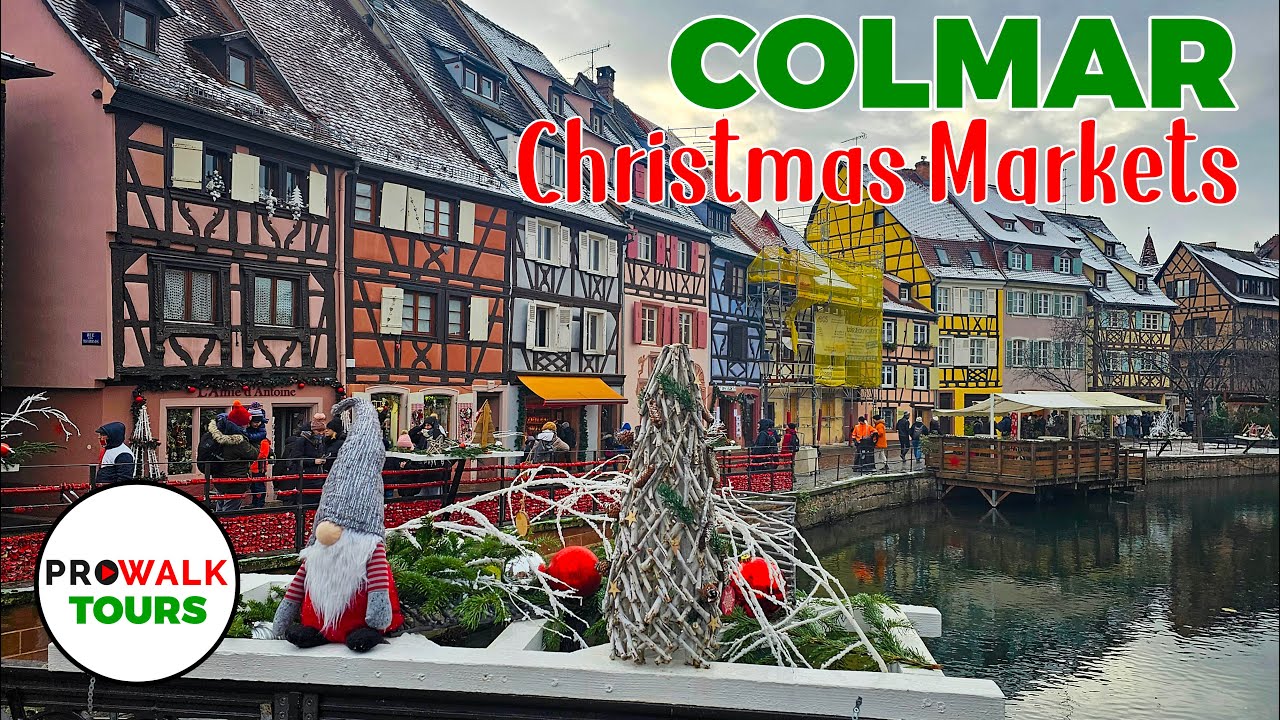
This walking tour through the Christmas Markets of Colmar, France was filmed on Wednesday December 6th, 2023 starting at 11:23 at the Place des Unterlinden.
🗺️Map of the Walk – https://www.google.com/maps/d/edit?mid=1ThIBZmv2HMJhvMrs8Q7U5A-LjW4Mc9c&usp=sharing 🗺️
🔻𝗩𝗶𝗱𝗲𝗼 𝗧𝗶𝗺𝗲𝗹𝗶𝗻𝗲 𝗟𝗶𝗻𝗸𝘀🔻
0:00 Intro and Map
0:52 Place des Unterlinden
6:25 Place des Martyrs de la Résistance
*10:04 Place des Dominicains*
21:00 Place de la Cathédrale
24:44 St Martin’s Church
37:43 Rue des Marchands
*50:14 Place de l’Ancienne Douane*
58:15 Place du 2 Février
1:00:57 Place Jeanne d’Arc
1:07:22 Grand Rue
1:11:37 Place de l’Ancienne Douane
1:15:29 Rue Des Tanneurs
1:18:48 Gourmet Market
*1:23:59 Little Venice*
1:27:50 Covered Market
1:38:20 Place des Six Montagnes noires
1:46:03 Grand Rue
1:49:22 Place du Marché aux Fruits
1:54:10 Rue de l’Église
1:56:57 Place de la Cathédrale
2:00:52 Rue des Serruriers
2:02:25 Place des Dominicains
2:05:18 Place des Martyrs de la Résistance
✔️Let’s connect✔️
➤Facebook: https://www.facebook.com/Prowalks
➤Instagram: https://www.instagram.com/prowalktours
➤E-mail: travel@prowalks.com
================================================================================
🌎Complete List of Walks: http://www.prowalks.com/videos 🌎
📢 𝗣𝗹𝗲𝗮𝘀𝗲 𝗦𝘂𝗯𝘀𝗰𝗿𝗶𝗯𝗲! 📢 – https://www.youtube.com/c/ProWalks?sub_confirmation=1
🔷 Help with a donation! – https://www.paypal.me/Prowalks 🔷
🔶 Support me on Patreon – https://www.patreon.com/Prowalks 🔶
🟥 Become a Member – https://www.youtube.com/channel/UCNzul4dnciIlDg8BAcn5-cQ/join 🟥
👕Merchandise – https://teespring.com/stores/prowalk-tours 👕
================================================================================
🔷THE EQUIPMENT I USE🔷
Amazon Storefront: https://www.amazon.com/shop/prowalktours
🎥Camera: Sony a7siii:
Camera Lens: https://amzn.to/3UtuZUm
🎬Gimbal: https://amzn.to/3FsDye5
🎤Microphone: https://amzn.to/3lYW5CI
🎧In-Ear Monitors: https://amzn.to/2DBdS1D
🎦Drone: https://amzn.to/3jYMiuR
For the best viewing experience, be sure to watch on a large smart TV like the Samsung Frame. Closed Captions [CC] which include historical facts and descriptions are available in all languages. This tour was filmed using amazing Binaural Audio 🎧 which is a method of recording sound that uses two microphones, arranged with the intent to create a 3-D stereo sound sensation for the listener of actually being there.
No part of this video may be used for personal or private use without written permission from Prowalk Tours. I will not remove a copyright strike after one has been issued.
#ProwalkTours #Walkingtour #Colmar #Christmasmarkets
Merry Christmas and welcome to Colmar, a beautiful city in north-east France. Colmar is famed for its well-preserved historic old town. Colmar’s Dominican Church was built in 1289. Colmar is particularly famous for its multi-colored half-timbered buildings. Colmar lies in the Alsace region of France which borders Germany and has many German cultural influences.
In the heart of the historic center, Colmar hosts six Christmas markets over the festive period. The markets sell craft items, Christmas decorations and traditional food and drink. You can find local sausages and raclette (cheese melted over potatoes) to eat. To drink, look out for vin chaud, or hot wine!
Colmar is located on the Alsatian Wine Route and considers itself to be the capital of Alsatian wine. The little huts and stalls are designed and painted to reflect the historic architecture around. The oldest Christmas market in France is in Strasbourg and first took place in 1570.
Colmar’s Christmas markets are relatively new compared to Strasbourg, but have become popular thanks to the fairytale location. The Alsatian wine region produces some of the most noted dry Rieslings in the world as well as highly aromatic Gewürztraminer wines.
These charming stalls lie in the shadow of the Dominican Church, whose stained glass windows date from early in the 14th century. The church was converted into military stores during the French Revolution and in 1807 it became a corn exchange. Colmar was first mentioned by Charlemagne in his chronicle about the Saxon wars.
In 884, Carolingian Emperor Charles the Fat held a political assembly in Colmar. Colmar’s most important church is the Roman Catholic Église Saint-Martin. Because of its past as a collegiate church, it is also known as Collégiale Saint-Martin.
Because of its large dimensions, it is also called Cathédrale Saint-Martin, although Colmar had never been the seat of a bishopric. The church is built in Gothic style with pointed arched windows and ornate stonework. Construction took place between 1234 and 1365.
Sadly, the interior is much less rich than it once would have been as a lot of furniture was removed during the French Revolution. The architecture of the building is quite heavy, but lightened by the airy stained glass windows in the apse.
The church was once home to the 15th century Isenmann altarpiece. However, it was dismantled in 1720 and the paintings dispersed. Seven surviving panels can be seen in the Unterlinden Museum in the city. Archaeologists have found remains of a Carolingian church below the present one dating from 1000.
This wooden carving of the Last Supper dates from the Late Gothic period. Remains of a Romanesque church built on this site have also been found. The facade is notable for its unusual, if cumbersome, supporting pillars. In 1572, a helmet was added to the bell tower after a fire.
The building is 78 meters long and the transept is 34 meters wide. Opposite the church is an elegant Guardhouse built in 1575. The tower is 71 meters high. In the 9th century, Colmar’s architecture was characterized by massive wooden barns and stables with inner courtyards.
During the Middle Ages, Colmar steadily expanded and developed. The guardhouse was originally intended to be the town hall, hence why it faced onto the main church. Colmar’s historic buildings are rich with sculptural detail like this merchant.
Maison Pfister is one of the most famous buildings in Colmar for its external frescoes and elegant architecture. It was built in 1537 according to an inscription found on the window. In the 19th century, the building was owned by a succession of merchants, and now it is a wine store.
Colmar was granted the status of a free imperial city by Emperor Frederick II in 1226. Nougat is a typical product from Colmar and you can buy it by weight. Colmar is known for its joyful decorations at Christmas. We are climbing the steps of Colmar’s Koïfhus, the former customs house.
It was built between 1433 and 1480. In the 19th century, the building was in a bad state of repair and at risk of demolition. Luckily, however, the project was cancelled and restoration work took place from 1895 to 1898.
The colorful tiled roof of the customs house was added during the 19th-century restorations. The Schwendi Fountain is named after the famous commander Lazare Schwendi and was rebuilt after WWII. After Colmar became an imperial city, religious orders were established there.
Franciscans, Dominicans and Augustinians built churches and monastic that can still be seen today. In 1354, Colmar joined the Décapole league of ten cities in the Alsace. Meetings of the Décapole took place in Colmar’s Koïfhus until 1678. This square is lined with the buildings of Colmar’s historic hospital.
The imposing structure was built between 1736 and 1744. It was built on the site of Franciscan convent buildings, which were already used as a hospital in the 16th century. The building has housed the city’s library since 2012. On our left is St Matthew’s, another ancient church built in 1292.
The half-timbered Christmas stalls continue here in Place Jeanne d’Arc. At stalls here you can find typical foods like flamette or flammekueche that are like a kind of pizza. The stalls even have red tiled roofs like the houses around.
Half-timbered houses like these in Colmar are characterized as being freestanding, without sharing any walls in common with neighboring buildings. Half-timbered houses are common throughout the Alsace region. The houses are constructed from wood, which was a readily available building resource thanks to large forests in the region.
On the left is the facade of St Matthew, which is a protestant church. Half-timbered houses have a kind of wooden skeleton as their structure. Traditionally, screws or nails were not used and timber was fitted together with carpentry and wooden plugs.
Once the wooden skeleton is completed, it is filled in with mud and straw to make walls. The whole construction is covered with a lime render painted various colors like blue, pink, ochre or white. In 2002, the Koïfhus underwent restoration to reinstall a sandstone Renaissance balustrade that had been removed in 1976.
The roofs of these traditional houses slope steeply to allow snow to slide off. The roof tiles are made from clay and formed like a beaver’s tail. You can see an imitation of the traditional tiles on the roofs of these stalls.
Ahead is a historic covered market that was built in 1865. Gingerbread is another typical product of Christmas markets influenced by nearby Germany. In 1575, Colmar became a Protestant city following the Protestant Revolution. At the Marche Gourmand, there are nine stalls run by nine chefs serving typical dishes.
Inside the covered market are various stalls of local producers selling meats, cheeses, fruits and vegetables. This area of Colmar is known as Petite Venise, or Little Venice, thanks to the river that run through it. There is a restaurant accessible through the market where you can eat on the water.
Originally, this waterside area was not a wealthy zone, but was inhabited by fishermen. The river is called the Lauch and runs 45 km from the Vosges to the Alsace plain. Alongside local vendors, there are bars, cafes and restaurants inside the covered market.
Produce would once have arrived by boat along the Lauch stream outside. This neighborhood was also once home to gardeners and tanners, who took advantage of the stream and used flat-bottomed boats to move around. It has become a tradition to attach heart locks to the railings.
Fresh fish would once have been sold along here, the Quai de la Poissonnerie. Continuing down the rue de la Poissonnerie, the colored houses here would have belonged to the wealthiest fishermen. There are now renowned fish restaurants here that are included in the Michelin guide.
The rue de la Poissonnerie leads to the rue de Turenne where the market gardeners corporation would once have been based. You can take boat rides along the waterways here. In the summer, you can sometimes see otters in the water.
This square is called the Place des Six Montagnes Noires translating as six black mountains and referring to the name of an inn that was once here. In the center is the Roesselmann fountain by sculptor Bartholdi.
In the Christmas market in the square you can find lots of gifts and games for children. And something for the adults too! At this stall they are making chimney cakes, which are typically from Hungary. A strip of dough is wound around a cylindrical spit and then roasted over coals.
It is then coated in granulated sugar and cinnamon. It is common to see timber in the form of St Andrew crosses on these buildings. These symbolise multiplication, to wish for large families and lots of livestock. It is also common to find timber in ‘v’ shapes, inverted ‘v’s, or diagonals.
The houses in this area date from between 1350 and 1610. Little Venice is the most popular area of Colmar and coachloads of tourists often drive directly here just to take pictures. The ornate white building ahead is Kern house, built in 1594 with an attractive Dutch gable.
The 15th and 16th centuries were Colmar’s golden age, when most of the most prestigious buildings in the city were constructed. During the Thirty Years’ War, Colmar was taken by the Swedish army in 1632, which held it for two years.
On the yellow building on the left, you can see crosses with curved lines. These indicated that the building was home to someone important. This is because the s-shaped cross looks like a curule seat, which is what Roman dignitaries used to sit on.
In 1634, the Schoeman family arrived in Colmar and started the first town library. In 1635, Colmar was placed under the protection of the King of France and forfeited its status as an imperial city. In 1698, Colmar became the judicial capital of Alsace province.
St Martin’s church is particular for having lots of additional portals along the transept. The tiled roof is another striking feature. In 1854, a cholera epidemic killed many in the city. With the rest of Alsace, Colmar was annexed by the newly formed German Empire in 1871 amid the Franco-Prussian War.
Colmar was returned to France following WWI according to the 1919 Treaty of Versailles. Colmar was annexed by Nazi Germany in 1940 and then reverted to French control after the battle of the “Colmar Pocket” in 1945.
Colmar has a sunny microclimate and is one of the driest cities in France, with an annual precipitation of just 607 mm. Colmar’s dry climate makes it ideal for growing wine. Look out for sweet and savoury bretzel at the Christmas market, inspired by German tradition.
Despite the French Revolution and subsequent wars, the center of Colmar survived relatively unscathed meaning its architecture remains attractively homogenous. Colmar attracts around 3.5 million tourists a year.
24 Comments
Have ever given thought about you creating a way to take people on your fantastic journey's?
Very good 👍
Colmar is a really very beautiful part of France that I haven't heard of until now
and it is fantastic here Thank You and have a Merry Christmas.🇨🇵🇨🇵🇨🇵🇨🇵
💖🎄☃️🎀☃️🎄💖
Благодарю за влог!Очень красивая ярмарка,счастливые люди.❤Привет из Москвы.
😍🥰🙂
How exciting the people holiday's approaching, and enjoying the winter.
❤
湊熱鬧人很多,很少看到小孩,買的人氣很少
What about at night???
You really know how make walk videos tour! Congrats
By the way, I think it would be nice if you visited the cafes inside
Muito linda essa cidade de Colmar, obrigada pelo vídeo maravilhoso !!! Um Feliz Natal para você e sua família. Sou de Brasil, São Paulo, Capital. ❤
😍Gorgeous place, awesome cinematography! Thanks PWT! Merry Christmas! 🕊️✨❄️🎄🎁☃️
What a wonderland village. People are free to wander without having to dodge around cars and delivery vans. Amazing indeed. Thank you for the the detailed filming.😊
Thanks Isaac. Another 👍 great video. Keep them coming safely.
What is your favorite Christmas Market,? 😊
wow. There is very nice this Christmas place.
Great memories from my time in Europe. One of the most beautiful Christmas markets for sure!
Love watching ❤️ wish I could see more inside the shops, their products, foods, more close up
Thanks
Very beautiful town with loads of things i enjoyed watching
👍👍👍🌲⛪🧑🎄
WOOOOOOOOOOW 🤗💅🧸🎁🎄🌝🥰👏🎅
💙🌎🌈👏🎈🎁🧸👏
THANK YOU so much for sharing such amazing moments! God bless you!
Thank you Isaac for the wonderful videos and tours this one is really adding to the ambience of Christmas Day. Wishing you all the best.