
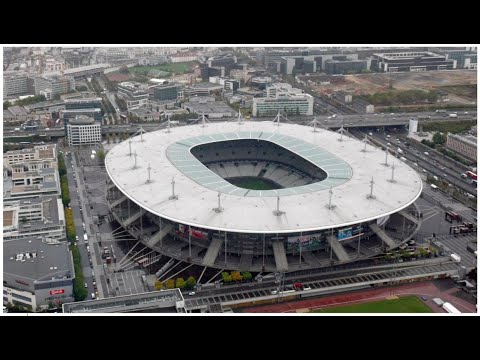
The Stade de France is the national stadium of France. With a capacity of more than 80,000, it’s the seventh-largest stadium in Europe.
Used by the French national football and rugby teams, the Stade de France was originally built for the 1998 FIFA World Cup final. Since then, it has hosted a number of iconic events, including three UEFA Champions League finals and two Rugby World Cup finals. Due to this, the Stade de France is one of only two stadiums in the world that has hosted both a Football World Cup final and a Rugby World Cup final (along with Nissan Stadium in Yokohama).
Although nine venues across France will host matches at the Rugby World Cup, the Stade de France will host more games than any other venue. As well as hosting the opening match between France and New Zealand, the ground will also welcome fans for a number of other pool-stage games, two quarter-finals, both semi-finals, the bronze final and the final.
Stade de France is the largest stadium in France and the stadium where the French national team plays its most important home matches.
Stade de France got built to serve as the centrepiece of the 1998 World Cup. At that time no stadium in France had a capacity of over 45,000 and the tournament needed a 70,000+ stadium.
Construction of the stadium began in 1995 and after 31 months, on the 28th of January 1998, it officially opened with a friendly match between the national teams of France and Spain. Zinedine Zidane scored the first and only goal of the match.
During the 1998 World Cup, Stade de France hosted nine matches, among which the opening match between Brazil and Scotland (2-1), the semi-final between France and Croatia (2-1), and the final between France and Brazil (3-0).
The stadium has also hosted two Champions League finals, the first in 2000 between Real Madrid and Valencia (3-0), and the second in 2006 between Barcelona and Arsenal (2-1).
In 2016, Stade de France once again hosted the final of a major tournament when the European Championships were played in France. On top of the final between Portugal and France (1-), it hosted four first round group matches, one round of 16 match, and the quarter final between France and Iceland (5-2).
In 2015, Stade de France was the site of a terrorist attack when three suicide bombers detonated bomb vests outside the stadium during a France vs Germany friendly international. One suicide bomber had tried to enter the stadium, but his suicide vest was discovered during security checks. He then blew himself up, killing one bystander. The other two suicide bombers did not kill any innocents.
Designed by 4 architects, Michel Macary, Aymeric Zubléna, Michel Regembla et Claude Costantini, the Stade de France is considered to be the stadium of the third millennium. It boasts 80,000 sheltered seating and is equipped with exceptional facilities: restaurants open for lunch everyday of the week, reception areas, conference and exhibition space, VIP boxes with private terrace, gourmet restaurant… Football (Euro 2016, French cup, French league cup…), rugby, opera, shows, motor sports, concerts… the diversity and quality of the events organised at the Stade de France goes without saying. It is interesting to note that due to its technology, its attractive design and practical aspect, the stadium opens its doors (outside of event days) to both lovers of architecture and sport.
@iyawoMI
Don’t forget to subscribe to our channel: the link is below