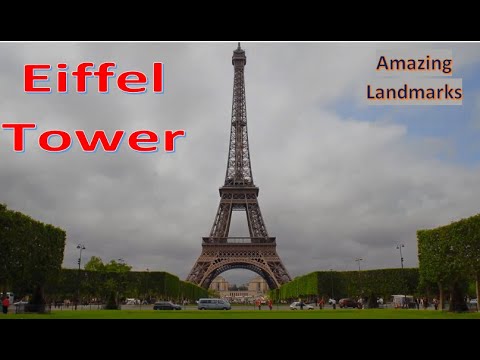
The Eiffel Tower is a wrought-iron lattice tower on the Champ de Mars in Paris, France. It is named after the engineer Gustave Eiffel, whose company designed and built the tower.
Locally nicknamed “La dame de fer”, French for “Iron Lady”, it was constructed from 1887 to 1889 as the entrance to the 1889 World’s Fair and was initially criticised by some of France’s leading artists and intellectuals for its design, but it has become a global cultural icon of France and one of the most recognisable structures in the world. The Eiffel Tower is the most-visited paid monument in the world.
The tower is 324 metres tall, about the same height as an 81-storey building, and the tallest structure in Paris. Its base is square, measuring 125 metres on each side. During its construction, the Eiffel Tower surpassed the Washington Monument to become the tallest man-made structure in the world, a title it held for 41 years until the Chrysler Building in New York City was finished in 1930. It was the first structure in the world to surpass both the 200 meter and 300 meter mark in height. Excluding transmitters, the Eiffel Tower is the second tallest free-standing structure in France after the Millau Viaduct.
The tower has three levels for visitors, with restaurants on the first and second levels. The top level’s upper platform is 276 meters above the ground – the highest observation deck accessible to the public in the European Union. Tickets can be purchased to ascend by stairs or lift to the first and second levels. The climb from ground level to the first level is over 300 steps, as is the climb from the first level to the second. Although there is a staircase to the top level, it is usually accessible only by lift.
The design of the Eiffel Tower is attributed to Maurice Koechlin and Émile Nouguier, two senior engineers working for the Compagnie des Établissements Eiffel. Eiffel openly acknowledged that inspiration for a tower came from the Latting Observatory built in New York City in 1853.
Equipping the tower with adequate and safe passenger lifts was a major concern of the government commission overseeing the Exposition. Although some visitors could be expected to climb to the first level, or even the second, lifts clearly had to be the main means of ascent.
The puddled iron of the Eiffel Tower weighs 7,300 tons, and the addition of lifts, shops and antennae have brought the total weight to approximately 10,100 tons. Depending on the ambient temperature, the top of the tower may shift away from the sun by up to 18 centimeters due to thermal expansion of the metal on the side facing the sun.
The nearest Paris Métro station is Bir-Hakeim and the nearest RER station is Champ de Mars-Tour Eiffel. The tower itself is located at the intersection of the quai Branly and the Pont d’Iéna.
More than 250 million people have visited the tower since it was completed in 1889.
The tower has two restaurants: Le 58 Tour Eiffel on the first level, and Le Jules Verne, a gourmet restaurant with its own lift on the second level. It owes its name to the famous science-fiction writer Jules Verne. Additionally, there is a champagne bar at the top of the Eiffel Tower.