

🌐 Around the World with Beyondia
🧵 Mediterranean Region
🪡 Episode 37
The world’s most famous French wine was built by the English. In 1152, Eleanor of Aquitaine married Henry Plantagenet. Two years later, he became King of England. Bordeaux became English for three hundred years. English ships filled their holds with claret. The London market turned a regional wine into a global one. By the time France won Bordeaux back in 1453, the world’s appetite had already been built.
Eleanor of Aquitaine was the most powerful woman in medieval Europe. She was Duchess of Aquitaine in her own right — the largest and wealthiest duchy in France, stretching from the Loire to the Pyrenees. She married King Louis VII of France at fifteen, went on the Second Crusade, had the marriage annulled, and within eight weeks married Henry Plantagenet, Count of Anjou. When Henry became King Henry II of England in 1154, Aquitaine — and with it, Bordeaux — became English territory. The result was three centuries of direct trade between Bordeaux and England that shaped both the wine and the city permanently.
The English didn’t just buy Bordeaux wine. They industrialised the demand for it. They called it claret — from the French clairet, meaning a light, clear red — and imported it in quantities that no other wine region could match. By the 13th century, Bordeaux was shipping over a hundred million litres of wine to England annually. The Quai des Chartrons along the Garonne river became the commercial heart of the global wine trade — négociants, brokers and shippers lining the waterfront in a district that still carries the name and the architecture of that era. The English market established the classification system, the pricing structure and the global reputation that Bordeaux still runs on today.
In 1453, at the Battle of Castillon — the final battle of the Hundred Years’ War — France won Bordeaux back. Three hundred years of English rule ended. But the trade routes, the market, the appetite, the infrastructure — all of it remained. The 1855 Classification of Bordeaux wines, commissioned by Napoleon III for the Paris World’s Fair, ranked the top estates into five growths — a hierarchy still in use today, virtually unchanged in over 170 years. Château Lafite Rothschild, Château Latour, Château Margaux and Château Haut-Brion were named First Growths in 1855. Only one estate has ever been added: Château Mouton Rothschild, elevated in 1973 after decades of lobbying.
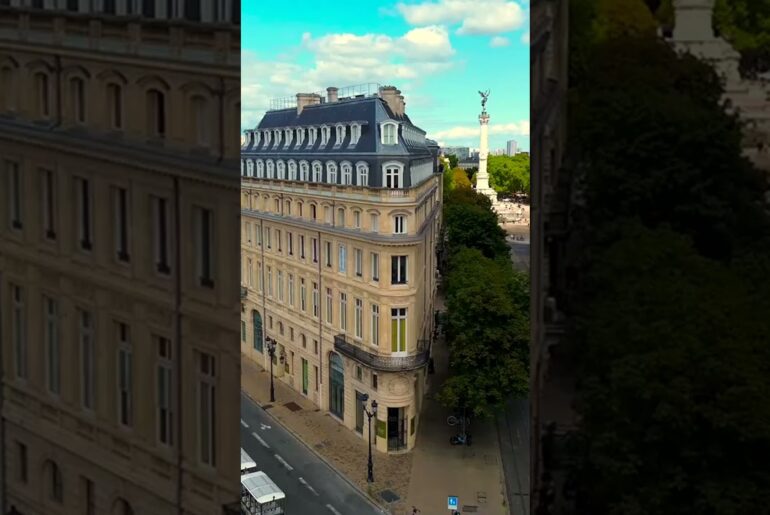
The city itself was transformed in the 18th century by a series of intendants who rebuilt the waterfront into one of the most elegant neoclassical ensembles in Europe. The Place de la Bourse, completed in 1755, faces the Garonne with a symmetry that influenced urban design across the continent. The Miroir d’Eau — the world’s largest reflecting pool — was installed in front of it in 2006, creating one of the most photographed public spaces in France. UNESCO inscribed the entire city centre as a World Heritage Site in 2007, calling it an outstanding urban and architectural ensemble.
The wine region surrounding Bordeaux produces roughly 700 million bottles annually across 111,000 hectares — the largest fine wine region in the world. Saint-Émilion, on the right bank of the Dordogne, was the first wine jurisdiction in France, established in 1199 by a charter from King John of England. It is now a UNESCO World Heritage Site — the first vineyard landscape in the world to receive the designation.
Three hundred years of English rule built the market. Seven centuries of French pride perfected the product. Bordeaux is the proof that the best things are sometimes built by the people who aren’t supposed to be there.
🗺️ GoBeyondia Atlas — Mediterranean Region
🌐 GoBeyondia.com
#Bordeaux #France #Wine #GoBeyondia #TrustedTravelCompanion


1 Comment
In 1152, Eleanor of Aquitaine married Henry Plantagenet. Two years later he became King of England. Bordeaux became English for three hundred years. The London market built the global appetite for claret. The 1855 Classification ranked the top estates into five growths — virtually unchanged in 170 years. Only one château has ever been promoted. Saint-Émilion’s wine charter was granted by King John of England in 1199. Full France guide → gobeyondia.com/france