
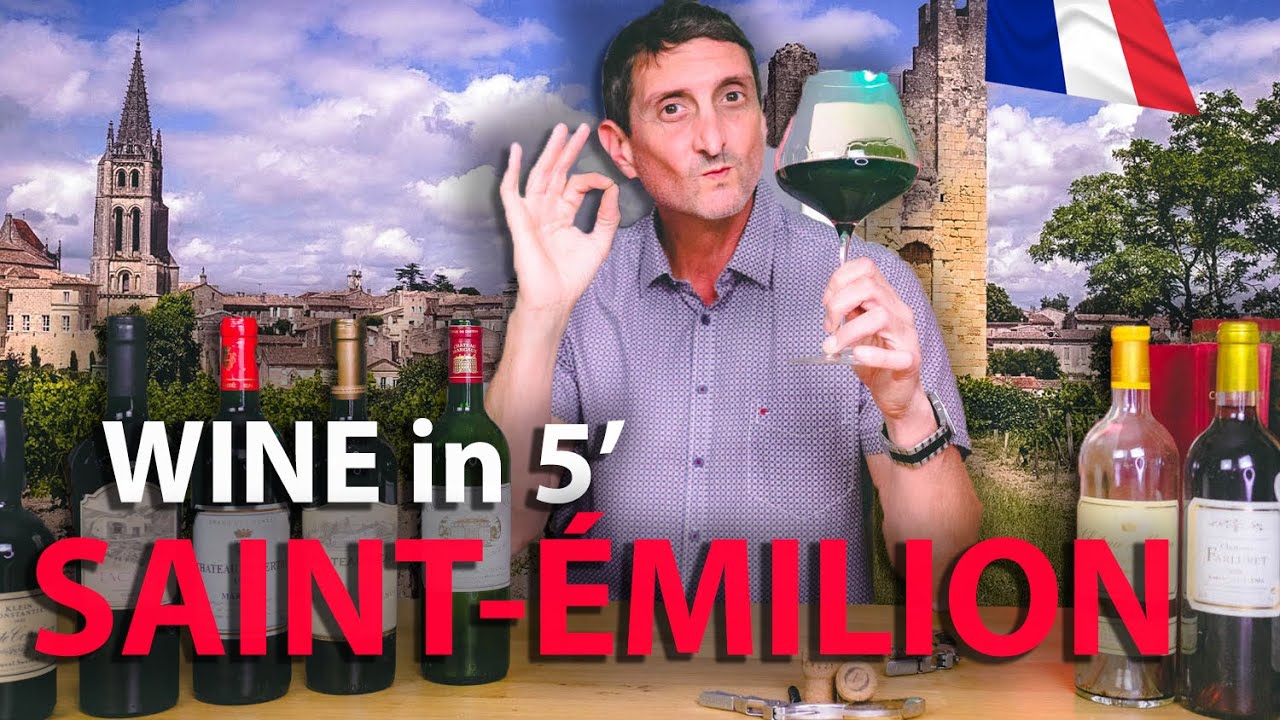
Today we’re continuing our Wine in 5 series…
——–
BECOME A WINE EXPLORER!
Want to Taste Rare, Small Batch Wines from Argentina & Around the World?
🍷Click here: https://bit.ly/3T9UI6y
EXPERIENCE EXTREME ALTITUDE WINES!
Want to Taste Wine from the Most Remote Vineyards in the World? (Think 6,000 ft+!!)
🍷Click here: https://bit.ly/3T9UI6y
——–
In previous episodes we looked at Pauillac, Margaux, we explained the Spanish Rioja and Italian Barolo, and now I want to look into an even more famous appellation of Bordeaux: Saint-Emilion. At the end of the video, we’ll rate St Emilion on our World Wine Appellations Leaderboard to see how it ranks in the world compared to others like Margaux AND talk about the most expensive St Emilions that you should probably taste before you die. While they whine, WE wine.
00:00 – Saint Emilion Wine Intro
01:25 – What and Where is Saint-Emilion?
03:06 – The Grapes of Saint-Emilion
03:58 – Saint-Emilion’s Terroir
05:03 – Wine Styles
06:13 – Most Expensive Saint-Emilion Wines
08:00 – How Good is St Emilion Wine?
Images featured in the video are curtesy of/To learn more about St Emilion visit: https://vins-saint-emilion.com/
Video Content (Transcript)
What and Where is Saint-Emilion
St Emilion is a village, or say a small town located on the RIGHT bank of the Bordeaux region so we’re going to expect Merlot dominant but we’ll discuss that in a minute, and around the town is quite a LARGE vineyard area that forms the St Emilion wine appellation. And I’d want to get back to how large St Emilion IS, because it’s actually pretty large, let me know in the comments if you’d like me to talk more about in a future video. 3 Interesting facts about ST Emilion: 1- The Romans were the firsts to plant vines here in the 3d century BC and you still find Roman ruins scattered in the local landscape. 2- The town of Saint-Émilion owes its name to a hermit named Emilion who lived in a cave in the 8th century. His monastery eventually grew into the thriving medieval town we see today. Thirdly, in 1999 for the first time in the world a vineyard was registered on the World Heritage List by the UNESCO.
The Grapes of Saint-Emilion
Yes, we are on the right bank of Bordeaux, so Merlot is dominant, because the soil, as we’ll discuss in a minute, is quite cold so Cabernet Sauvignon doesn’t do as well here because it ripens slower and later. Still, unlike Pomerol that uses almost exclusively 100% Merlot, in St-Emilion, most wineries use a blend, mainly Merlot, but also blending in some Cabernet Franc which accounts for a third of plantings here, and sometimes some Cabernet Sauvignon.
Saint-Emilion’s Terroir
The soils of Saint Emilion are often presented as based on limestone rock, so clay-limestone, but it’s actually way more complicated than this. Being such a large appellation, you find a variety of soils. If you look at a map of soils, you’ll see that yes, ON the St Emilion plateau, on the hill where the village is, IT IS very limestone-rich and vines grow on the limestone rock, which is where most of the Top Chateaux are, but around that hill, you have large plains with clay soils, others with sand and gravels and areas where it’s a mix of everything, as a result, the wines of Saint Emilion are quite diverse in fact…
Wine Styles
St Emilion wines are exclusively red wines that are dense, generous reds, quite fruity thanks to the Merlot, but also complex and compact thanks to the Cabernets. Most premium St Emilion wines are aged in oak barrels for a year or two, but they do not have to. Cheaper examples can just be matured in tank. Entry-level St Emilion will typically age for 5 to years, while premium ones more like 15 to 20.
The Most Expensive Saint-Emilion Wines
The #1 most expensive St Emilion is called ‘Hommage a Elisabeth Bouchet’ by famous winery Chateau Angelus at about $1500 a bottle, and I’ve covered it in my Top 10 Most Expensive Bordeaux wines video. I don’t want to repeat myself too much, you can watch it here. AFTER this anecdotal cuvée come the 2 super stars producers of St Emilion, Chateau Ausone at about $700 a bottle, a winery with quite a small production for the area, it’s very exclusive and located right on top of the limestone hill with a lot of Cabernet Franc in the blend, so a truly unique and scarce wine. In the third position is Chateau Cheval Blanc at $690, a totally different beast, located on the fringes of the appellation, more towards Pomerol than towards the St Emilion village. The strength of Cheval Blanc is that they have a variety of soils, clay, gravels, limestone which is great for blending one of the finest wines of Bordeaux. As a Bonus, at 4th and 5th are the afore mentioned Chateau Angelus, and Chateau Pavie both at around $350 to $400 a bottle.
11 Comments
Thanks, Julien. I would like to know more about the St Emilion satellite appellations, please. Your fellow YouTuber, Bob Paulinski recently did a video on two wines from these areas. I would like to learn more. Thanks.
One of my favorite wines is an inexpensive wine that I discovered at a Monoprix in Paris when I lived there for a year 40 years ago. It was a Montagne St. Emilion. It had a very distinct flavor that I love to this day, and I’m always seeking out Montagne St. Emilions which all share this flavor profile that I like. What can you tell me about this appellation and what is its relation to St. Emilion?
I agree with your ranking of St. Emilion. The soils give a wide diversity of wines so one doesn't quite know what they are getting by the region alone. I've had nice wines and some I did not care for – all within the same price range. You alluded to the soil differences from the 'top of the hill' to the plains and more on that topic would be useful.
as your ranking is designed I have to agree… but it doesn’t really do justice to the better examples of St. Emilion wines – which I really love
Good video as usual, but i think You could have mentioned the classification system, different from many others. And if I was the owner of Chateau Figeac I probably would feel offended…😉
Great video and I would like the little extra please. I really wish I knew Bordeaux wine better than I do. I just find it irritating that I have to spend so much for a good bottle. £20 – £30 will buy you a fantastic Spanish wine and a very good Italian.
Just returned from Bordeaux. St Emilion was an amazing experience with beautiful tastings. Would love to hear more in depth episodes
A Chateau Ausone 2005 would be nice ☺️
Thanks for these videos. Really enjoy them. Interesting to hear about the most expensive wine but would be even better to get a few (maybe personal given the large amount of options) recommendations for more affordable ones. Good you give a price range for quality bottles though.
Is rarity a good or a bad thing? In your ranking it counts upon the result, so the rarer the better. On the other hand rarity drives up the price which is bad for price/quality ratio.