
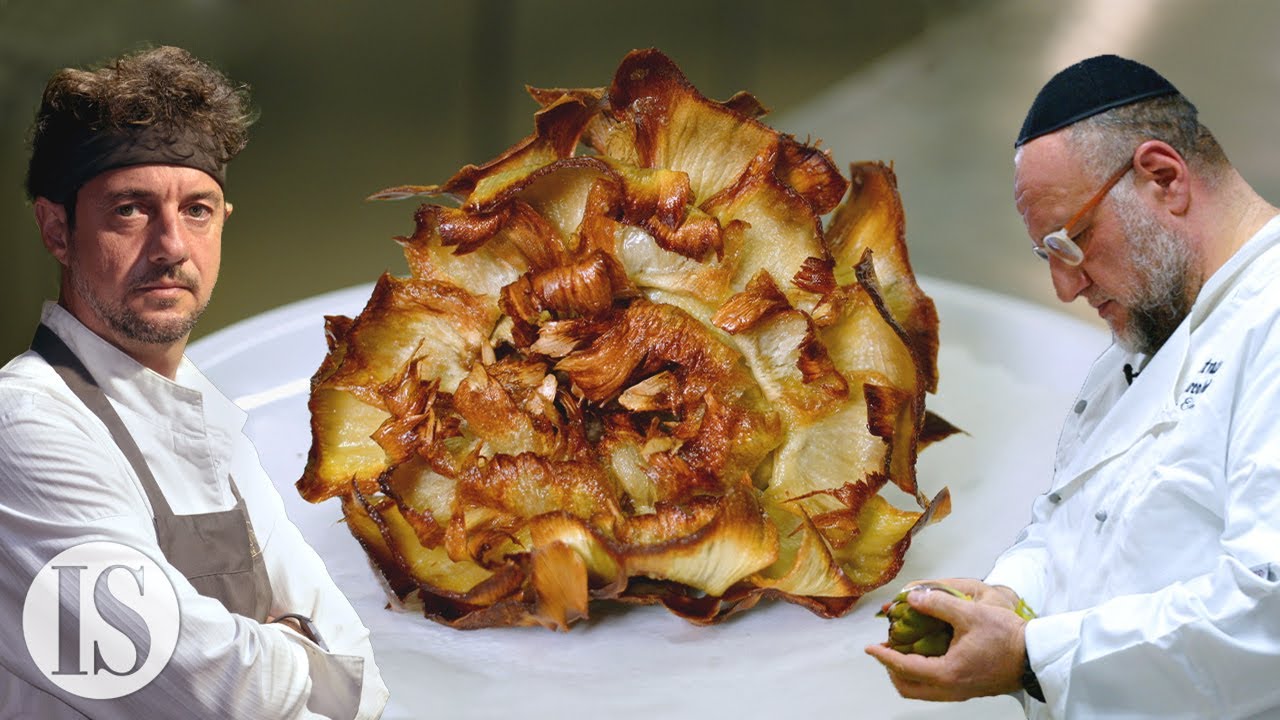
A Roma, da oltre 2000 anni, vive una delle comunità ebraiche più antiche d’Europa. La tradizione culinaria giudaico-romanesca ha avuto un enorme impatto sulla cucina italiana, con molte ricette originali diventate nel tempo patrimonio nazionale, tra le quali la più riconosciuta è senz’altro il carciofo alla giudia. Marco Sed, del ristorante kosher Yotvata, racconta la storia di questo piatto vegetale insieme ai trucchi per cucinarlo alla perfezione. La parola passa poi ad Angelo Troiani, una stella Michelin al Convivio, che allarga l’orizzonte con il suo “carciofo strike”, un piatto che racchiude tutti carciofi della tradizione laziale: “alla romana”, “alla marticella” e naturalmente “alla giudia”.
In collaborazione con Frienn di Olitalia https://www.olitalia.com/it-it/landingfrienn
Scopri il libro ORIGINALE & GOURMET, visita lo shop e acquista: https://shop.vertical.it/collections/books/products/originale-e-gourmet-offerta-preorder
1:54 Origini del carciofo alla giudia/Origins of the Roman-Jewish artichoke
2:27 Tipologie di carciofi/Types of artichokes
3:22 Come pulire i carciofi/How to clean artichokes
6:09 Prima frittura/First deep frying
8:05 Seconda frittura/Second deep frying
11:58 Carciofo alla romana/Roman style artichoke
14:55 Carciofo alla marticella/Marticella style artichoke
15:53 Friggere il carciofo/Frying artichoke
16:37 Impiattamento del “carciofo strike”/”Strike artichoke” plating
Visita:
http://italiasquisita.net/
Shop:
https://shop.vertical.it/
Seguici su:
https://www.facebook.com/pages/ItaliaSquisita/147031685608
Tweets by italiasquisita
https://www.instagram.com/italiasquisita/
Contattaci:
info@italiasquisita.net
Hello everyone, I’m Marco Sedde, owner of Yotvata restaurant in Rome in Cenci square 70, a kosher restaurant. For over 20 years I, together with my wife and my daughter, manage this restaurant respecting the tradition of true Jewish-Roman cuisine. For Jewish food, meat cannot be mixed with milk. It follows that certified restaurants
Are either milk and fish or meat and fish. Yotvata, our restaurant, is a kosher restaurant with milk and fish. In Yotvata restaurant, the cheeses used are produced by us within national dairies that adhere to our kosher standard. We produce all the best types of cheeses that we sell and use here
In the restaurant and that we sell all over the world. Today we are here to talk about a dish that is typical of Jewish-Roman cuisine and reigns supreme on all dishes: artichokes alla Giudia. Artichokes alla Giudia was born like all traditional Jewish-Roman dishes, by the need to optimize raw materials.
Jews during the Ghetto period were forced to do their shopping at the end of the market. The only raw materials that were available were those of greater availability within the Lazio region: above all artichokes, ricotta, endive, Roman courgettes. Those make the best dishes of the Jewish tradition: cassola with ricotta, concia with courgette,
Anchovies with endive, but above all artichoke alla Giudia. First of all, we must begin by specifying the difference between the various types of artichokes. The best artichoke to be made in the Giudia style is the famous Roman artichoke or, as it is also technically called, ‘mammola’.
The seasonality of the Roman artichoke ranges from February to May. The artichoke that is currently most easily found due to its seasonality is the Ares artichoke, which resembles the Roman artichoke a bit. Throughout the year, we have the possibility of processing various types of artichokes, from ‘violetti’ to even imported artichokes when
Those are not available, for example, ‘petite violet’ from Normandy are artichokes that are often used inside the kitchen to always give a fresh product to our clientele. The preparation is relatively simple. There is a first phase which is the ‘capatura’, as in cutting the artichoke. It is important to know
Depending on which type of artichoke you are going to clean, how to treat it, how to cut it. It must be understood that the Roman artichoke or ‘mammola’, which is a very closed artichoke, is better cut in a rose shape, precisely because its morphology and
Shape lend themselves to being very similar to a rose. As you can see, he is taking off obviously the choke inside. We’re checking that there are no insects. This, from the Jewish point of view, is fundamental. Then, to prevent it from oxidizing, the artichoke is put in a solution of
Water and lemon or water and vinegar, or there is even those who use parsley stems. Now our chef Mina will show us how to cut a ‘violetto’. We like to cut a ‘violetto’ artichoke in a square fashion, so that you have the possibility of exposing more leaves, also because the leaf
Once the tougher external ones are removed, lends itself to being fried and the final effect is like I’m eating a French fry, a cookie, so it’s very very tasty. Also in this case the choke is removed. It is put in lemon and water and can be kept until we will fry it.
A particular memory of my family that I have connected to artichokes alla Giudia is when my mother used to cut these artichokes. My father used to buy 40-50 artichokes, which are important numbers for a single family, and my mother used to clean the artichokes and I remember this
Anecdote: my father and my mother always argued because my mother complained that she didn’t have a knife suitable for artichokes and my father used to tell her to use a normal knife, and she would reply that artichokes must be cut with a particular knife called
‘spelucchio’, basically a hook knife that allows you to cut the rose shape, and I still remember these big fights, obviously playful, inside the kitchen in our home, but in the end the goal was the same: to prepare more, as quickly as possible and cut the artichokes to ready to be eaten alla
Giudia or even in other ways, but basically alla Giudia. A fundamental process for cooking artichokes is frying. The mainly used technique is the double frying. The oil we prefer for frying is sunflower seed oil high oleic Frienn by Olitalia. This is a stable kosher certified oil, an oil that can also be reused
For frying several times, without exaggerating, but it is a stable oil that does not affect the flavor of the artichoke or of frying in general. Now let’s move on to the pre-frying phase. We put Roman artichokes in one basket, in the other basket we will put the others.
We’re placing them horizontally, so that the stem takes this pre-cooking and therefore softens. After that, it is immersed at a temperature of 150°C. They will have to cook for about 18/20 minutes, the time for the stem of the artichoke and the heart of the artichoke to soften. We placed these
Skimmers over the artichokes to hold them well pressed and immersed in oil, so that no part of the artichoke is outside and can be cooked evenly across the entire surface of the artichoke, both on the stem side, the heart and on the external leaves.
We can then remove it. The artichoke at this stage can also be stored in the refrigerator for several days. In the context of the optimization of the raw materials that Roman Jewish families found at disposal, the artichoke also lent itself to use over time. Frying was also a system for preserving. The
Hygienic and sanitary conditions of the Jewish people during the ghetto period were not particularly thriving and so they also tried to optimize when cooking foods, those foods that could be stored and kept for several days. Leave the artichokes to rest for 15 minutes even 20 minutes and then once they
Have rested they will be ready for the final cooking. Now the peak moment for the artichoke: it is immersed in boiling oil at 180°C for 2-3 minutes, the time to give it that crunchiness which is typical of artichoke alla Giudia. Look at how it opens up. The artichoke is ready. Let it drain
For 30-40 seconds to remove the excess oil, after which it is transferred to absorbing paper. A little salt and this is the end result: the true artichoke alla Giudia. When the artichoke is plated and the kitchen calls, there are no excuses: you have to run to the dining room because fried foods
Must be cooked and eaten. This is our version of the artichoke alla Giudia. I hope I was thorough enough. I’m waiting for you here in our Yotvata restaurant in Cenci square, 70. You will be welcome to enjoy with us this typical dish of the Roman tradition which is the artichoke alla Giudia.
Now I’ll give the floor to Angelo Troiani who will show us his version of the artichokes. I wish ‘shalom ve lehitraot’ to all the friends of ItaliaSquisita. We’re waiting for you here in Yotvata. Hi, I’m Angelo Troiani, the chef of Il Convivio restaurant in Rome, just a stone’s throw from
Navona square. Today after you have seen, tasted with your eyes, savored with your fantasy the artichoke alla Giudia in the Jewish quarter in Yotvata restaurant with Marco Sedde, instead we find ourselves inside Convivio for an all-round of the artichoke, a dish that I called in fact Strike Artichoke, that is the three
Recipes of the artichoke that are children of the Roman culture: therefore the artichoke alla Romana, the artichoke alla Giudia and the artichoke alla Matticella, all in one dish. Let’s start from the cleaning of the artichoke. The artichoke is the ‘cimarolo’, ‘cimarolo’ in Rome, otherwise ‘mammola’ in
Italian, that is, the first artichoke of the season, the first artichoke that is found on the plant. First of all, I’m cleaning the stem, that is, I’m removing all the fibrous outside part of the stem until I almost reach the core, this is to avoid fiber and the bitter part.
Then I’m peeling the artichoke and removing the first leaves outside, but I’m also going to use these from the perspective of a concept let’s say about catering, without wasting anything and recovering what is good. Then with the knife, placing it vertically I start to turn it as if I was peeling an
Apple, until I obtain a rose, a ball in the shape of an artichoke. Now after cleaning the artichokes, I’m placing all the waste from the stems and leaves in the oven as they are, without adding anything. I baked them at 180°C for about an hour and a half. The first process now,
The first step is to prepare the artichoke alla Romana. So, I’m cutting the stem, seasoning the artichoke with salt and pepper and placing it in a saucepan with some oil. The oil must be olive oil with light fruity notes. This is because if we used a more bitter oil,
Then a medium fruity one or even worse intense, we would exalt the bitter taste and we would obtain an unbalanced flavor. In addition to the oil, I have to add a little water. This is because it allows the temperature of the oil not to raise. I’m adding half a
Clove of garlic and let it cook for about 15 minutes. Simply put, the artichoke alla Romana is a kind of oil cooking. So we’ll start at the beginning with water and oil, but at the end of cooking the water must be completely evaporated. This is why at the beginning of cooking,
I will keep the saucepan closed with the lid to give it a high temperature, a sort of short pressure cooking. Then I’ll open the lid a little to allow the steam to escape. The only small, let’s say, difficulty where I need a bit of experience is to calculate the water quantity
To reach the end of cooking. This obviously depends on the tenderness of the artichoke. When cooking, I’m adding parsley and mint leaves until the end of cooking. It will take approximately 15 minutes, depending on the tenderness of the artichoke, but still to understand when you are getting
To the end of cooking, you can help yourself with a toothpick, that is, inserting the toothpick in the artichoke, it shouldn’t cause resistance, it shouldn’t get stuck. I can insert it and remove it very easily. At the end of cooking, I’m taking the artichoke out. I’m keeping one part of the stem
For the final preparation and the other half of the artichoke instead, together with the herbs and garlic and a part of the cooking oil with a drop of water will be used to make a sort of pesto cream. I’m also adding two or three pieces of walnut kernels.
So, through a simple mixing gesture with the hand blender, I’m building the cream which I will then place in the stem to enhance the flavor of the artichoke alla Romana. I now have to build the artichoke alla matticella. What is the matticella? Matticella is the kindling of the vine pruning that was used
On trips out of town to cook the artichoke under the coals, because it has a very fine wood, resistant and not very calorific. If you remember about all the waste of the artichoke, I put it in the oven let’s say to burn. Once cooked, let’s say burnt, I took them out and
Used them to make a broth with water and ice. This broth will cook about 2 hours I have to reduce it a lot to have a very strong extract, then I’m taking a part of the stem that I had available and then by only adding a
A drop of oil, I’m going to emulsify it, thus obtaining a cream with artichoke alla matticella, which I will then use to complete the dish. What is now left is the central part, meaning I cooked the artichoke alla Romana first, and now I am transforming it only
In part, only the part of the leaves, alla Giudia. How do we make it? Easy: I’ll take a pan, add some high oleic sunflower oil and I prefer sunflower high oleic oil because unlike peanut oil it does not have allergens. As you can see, under the bottom
Of the pan I inserted a grill. This is so as not to let the leaves touch the bottom of the pot otherwise they would quickly turn black, because the pot has a much higher temperature than the oil. By lifting it a bit, instead, I’ll obtain a very uniform cooking.
I need to obtain a bright golden brown that is not too dark. I’m now checking it to see if it is browning well, if it is golden and the artichoke has reached the right cooking point. It’s ready. I’m removing it from the oil and letting it
Drip for a moment to let it lose those few drops of oil that can go away and then I’m going to start the plating. I liked to represent the artichoke as it is, that is, a flower. For this reason I’m going to assemble it this way: I’m placing the artichoke
In the center, then I’m going to create the corolla on the outside with the artichoke alla matticella cream. I’m placing the stem below it and I’m going to chain the stem with the cream that represents the flavor of the artichoke alla Romana. Finally I’m also adding a little bit of
Alla Romana cream on the center of the artichoke to create a trilogy of flavors. This is my tribute to the Roman tradition. It usually is very difficult to take traditional recipes and play with them so as to obtain something that makes a some kind of sense. I tried, if you want, try it
Yourself at home, just follow the steps as we have shown them. And all that is left is to send you greetings from the Convivio, from my staff and I hope to see you soon. Ciao!
24 Comments
Marco Sed è un'istituzione. Un grande.
La cocina Kosher es muy interesante, muy buen video! 👍
deepfried 😂👍
Palestina libera
Que cocina de profesionales, impresionante!!!!…..me gustan mucho las alcachofas. Saludos desde México.
Li adoro.
Dato il periodo non ci penso nemmeno a venire da Voi
La versione gourmet deve essere pazzesca..impiattamento orribile però 😅
in pratica è la cucina libanese rivisitata
Free Palestine!
Mi aspettavo dei commenti furiosi tra sostenitori di Palestina e Israele
Il concetto Kosher racchiude tutti i concetti moderni di profilassi alimentare,contaminazioni crociate,tracciabilità Dop e DOCG. Il rabbino assisteva alle produzioni come oggi lo fanno i consorzi e gli ispettori.
Non per niente è una religione che non pratica proselitismo.
La loro cucina è fantastica e merita molta attenzione.
Troioni miticoooooo!!
Molto interessante! Verrò sicuramente da voi quando verrò a Roma. Purtroppo in casa e complicato da fare!
Piuttosto che boicottare israele, IS promuove la loro cucina, pollice in giù ed unfollow automatico, ciaone
Ma la seconda ricetta è seria?
❤😋😍👏
Yotvata se vuoi mangiare la vera cucina kosher. 👏👏👏
Un fiore 🌸
Buonissimoi.
Comimos ahí absolutamente excelente
Olio come se piovesse
fabulous thank you
No grazie…solo cucina goyim per me