
Click my CoPilot link https://go.mycopilot.com/jameshoffmann to get a 14-day
FREE trial AND 20% off your first month of personalized fitness if you sign up
before February 1st!
Decaf has been a popular topic, and heavily requested, but let me know if there’s more you want me to cover!
Prufrock Coffee https://prufrockcoffee.com
I Did Caffeine Analysis video: https://youtu.be/etnMr8oUSDo
Caffeine Explained video: https://youtu.be/j805qJJajmM
Timestamps:
0:00 Introduction
1:51 Brief History of Decaf
03:24 Short Ad for CoPilot
04:57 Decaffeination Processes
10:02 How Much Caffeine Is In Decaf
12:06 Decaf & Health
13:22 Roasting Decaf
15:30 Decaf in Coffeeshops
15:55 Decaf At Home
20:09 Your Thoughts on Decaf
Links:
Patreon: https://www.patreon.com/jameshoffmann
Limited Edition Merch: https://geni.us/TensHundredsThousands
My Books:
How to Make The Best Coffee At Home: https://geni.us/howtomakethebestcoffee
The World Atlas of Coffee: http://geni.us/atlasofcoffee
The World Atlas of Coffee Audiobook: https://bit.ly/worldatlasofcoffeeaudio
The Best of Jimseven: https://geni.us/bestofjimseven
Find me here:
Instagram: https://www.instagram.com/jimseven
Twitter: https://www.twitter.com/jimseven
Things I use and like:
My video kit*: https://kit.co/jimseven/video-making-…
My current studio coffee kit*: https://kit.co/jimseven/studio-coffee…
My glasses: http://bit.ly/boldlondon
My hair product of choice: https://geni.us/forthehair
*Affiliate links
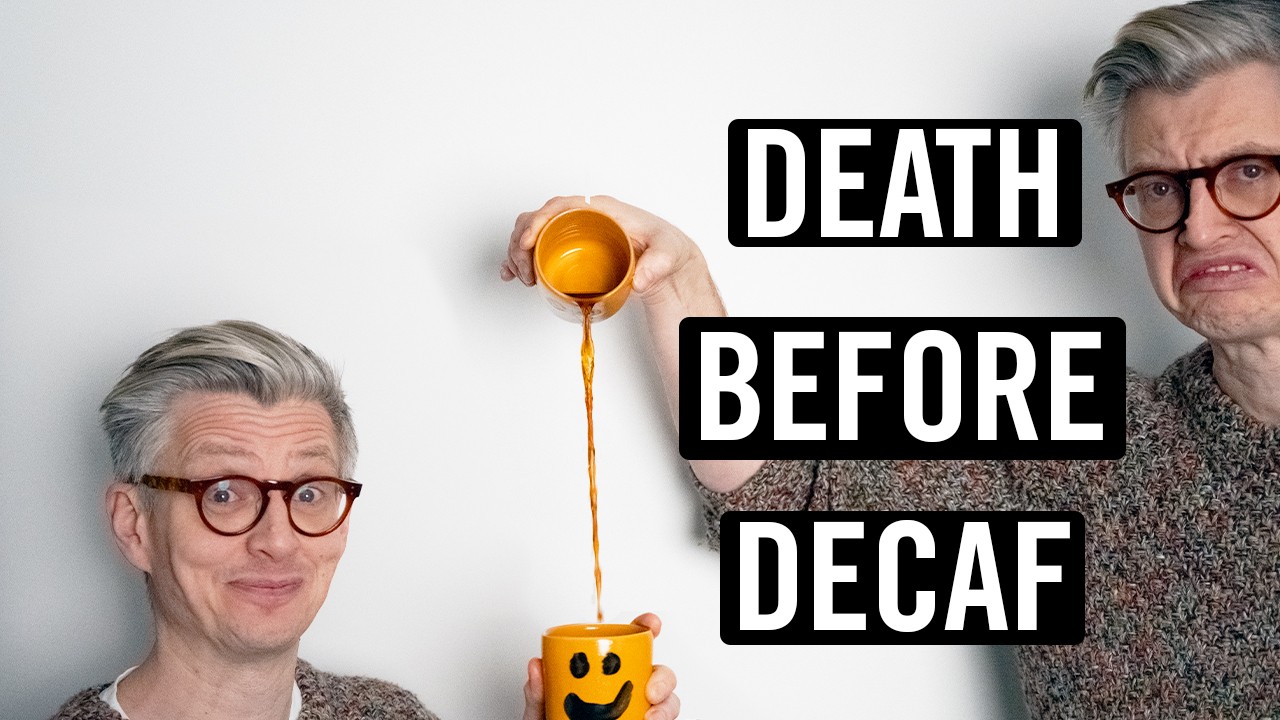
– Today we’re gonna talk about decaf because decaffeinated coffee seems to be this weirdly controversial topic. There’s a big group of people out there that are really kind of against decaf, the whole Death Before Decaf crew. And if you’re one of those people watching, well then I’ve got good news and bad news.
And the bad news is, I think you might be wrong, but the good news is, well, decaf you know, often is disappointing and you’re kind of right to be skeptical of it because I would say most cups of decaf coffees served in most places are a letdown, are not that good.
I wanna get into the hows and whys of decafs because the kind of decaf drinker to me is the top tier coffee drinker. They are the purest of all coffee drinkers because they’re just drinking it for the taste. They just like the taste of coffee and they’re willing to drink decaf,
Disappointing decaf, often, to get there and that feels very sad. But the really good news is that decaf can be amazing. It can be as good and enjoyable as any other caffeinated coffee if you get it right. Now, you might also be of the mindset of like, “What’s the point?
The point of coffee is caffeine!” and I would argue a point of coffee is caffeine, but that misses a bunch of fun and that’s kind of the whole point of this channel. We think coffee can be really genuinely delightful in a whole bunch of ways. Not just how it tastes, but its history,
The whole process of making it, coffee’s great and worth exploring. Now I want to get into why decaf is so often disappointing. And to do that, we’re gonna have to go right back to the beginning of decaf and then talk through the processes used to decaffeinate coffee.
Then I wanna kind of touch on the health side of things because I think it is a really important part of this whole conversation. And then, of course, we will cover how to make delicious decaf coffee at home. What’s important, what you need to worry about,
What tends to go wrong, and what should go right. Let’s go back to 1905 in the city of Bremen in Germany and there was a coffee trader there called Ludwig Roselius. Now his claim is that the idea of decaf came to him when he had a batch of raw coffee
Soaked in seawater at some point, and then afterwards when they roasted it, he thought it tasted pretty good and it was kind of decaffeinated. He patented a process where they would kind of soak the coffee beans in hot water and then get in there with a compound called benzene
That would bind into the caffeine as a kind of solvent and take it out. And at the end of it, you had relatively decaffeinated raw coffee beans that you could then roast. And being an entrepreneur, well, he then built a brand selling decaffeinated roasted coffee and that brand was called Kaffee HAG.
They had another brand too, actually they started called Sanka, which was ‘sans caffeine’. And that brand I think had much wider reach. It was certainly popular in the US, really pushed decaf into that market. And most of the early marketing for decaf was it was a healthier choice to drink a coffee
Without the caffeine. Small problem with that, benzene, the compound they were using as a solvent in that process turned out to be a carcinogen. We don’t do that anymore, benzene is off the table, but that basic process of treat the coffee bean in preparation for the extraction,
Use a solvent to get at the caffeine specifically, and then get rid of that and keep the remaining beans to roast and drink. That’s kind of the process that we still use today. But there’s kind of three main categories of decaffeination that I think are worth sort of talking about separately.
Before I tell you about those processes though, I wanna talk about something a little bit related, which is health and fitness. In this short ad for this video sponsor, which is CoPilot. CoPilot is a fitness app that pairs you one-to-one with an online personal fitness coach.
And for me over the last eight or nine months, it’s been absolutely game changing because in terms of goals, I’m not trying to run a marathon, I’m not trying to hit a certain deadlift, I just wanna make exercise a regular, repeatable, enjoyable, sustainable part of my life.
And I check my CoPilot stats and it’s working. Now, it all starts with a little video call once you’re paired with a trainer, you can go through what your goals are, how you want to exercise, what your schedule looks like, when you might do it.
And from that point on, everything is built custom for you. And it’s helped me in three big ways. Firstly, most obviously, accountability, having Celina there, checking in on me, making sure I’m doing what I say I’m gonna do is really helpful. Two, flexibility.
A trainer in the real world requires having a fixed schedule turning up and matching their schedule. And my schedule changes all the time and I need the flexibility of having a kind of trainer in my pocket. And third, customization. It’s not like just buying a program and following it.
If things change, if my needs change, if my fitness goals change, if I get an injury, my program can change. If I can’t go to the gym when I’m in the park and I only have a few things to work out with, the program can be built around that.
If you want to try CoPilot, if you click the link in the description down below, you can get a 14 day free trial. And if you sign up before February 1st, 20% off your first month. Thank you to CoPilot for sponsoring this video. The first is actually very similar to the original process.
It’s gonna be organic solvent used to extract the caffeine from the coffee beans. The sort of successor to benzene was one called methylene chloride or dichloromethane. It’s the same thing. That compound has a bunch of names. It’s a very effective way of doing it. The process is much the same.
You might steam the beans or heat the beans up in hot water to kind of open them up so that you can get inside them. Green coffee beans are very dense and if you’re trying to get stuff out of the middle of them,
You’ve gotta do something to them to kind of open them up to give you access chemically to the middle. Dichloromethane isn’t the most glorious and wonderful chemical in the world. I don’t recommend consuming it. I strongly recommend not consuming it. You shouldn’t be exposed to it in any serious quantities.
But the EPA in the US, the Environmental Protection Agency have a little paper on dichloromethane and they say in a US city, they measured three different cities. Daily exposure to airborne dichloromethane was 30 to about 300 micrograms per day. Per day. If you take a well processed kilo of decaf coffee
That’s used the dichloromethane process that might have, in total, retained in it 200 micrograms of dichloromethane, the limit is 2000 micrograms per kilo, but most of them are, in well run optimized plants, are below that limit there. So if you drank that entire kilo and you extracted all of it in that process,
You’d be kind of at a typical day in a North American city in terms of exposure. It’s a bad compound but the dose makes the poison. Dichloromethane became less and less popular because the name freaks people out and there was a big push against it
And there is a successor to it called ethyl acetate. That also sounds very scary, so you don’t tend to see that on bags of coffee. What you tend to see is the Sugarcane Process listed. Sugarcane is what’s used to produce ethyl acetate. It is a naturally occurring chemical. It occurs in fruits,
It occurs in a bunch of different processes. Yes, if you concentrate it down you can use it as nail varnish remover, but it’s present in a bunch of stuff and it’s really not that scary. It works much the same way where again, you’re gonna steam the coffee beans to open them up,
Add the ethyl acetate, dissolve out the caffeine through a number of different washes, take that away, extract the caffeine from it ’cause that stuff’s actually useful and valuable, and then steam the coffee beans a second time to get rid of any solvent before drying them down
And having them ready for kind of roasting. That’s actually a very common process. It’s really kind of interesting how popular it’s become recently. There’s a few different plants around the world doing it. One of them is in Colombia, so you tend to see a lot of Colombian coffee processed as ethyl acetate decaf.
The second kind of grouping, I suppose, is kind of water extraction. The Swiss Water Process involves making a green coffee extract. You are gonna take a very large batch of raw green coffee and steep it aggressively in hot water to try and leach out everything you can. That’s the caffeine
And all of the stuff that makes the flavor. That raw coffee is no longer useful to you. But the green coffee extract really is because you can decaffeinate the liquid using things like sort of active carbon rods and then you’ve got a caffeine-free green coffee extract.
When you put a fresh batch of green coffee into it, well the flavors aren’t gonna leach out of the coffee bean because they’re already in equilibrium with the solution, but the caffeine isn’t. And so the caffeine leeches out of the coffee bean into the green coffee extract. You do this multiple times
And it will fully decaffeinate the raw coffee. And again, each time you’re pulling out caffeine from the green coffee extract, that you can sell to pharmaceuticals or to you know, beverage manufacturers. It ends up in things like Red Bull or cellulite cream. A lot of people like the Swiss Water Process
Because it is ultimately a water-based process and people aren’t freaked out by water. I don’t really have an opinion that lines up with that. I’m kind of open to any and all decaf methods. They’re all safe. And I’m not gonna come down on one side of one decaf process in this whole thing.
I’m interested in all of them. This leaves us with our third process, which has I think the coolest sounding name, which is ‘supercritical carbon dioxide’. Now carbon dioxide is kind of weird. It’s one of those things that sublimates, what a lovely word. It goes from being a solid straight to being a gas.
You’ll see it if you have a block of dry ice, when it melts, it doesn’t turn into a liquid. To get carbon dioxide to act like a liquid, you need to apply a specific temperature and pressure to it. And if you get those right, it sort of acts like a liquid.
And if you mix it with water, well then you can use that mixture to sort of decaffeinate coffee because the supercritical CO2 does seem to extract caffeine specifically. This process sounds very interesting. It doesn’t tend to freak people out because even though CO2 may not be good
In excess for the environment, it’s not a scary thing. It’s in the air around us. There’s nothing terrifying about CO2 from that perspective. Again, this is not me saying ethyl acetate and methylene chloride are bad, I’m just saying how people react to them. Now I’d love to go to these plants
And look in depth at how they work and if that’s something you wanna see, let me know down in the comments below. Okay, so you’ve got your raw decaffeinated coffee and then you roast it up. You buy a bag of roasted beans, you take them home, you brew a cup.
Does that coffee have zero milligrams of caffeine in it? No. If you look at a lot of the language around decaf, you’ll see that it’s often described as being 99.7% caffeine free. Looking at the EU legislation specifically, they say that of the dry coffee matter, I presume that means the ground coffee,
It can be up to 0.3% caffeine by weight in order to be classed as decaffeinated. Coffee, normal caffeinated coffee, is one to maybe 2% by weight, caffeine. So the reduction is going from say 1 to under 0.3. So yes, once it’s below 0.3, it is more than 99.7% caffeine free.
But that’s not the reduction, it’s not reduced by 99.7%. Now viewers of the channel may be familiar with this: it’s a caffeine meter, it’s a little device I’ve used over the years to do a bunch of caffeine testing. And interestingly, it’s actually not sensitive enough to measure decaf coffee as brewed coffee
Because it’s below a concentration of 10 milligrams per hundred milliliters. So it’s definitely gonna be below 20 milligrams for like an eight ounce cup of coffee or a 225 ml cup of coffee. It will typically be lower than that. One thing we can measure though is espresso because that’s obviously much more concentrated.
So here we have 36 grams of liquid espresso brewed from 18 grams of ground decaffeinated coffee. In this case it was an ethyl acetate decaf. That’s not particularly important to us now. What I’m gonna do is give it a good stir and then pull a sample, add it to some reagent,
And then add it to this little machine and it will give me a number about how much caffeine is in here. This has 13.91 milligrams per deciliter per hundred milliliters. And this is about a third of a deciliter but it’s four and a little bit milligrams of caffeine.
Very little caffeine for a double espresso, which is good news. Now I do wanna draw your attention just quickly to this number here, the chlorogenic acid number. Now we’ve never really talked about this aspect of the analyzer on the channel before, but chlorogenic acids are polyphenols, they’re kind of plant defense chemicals
And they’re actually present in relatively high quantities compared to caffeinated coffee, in decaf. Now recently I did a podcast with Tim Spector. They invited me back to the Zoe podcast. I don’t think that’s out yet, but when it is, I’ll leave a link in the description down below.
They were talking more about the importance of polyphenols from coffee for gut health. It’s one of the ways I think in which coffee is particularly healthy for you, in that it’s got loads of CGA, got loads of polyphenols, so it feeds your gut and that makes you,
Or helps you have a healthier gut basically. And that has a bunch of health benefits on the back of it. That makes decaf to me particularly interesting. It tastes great when it’s done right, it’s got loads of polyphenols in it, so it’s good for me,
But there’s no caffeine, which is also potentially useful if I suffer sensitivities to caffeine, if it delays the onset of my sleep, or it lowers the quality of my sleep, or it exacerbates things like anxiety for me. So there’s reasons not to drink caffeine, but decaf lets you have a load
Of the potential, theoretical health benefits of coffee without kind of the downsides. So why is decaf bad so often? It turns out that first part of every process is extremely disruptive. The part where you kind of open up the coffee bean changes the kind of structure of the raw coffee irreversibly.
It makes it kind of more porous. It looks really weird as well, let me show you. Here we’ve got some Swiss Water Processed decaf coffee and here we’ve got some ethyl acetate processed coffee. The green is a very different green to most green coffee. These are both washed coffees originally.
It’s kind of interesting to see, they don’t look that much different in size. You can see some difference between the two. The way that these roast is totally different to the way that normal coffee roasts, right? Like the way that the heat transfer happens in this very different kind of density coffee bean,
Means that it’s a tricky thing to roast well. And as a result, a lot of decaf goes wrong at this stage. And this whole thing does funny things to the way that the coffee looks once it’s roasted. Decaf often looks a kind of different roast level
Than it is inside on the outside of the coffee beans. There’s a couple of reasons for that. One, I think the heat transfer is a part of it and two, because it’s so porous, when it has been roasted that little bit darker, the oils that usually don’t come to the surface
Until a pretty dark roast, will come to the surface after roasting relatively quickly. So you get these weirdly oily looking beans that aren’t that darkly roasted. I’ll try and show you this in a slightly nerdy way. We have a roast color analyzer here and we’ll look at two different coffees.
One sort of specialty coffee, caffeinated coffee, and we’ll look at the color of the outside and then the inside once we’ve ground it. And then we’ll do the same thing with a decaf coffee. When it comes to using this little machine, the lower the number, the darker the roast.
So with the decaf you can see, to me, the beans look much darker than these beans, but the ground coffee looks only fractionally darker. And I think that’s what we saw with the color testing. Essentially the outside of a decaf coffee bean
Is not as good an indicator of the color of the inside of the coffee bean, of the ground coffee, of the overall roast level. But this is where it becomes truly relevant for you brewing decaf at home. Because this decaf is more porous.
Yes, oils are able to get to the surface more easily, but the far bigger concern is that air, oxygen, is able to get in to the coffee beans much more easily. Decaf coffee stales faster than caffeinated coffee of kind of matching roast levels ’cause the darker you roast normal caffeinated coffee,
The faster it stales. So if you have a very dark roast of decaf that will be stale incredibly quickly, two weeks off roast if it’s not held in a kind of oxygen free environment, you will really taste a significant drop off in quality and flavor.
I’d love to tell you that most cafe operators think the same way about this kind of stuff, that they’re really paying attention to the freshness, but often they’re not. You’ll still see, you know, small coffee shops buying large bags of decaf and not going through them that quickly.
Decaf is as popular as cafes want it to be in a funny sort of way. Actually side note in researching this, we came across one article from the eighties from the New York Times, which claimed that up to 25% of coffee drunk in America at that time was decaf. That’s astonishing numbers.
I would say right now, I had a look at Prufrock’s cafe kind of figures for 2023 and four and a half percent of the drinks were decaf. It’s one of those things that often people don’t buy if it’s not clearly available. And then lots of cafe owners don’t sell
Because no one’s asking for it. It’s a kind of chicken and egg thing that’s confusing. A lot of cafes, frustratingly, don’t really invest time and energy into decaf. Again, their most passionate consumers are not well-catered to. Buying massive bulk bags of decaf is not in the consumer’s end interest.
You know, you need to invest in a good grinder. It doesn’t actually grind particularly differently to normal caffeinated coffee. We took a bunch of different decafs and run them through the particle size analyzer for a fixed grind setting and we didn’t see much difference as long as the roast was fairly consistent.
Different roasters do grind differently, but decaf doesn’t grind substantially differently to caffeinated coffee. You still sometimes see people pulling out the sachet of pre-ground decaf that is 100% guaranteed to be terrible. You see them sort of shaking the little foil thing into the portafilter, spilling everywhere.
That’s not a cafe you wanna be drinking decaf in or probably much coffee at all. You know, decaf can be great, but I don’t think most coffee shops are a good benchmark for how it should taste. So let’s wrap up with the key stuff around great decaf at home.
First and foremost is gonna be freshness. Use your freezer, decaf freezes really well. All coffee beans freeze really well. I would recommend potentially even portioning a little portion of decaf that you might need. And freezing them individually, as when you need them you can kind of draw them down.
If you don’t go through decaf that much, it will keep really well in the freezer. If you go through loads of decaf, just yeah, have a bag out. Things like, you know, the canisters and stuff help a little bit, but really the freezer is the best place to keep coffee that ages quickly.
The second thing is the most difficult thing, which is you need to buy great decaf from a roaster that cares deeply about their decaf. I had an experience in 2007 where I was visiting a cafe in Portland. It was a Stumptown cafe where they still roasted in the cafe.
And the roaster there, I was chatting and they said, “do you want espresso?” And I said, yes. Brought me an espresso. I drank it, it was delicious. And he is like, “By the way, that’s our decaf.” And that ruined me, like that was like
“Oh no, there’s no excuse for decaf not to be good.” And that stuck in sort of my head from that point onwards. I don’t think that’s true of all people involved in coffee roasting and that kind of stuff. I would say find the passionate people who are excited
To serve you decaf, sell you decaf, talk about their decaf. You wanna find a roaster who is proud and excited about their decaf because then, it genuinely, it can be very good. It’s one where I would recommend being involved in online communities who talk about coffee,
Who recommend coffee from local roasters, swap tips, who’s had a good experience, who hasn’t had a good experience. Buying great decaf is tricky, but really that’s kind of the key to this whole thing. Well-roasted, well-sourced, well-processed decaf is a wonderful and very enjoyable coffee to drink, but freshness is key.
Dialing it in ’cause it will brew differently to other coffees. Those are the key things. And beyond that, shockingly, there’s no extra tips or tricks. It shouldn’t be as hard as it seems to be. But drinking decaf is really lovely. It’s become a little ritual here at the studio.
About three o’clock we brew a little batch of decaf ’cause we all like drinking coffee and we all like sleeping well. I don’t want any caffeine after two o’clock, but I really enjoy a little cup of decaf in the afternoon. I just like drinking coffee, which is probably not a great surprise.
But now I wanna hear from you down in the comments below. Will you tell me, do you recommend decafs that you’ve really, really enjoyed? Don’t use URL, don’t put a link in there because that won’t work. Just just talk about some decaf you’ve really enjoyed and why. I’d love to hear from you.
Are there other things you want to know about the decaf process? Do you want me to go and visit some decaf processing plans? Would that be interesting stuff to see in the future? I’d love to hear your thoughts down in the comments below. Also, thank you again to CoPilot for sponsoring this video.
Don’t forget about the link down in the description below and the QR code on screen. But for now I’ll say thank you so much for watching and hope you have a great day.
34 Comments
Ok ok…but I'm still going to be annoyed as hell when my hotel room is stocked with only decaf.
Yes I’m a decaf only drinker I get anxious with caffeine. Please make a recommended tasking video !!
My favourite decaf is La Serrana from Doubleshot roastery in the Czech Republic. Why? It does not taste like soap, unlike other decafs I've tried 🙂
Just got a bag of decaf in from Topeca Coffee Roasters in Tulsa, OK. Still dialing it in but my first shot, even when under-extracted, was pretty good!
My decaf coffee bag (water process) from my local roaster says to never store in the fridge or freezer. Why might it say that?
I bought some decaf green bean but have procrastinated to roast it after seeing so much complains about it. I now am super excited to roast a batch and drink them after watching this video.
For me, the most downside of coffee drinking is the caffein. I often tell my colleague who thought I needed caffeine to work that it was caffein that is stopping me from drinking 24/7. I don't need that caffein really.
I want to see the inside of the super critical CO2 decaf plant! I'm really curious to know what happens when the CO2 transitions back into a gas. Does it happen suddenly or slowly? Does the caffeine crystalize? Or does it turn into a molecularly fine powder? And how do they avoid extracting all the flavor stuff along with the caffeine?
Koffee Kult brand decafe coffee is absolutely best tasting decafe coffee you can get as far as I’m concerned. But it ain’t cheap.
I drink both! I think they both have a place. Especially when you want to enjoy a cup of coffee at night
I’ve been saying this for 8 years! (I’m not a decaf drinker but stop
hating on decaf)
after all of Microsoft's shenanigens, having another copilot isn't helping the confusion…
I switched to decaf because of anxiety. I do love coffee did not want to live without it!
My coffeeshop doesnt even sell decaf coffee. Only weird smelling cigarettes 🤔
Drinkimg Decaf changed me and my dads life. I have a sensitive bladder and used to wee the bed as an adult constantly. Changed to decaf and have never done it since. My dad also had issues and was about to have to urinate via a caffiter. Lost control of his bladder. Changed to decaf and hes not had any lroblems since. Caffeine can be a bit of a hidden evil. Especially to certain people.
Just approaching the end of a 2-month tapering off from caffeinated coffee – now at 80% Swiss Water decaffeinated beans and 20% caffeinated beans. I tried going cold turkey before this process and was so ill with a severe migraine and nausea 🫣 The gradual tapering has worked brilliantly! I love the aroma and taste of good coffee, plus the process of making it! Although from the UK, I’ve always been a coffee person and find black tea disgusting to smell and taste. Tea to me means herbal infusions. BTW Tulsi herb tea is a very good non-caffeinated replacement for coffee-fuelled mental clarity if needed 😊 Great video thank you 💗
I AM THE PUREST COFFEE DRINKER ! BOW BEFORE ME !
Due to my love of coffee and borderline high blood pressure, I switched to mixing 50/50 decaf/regular beans a few years ago and it helped to lower my BP and I can still drink the same amount. My wife doesn’t love the flavor of decaf though, because she thinks it’s too acidic. Thanks JH for sharing why that is with the CGA, though maybe they taste bad for other reasons as he mentions. And yes, bring on the tours!
Chimney Fire Coffee (UK) does amazing decaffeinated coffee. I’ve been drinking it since my wife got pregnant and I didn’t want to make different batches. In terms of future videos, absolutely yes to a processor tour and I would also love to see a side by side taste comparison of the same coffee decaffeinated in different ways (which I think might be harder to do)
Onyx Columbia Aponte Village Decaf (Rogers, Arkansas), Allegro Organic Decaf Espresso Bel Canto (Whole Foods)
Can you look at the Hugh Leverpresso
I too enjoy a decaf as I cannot have coffee after 3pm. However I have settle for the lor decaffeinated pod. Would love to hear from you any suggestions for decaffeinated pods that are good.
The two pound bag of whole bean Kirkland Decaf (which is still available at Costco) is roasted by Starbucks, relatively cheap, and stored correctly has a pretty long shelf life. It is a dark less acidic roast which may not be to everyone's taste but it makes for a solid cup every time (brewed and Moka pot brewing methods mostly).
I want to see how these „plants“ work.
I was a serious coffee drinker. I roasted my own beans. Then my heart went wonky. I loathe decaf, but it's that or nothing. 😕
We need a series of videos about coffee in colombia
I’m a purest !!
Please tour decaffeinated roaster for all the processes. I would love to see it in action.
Still death before decaf bro
The best coffee ive ever had was decaf from a quant coffee shop in melbourne
couldnt find it again. so sourced it from a different place that roasts their own using SWP beans. They have both decaf and caf versions of the same bean.
The decaf tasted better and more floral
I wanna see how it works. Badly.
As someone who has recently had to switch to mostly decaf for medical reasons this video is exactly what I needed
I've reduced my coffee consumption down to 250-500mL a day after discovering my mood and personality changes negatively from withdrawal on weekends from amounts I used to consume. Decaf is very much my crutch for that coffee craving after I've reached my daily limit of regular coffee, so absolutely would love more decaf content.
This is probably sacrilegious but I like Folgers decaf. I realized that the amount of grounds really matters because it becomes bitter quickly with too much. I drink it with a little cream and it’s nice and relaxing. It’s replaced my whiskey or beer at night which is also probably a good thing.
San Francisco’s Sightglass Coffee has a decaf that is absolutely delicious: Hunky Dory. Always have a bag on hand for afternoon drinking.