
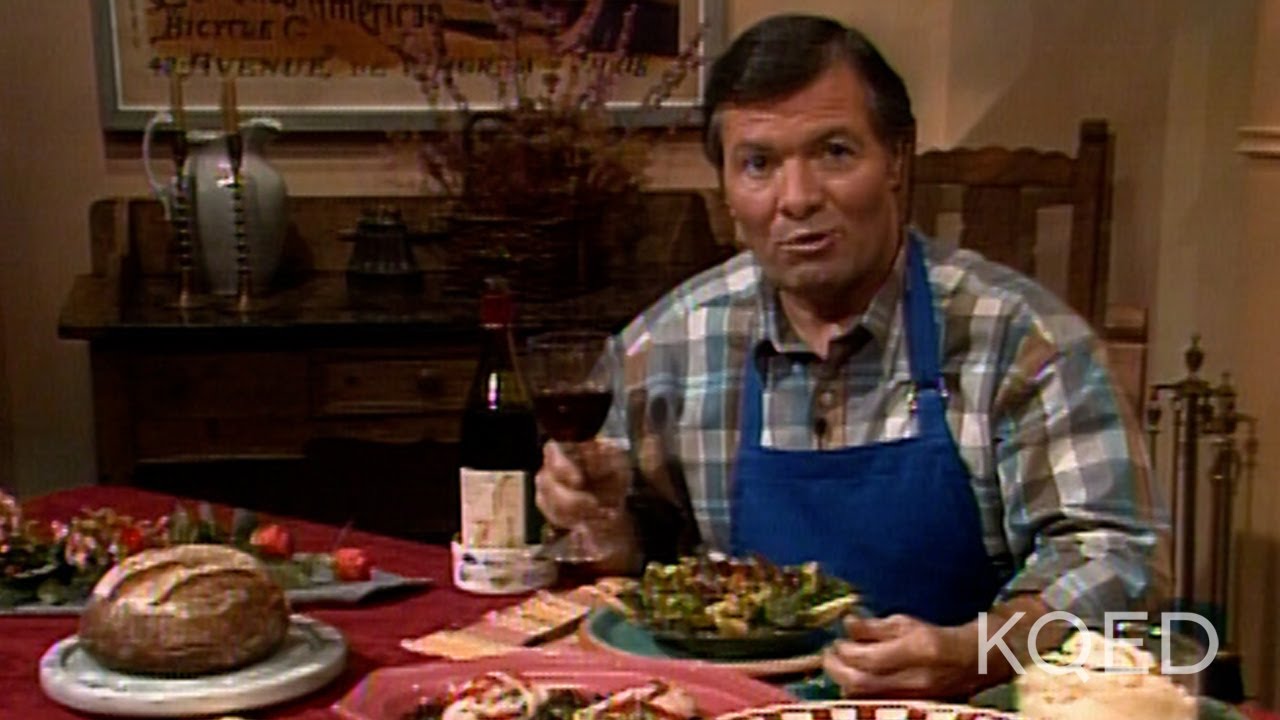
Making dinner for friends? In this episode of Today’s Gourmet, Jacques Pepin prepares elegant and simple crowd-pleasers like coq au vin, a chicken with red wine sauce. Also on today’s menu is a
poached cod with a caper, olive, fig, and anchovy tapenade, a tutorial on homemade croutons, and a simple blueberry dessert.
In This Episode:
00:00
1:00 How to make coq au vin, a chicken with red wine sauce.
8:15 Poached fish tapenade recipe
15:35 How to make croutons
20:00 Blueberry and yogurt dessert
Today’s Gourmet with Jacques Pépin – Full episode
Season 1, Episode 15, 1991. Chicken Tapenade
Subscribe to watch a new Jacques Pépin video every Wednesday:
https://www.youtube.com/kqed?sub_conf……
#jacquespepin #chicken #kqed
About Today’s Gourmet with Jacques Pépin:
Today’s Gourmet aired on KQED 9 for 3 seasons, spanning 1991 – 1993. The series showcased Jacques’ culinary techniques, mouthwatering recipes, and his sensibilities as a chef. Episodes include recipes such as gnocchi maison and visits from special guests including the godmother of the organic food movement, Alice Waters.
The Jacques Pépin Foundation is dedicated to enriching lives and strengthening communities through the power of culinary education. https://jp.foundation/
Subscribe to @KQEDFood to watch more food videos.
– Today I’m cooking for my friend. When I cook for my friend, I do dish that I know they’re going to like. I do dish that I like myself too, so that everyone feel comfortable. This is not the time to try very esoteric ingredient. You want people to be familiar with the food
And enjoying it. What is more familiar than a chicken? And this is what we’re going to do today. Starting cooking a what we call a coq au vin sometimes in France. A coq refers to an old, of course, chicken, and this is the poulet, just the regular chicken with a red wine sauce.
And to do this I’m going to start by cutting the wing off into two piece. We’re going to start browning this in there, both of them, and that will give me just a little bit of fat from the skin of those two piece of meat and this is what I’m going to brown
The chicken in it later on. So we start there and the second thing we have started here is the tiny pearl onion. I have some pearl onion and I want to glaze them and to glaze them I put a tablespoon of olive oil, half a cup of water, a dash of sugar,
So and now we cook that covered. What happens is that they’re going to cook in the liquid, the liquid will reduce, eventually we’ll take the lid off and continue cooking it until there is no more liquid so they will start frying in the little bit of olive oil and sugar at the end,
And that’s what we want. This, I want to brown around, and during that time, let’s bone out the chicken. When you bone out a chicken, to cut the leg, the best way, instead of have it on the back, put it on the side then lift up the chicken
To actually use the weight of the chicken, so with the point of a knife, all that you have to do is to cut the skin. Then here, there is a little thing called the oyster that I have to cut and now I have to crack that leg open
And often people do this and it doesn’t come open. Bring it back up, grab at the knee, and crack it open here. Then you cut through that sinew and you pull out. The leg will come. Second leg again, cut the skin, the little oyster, break it open,
Cut at the joint and pull it out. In our recipe here, we want to eliminate, you know, a great deal of the fat, of course, and it’s in the skin especially because the chicken is going to be boiled with red wine, so we don’t need the skin. I discard the skin and here,
I will remove maybe the wishbone that I have here, which I pull out with my finger right there. Those bones, this one happens to be broken. Then, cutting into the center here, on each side we want to take the two breast of that chicken here.
Here, I’m cutting it, and you see, pulling out. A lot of the boning out has to do with pulling out. You have a nice breast of chicken. The breast of chicken, of course, is going to take longer than the dark meat, so this is really what we should start first.
I have the thigh and the drum here separated in two, removing the end of the drumstick, and pulling the skin out of it. Use a towel sometime, you know, it’s easier to pull it out with the towel, as you can see. Of course, most of your calorie goes in there.
Sometimes when I fry chicken, I still leave some skin, and I really press on it to remove as much of the fat as possible, but when I am going to cook a chicken with liquid like in that recipe that I would rather, you know, remove all the skin.
Now this you put in your freezer, you know, this is very good for stock, or you do a stock with it. So let’s see, this has been frying very nicely. That’s what I need. So now it is time to brown the chicken. So the idea is to brown the chicken all around here,
Get a bit of that crust on top of it, you see? Even the breast. So the first part we brown it and the second part we cook it with the sauce, you know? So I don’t cover it, I’m going to leave it like that here. Put a little bit of salt on top. And… I should really… Clean up my table,
Clean up my table good after the chicken. It’s always important to clean up the table with a bit of soap and water, if you can, and rinse your knife and your hand. This is important. Remember, especially now that people are talking a great deal about salmonella,
Which is going to be mostly in the skin, but it’s important. The second thing that we are going to do with that is to start our potato. We’re doing a mashed potato today with garlic and turnips, and the garlic and turnip mashed potato, I’m lowering this,
And I’m going to put a little more water in there. The water’s evaporated already. Okay, on low heat. And I have here half a cup of water. I put only a little bit of water and a dash of salt in the bottom. Again, when I cook vegetable,
I like the vegetable to cook down and by the time they are cooked, there is barely no liquid leftover, so I don’t drain the potato, I don’t drain the vegetable, I use all of the liquid, which is better for you. So I have a pound of potato, which are three potato.
Peel with a vegetable peeler, of course. This way. You can peel the potato ahead, as I had the other one, you see, providing that you keep it in water. If you don’t keep it in water, it is going to discolorate, you know, so… I wash my potato in there. Cut it into pieces.
I mean, the size of the pieces of your potato will kind of determine the amount of time it’s going to cook. I have that white turnips here. Now you know if you do a puree of turnip, the turnip will reduce into kind of liquid, that’s why we put the potato with it.
Sometimes when the turnips are young turnip in spring, I do half potato, half turnips. When the turnips are stronger, two thirds potato, a third turnip. Remember, you have half of the amount of calorie in the turnip than you have in the potato, but the turnip by themselves are strong
And I say kind of reduce to nothing. In addition, what I like to do in it, see, the end may be tough, what I like to do in there is to put some garlic, you know? Couple of clove of garlic. Here, my… My godmother, you know, in the South of France
Always cook garlic in her mashed potato and it give a very fine, delicate taste right there. People won’t even know there is garlic. A dash of salt in there, then we put that to cook directly here. Cover, that will cook for about 20, 25 minute. That depend really on the amount of,
On the size that you cut your potato. So here… I’m turning my chicken now, which is browning, you know, pretty nicely. Okay, continue doing it. And now while the chicken is finishing browning, I can get rid of that, I can start on the first course,
And the first course today is a cod fish which is poached and it’s placed on top of a mixture that we call a tapanade, T A P A N A D E. The South of France. Actually, the tapanade is the word in Provencal in the South of France for capers.
So it is a sauce made with capers, and this is what we have here. We have anchovy filet in oil, we have fig, dry fig, that I put in it as it’s commonly used in the South of France, and the capers and the black olives, you know, oil cured,
And we are going to poach or steam rather that fish directly on top of water that I have here boiling, you see? You put that directly on your plate and that will take only a couple of minute to cook, so during that time we can start on doing the tapanade here
And I have some black olives that I put in there. Maybe my chicken may be roasted enough. I think I might as well start the sauce with that. This is brown, you see, you want to get the crystallization around to have it brown, and in the dripping of that chicken here,
In the dripping I’m going to do the sauce, the red wine sauce. Remember also that I will re-put the dark meat to cook in it first, then the white meat only at the end, because if I put it too early, that is, the white meat is going to be fibrous
And kind of overcooked. So we have onion that I put back in there In the dripping. (knife chopping) Finely minced onion that I have here right into those dripping. (pan sizzling) Okay, saute them for like a minute or so, and I will add chopped garlic to it. Again, all of that mixture. Saute it. And with that now we are going to put red wine in it.
The chicken with red wine. About a cup, cup and a half. Remember that a great deal of the calorie goes with the alcohol when you cook with wine or alcohol. Not all of it, but more than half of it will go through the evaporation of the alcohol.
I have some bay leaf and thyme in it, seasoning, dash of salt and into this I’m going to put back the dark meat first. That should reboil for a few minute in there. And during that time, we finish the sauce and I could also actually put now,
This is, as you can see, browning now, so that is my pearl onion. I put the mushroom in there so they finish cooking for the garnish on top. Finishing cooking nicely. And now I can finish cooking the fish. Or rather, making the sauce for the fish.
On those capers, there is a lot of salt in it, so what you can do is to wash your capers to remove some of the sodium, you know, and press them. You look for those type of capers which are tiny, small capers, the small capers are better quality than the big one.
Those oil cured olives, you can press out and the seed will come out, so it’s easy to do. The fig, as you can see, are chopped finely, and it gives a very interesting taste also, it’s not classical in the tapanade but it gives a terrific taste, a kind of sweetness, you know,
Which counterbalance the anchovy filet as well as the olives, you know. I put the olive oil from this. Remember that the tapanade is actually a spread, if you want. I mean, you go in the South of France and you have tapanade with crouton, whatever, that you eat around, mm?
This is what we use it for. I put a little bit of water into this, you know, some olive oil. Monosaturated oil, you know, that makes a great sauce, and of course you can always cut down. Cracked pepper in this, and basically this is my tapanade, you know?
Actually, you know, very often I chop the little capers, you know. I did not hear but you can do it one way or the other. So now the fish should be practically cooked. What I want to do first, the chicken is boiling nicely here, and you see that fish will cook very fast.
A couple of minute in this and I’m not even going to remove the plate, you know? I’m just going to keep it right on top of it. Stop my heat and before I finish the fish, which I have here, I’m going to put the chicken in pretty soon.
I will arrange the tapanade as a sauce, you know, in the bottom of this. It has a beautiful not only color but a very strong taste, you know, that mixture and that goes so well with a poached fish, you know? Here, and on top of this I’m putting the fish.
I’ll still do a little bit of garnish, see, this is just barely flaking and cooked, on top of it. That’s good. Another piece here. Maybe a bit more of the garnish around. And before I put the garnish on top, I’m going to add to my coq au vin here
The two breast of chicken, who should cook a few minute but only at the end. Lower my heat. And now on top of that, just for decoration, I can put maybe a little piece of tomato here, just so that it looks better,
Gives some color because the fish is kind of pale on top. I have some basil on top, we can do a julienne of basil, that is putting it together again for taste as well as for color, of course, and on top of our fish now we’ll put little pieces of basil
Plus the coloring of the tomato here, and here it is, our cod fish poached with the tapanade. You know, we use crouton in our cooking a lot. I mean, crouton for salad, for different type of thing, and I want to talk about you, I mean with you about crouton.
We do them with different type of bread. Of course, the white bread like that, this is your conventional crouton like this, which is done just by trimming the bread and cutting it into little square. You know, this way the bread is better if it’s stale, like one day, not fresh-fresh.
So those little croutons should be done fresh, that’s really when they are good. We used to fry that in a skillet, and of course use a great amount of oil. Now you know what is done is to put a little bit of oil like this and I put the crouton in there
And moisten the crouton so that they are just coated with a little bit of oil and then I put them directly onto a roasting pan to put in the oven this way. You lose much less oil this way. Now, again, with this, the same way, you know,
Conventionally we do those crouton with a baguette this way and again fry them in a skillet. What we are doing now is to pour a little bit of oil directly onto the cookie sheet and spread it with your finger so you have maybe one or two teaspoon
And press the bread into it a little bit on each side, then you put it in the oven. Much less oil used this way and it’s much better. The crouton we are going to do today for the coq au vin, the chicken with red wine sauce,
Is done, we call that, lion teeth, or lion tooth. It is done by cutting piece of bread in half like this, then after that half piece of bread, so this you cut the corner here and trim it all around to do like a triangle, a lion teeth here,
And sometime we mark that mark right here, and this is basically again the way it’s done. You dip those again in oil on each side and put them in the oven in the same way. And now you may not know how toast Melba are done and a toast Melba that Escoffier developed
For the famous Australian singer Melba is done with a toast. You put it flat and now you cut right through the toast to have it very, very, very thin, which is the way she liked it, very thin. See, you cannot toast a piece of bread as thin as that,
Otherwise it’d just curl up and burn, but this is your real toast Melba. And don’t forget to put your crouton on top of the salad when they are nice and fresh, and I think now we’re going to finish our meal and first let’s check the mashed potato here,
And the potato are boiling nicely with the turnip. They are cooked, so we’re going to put them through the food processor. If I had only potato, I would not put the potato into the food processor, because they tend to get cordy, but with the turnips it’s fine, you know?
Realize that I’m putting all the water of my potato in there plus two tablespoon of butter. We don’t use much butter in our show, but occasionally it is worth it, you know? But we put it at the last moment, a small quantity unsalted butter, to have the best possible quality, and remember in there we did not put any, we did not put any cream or milk or anything like that, just the cooking water, that if you calculate right at the beginning,
You just have the right amount, meaning that you keep all of the nutrient of the potato and of the turnips. Potato are high in potassium and all this. So that dish doesn’t really have that much calories, it’s about 150 calorie per portion and we have four portion in there,
So you can see we have pretty hefty portion in this and nicely done fresh this way. Then the rest of my mashed potato here. I have that wonderful smell of garlic, you know? That two clove of garlic that I put at the beginning in it
And I thank my aunt for that in Valence, the South of France, and here it is, the mashed potato with a little bit of juice. Sometimes, you know, that’s terrific, I love those mashed potato. We’re going to leave it here now and do a very simple dessert again today.
A dessert made of blueberry and brown sugar. This is my wife’s favorite, she loves blueberry. So we’ll do it with yogurt and with brown sugar I like to use the light brown sugar and instead of putting the brown sugar directly into the blueberry, you know, I spread the blueberry around for each portion,
Of course, and put the yogurt in the center, you know, if you want to splurge with sour cream, of course, it is richer. It is more calorie but that’s very good. You see, what happen is that that brown sugar here within a couple of minute is going to melt, it’s starting melting now,
And it will form a beautiful design into the yogurt, you know? We can put a couple of edible flowers for decoration to make it a bit more festive around, and that really makes a beautifully simple dessert. And now it’s time to finish our chicken and the chicken, we’re going to present it
On that beautiful platter here. Here I have, so the chicken there has been cooking long enough and I want to remove it to a slotted spoon with those onion and mushroom that we had there. So I will arrange that on the plate because I want to thicken the sauce a little bit.
Sometimes I discard and sometimes I leave the thyme or bay leaf here, it’s fine, you know? We arrange that on the plate. Remember, we have the two breast and the two legs, so the breast, you can cut those breast in two piece so that you have a piece of white meat
And a piece of dark meat for everyone. Here it is, here. I put that to cook because I want to thicken it. It should come to a boil, and on top of it, look at those beautiful onion and mushroom here, which are glazed, you know?
This is the classic, well, in that recipe, actually, years ago we would put little piece of unsmoked bacon, you know, we call lardon in France, which are salty and add it to it and it is fine but of course it is very caloric, so I kind of tend to omit them.
Then that dark juice, we’re going to add it to the sauce, and the sauce will be thickened lightly with a little bit of potato starch there. I put a little bit of potato starch which I dilute with a dash of water. Actually, you could use red wine here, you know,
Because actually it’s part of the dish, and when that comes to a boil, as soon as that starch will touch the liquid, it will thicken on contact. So what you do, you put a little bit, and you look at it. You put a bit more, you look at it.
You know exactly where you are. And… (spoon dinging) Now we put this on top. Beautiful sauce, as you can see, and all you have to do now is to arrange your crouton here and you see the crouton that we showed you before,
What you do, you dip the end of it in the sauce, then in chopped parsley and put them here, or you can arrange them all around, of course, this way. At least one per person, you know. Now that, you can serve more at the table,
Maybe a little bit of herb also on top and here is our modern coq au vin, and now it’s time to move to the dining room with our stew of red wine, the poulet au vin rouge from Burgundy, that’s where I come from, a specialty of the area.
We have a great meal for you today and the whole meal is in the area of 1000 calorie, which is not too much, and of course the dish starts with that poached cod fish and if you don’t have cod fish, of course, you can use another type of thick white filet
On top of that tapanade mixture of capers, fig, and olive, and so forth, and with that, the chicken in red wine sauce with the boiled onion there, you know, glazed that there and the whole mushroom, the crouton, with that rich red wine sauce, it’s terrific.
You have that with the mashed potato with garlic in it, remember, and turnips, a salad all the time, I enjoy a salad, and finally your blueberry with the yogurt and the brown sugar. Look how beautiful the brown sugar has melt on the blueberry, and with that a wine from upper Burgundy again,
A (speaking in French) to go with the meal. I enjoyed cooking that meal for you. Cook it for your friend and enjoy it. Happy cooking to you. (cheerful piano music)
42 Comments
Can't wait to see WHO can bone a chicken faster, between Jacques and Martin.
I liked Bruce Lee. I loved Jimi Hendrix, but Jacques Pépin beat them all. I wish to be there, eating your stuff, sensei Pépin, you're the cordon bleu of the discipline.
🍾🥂🍺
Hi my name is Micheline Jeri i am 8 an i cooked his resipie with my plastic toy food
Jacques is extra fun to watch at 1.5X. He is still with us aged 87.
Must be aimed particularly at Ammurrricans who are weight conscious health freaks. Am sure this meal is deelishus but could certainly be improved with lardons and chikkin skin, feet beak and all.
Sir Alex Ferguson!!
comparing this quite brutal,unelegant and purely mechanical efficient way to debone a chicken to the one of Chef Jean-Pierre, definitely I have made my choice of a delicate ,sympathetic,funny and optically attractive cooking….
You're still going to fry up that chicken skin, right?
What a master .
His hygiene is poor. He contaminated the towel, then wiped the knives with it. He talks a good game about cleanliness, but he goes on to contaminate his hands and then everything he touches.
Unbelievable Chef. Absolutely awesomeness. Love this Legend. ❤❤❤ Coq Au Vin a dish of beauty
Definitely watching a master
My favorite chef
what a master
amazing
Garlic mash, terrific ❤
He is burning everything lol
Did I miss it? When did he add the red wine?
D accord
What a wonderful clever guy! And in spite of all that 'caloric' thing, being a real French chef he couldn't avoid mentioning something important here and there like cream, butter and bacon and stuff 😂👍
This great man has skills.
Tasting with my minds tongue 😋
The 90’s obsession with calories meh.
“A lot of the boning out has to do with pulling out” oh Jacques say it again but slower
This chef made me really confident in learning how to choose, prepare, cook, serve and eat simple wholesome food.
Man cross contaminated literally EVERYTHING he touched with that nasty towel😂 …over & over.
Jacques is a friggen master. He loves what he does, and cooking is his passion and vocation.
I put a small quantitée to have the best possible qualitée. C'est divin ce franglish
I appreciate that Pepin is reducing calories here, but Coq Au Vin is not something a person is going to eat often. So, why not make it the traditional way with lardons and more butter for the mashed potato and leave out the sugar and the berries? Most people get most of their calories with a muffin for breakfast, sodas, hamburgers and fries for lunch, and junk food as a snack. Not with well food made of high quality ingredients.
That dude is rad.
2:55 – "A lot of the boning out has to do with pulling out" – Very true.
Dazzling. So much experience into each step! Bravo chef
C’est un plat qu’on mange avec beaucoup de plaisir, et merci Jacques et bon appétit 😋
I made this the day the Balthazar cookbook came out years ago. Just sayin one primo chef doesn’t erase others (especially w this dish).
He’s heaven to watch regardless of what he’s cookin. As I age, my passion for cooking only gets more intense. I’m sure everyone watchin a JP video knows that feelin. 🤷♂️😄
A fart in your general direction
I really miss Jacques tv series, I learned so much, and I still make his homemade bread in a pot! What an amazing chef.
You can tell it's killing him to talk about calorie content
Chef Jacques is definitely an amazing chef but darn it, so much cross contamination going on here from that raw chicken.
An inspiration to many
No disrespect to Chef, but this recipe did not work for the time spent on film. It was rushed far too much.
Doesn't the Coq usually come after a lot of wine?
Back in the day when nobody complained about not washing chicken or cross contamination.