
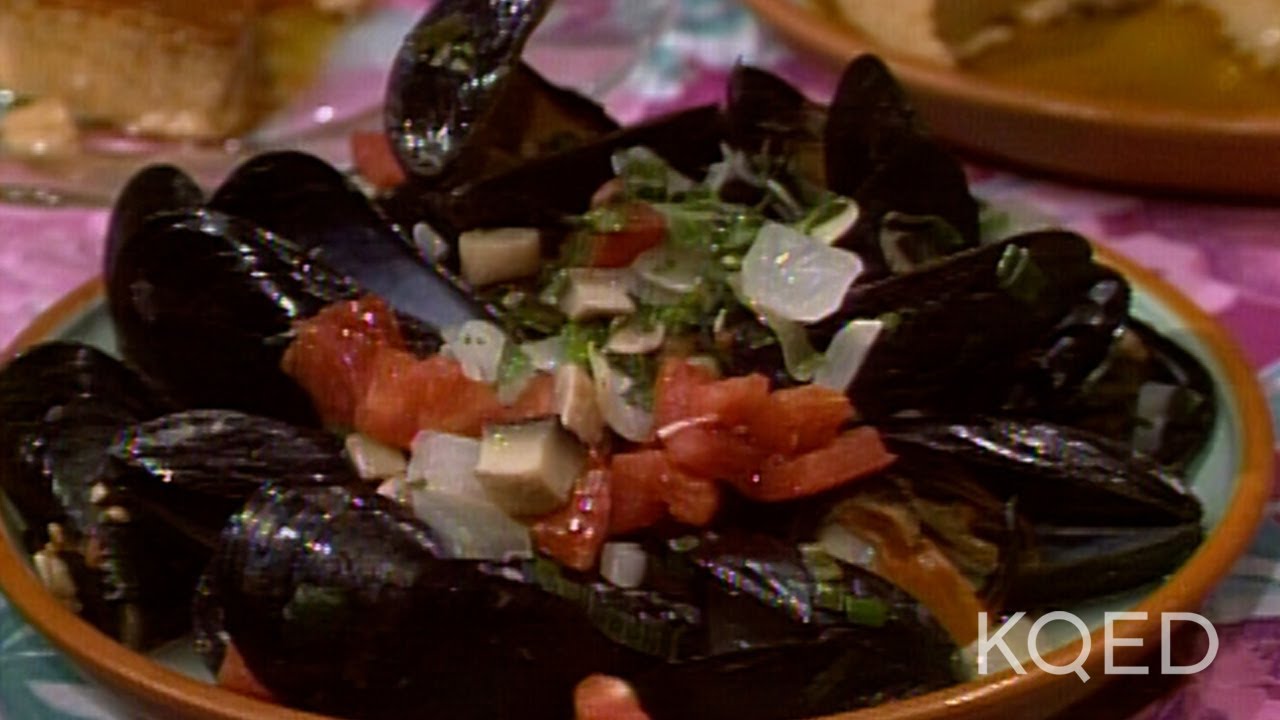
Jacques Pepin walks us through a classic recipe from the French countryside: moules frite, or mussels with french fries. But first, he kicks off the episode with dessert by introducing a rich caramel custard au lait (1:00). Next he demonstrates how he likes to prepare French fries (3:55) for moules frite (10:53). Artichokes stuffed with mushrooms and breadcrumbs make a perfect side dish, rich in potassium. (5:44)
Today’s Gourmet with Jacques Pépin – Full episode
Season 1, Episode 17, 1991. Moule frite
Subscribe to watch a new Jacques Pépin video every Wednesday:
https://www.youtube.com/kqed?sub_conf……
#jacquespepin #moulefrite #mussels #kqed
About Today’s Gourmet with Jacques Pépin:
Today’s Gourmet aired on KQED 9 for 3 seasons, spanning 1991 – 1993. The series showcased Jacques’ culinary techniques, mouthwatering recipes, and his sensibilities as a chef. Episodes include recipes such as gnocchi maison and visits from special guests including the godmother of the organic food movement, Alice Waters.
The Jacques Pépin Foundation is dedicated to enriching lives and strengthening communities through the power of culinary education. https://jp.foundation/
Subscribe to @KQEDFood to watch more food videos.
– What is country French style? Wallpaper, antique furniture, but there is a style of cooking as well. That is eating with your finger, easy type of food that you eat with friends on Sunday afternoon, and this is what we are going to do today. And we start with a classic dessert,
Which is a caramel custard, a creme caramel or cafe with coffee. And we’ve started there to make a caramel for it. And as you can see, here is sugar and water, which is cooking until it reach the caramel phase, which is close to now, as it turn color, caramel indicator color, really.
And this is what we are going to have here. So you cook your caramel into a sauce pan like this. You can actually cook it directly into your oven proof container if it goes on top of the stove. But as it reach the right color here,
This is what you do, you put it in there, which is going to cool up the caramel, and you slush it around so that the bottom of your container is covered with the caramel, that we put here, it has to cool a little bit. And the second part of the recipe,
We’re going to warm up some milk. I have a cup and a half of milk here. And with this, a couple of tablespoons of sugar, don’t put too much sugar. And we are flavoring it with coffee here. So I’m putting about a teaspoon or so of an instant coffee.
Now we use to do those recipe with cream, you know, a lot of cream and a lot of eggs and so forth. We’ve cut down a great deal nowadays. So even though this is a caramel custard, relatively rich, it has only one egg plus one egg yolk,
Or rather one egg plus one egg white. We use only one egg yolk in the recipe for four. So, done with the milk. And this is whole milk. If you use a defatted milk or a lower type of a fat milk, you will even lower your calorie content.
In that case here, we have about 120 calorie per person. One way of separating eggs, you know, you can break your eggs and separate it this way, that you’re sure you have all the egg white in there. Remember that the egg white here is really the albumin, which is going to give you
The coagulating thing that you need. I mix my egg and egg yolk in there. I don’t want that milk to be too hot, you know, just hot enough, actually, to melt that instant coffee. And it’s about enough now. So I’m going to put that in there, mix it well.
Of course if that milk was boiling hot here, you would have problem putting your eggs in it because it would cook the eggs. So make sure the eggs is lukewarm. To be sure that you don’t have any little pieces of eggs on top, we strain that directly on top of the caramel.
And notice here that I use a double mesh type of strainer, thick. And that double mesh strainer is very good to take all the little particle in it. This has to cook in a double boiler that is through the heat transfer of water.
So the protein that is the egg white coagulate, very slowly. If it cook too fast, you’re going to have all kinds of little air bubble around, because it cook too fast, it start expanding. So you want to cook it to a slow transfer. We put that in a 350 degree oven,
And that will cook for about close to an hour. If it goes too fast, the water should not boil around, because if the water boiled around it is going to cook too fast. So make sure the water doesn’t boil. If it start bawling, you can always put
A couple of ice cubes around to lower the temperature of the water. We continue the French style country cooking. It actually Belgium, a great deal, we are doing french fry. And even though the french fry may come from France, in Belgium, this is really the natural dish.
And we are going to cook it later, actually, with mussels, and mussels and french fry is typically Belgium, you know. So we have our potato, so the potato is pilled. I can leave it in water, it won’t discolor it. We cut it into about half-inch slice and across again.
To do you’ll stand out french fry, sometime we call, if we do them smaller in France, we call them (speaks foreign language) matchstick potato, if they’re a bit smaller than that. Then I wash them in water. It takes some of the starch out of it.
And what we do in professional kitchen, we cook those ahead. You know, when you have a restaurant and you serve a lot of french fry, don’t think that the french fries are cooked at the last moment. Because first, if you cook them at the last moment like this, they will be dry,
Dry inside, too crunchy on the outside. What we do, we pre-cook the french fry. And I have a cup and a half of oil here, put that much, and about 330 degree. We’re going to cook those potato in there. So they cook about four, five minutes
Until they are cooked, you know, until they are cooked, but white, still and soft. And this is your first part, you can do that hours ahead, you know. And I have some that I have done here. As you can see, those potato are soft, they are cooked.
Now, soft, but they are not crunchy, they are not crispy, and they are white still. And this is what you do, you cover them, you can do that a few hours ahead. At the last moment, you drop them back into very hot oil, then they crisp, the classic way of doing potato.
And now, are the first course, in our recipe, we’re doing artichokes. So I want to talk to you about artichokes and show you those beautiful green artichoke specimen, artichokes is very good, very high in potassium, you know. You have about a third of your daily requirement in one artichokes low in calorie.
It is about 50 calorie per artichokes. Now the stem like that, we can feel it as I’m doing here, and keep it, you see. Even when we cook a classic artichoke, we take the top off, you have to watch those needle, they are quite of a. So we take the top off.
There is really not much to be used there. And those leave on the outside here, you can trim them this way so that when you grab them to eat them, you don’t puncture your finger, and it look a little better. That artichoke sheer that I am doing,
I will put that in boiling water, put a plate on top of it to push the artichoke so it stay under the water, and boil it for like 25, 30 minutes. And this is the way we cook artichokes. Now, when you want to do artichokes bottom, like I have an artichokes bottom here.
There’s a couple of way of doing it. You take an artichokes that I have here, and I have already started, and you break it, like if you were eating artichokes, and pull it out. You see the part that you eat, stay there. If I break it and pull it down, you see,
That you don’t lose anything really. You have to be careful, if you pull too much, look at this, I’ve taken here that piece, which theoretically, that piece which is edible here, which belong right there, you know? So you have to break it, pull it down, break it, pull it down.
There is another way of doing it that I will show you. When you finish doing that, you cut the top. You can retrieve those leaves from the center, which are kind of tender those here. This, you can cook with your artichokes, and you cook that artichoke.
You can clean it up a little more around if you want with a vegetable peeler. What I do also with another artichoke, this one is nicer. I cut the end of it, and cut it all around with a knife this way, but that you need a little more practice. Cut the center.
Again, this you can keep, you finish trimming it around, and you have an artichokes bottom just like I have here, and I keep the tail. Most of the time the artichokes, after they’ve been in that position, you cook them in water as we are going to do today,
And I have one cooked here, a bit smaller than this one. What you do, you grab the center of it when it’s cooked and you put out the whole center of those leaves like this, you see, this is edible. Now what you’ve done there, you explored the choke inside, and the choke here,
With a spoon, you remove that choke, you know, that’s no good. This is your classic way, you take this, put it back on top of it. You take a little spring of parsley, you take that. And this is your classic artichoke vinaigrette with a light around it.
We don’t do it on this anymore, but maybe a little bit of vinaigrette to put on top and that’s a terrific first course. And now I’m going to finish the artichoke. The artichoke that I show you there. Remember I take the inside out, I take the choke,
And those leaves that I took out of it, very often I will take some part of it, like the bottom part of it, which is standard, and add that to my stuffing along with the tail. I mean, the stem like that, if you cut it, this is perfectly fine.
What we are doing it here, we are mixing that with the stuffing, you know. I have a very simple stuffing here made of chopped onion. You saute a little bit of onion with olive oil, then I put mushroom in it, those little pieces of artichokes and finally breadcrumb.
Don’t get it become too gooey. The breadcrumb should be nice and fluffy. So you cook the breadcrumb a little bit with the onion until the bread fry. And when I talk about breadcrumbs, really, I’m talking about fresh bread. You take a couple of slices of bread, put it in your food processor.
Now notice what I do here. I can put some between the leaves, you know, you finish your stuffing, stuffing it a bit between the leaf and inside. We have a famous dish in France like that called artichoke barigoule. Barigoule is the name of the recipe, nothing special.
Remember that those artichokes are very high in potassium. What we are doing here, putting them into, I have a cup of water here and a little bit of olive oil, and we finishing braising it in that mixture. We have a bit of stuffing, I put it right on top of it here.
Basically by the time we finished cooking, I should have nothing left in that part. So that will cook about 20 minutes. We cover it here and let it cook. Now I’m going to start the mussel. Remember we’re doing a French-Belgium type of country menu. The Belgium use mussel with french fry.
I have four pounds of mussel here, they are all clean. And I will tell you a little more about the mussel later. What I put in those mussel here is some fresh tomato. I put some scallion. I have a lot of different vegetable, I love the color,
As well as the taste of course. I have slice garlic, you know, all clove of garlic slice like this. Of course, onion, a lot of onion here, and mushroom. I have all of that mixture here. And finally, a bit of olive oil on top of it.
I’m putting some white wine in it and Tabasco, the white wine will of course mixed with the juice of the mussel and create it’s own sauce. A bit of Tabasco, if you like it hot, you can put the jalapeno papers or one of those. I like the Tabasco.
You wanna toss your mussel a little bit. This way, cover it and start cooking. Actually, when they are cooking, you wanna toss them a couple of times, you can bring that across, hold this with your thumb and toss the mussel this way, you know, that’s a good way of doing it.
So this has to cook a good five minutes. During that time, we want to finish our french fry. Now the oil is very hot and those pre-cooked french fried as you saw before. Where they go into that oil again. Now the oil is about 400 degree now,
You don’t want to go too high with the oil either because you don’t want to burn the oil, you know. We use the polyunsaturated type of oil here, which can withstand high temperature like safflower oil, peanut oil is a beat heavy but safflower
Would be very good or calendula oil would be very good too. I wanna discuss mussel with you a little more. Now you see that mussel here, there is a beard attached to it here. Usually they are quite clean. Remember that you have to buy your mussel in a reputable place.
Don’t go and mussel yourself because a lot of places are polluted now. So in that reputable place, you have your mussel, which are basically clean now. They grew on the wire suspended in water. Yet we put out that beard. In Greece, you know, they take that beard and it to do glove.
They give that from daughter to father and so forth, father to son rather. And they use that to go fishing, the knife doesn’t go through it. Remember that when you see one of those opened, like this one is open, it really doesn’t necessarily mean that it’s bad.
Look, if I touch that mussel inside, I touch the mussel here. I touch the inside and I see that mussel is closing. So it’s just opening to breathe and to get water, it doesn’t really necessarily mean that it’s bad. Otherwise, if it smells strong, if it’s happened,
Then discard it, but touch it a little bit inside to know whether it is alive or it is just, this one I think is dead, I would discard it, you know. So this is important. Now those mussels are relatively inexpensive, and they are very good in the protein and all that.
So they are nice things to do. Now, let’s see our french fry are practically ready now. As you can see, they’re nice and brown and crisp, they will cook very fast there, like a minute or so. The real french fry now. And I was saying, when you go to Belgium,
They eat french fries every day or potato in one form or another. When I go to front of mine which are Belgium, whatever the menu is, there is potato in it. They will tell you about the menu, but is always potato included. Remember also that in Belgium,
We can put a little bit of a salt on top of this, in Belgium, the mussel as I did it is a bit different because they don’t really put, they don’t put all of the tomato and stuff that I put in it. Usually they put celery and onion.
Now, I have my artichokes here. which are about finished, so we’re going to serve our artichokes. Now you can see our beautiful artichokes here. I’ll take a little bit of the juice oil there, you’ll see that I put around. If you see this one, I reduce a little too much, you know,
You could always add two or three tablespoons of water that I could have done on top, that on top, and that set. You eat that like lukewarm, you know, now I’m going to try the french fries. Now I have my french fries, nice and crisp here, you see.
And what we have done in those french fry, and I know that there is a lot of calorie in french fry. Remember, I started those french fries and I measure one and a half tablespoon of oil that I add in there, one and a half cup of oil, rather,
Not tablespoon, that I had to start with. I cook those mussel the first, I cooked those french fry the first time, I refry them the second time, then I measure the oil that I use, and I actually add a cup and a quarter of oil leftover. Meaning that in my recipe there,
I use four tablespoon of oil, which is for four people. So it ended up being one tablespoon of oil per person, which is relatively little. I mean, if those potato, I had done a potato salad with it, I would use at least the same amount of oil or more,
And so even in a green salad also. So we can dish out, this is sailor’s style, you know, so very often, sometime if you want it a bit more fancy, you open the oyster, disregard that part and just serve that half shell. With sailor’s style, we serve the whole thing together,
Juice and all, you know, in that way. There’s a lot of juice in the bottom here, and you have big portion of mussel here, you eat a lot of this. You know, there is a way of eating it also, in the country very often you may take one empty thing
Like this, and you use that actually to pick up your mussel out of it, use that as a spoon if you want or other fork to get it out. So I have my mussel ready here, maybe a little bit of herb, fresh herb on top of it.
And this is the whole menu that we have today. You know mussel are not that common or that a familiar to many people in the country, because even though they are high in protein, very nutritious, you don’t get them all over the country.
But I want to show you a couple of other dish that I do with mussel, which are terrific. One of it which is very classic is the soup, you know. We call it the Billi bi, and it’s really done with the stock.
As you see, there’s already a lot of stock coming out of it. And you can reduce that, bind it with a little bit of cream if you want. And you do, this is a very, very good stock, maybe the best stock that you can have to do other type of fish soup also.
Another thing too, we serve the mussel like this, the whole mussel, sometime in what we call a type of vinaigrette, you know, and the vinegar, a type of dressing, you know, with a lot of onion, vinegar and so forth. And for that very often, we take that strip around here,
Which is the pan, really of the mussel, which tends to be a bit elastic and strong. I mean, most of the time I don’t remove it, but if you do, a very elegant soup, that’s another thing that you can do. And more often than not, those mussel have served on the half shell
Like that, just blanche. And now they say, when you do this, you keep the juice to be your soup. Then you take your mussel this way, you arrange them and you can inside those mussel, if they are small, you can put two, you know,
And you do them just like we do snail in France, (speaking foreign language) you know, that we call a snail. And by putting a little mixture of herbs on top of it and fresh breadcrumb, and this is what you can do very easily if you have a small food processor.
Fresh breadcrumb, makes a big difference on the fresh breadcrumb to the dry one. So I put a little bit of fresh breadcrumb here. I can put some parsley in it. You know, this is flat parsley, but you can have another type of verb if you want, directly with it.
And maybe a clove of garlic, you know. Put all of these together. This is really what we call a snail butter. We use this to butter. Now we use much less butter than we’re used to. But as you can see, that makes a terrific mixture. Actually that mixture here, a fresh breadcrumb with the herb like this, you can use that on a roast of lamb, on a rack of lamb and all that, it’s classic. That often when you put it on lamb,
These may dry out on top of this too, so what you do, you moisten it with a little bit of oil. Not much, just enough so that the oil, I mean, the breadcrumb doesn’t get gooey. But as you can see, it’s still say quite fluffy here,
But enough so that it brown nicely on top. And that’s what you fill up on top of your mussel. Sometime I like on top of that even to put a little bit of Tabasco. Now, you can prepare that way ahead, you know, and after you’ve prepared it ahead, keep in the refrigerator.
By the time you serve, you put that on the boiler for a couple of minutes, it get beautifully crisp, and you have another terrific dish with mussel. The caramel custard is really a real French country dessert. Remember, I put it in the oven, tell you it will take like 45 minutes to an hour depending on the thickness and the type of material you put it in. Now, when it comes out, this is the way it should look like.
You can see it is shaking a little bit. It seemed that soft shaking, but it is cook. You can check it by putting a knife into it. If it comes out completely clean here, the eggs are set. So this is what you do. But of course at that point, this has to rest.
You can even do it overnight. Often that type of dessert is done overnight. And I have one here which has been setting up overnight. Then what you do here, you run your knife around. As you see, I hold my knife steady and really pull the mold around rather than the opposite.
Then put it on the plate, this is now the time you start praying and unmold it. Here as it comes, we have caramel. And as I told you before, you know, if it’s over cooked, which is what happened to mine, the water must have boiled in the oven.
I have those little dots here, which handy kit expansion, it start expanding, the protein develop a little bit, but I’ll show you the center and you’ll see that in the center it is nice and smooth. See the center is just holding enough, and that’s what you want.
As you see, we just have one egg in there. Remember, plus one egg yolk, and now natural caramel, caramel saucer on. Sometime in restaurant, you know, they sponge out that type of sauce, do another type of caramel, thicker that you flavored with rum or cognac or a bit of vanilla
And serve it this way. So we are going to bring that to our meal, to have the whole meal together now. We put that here and recap a little bit what we did today, what we cook today. We had, remember, the stuffed artichokes here. I also have the plant artichokes, you know,
With the little thing put back on top of it. This is the plant artichoke which is 50 calorie. Of course, the stuffed artichokes is going to be more caloric with the bread and a little bit of olive oil, but it’s still quite nice.
You can see we have used no butter here in any of the dish. I have the mussel, mussel rather, French style if you want, with all kinds of vegetable, mushroom around, tomato and so forth. Finally, our french fry. And remember, the french fry, the way we did them there,
We used one tablespoon of oil per portion of french fry, because we started with one and a half cup of oil, we finished with one and a quarter for four portion, which is four tablespoon. And done this way with french fry will be about 275 calories, which is not that much.
Finally, the caramel custard here done with one egg and one egg yolk for four will be about 120 calories, so that quite a low calorie type of dessert, or we always have a nice salad with it, add fiber, add color to the dish. And maybe with this, a nice glass of Beaujolais.
This is a Gamay Beaujolais from the Napa Valley, which I love, it’s nice and very live with a strong taste of berry. I think it would go very well with it. I hope you’re going to do our Belgium French country meal and enjoy it as much as I’ve enjoyed preparing it for you
Happy cooking. (upbeat music)
28 Comments
Wow. There was a lot of useful info packed into that 24 1/2 minutes. He doesn't waste his or our time teaching, that's for sure.👍
Belgian « French » fries should be from the Bintje kind, and MUST be cooked twice (you’ve got it right) in BEEF grease, not vegetable oil, you iconoclast! Belgian mussels comes mainly from Zeeland, witch is in nearby Netherlands because we do not have enough coast in Belgium to have enough local production. France has very delicious « moules de bouchots » which are quite smaller but admittedly more tasty. Oh, and btw, I’m Belgian, born and living in Brussels.
These videos are an absolute goldmine for learning, a masterclass every single video. Thank you for uploading
I was hoping he was going to show us how to make the Billy B
Watching him handle those hot things by hand….he has no feeling left in his fingers.
OMG reminds me of home
He stuck his finger in the oil. That had to hurt ..
Best chef ever
Lost count of how many times he put his asbestos fingertips into boiling oil or some other hot thing. I have learned so much from him, truly such an amazing teacher and chef 🙂
Are you supposed to put your finger in boiling oil?
Yikes, you have changed so much!!! Tristesse!! Well, you are so far from your grand roots, the marriage, time….. Many reasons, but I wish w all my heart you could find in your heart to return.
God bless J first chef to freely admit hes mistakes , LOVE
People always comeback to classic
Master Pepin always ahead of his time! What a genius!
no matter how many times i watch i still dont understand how an artichoke works lmao.
Great chef but he always mis speaks its so annoying 🙄
Bonjour Jacques, I appreciate the artichoke recipes. I live near Castroville Ca. the artichoke capital of the world. Do you have any recipes for baby artichokes?
Back in the day they didn't care if you overcooked the dessert on TV. They aired it anyway.
I love ur kitchen nd the paintings nd ur unique recipes.Evrything has a wow factor. I hope u have written a cookbook as well which i need the most.
I love the sound of muscle shells clanking together.
France basically stole all of their dishes from belgium
The master at work
Love this menu!❤
love it!!!!!
Mussels and French Fries. Yum
I lived in Brussels for 5 years. Really enjoyed the food and the beer! One of my favorites was pomme fritz with a heafty serving of beef carbonnade on top with andalouse sauce on the side. What's not to like–beef and potatos right? A second was moules vin blanc.
I’ve been a chef for over 35 years and I’m still learning from Jacques
Not a one of my friends cook for me I cook not even a piece of toast to my friends make and f*** the I'll go to a greasy spoon or a diner or restaurant yeah not one of my friends cook for me