
More Aviation Icons @
THE CONCORDE STORY
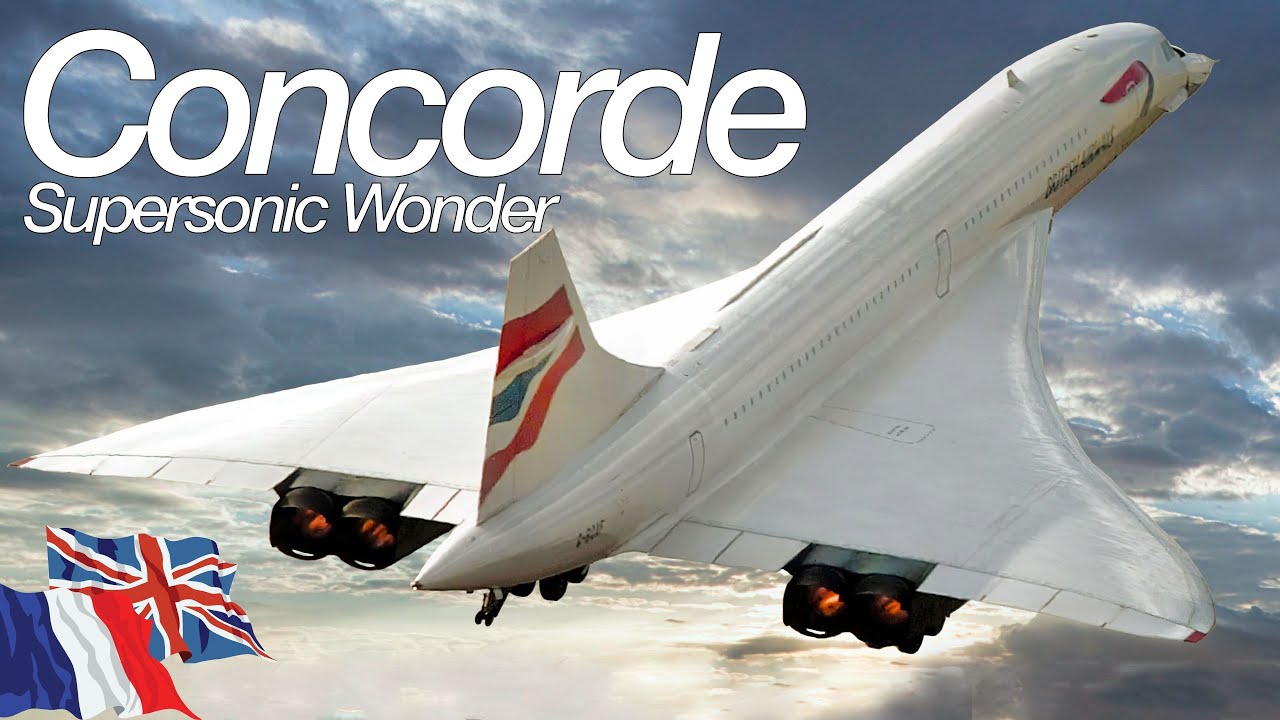
The Concorde made by a joint venture between Aérospatiale and BAC was a turbojet-powered supersonic passenger airliner, a supersonic transport (SST). It was the result of the English and French government’s joint venture, combining the manufacturing efforts of Aérospatiale and the British Aircraft Corporation. First flown in 1969, Concorde entered service in 1976 and continued commercial flights for 27 years.until catastrophic accident, caused by a Continental flight losing a piece on the runway that ruptured the Concorde’s fuel tank.
Among other destinations, Concorde flew regular transatlantic flights from London Heathrow (British Airways) and Paris-Charles de Gaulle Airport (Air France) to New York JFK, profitably flying these routes at record speeds, in less than half the time of other airliners.
With only 20 aircraft built, their development represented a substantial economic loss, in addition to which Air France and British Airways were subsidised by their governments to buy them. It retired as a result of the only crash on 25 July 2000 and economic factors on 26 November 2003.
The aircraft is regarded by many as an aviation icon.
Concorde won the 2006 Great British Design Quest organized by the BBC and the Design Museum, beating other well-known designs such as the BMC Mini, the miniskirt, the Jaguar E-Type, the London Tube map and the Supermarine Spitfire. The type was retired in 2003, three years after the crash of Air France Flight 4590, in which all passengers and crew were killed. The general downturn in the commercial aviation industry after the September 11 attacks in 2001 and the end of maintenance support for Concorde by Airbus.
The origins of the Concorde project date to the early 1950s, when Arnold Hall, director of the Royal Aircraft Establishment (RAE), asked Morien Morgan to form a committee to study the supersonic transport (SST) concept. The group met for the first time in February 1954 and delivered their first report in April 1955.
At the time it was known that the drag at supersonic speeds was strongly related to the span of the wing. This led to the use of short-span, thin trapezoidal wings such as those seen on the control surfaces of many missiles, or in aircraft such as the Lockheed F-104 Starfighter or the Avro 730 that the team studied. The team outlined a baseline configuration that resembled an enlarged Avro 730.
This same short span produced very little lift at low speed, which resulted in extremely long take-off runs and frighteningly high landing speeds. In an SST design, this would have required enormous engine power to lift off from existing runways, and to provide the fuel needed, “some horribly large aeroplanes” resulted. Based on this, the group considered the concept of an SST infeasible, and instead suggested continued low-level studies into supersonic aerodynamics.
Soon after, Johanna Weber and Dietrich Küchemann at the RAE published a series of reports on a new wing planform, known in the UK as the “slender delta” concept. The team, including Eric Maskell whose report “Flow Separation in Three Dimensions” contributed to an understanding of the physical nature of separated flow, worked with the fact that delta wings can produce strong vortices on their upper surfaces at high angles of attack. The vortex will lower the air pressure and cause lift to be greatly increased. This effect had been noticed earlier, notably by Chuck Yeager in the Convair XF-92, but its qualities had not been fully appreciated.
Tech specs:
Crew: 3 (2 Pilots and a flight engineer)
Capacity: 92–120 passengers
(128 in high-density layout)[N 9]
Length: 202 ft 4 in (61.66 m)
Wingspan: 84 ft 0 in (25.6 m)
Height: 40 ft 0 in (12.2 m)
Fuselage internal length: 129 ft 0 in (39.32 m)
Fuselage width: maximum of 9 ft 5 in (2.87 m) external 8 ft 7 in (2.62 m) internal
Fuselage height: maximum of 10 ft 10 in (3.30 m) external 6 ft 5 in (1.96 m) internal)
Wing area: 3,856 ft2 (358.25 m2)
Empty weight: 173,500 lb (78,700 kg)
Useful load: 245,000 lb (111,130 kg)
Powerplant: 4 × Rolls-Royce/SNECMA Olympus 593 Mk 610 afterburning turbojets
Dry thrust: 32,000 lbf (140 kN) each
Thrust with afterburner: 38,050 lbf (169 kN) each
Maximum fuel load: 210,940 lb (95,680 kg)
Maximum taxiing weight: 412,000 lb (187,000 kg)
Performance
Maximum speed: Mach 2.04 (≈1,354 mph, 2,179 km/h, 1,176 knots) at cruise altitude
Cruise speed: Mach 2.02 (≈1,340 mph, 2,158 km/h, 1,164 knots) at cruise altitude
Range: 3,900 nmi (4,488.04 mi, 7,222.8 km)
Service ceiling: 60,000 ft (18,300 m)
Rate of climb: 5,000 ft/min (25.41 m/s)
lift-to-drag: Low speed– 3.94, Approach– 4.35, 250 kn, 10,000 ft– 9.27, Mach 0.94– 11.47, Mach 2.04– 7.14
Fuel consumption: 46.85 lb/mi (13.2 kg/km) operating for maximum range
Thrust/weight: 0.373
Maximum nose tip temperature: 260 °F (127 °C)
Runway requirement (with maximum load): 3,600 m (11,800 ft)