
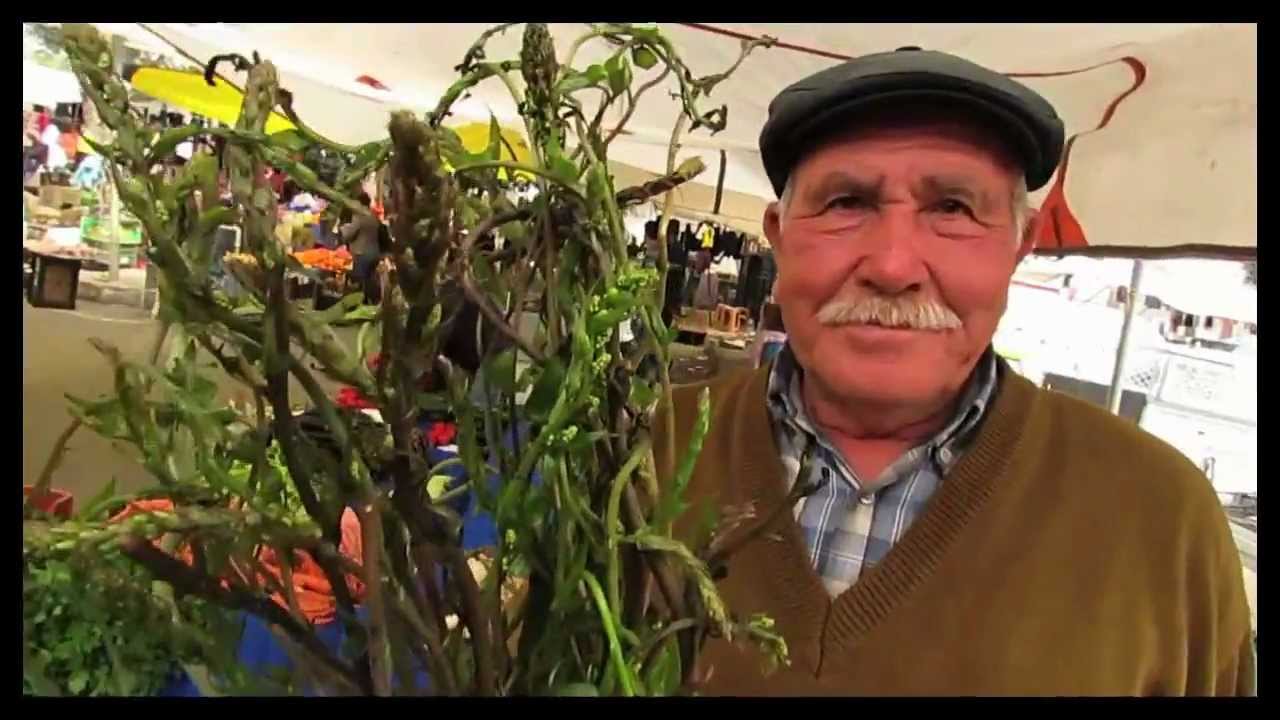
This is really the real thing and a excellent food for so many reasons. Currently know in season and the season only lasts a few weeks.
Asparagus is a herbaceous, perennial plant growing to 100–150 centimetres (39–59 in) tall, with stout stems with much-branched feathery foliage. The “leaves” are in fact needle-like cladodes (modified stems) in the axils of scale leaves; they are 6–32 mm (0.24–1.3 in) long and 1 mm (0.039 in) broad, and clustered 4–15 together. The root system is adventitious and the root type is fasciculated. The flowers are bell-shaped, greenish-white to yellowish, 4.5–6.5 mm (0.18–0.26 in) long, with six tepals partially fused together at the base; they are produced singly or in clusters of two or three in the junctions of the branchlets. It is usually dioecious, with male and female flowers on separate plants, but sometimes hermaphrodite flowers are found. The fruit is a small red berry 6–10 mm diameter, which is poisonous to humans.[5]
Plants native to the western coasts of Europe (from northern Spain north to Ireland, Great Britain, and northwest Germany) are treated as Asparagus officinalis subsp. prostratus (Dumort.) Corb., distinguished by its low-growing, often prostrate stems growing to only 30–70 cm (12–28 in) high, and shorter cladodes 2–18 mm (0.079–0.71 in) long.[2][6] It is treated as a distinct species, Asparagus prostratus Dumort, by some authors.[7][8] A remarkable adaptation is the edible asparagus, while in the Macaronesian Islands several species, (A. umbellatus, A. scoparius, etc.), are preserved the original form, a leafy vine; in the Mediterranean, the asparagus genus has evolved into thorny species.
[edit]History
Asparagus has been used as a vegetable and medicine, owing to its delicate flavour, diuretic properties, and more. It is pictured as an offering on an Egyptian frieze dating to 3000 BC. Still in ancient times, it was known in Syria and in Spain. Greeks and Romans ate it fresh when in season and dried the vegetable for use in winter; Romans would even freeze it high in the Alps, for the Feast of Epicurus. Emperor Augustus reserved the “Asparagus Fleet” for hauling the vegetable, and coined the expression “faster than cooking asparagus” for quick action.[Note 1][9][10] A recipe for cooking asparagus is in the oldest surviving book of recipes, Apicius’s third-century AD De re coquinaria, Book III.
The ancient Greek physician Galen (prominent among the Romans) mentioned asparagus as a beneficial herb during the second century AD, but after the Roman empire ended, asparagus drew little medieval attention.[11][Note 2] until al-Nafzawi’s The Perfumed Garden. That piece of writing celebrates its (scientifically unconfirmed) aphrodisiacal power, a supposed virtue that the Indian Ananga Ranga attributes to “special phosphorus elements” that also counteract fatigue. By 1469, asparagus was cultivated in French monasteries. Asparagus appears to have been hardly noticed in England until 1538,[Note 2] and in Germany until 1542.[10]