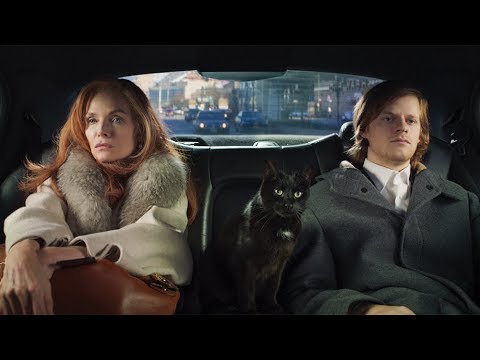
Frances Price married well, if one’s notion of success in that department is defined more by financial comfort than by romance. Her marriage wasn’t so much loveless as moneyful, and that arguably works out better for the wealthy Manhattan wife Michelle Pfeiffer so memorably embodies in Azazel Jacobs’ “French Exit,” a sophisticated closing night choice for this year’s virtual-hybrid New York Film Festival, which “The Sisters Brothers” author Patrick deWitt adapted from his own novel. After the death of her husband — whose corpse she left to rot for several days, giving herself time to take a short ski vacation in Vail, before reporting it to the authorities — Frances pulled her son, Malcolm, out of boarding school, drove him home in her silver Rolls-Royce, and decided to express an interest in his life. “Did you drink to the brink of sound reasoning?” she queries her son (now a sullen young man played by Lucas Hedges) a dozen years later, lobbing the question over breakfast in a formal dining room large enough for at least 10 guests. “Menstruating?” she asks when he fails to offer much of a reply. That afternoon, Frances’ accountant arrives with bad news: It seems she has exhausted her inheritance. Naturally, she has no plan. “My plan was to die before the money ran out,” Frances says with a nihilistic sigh. “But I kept and keep not dying.” In circles like Frances’, people talk in euphemisms and hypocrisy. Her husband’s death was “untimely,” but in a way, Frances’ is more so in that it hasn’t come soon enough. She has outlived her means, and now she must sell her things and take her cash and her son and her cat to Paris, where one of her few true friends has offered her the use of an apartment. (The cat, whom they’ve named Small Frank, may or may not be possessed by Frances’ late husband.) If this all sounds too far removed from the reality most of us experience, don’t let that discourage you. Yes, “French Exit” blisters amid the rarefied air of Tom Wolfe or Whit Stillman, but it’s nicely cut with the schadenfreude of “Schitt’s Creek.” Frances is nothing if not a perfect Dorothy Parker character, and in Pfeiffer’s hands — or her clutches, we might say — privilege has seldom seemed so delectable, even as it attempts to make some necessary economies. That means no driver, no maid, no bottomless stock of Champagne. Just imagine the humiliation of having to move to Paris, now that Manhattan has become untenable! Surely there exists a more serious way to confront the Prices’ situation, but Jacobs and deWitt wisely opt for wry satire instead, delivering to Pfeiffer the role she’s been lacking all these years: not quite a diva, but an elegant, entitled and wickedly articulate socialite. We caught a glimpse of it in “Murder on the Orient Express,” and saw more concentrated camp showcases from her in both “Stardust” and “Batman Returns.” But here’s a character who’s at once larger than life and undeniably, recognizably real, and it’s the way Pfei