
Join Spanish Steps, as we follow in the footsteps of the first non-Spanish pilgrim, the 10th century Bishop of Le Puy, Godescalc, along the Via Podiensis from Le Puy en Velay to Roncesvalles in Spain. We break this celebrated trail into three 2-week sections but for the first time ever, to celebrate the Holy Year of Saint James, we are offering the chance to walk the entire way. EFI. Come walk with us from the headwaters of the mighty Loire, deep in the Auvergne, to the frontier mountain range of the Pyrenees and into Spain, as we reveal the legends of this century trodden path. Bon Chemin!
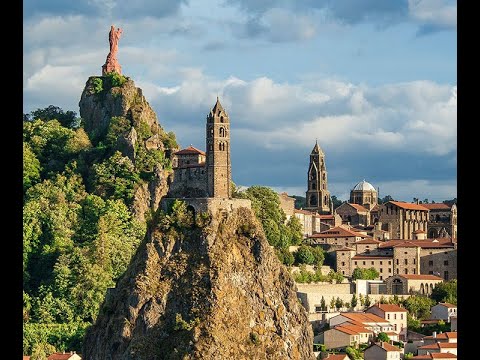
Le Puy en Velay to Figeac: Lying in the volcanic heart of the Auvergne, the curious setting of Le Puy makes for a dramatic start. Rising from a fertile and green basin, are three volcanic ‘pugs’ of rock upon which are sited important religious edifices, most notably the Chapel of Saint-Michel d’Aiguilhe and the Black Madonna. From here, over the past 1000 years, pilgrims from the eastern parts of Europe officially began their pilgrimage. Our trail takes us through dense pine forests and through the striking Allier gorge. Let us tell you of the clock that strikes twice each hour in Saugues, the perched castles, the gastronomic splendor of mouth-watering lamb, black truffles, the evolving saffron industry, local specialties of aligot and estofinado, wines from the steepest vineyards in France and legends of Saints and miracles, as we tread our ‘way’ along this glorious stretch of the Chemin de St Jacques.
The dramatic landscapes of the volcanic Aubrac, wild, green mountain plateau – remote, pristine and timeless with a luminous and endless skyscape – offers us the chance to truly lose ourselves (metaphorically only of course!), as we step away from everything. Except for cows! This stretch is one of the most peaceful and empty all the way to Santiago. Upon leaving the high plateau, the gentle charm of the Lot river valley awaits us. The longest river in southwest France, it winds for almost 300 miles, a ribbon of jade, or sapphire, meandering through ever-changing landscapes. We wend our way through a delightful array of stone villages dotting riversides, hilltops, and cliffs. The stretch of the Chemin between Saint-Côme-d’Olt and Estaing in the upper valley, the Pays d’Olt (the Lot’s original Celtic name), is a UNESCO World Heritage site. One of the great highlights of Part 1 is arriving into the magical medieval town of Conques, also UNESCO, famed for its association with the miracles of St Foy and herein lie her relics bringing thousands of faithful every year, to this hidden gem of a town.
The first part of this journey ends in Figeac, a town deeply rooted in the pilgrim’s way. By the 13th century, four different orders had established monasteries here which in turn became pilgrim hospices, one of which still runs today as the local hospital. It is also the birthplace of Jean François Champollion, the first translator of Egyptian hieroglyphics and a replica of the Rosetta Stone is here to honor him, as is a museum dedicated to his life.