
TIMING: After the presentation of the whisky, the tasting starts at 5’15
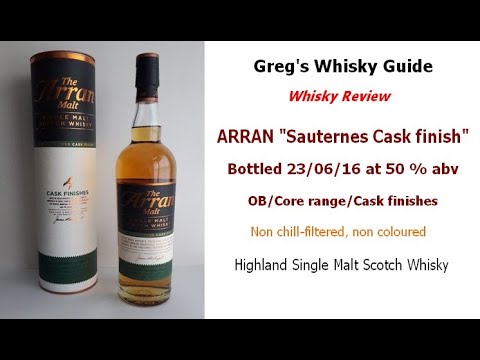
I am tasting today an official release of the ARRAN « SAUTERNES CASK FINISH », a Highland Scotch Single Malt from the Isle of Arran bottled in 2018. As usually in the « Cask Finishes » subrange within ARRAN’s core range, there is no age statement (my guess ? Around 8 years old), no chill filtered whisky, with no caramel colouring as well & it is bottled at 50 % abv. This one is finished in « Sauternes » casks, a French sweet wine from the Bordeaux (West Coast) area & a subregion called « Sauternais » (« Graves » section), is usually drunk with dessert but also enjoyable with French end of the year merrymaking starter « foie-gras » (goose liver), or, a more recent trend, with seafood (crustacean or scallop).
The « Sauternes » sweet wine (when following the letter « e », we don’t spell the last letter « s », it is muted, so the word is spelled « Sautairn » in English), is made from several grape varieties (Sémillon, Sauvignon blanc, Muscadelle B type), and obtained by the effect on the grapes of « Botrytis cinerea », also known as « noble rot », (overriped grape, but in fact it is a mushroom that grows on the grape), which gives this wine notes of heady flowers, very fruity candid fruit, rich honey & citrus fruit. It is one of the most sugary French wines (45 g/liter). The most famous Sauternes known worldwide is the « Château d’Yquem », a « Premier Cru Supérieur » estate, in the official 1855 Bordeaux wines classification, but whiles vintages quality can vary, some old bottlings are much sought after by collectors (jumping over 1000 € for some post-World War II vintages). More affordable, there are other sweet wines from neighbouring areas with an almost similar aromatic profile worth trying in my opinion, such as Montbazillac, Cadillac, or (my favorite) Loupiac.
The DISTILLERY: The ARRAN distillery was founded in 1993 (& distilled for the first time in 1995) by the Isle of Arran Distillers Ltd (initiated by Harold Currie, former manager director of Chivas Brothers, who wished to create a Speyside character single malt) in the Isle of Arran (an island at the South-West of Glasgow & facing the Campbeltown peninsula), in Lochranza, in the North part of the island. ARRAN has a 1,2 million L.P.A. production. ARRAN first distillery is equipped with a 2,5 ton semi-lauter mash tun, 6 Oregon pine washbacks & 4 stills. The first ARRAN single malt (a 3 yo) appeared in 1998 & the distillery launched its first 10 y.o. in 2006, a 12 yo Cask Strength in 2008 & a 14 yo in 2010 (both now discontinued), while their first peated whisky, using mainland peat, appeared in 2009. Previously, aside from a young « non chill-filtered » n.a.s. single malt, but also several more generic references such as the « Robert Burns » & released many vintage single casks with lots of different finishes. In 2019, a big rebranding of ARRAN single malts started, to be finished only in 2020, when the « Cask finishes » series will be also revamped. For now, the core range consists in a 10 yo, a 18 & a 21 yo, but also 3 n.a.s. (but around 7 yo) whiskies, the « Barrel Reserve » (at 43%), the « Quarter Cask /The Bothy » bottled at 56,2 % (new version of « The Bothy ») & the « Sherry Cask /The Bodega » bottled at 55,8 %. Current peated versions of ARRAN named « Machrie Moor » (one at 46 % & one at Cask Strength) will be rebranded soon (see below). The Isle of Arran receives around 400 000 visitors each year, and by far the ARRAN distillery is the most visited Scotland whisky distillery, with 100 000 visitors per year. The distillery owners hope to double this number in the near future with the opening of the new distillery :
The Northern ARRAN distillery is nowadays the only whisky distillery in the island, but since 2017 (and March 2019 for the first distillation there), another distillery from same ownership opened in the South part of the Island, where a distillery was operating until its closing in 1837. The owners of the first distillery decided the construction of this second distillery with another name (LAGG distillery) & destination in order to separate the peated version of their single malt from the unpeated ones that will be produced exclusively produced in the northern Lochranza distillery. They also wanted to devote part of the LAGG distillery production to do some experiments. The heavily peated whiskies (around 50 ppm) produced at LAGG should be sourcing peat locally in the future, but for now it is still mainland peat that is used (peated malted barley comes from the Aberdeenshire area). LAGG is using a 4 ton full-lauter tun, a 20000 liters Douglas fir washback, two big stills (or 10 000 liters of capacity) & racked & palettised warehouses.
Thanks for watching & if you like the video, please click the like button & subscribe to my channel if not already done & also to click on the notification bell to stay tuned about my next videos & live streams.