
📘 Discover my first book:
👉 Top 99 Most Planted Wine Grapes in the World
🔗 https://www.amazon.com/dp/B0GC5KRHGF
In Vivianne’s journey through wine regions, this book is the perfect companion — a guide to the grapes that shape global wine culture. From classics like Cabernet Sauvignon to hidden gems planted in remote corners of the world, it’s a beautifully structured reference for anyone who loves wine, storytelling, and terroir.
🍇 Explore. Learn. Taste the world.
History of Alsace
Alsace is a borderland, a region shaped by centuries of shifting identities between France and Germany. Its vineyards trace back to Roman times, but its cultural duality has given it a unique voice in the world of wine.
Monks cultivated its slopes in the Middle Ages, and by the Renaissance, Alsace wines were celebrated across Europe for their purity and fragrance. Wars and annexations left their mark, but the vineyards endured, carrying both French elegance and German precision.
Today, Alsace stands as a bridge between cultures, producing wines that are unmistakably its own—aromatic, crystalline, and deeply expressive of terroir.
2. Subregions, Styles, Soils, Grapes, and Appellations
Grapes and Styles
Alsace is a region defined by clarity. Here, the tradition is to vinify grapes in their purest form, single‑varietal, unadorned, each allowed to speak with its own voice. The result is a chorus of whites, each distinct, each crystalline, each a reflection of soil and slope.
Riesling is the benchmark. Dry, racy, mineral, it carries notes of citrus and stone, a wine of precision that cuts like light through glass. It is Alsace’s most disciplined voice, a model of purity.
Gewurztraminer is the opposite—exotic, perfumed, flamboyant. Lychee, rose, spice, and richness pour from the glass. It is Alsace’s most dramatic expression, a wine that refuses to whisper.
Pinot Gris brings texture and smoke, capable of both dry restraint and off‑dry generosity. It is layered, complex, a wine that moves between austerity and opulence with ease.
Muscat is delicate, floral, fragrant—a whisper of spring, a fleeting bouquet carried on the wind.
Sylvaner is fresh and light, approachable, the everyday companion of Alsace. It may not seek grandeur, but it offers honesty, simplicity, and charm.
Pinot Blanc is versatile, often blended, often sparkling, a quiet backbone that supports others while rarely demanding the spotlight.
And then there is Pinot Noir, the region’s only significant red. Once modest, now increasingly important as climate shifts, it yields wines of elegance and lift—light, fragrant, and quietly promising a new chapter for Alsace.
Terroir
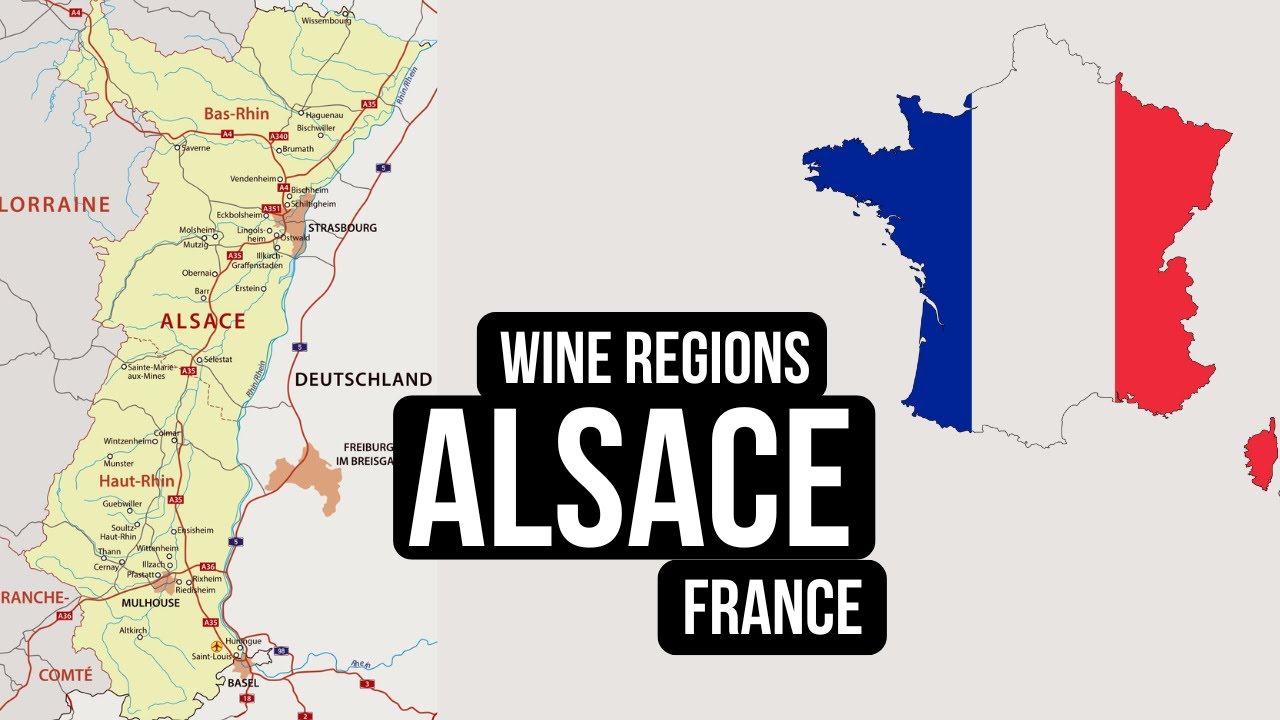
The vineyards of Alsace lie in a narrow ribbon along the eastern slopes of the Vosges Mountains, shielded from rain by their protective shadow.
This geography creates one of France’s driest wine regions, where sunlight lingers and grapes ripen with clarity. Beneath the vines, the soils are a mosaic—granite, limestone, clay, schist, volcanic rock—each parcel shaping the grape differently.
It is this patchwork of geology that gives Alsace its kaleidoscope of styles, wines that are transparent reflections of place.
Appellations
Alsace’s identity is safeguarded by its appellations.
The Alsace AOC covers most still wines, proudly labeled by grape variety—a rarity in France, but a tradition born of Germanic influence.
At the pinnacle stand the Alsace Grand Crus, fifty‑one classified sites where terroir speaks with precision, often through Riesling, Gewurztraminer, Pinot Gris, or Muscat.
And then there is Crémant d’Alsace, sparkling wines crafted in the traditional method, crisp and lively, among France’s most celebrated bubbles outside Champagne.
3. Laws and Classifications
In Alsace, the AOC system emphasizes varietal labeling, rare in France. A bottle of Riesling or Gewurztraminer speaks directly of its grape, a tradition influenced by Germanic heritage.
The Grand Cru system, established in 1975 and expanded since, highlights the finest terroirs, each vineyard named and regulated.
Unlike Bordeaux’s hierarchies or Burgundy’s climats, Alsace’s classifications focus on purity of site and grape. This clarity has made Alsace a reference point for varietal expression worldwide.”
Alsace is a region of contrasts: French in elegance, German in precision, yet entirely unique in voice. Its wines are aromatic and crystalline, each grape speaking clearly of soil and slope.
Riesling’s racy minerality, Gewurztraminer’s exotic perfume, Pinot Gris’s smoky richness, and Crémant’s lively sparkle together form a tapestry unlike any other in France.
To taste Alsace is to taste transparency itself—a region where wine is not adorned, but revealed, a pure echo of land and culture.
#wineeducation
#winelover
#winetasting
#winetime
#viral
#viralvideo
#crushedandcorked
#subscribe
#fyp
#foryoupage
#winelover