
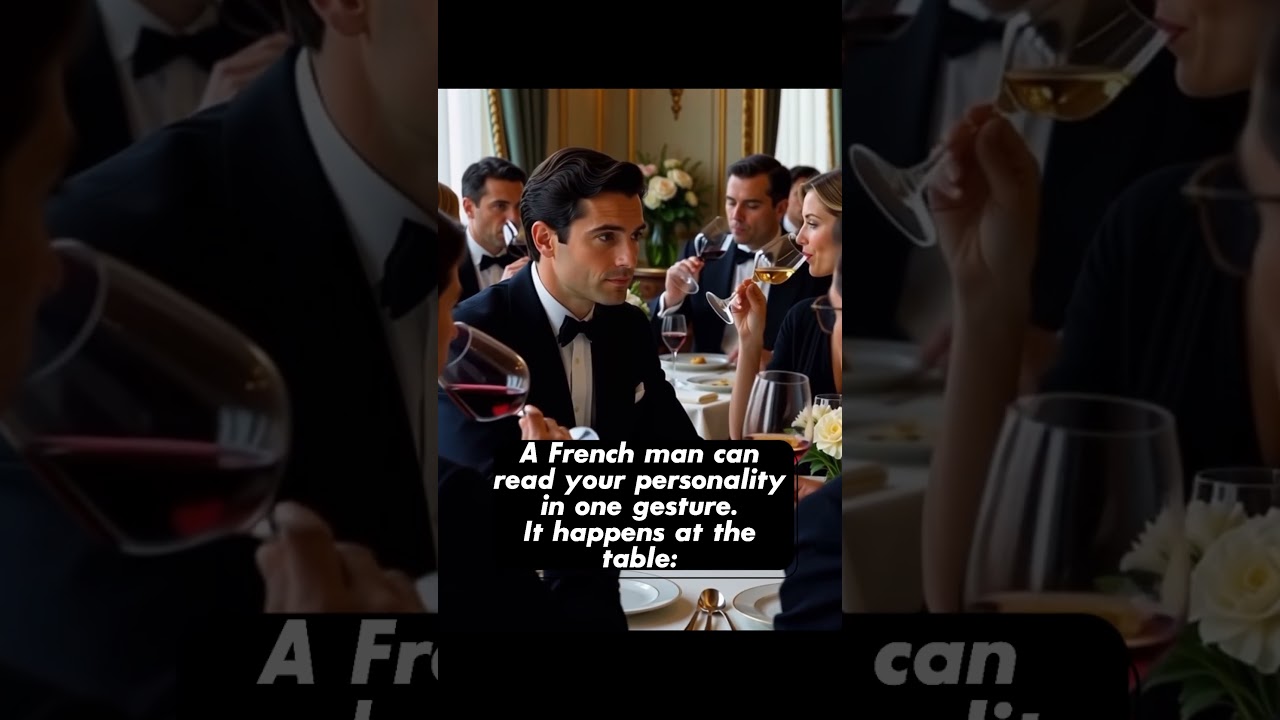
French elegance isn’t about fashion or accent.
It’s revealed in one small movement.
In France, first impressions are rarely formed by what you say. They are formed by how you handle ordinary things. A door. A chair. A fork. And, most revealing of all, a wine glass.
A French man may learn more about you from this gesture than from an entire conversation.
If you grip the glass like a tool—tight fingers, firm wrist, utilitarian hold—he quietly categorizes you as practical. You value function over ritual. You are here to drink, not to perform. Reliable, perhaps. Predictable. Someone who solves problems rather than creates atmosphere.
If you cradle the glass loosely, almost protectively, as if it contains something private rather than liquid, a different assumption forms. This posture signals awareness. Sensitivity. Someone who understands subtext. In French social logic, this can read as intriguing—or dangerous. You notice more than you say. You may not reveal your intentions easily.
If you swirl the glass excessively, lifting it often, watching the legs, repeating the motion without necessity, another conclusion emerges. You are trying too hard. Performing knowledge rather than possessing it. In French culture, excess demonstration signals insecurity. True confidence does not need rehearsal.
None of this is written. No one will explain it to you. But it operates continuously.
French social perception is rooted in economy of gesture. Doing only what is necessary. Allowing form to arise naturally from function. When movements are restrained and unforced, they suggest internal order. When movements are exaggerated, they suggest compensation.
This is why subtlety carries so much weight. How you hold a glass reflects how you hold yourself. Whether you impose on objects or adapt to them. Whether you rush to display identity or allow it to be inferred.
The judgment is not moral. It is observational.
In French culture, elegance is not decoration. It is control without rigidity. Ease without sloppiness. The wine glass becomes a proxy for this balance. A small test of embodied awareness.
You are not being judged for the drink.
You are being read for your relationship to attention.
Do you dominate the moment? Do you disappear into it? Or do you move within it naturally, without announcing yourself?
The French understand something many cultures overlook: identity leaks through micro-actions. Not through declarations, but through how the body treats what it touches.
So when you lift a glass in France, it is never just a toast.
It is a sentence.
And you are writing it without words.
2 Comments
Oui,right !
Interesting