
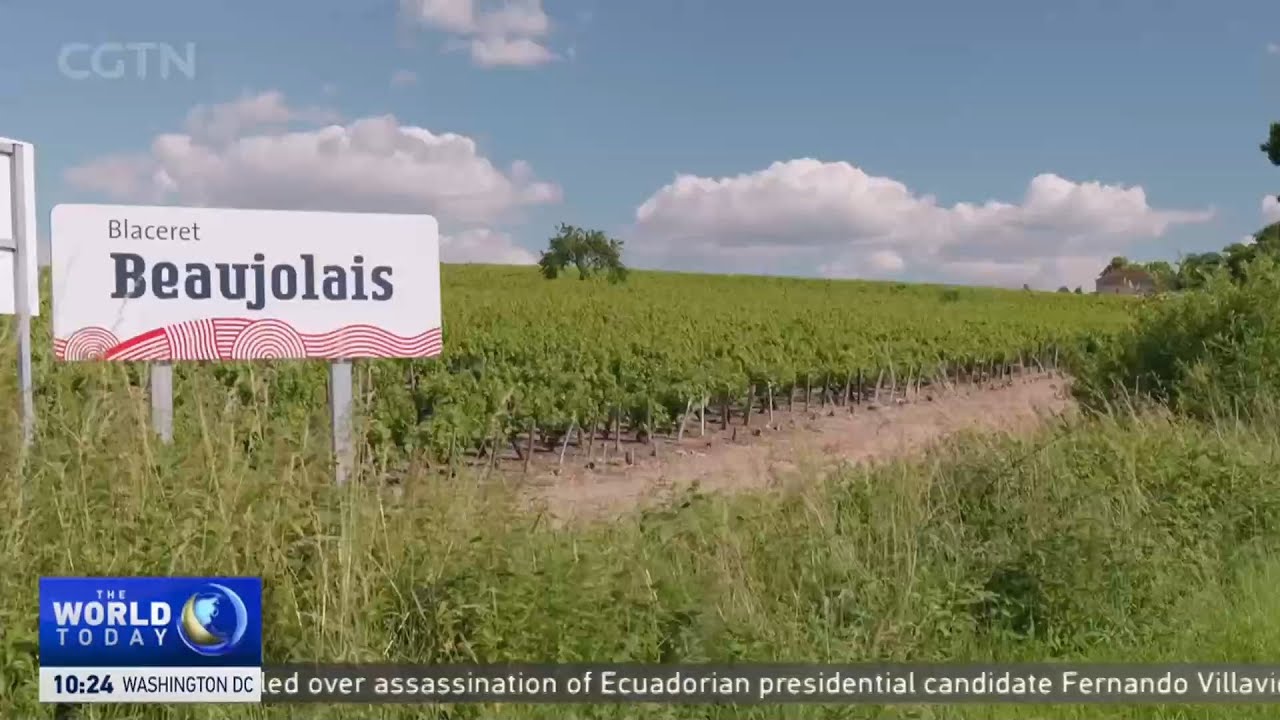
In the Beaujolais region in France, where vineyards stretch thousands of hectares, climate change is hitting French farmers hard.
High temperatures and unpredictable weather patterns are challenging the traditional practices of viticulture. But the farmers are not standing idle. Kamuran Samar reports.
#wine #vineyards #france #farming
Jean Pierre Rivier witnessed the first effects of climate change on his Vineyards 20 years ago the buds on the vines burst earlier than usual fooled by a warm spell in March the yield that year was poor and the quality of the grape suffered the French farmer hoped it was a one-off but it has become almost an annual occurrence in 2003 we were especially disturbed because we didn’t really understand I mean we thought it was an exceptional event determined to save his Vineyard he inherited from his father jeanpier is adapting to the challenges posed by climate change through Innovative and sustainable practices and experimenting with new techniques we are working mainly on modifying the height of vegetation at our research organization we’re also working on all the root stocks we’re very hopeful because the vine is a grafted plant the above ground part is European plants and the underground part is American plants which have been grafted precisely to resist felox since around 1870 we’re working on these different families to find root stocks that are more resistant to Drought because they’re able to develop strong roots and go deep underground to find moisture and be less sensitive to Drought the wine makers are contending with a range of obstacles as well as carefully managing water it’s also critical to ensure the grapes do not ripen too early early before the vines have been able to convert the bright Mediterranean Sunshine into sugars despite his International reputation Bo remains relatively affordable compared with France’s other traditional Powerhouse wine regions and so it has emerged as a place of experimentation where new techniques can be tested David ratinier vice president of the boj villages says Farmers efforts are already starting to bear fruit our soils are very poor so we’ve added a lot of organic matter to increase water storage in the soil in summer so it works his confidence is borne out of the numbers France reclaimed the title of the world’s largest wine producing country in 2023 after a 9-year Hiatus according to the international organization of wine production report grapes have been cultivated in fields in this area for 2,000 years and the wine industry is much more than just a business here so farmers like Rivier are determined to fight on against climate change to preserve the lifeblood of their land Kamar and Samar for cgtn in boo
2 Comments
Quotes from the UN's IPCC AR6 WG1:
Flooding –
“the assessment of observed trends in the magnitude of runoff, streamflow, and flooding remains challenging, due to the spatial heterogeneity of the signal and to multiple drivers”
"Confidence about peak flow trends over past decades on a global scale is low."
"In summary there is low confidence in the human influence on the changes in high river flows on the global scale. Confidence is in general low in attributing changes in the probability or magnitude of flood events to human influence"
So in absence of detected trends, there won’t be much ability to attribute to humans. You can't say floods are caused by, driven by, or intensified by climate change. The evidence doesn’t support that.
Drought –
"There is low confidence that human influence has affected trends in meteorological droughts in most regions"
So no real evidence we changed the weather to cause periods of dryness.
Tropical Cyclones (TC) –
"Identifying past trends in TC remains a challenge…There is low confidence in most reported long-term (multidecadal to centennial) trends in TC frequency – or intensity based metrics"
So we can't spot a trend and therefore we can't really attribute that unknown trend to us humans.
Storminess – outside the tropics (ETCs) –
"There is overall low confidence is recent changes in the total number of ETCs over both hemispheres"
"Overall there is low confidence in past-century trends in the number and intensity of the strongest ETCs"
So we don't know what's happening with winter storms, so we can't say it's us that changed them.
Tornadoes, hail, lightning, thunderstorms, extreme winds –
"It is not straightforward to make a synthesizing view of trends in severe connective storms [thunderstorms] in different regions. In particular, observational trends in tornadoes, hail and lightning associated with severe connective storms are not robustly detected"
"the observed intensity of extreme winds is becoming less severe in lower to mid latitudes"
That's between 60°N and 60°S, so pretty much where everyone lives.
And this year….they have more rain than they need