
Every little bit helps. Please consider supporting the work of this channel with a donation.
https://www.patreon.com/OBSESSEDWITHCINEMA
https://www.paypal.com/donate/?hosted_button_id=UE98FPDD2YEKY
https://ko-fi.com/obsessedwithcinema
Now with enhanced closed captioning (cc).
Warning: Spoilers
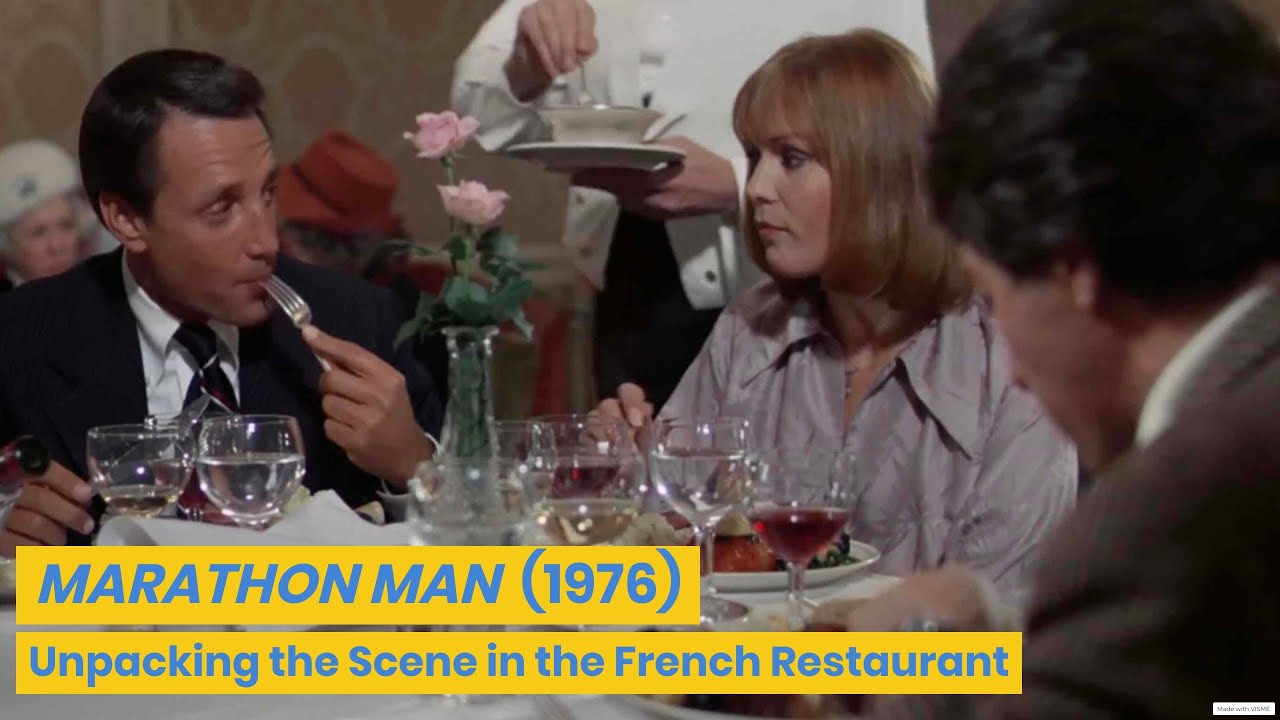
Since childhood, John Schlesinger’s 1976 film, Marathon Man has intrigued me. I found one scene particularly curious. The French restaurant section of Marathon Man remains as memorable and entertaining and fun today as it was in 1976. In a film overflowing with unusual and indelible scenes, the conversation in the French restaurant is sometimes overlooked, though it is indispensable to revealing the closeness of the relationship between Doc and Babe and thus understanding the significance of what happens next. Doc, Babe’s older brother, is a kind of wish fulfillment, a brother who truly wants to look out for his younger sibling. When Doc, a covert operative for the government, learns that his brother Babe has become involved with a mysterious European beauty, he suspects that something is amiss. Doc invites Babe and Elsa out for lunch at a three star Manhattan restaurant and utilizing his tradecraft, he begins unravelling Elsa’ story. At a minimum, Doc reveals that Elsa has an agenda of her own. Doc is truly concerned for his younger brother and needs him to grasp that Elsa is trouble. I have reflected back on this scene–which is only three minutes and 24 seconds in duration–many, many times throughout my life. I decided to make this video as a love letter to the French restaurant scene, the place where Babe’s real education about life begins. I wanted to post this video many months before it was actually posted, but I was prevented from doing so by unfair and downright plodding and idiotic copyright claims by the studio. It was frustrating and especially ironic, since I hoped that this video (which deals with only one scene after all) might prompt people to watch or rewatch this timeless film. I hope that people find my take on the French restaurant to be instructive or at least entertaining. Please consider subscribing to this channel, so that I can continue to make videos like this one, whether the studio approves or not. Also, I welcome any comments you might have.
#marathonman #williamgoldman #dustinhoffman
Would you like me to help you? No, I, I can do it, Fine, thank you very much. What a klutz. What? How could you forget a tie? I didn’t forget. Who wears a tie when they eat lunch? John Schlesinger’s Marathon Man is a fascinating film consisting of many diverse and entertaining scenes. I first saw this film in a theatre as a ten year old and it made an immediate impression on me. There were seemingly endless numbers of interesting things going on, and truly diverse characters to meet. There was a suave secret agent, a dangerous assassin, a Nazi war criminal, a demanding university professor in a graduate seminar, antique shops, fine dining and luxury hotel rooms in Paris and a particularly alluring and mysterious foreign girlfriend. For a kid from a small town, this was a truly irresistible film. It does have a confused and confusing and complex opening fifteen minutes, probably needlessly so, but the film really delivers after that. It takes the viewers to great cities and it brings all these different people together. It is worth noting that the film was largely ignored at the 49th Academy Wwards in 1977: one nomination, but in fairness, it was an exceptionally tough year. Some of the other movies nominated in the various categories included Network, Rocky, Carrie, Taxi Driver, Bound for Glory, A Star is Born and All the President’s Men. In a bizarre twist of fate, the writer of Marathon Man, William Goldman, actually did win the Academy Award that year for Best Adapted Screenplay, but not for his adaptation of Marathon Man from his novel. Instead, Goldman won for All the President’s Men, adapted from Woodward and Bernstein’s book. Marathon Man is filled to bursting with great individual performances…acting from Lawrence Olivier, Dustin Hoffman, Roy Scheider and William Devane, and with great off-camera people as well…the director is John Schlesinger, cinematography from Conrad Hall and editing from Jim Clark. All three are in fact Academy Award winners, though of course not for Marathon Man. I think what really grabbed me the most from this film was a loving relationship between Babe Levy, played by Dustin Hoffman and his older brother, Doc Levy (Roy Scheider). We see this in the scene where Doc surprises Babe by showing up in the middle of the night, to Babe’s rather sad apartment (Doc calls it an armpit) and despite terrifying Babe out of his wits, we can see that they are genuinely happy to be together. They roughhouse around…they seem almost like truly best friends more than brothers. Doc may be in Manhattan for other reasons, but he is still concerned for Babe’s happiness and safety. In any case, Marathon Man is a movie with many memorable scenes: there is the nearly silent hotel room fight scene between Doc and Chen, a world-class assassin; there is the most famous scene in the film where Babe is tortured by the Nazi dentist Dr. Christian Szell and is asked over and over, "Is it safe?" when in reality Babe has no idea what is going on (it creates tension and humour simultaneously); there’s also this scene where Szell has it out with Peter Janeway (played by William Devane). As far as we’re concerned, Mr. Szell, you’re a relic and you’re on your way. Thus far, I find you rather detestable. May I say that without hurting your feelings? Praise from Caesar. There is the scene in the graduate seminar, when Professor Biesenthal quotes Tennyson and only Babe knows the answer to the question, yet he does not want to embarrass the other students. There is the scene where men invade Babe’s apartment and abduct him for interrogation. There is the scene where Babe escapes and runs for his life through New York City late at night and memorably, but unsuccessfully, tries to flag down an ambulance. After getting away, he is forced to trade his Rolex, a gift from his brother Doc, for a handful of change from the taxi driver to make a phone call. Here’s a dime, man. Here’s some more change. There’s also the scene in the diamond district, when Szell is recognized by a survivor. My god, he away. Yet despite the presence of all this truly memorable hyperbolic stuff and I should add "Praise from Caesar" is especially great…I still don’t know how that one never caught on. But anyway, there is one particular scene from halfway through the film that is truly pivotal to appreciating Marathon Man, and it remains as quirky, fascinating and watchable today, as it was back in 1976. It is, in fact, the lunch scene in which Roy Scheider’s character, Doc takes Babe (Dustin Hoffman) and Babe’s new Swiss girlfriend, Elsa (played by Marta Keller) out for a fabulously expensive and delicious lunch at a French restaurant. In the novel, it is Lutèce. At first, I was unsure why I liked this short scene so much and why I always came back to it. Answering that question is what motivated me to make this video. I wanted to explain why I believe the scene matters and what it means, both in the context of the film but also in the real world, because there’s something universal going on here. It is hard to know exactly where to start unpacking this. So many things are happening simultaneously. It all starts off humorously, with Babe asking Doc when he last used the New York City subway system. 1962 is Doc’s answer. We see a nice repartee between the brothers. What a klutz. What? How could you forget a tie? I didn’t forget. Who wears a tie when they eat lunch? Well, at least his fly is buttoned. And there’s something particularly unique about when your brother or sister finally meets your new partner, especially when it’s someone like Doc, who would probably seem impressive in any environment in which he moves. He is in extraordinary physical condition and wears only the finest clothing. He truly is Babe’s opposite in every way. Soon after the scene begins, we can see Doc get down to work. He uses his brother as a foil, ridiculing Babe’s lack of sophistication, for example at not wearing or perhaps not even owning a tie and intimating that Babe would be infinitely more at home in a McDonald’s than in an elegant French restaurant. In the novel, and perhaps the movie, also, Babe initially believes that Doc is somehow hitting on Elsa, but the viewer sees that Doc is doing something else entirely at this point in the action…no one knows less of what is actually happening than Babe. He truly is a "babe," surrounded by dangers that he cannot imagine. Doc is immediately leery about Elsa, since she seems too sophisticated and too beautiful to be with someone like Babe, and also perhaps a little too old to be a student at Columbia. Doc is immediately looking to get to the truth of Elsa. Who is she? What is she after? Is she really who she says she is? Touching her hand seems to be a way of disrupting her rhythm, of putting her off her game and perhaps putting her on notice, to a degree, as if to say I’m on to you. There is a certain screenwriting genius at work here: William Goldman creates a character who’s nearly superhuman. Doc can out think, out fight and out charm anyone, and in all scenarios. He’s always one step ahead. In any other film, Doc would have had to have been the protagonist. He’s simply too interesting not to be. Yet here, it is infinitely more fascinating to see him as the protector, the secret agent using his tradecraft to look out for his younger, naïve brother. Ultimately, Doc is trying to evaluate if Elsa Opal poses a threat to either Babe or himself. For the first time, the viewer can see that several of the intertwining plots are converging, at least in Doc’s mind. No one can really put one over on him. He’s figuring things out. It is truly genius having him as the supporting character, rather than the main character. It seemed to me that this scene could not possibly be just a one-off personal association for me alone. It had to be more…by having Doc acting as Babe’s protector, William Goldman is tapping into something universal, that many people have a fantasy that their older sibling could really and truly look out after them throughout their lives, truly protect them when they needed it. We see this in the scene just prior to the French restaurant, when Doc invites Babe to live with him in Washington and attend Georgetown University. It feels like an offer so sincere and flattering that it would be hard for anyone to turn down, though Babe does. Doc is a kind of wish fulfillment fantasy. He is Doc, the sophisticated wealthy, well-dressed brother, when he socializes with Babe, but at other times, as when he’s fighting for his life against Chen in the hotel room, he is Scylla, the ruthless, dangerous secret agent. In the first half of the film, we see people continuously trying to kill Doc and failing. Even the bomb in the baby carriage somehow misses him. At a certain point, after ordering the wine, he cryptically speaks to Elsa with a sentence that sounds a lot like a code phrase. "You know the great chablis of the world are almost always green eyed. In fact, they’re the ones that most resemble diamonds. This serves as a kind of shot across the bow. Doc has already reasoned that Elsa might be working for Christian Szell. Later, she admits that she is a courier for his money. Near the climax of the film, Babe asks if she was Szell’s lover, but she denies it. By this point, however, it is not clear that anything she says is trustworthy. Doc uses a particularly clever maneuver to get Elsa to reveal herself. He takes what little she’s given him and then kind of turns it upside down, by introducing two new facts into the equation. Doc starts by admitting that he does not know Switzerland too well, and then enquires where Elsa is from. She answers Verbier. Verbier? Oh, I don’t believe it. What? There’s this guy that works in my office, a ski bum, a real pain in the ass about skiing… excuse me..but he’s always going on about Verbier. From here, it’s off to the races. Doc casually inquires whether Elsa knows the local ski instructor in Verbier, Claude Laseur, and whether Verbier sits at the foot of Mount Rosa. When she says "Yes," he’s got her. I’ve made all this up. There is no Mount Rosa in Verbier, and there is no Claude Leseur. You’re not Swiss. What are you? After as good as conceding that she has lied about being Swiss, Elsa tries to lead the discussion off in a different direction. Why don’t you ask me if I care for him? Why bother? You haven’t told the truth so far. But why don’t you ask me if I love him? Why don’t you… Doc’s instant answer to her angry query: "Why don’t you ask me if i care for him?" is almost the equal of Peter Janeways’ "Praise from Caesar" line. "Why bother?" Doc says, "you haven’t told the truth so far." It really is an incredibly memorable line. The scene is so ‘actorly’ and ‘writerly’ as to nearly take your breath away. We now know that Elsa is up to something. It must have been really fun for the actors in the scene. Though very short in duration, each of their characters is being revealed by the second. For the first time, Doc has really shown Babe a new gear, how incisive he can be, perhaps something Babe has never seen Doc do previously, and Doc, for his part, has revealed (perhaps inadvertently) part of his Scylla persona, if only for a second. Babe still… even by the end of the scene…can’t quite grasp why Doc did this, nor it’s significance vis-a-vis Elsa’s ongoing credibility. For her part, Elsa runs out, exposed as a liar, but still keeping Doc guessing ultimately about whether she’s connected to Christian Szell, though of course he must now suspect this is a possibility. Getting away from Doc’s prying eyes is Elsa’s only possible protection against his instinctive bullshit detector. In the very next scene, Doc is killed by Christian Szell, thereby creating an entirely new complication in the plot. To see this supporting character, who cannot be defeated, undone by the likes of Szell, is an utter tragedy, especially because we now know that Babe is truly alone in the world. He no longer has a brother to protect him and he will soon realize that Elsa is little more than a hired hand. Everything was an illusion. Of course, Babe is ill-equipped to take on Christian Szell, who is particularly amoral and cruel. With the death of his brother-protector, Babe cannot conceive of how dangerous his situation has now become, though he is about to find out. The point at which his true education begins is not in professor Biesenthal’s graduate seminar, but rather during the fateful lunch he has with Elsa and Doc. Perhaps it is inadvertent, but Doc lets Babe begin to see that Elsa’s love was an illusion. This must hurt, of course, but it’s Doc’s last gift to Babe. It helps Babe begin the process of learning how he must ultimately turn the tables on Peter Janeway and Christian Szell, if only to protect himself. Again, the lunch scene is pivotal. After the lunch, and then Doc’s murder, Babe begins the process of actually learning to proactively protect his own interests, seeing the world going forward for much more of what it actually is. Thank you for watching my take on the lunch scene from Marathon Man. Please feel free to like and subscribe.
27 Comments
I watched it when I was quite young and remember the opening car chase scene seeming to go on for ever and getting really tiresome. But the rest of the film was exciting. I've re-watched it as an adult and can better appreciate the subtext and war references. Good review, mate.
Wow. Movies have gotten really really really dumb.
"IS IT SAFE"
I enjoyed your critique, this has always been one of my favorite films and now I appreciate it even more.
Lutece is a white linen restaurant here in New York, USA. Its famous for once having had not just one ex-US President but three dine there in the space of one afternoon! According to a close family friend who dines at places like it the correct pronunciation is "Lou – Tess".
Everything about Doc's murder was troubling. Being stabbed in the stomach by someone he hates, still alive hiding in the closet bleeding to death and finally pale faced as he dies on his brother's apartment floor. Bothered me in 1977 at age nine and still bothers me today. It's a movie that you don't really enjoy, more like a movie you watch and just try and survive through, exhausted, like you just ran a long marathon.
Excellent
Great movie. Great explanation.
Very interesting!
Great analysis. Loved the film when I was an adolescent. Then read the book. The book is even better than the movie. BTW, this film sadly only had one Oscar nomination. Epic film.
Great scene, agree.
It seems that the film shows that wars never end or at least not when people think they do.
It seems that the film shows that wars never end or at least not when people think they do.
Hoffman's student klutziness, Scheider's urbaneness, his subtle examination of Keller…they don't make'em like this anymore. The first fifteen minutes relates the Nazis hiding in America (unfortunately still very much present) and kicks off Olivier's reason for arrival.
on my favorite movies list.
I forgot Fritz Weaver was in this.
Although I saw it long time ago, like you, probably only 10, I remember the other movies then: Taxi Driver, Network, and so on.
Goldman wrote a gonzo sequel novel to “Marathon Man” which reveals that Doc hadn’t died after all. He spends some time on a deserted island getting his mojo back for his next assignment, something to do with exploding child robots, which is all I remember about it.
Great analysis.
I was 16 when this terrific film came out, and was blown away by it. What suspense!
Had to read the book shortly thereafter…
What an incredible film.
I saw this when it first came out and have always had a problem at the Dentists' Office, since. One of the most powerful scenes I ever saw. Obvi.
In the book both the Devane and Schieder characters are gay and lovers
Amazing movie¡¡
I enjoyed listening to this take on this film.
is it safe. TY
Saw this movie by accident on tv. Was one of the best surprises ever. Great movie
Pretty racey film for a 10-year old to watch.