
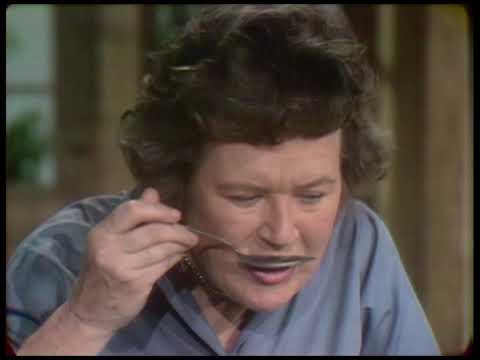
Julia Child shows you how to take advantage of beef specials — turning them, with the addition of a little red wine, mushrooms and onions, into the most famous of all beef stews.
About the French Chef:
Cooking legend and cultural icon Julia Child, along with her pioneering public television series from the 1960s, The French Chef, introduced French cuisine to American kitchens. In her signature passionate way, Julia forever changed the way we cook, eat and think about food.
About Julia Child on PBS:
Spark some culinary inspiration by revisiting Julia Child’s groundbreaking cooking series, including The French Chef, Baking with Julia, Julia Child: Cooking with Master Chefs and much more. These episodes are filled with classic French dishes, curious retro recipes, talented guest chefs, bloopers, and Julia’s signature wit and kitchen wisdom. Discover for yourself how this beloved cultural icon introduced Americans to French cuisine, and how her light-hearted approach to cooking forever changed how we prepare, eat and think about food. Bon appétit!
— Managed by PBS Distribution
Get More Julia Child on PBS:
Twitter: https://twitter.com/pbsdistribution
Facebook: https://www.facebook.com/PBSDistribution.org
-Big chunks of beef and onions and mushrooms in a rich, meaty red-wine sauce — this is really the stew of stews, boeuf bourguignon, today on "The French Chef." ♪♪ ♪♪ -"The French Chef" is made possible by a grant from the Polaroid Corporation. ♪♪ -Welcome to "The French Chef." I’m Julia Child. This is probably the most famous stew in all the world. This is boeuf bourguignon, and it’s deservedly famous because it’s really about the best stew that you could ever possibly make, but it’s really — As you’ll see, it is a basic type of stew, and once you know how to make this marvelous dish, you’ll know how to make any stew, and they’ll all be very good because, well, a stew is not difficult to make, as you will see, but there is just something special about the bourguignon. And one thing that I think stews are terribly important for everyone to know about because in these days of high prices, this is where you can use inexpensive meat, and the Europeans are marvelous at this, particularly the French. And they make the most savory dishes out of the most really plain cuts of meat. And for a stew, I like to have big, chunky pieces like that because they shrink up a bit when you cook, and these are about — I’d say that’s about 2 1/2 or 3 inches long and about 2 inches high and 2 inches deep, but they’re nice, big pieces. And when I went to the supermarket the other day and I looked in the counter for stew meat, that’s what I found, these little, nasty pieces, and you don’t know where it comes from on the animal. And it’s too small, and it looks like cat food. And I don’t like it, so I decided the best thing to do was to buy a big pot roast and cut up the stew myself. So I got a piece of chuck, and the chuck, as you know, is the beef’s shoulder. It includes the neck and the arm, and then it includes back here down to the first five ribs. And there’s a lot of very good meat in it, and in the supermarket, half the time, if you buy something that’s called a chuck roast, it has all kinds of different pieces of meat and separations in it, and it’s a very good thing to cut it up yourself. And then you can use the nice, big pieces for the stew, and any little pieces that you don’t want to save for cat food, you can grind up and use as hamburger. I think I better put on my glasses so I can really see here. But as you notice, the meat has seams. See? There are flaps and seams and things like that, and I like to separate. You just go right down the seams, and then you get solid pieces of meat, and they’re not going to separate as you cook them. See? Now that is pretty well separated into various flaps. Then you have this part here of the chuck which has larger pieces, and by doing this, cutting it up yourself, you get all the extra fat off because I think they always leave as much fat as they possibly can on so that they can charge more. That’s not a nice thing to say, but it does happen, I think. Then you want about 1/2 a pound a person, I think. Now see there. You got a nice piece, and you can just cut that up and have nice, big pieces of meat for your stew. And for six people, I think you need, oh, 4 to 5 — I mean, 3-1/2 to 4 pounds, and then you’ll have really plenty of meat. Then in French stews, you always start out with what is known as lardons, which are little pieces of pork fat that look like this, and you get a piece of bacon. I’m going to show you how to do it. You can leave out this pork fat if you want, and you cut off the rind. And that you’re going to save, and then you cut the bacon into slices about 1/4 of an inch thick, and then you cut the slices across, making little pieces that are about 1/4 of an inch by an inch to an inch and a half. You can use salt pork, but I like bacon much better because I think the quality of the bacon is usually better than the quality of salt pork. It somehow is fresher than the salt pork. Heaven knows how long it has been sitting around, and if you’re living in an area where you can get fresh, unsalted, unsmoked pig’s — What do you call it — Hog belly, that is the — Then, that is the best thing to use, and that is what they use in France. But I’m assuming that you haven’t gotten fresh hog belly and have to use bacon. You have to refreshen the bacon so as to get all the smoky taste out, and to do that, you take the bacon, and you put it into 2 quarts of water and you simmer it for 10 minutes, and then you drain it. And you do that so that you can get all of the bacon-y taste out. If you didn’t, your whole stew would taste of bacon rather than of beef. When you take it out of your water, and you’ve also blanched the rind because you’re going to use that, as well, and then you sauté it to render the oil, and then the oil is what you’re going to brown your beef in, so that’s a very French type of thing. And then, you also… These little bits of bacon also flavor the stew, and you want about 1 cup of these. And after they’re sautéed, they will look just like that. Out of the way. So you’ve rendered out the oil. Then… …you put it into a pan to drain out the oil, and then you put your oil back into your pan, and then you’re ready to brown your meat, which I have over here. And now you want to be sure that your oil is hot and that your meat is dry, so while you’re heating up your oil, you dry off the meat. And this is terribly important. I will say this every time we do kind of a sauté or browning, but be sure that the oil is hot and be sure that the meat is dry and be sure that you don’t crowd the pan. And if you do that, then you’ll always have nicely browned meat, and if you don’t, the meat won’t brown and it’ll just steam, and that means that if you have lots of meat to sauté like this, you have to do it in batches. I’m using one of these no-stick pans. Then after it’s browned, it’s going to go into the — Each piece is browned, it’s going to go into the casserole, and then you add another one. I’m really doing mostly a token here so that you get the idea. See that this meat is brown. In it goes to the casserole. Another one, oh, goes into the casserole, and then add the fresh meat to the pan. Not with a paper towel. [ Pan sizzling ] As you notice in most French stews, they do not flour the meat. They sauté it dry and naked because it really gives it a better taste. If you do flour it, of course it makes it easier to brown, but you find that after the stew has stewed — And very often it’s called a ragout, in that case, as the meat is floured — you really don’t get all of the oil out of the sauce, so it’s rather fatty. So after your meat has all been browned and you put it into the casserole, remember this will take you about 10 to 15 minutes, not go as fast as I do. You want to deglaze the pan. Pour out any fat, and then deglaze the pan with a little red wine or with a little bouillon or even a little water, and that goes into your casserole. And this preliminary of sautéing the meat first is what I think you have to be the most careful of and do with the most — It’s going to take you probably the longest time of all of the stew. You can brown it ahead of time if you want, but be sure that you brown it nicely. Remember that I’m only doing a token, and this meat is not brown as it should be. When it really is brown, it is a little bit firm, and it’s the browning first that makes the difference between just a plain, ordinary stew and a bourguignon. Then after your meat is brown in the casserole, this is a red-wine sauce. You want about 3 cups of good red wine. I’m using a good California Mountain Red. That’s about 3 cups in there, and then I want to have some meat stock, and if you have saved the bowls, you can boil them up and — Oh, look at all those bones there in that lovely, rich brown stock, and you need just about enough stock, probably about 2 cups for this amount of meat so that the meat is covered, what they call [Speaks French]. And really, the better the stock, the better your stew is going to be. You can use canned beef bouillon if you wish, and then this should come up to the simmer. And you will also add seasonings to it at this point, and these will be — This is going to be the pork. That’s that blanched pork rind. This is something that will also add a little bit of character to the sauce. Pork rind and knuckle bones give a gelatin quality. We want a nice, big imported bay leaf, and we want some thyme. That’s about a good teaspoon of thyme. This has a good hearty flavor to it. You can put another piece of dried orange peel or a little bit of bottle-dried orange, which gives a good taste. Then we want some garlic, and you don’t even have to peel the garlic. You can just put it in and cut it with its peel and cut it in half because the peel also has flavor. Then you want a whole tomato. The sauce is going to be strained so that a whole fresh tomato just gets cut up, and then I think a little bit of tomato paste is a good idea, too, but not very much. You can always add a little bit of tomato paste afterwards. That’s about a tablespoon of tomato paste. And stir that all around. And then you want very carefully to taste it. And it’s supposed to be — It’s going to taste not very well at this point because you’ve got raw red wine, but you know whether it needs a little bit of salt, so just take a good taste there. I don’t think at this point, it needs any salt because there was already salt in the bouillon, but if you didn’t have enough salt in it at this point, I think the meat needs it when it’s cooking. And now it gets the cover on, and you can cook it either on top of the stove at a very, very slow simmer or in the oven. In this case, cook it in the preheated 325-degree oven, and it should simmer very slowly. Take a look in about half an hour, and if it’s cooking too fast, turn the oven down to 300. And as for timing, this depends very much on the quality of the meat and the cut. With this chuck, which is a very good quality of chuck — I should get my ready stew at this point out. This didn’t take more than 2 hours, but if you had a less good quality of meat, it might take 3 or even 4, but, oh, but look at it… …after about an hour and a half and see how it is, and this now is done, and it’s just tender. And be very careful that you don’t overcook it because the meat can come apart, so that means taking a good look at it. Now, this is a basic stew just as it is, and it would be very good. You could make the sauce, but we’re going to turn it into a boeuf bourguignon, which means it has a garniture bourguignon, and that is onions and mushrooms and little lardons of bacon, and you can use in a red-wine sauce, and this is a garniture bourguignon which you can use for all kinds of — I’ve got the wrong knife here. Oh, I’ll use a great big one. For all kinds of other things. Now, this is going to have the onions, and these are onions, just little white onions that have been dropped for a minute in boiling water, and then you take a knife, and you just shave off one end and cut off the other and then pierce across in the root end, and that prevents them from bursting while they cook. I should have another onion in there, but I don’t, but anyway, remember, peel it very, very — Just shave off each end, and remember to pierce the cross in the root end, and these are — You’d want about three or four onions per person. It just depends on how many you like and how many you would like to peel, and then to cook them, these have a little bit of water in. And they should cook in just one layer, and put in about 1/2 an inch of water. And for this amount, I’m going to put in just a bit of salt. And I’m going to put the lardons of bacon to cook in with the onions so that we’ll be sure to have them in our garniture. If you didn’t have the lardoons of bacon, you could put in some butter, but I like the idea of you want the lardons to cook, and you want their flavor to go into the sauce of your stew, which you will have later on. Now here are — Oh, well, here are my ready onions right there. You see there they are, and they’ve cooked. And there that lovely little onion juice is there, and you also have your lardons. And so there is one part of the bourguignon garniture done, and the other part is mushrooms. And here are the mushrooms, and these should be quartered and sautéed. And these have been washed and trimmed, and then you cut them in quarters like that. See that you don’t have the stem on. That doesn’t make any difference. Just cut the cap in quarters. If you have little ones, you keep them whole, and if you have the stem left, you do like that, and then these are to be sautéed, and you can use the same pan that you sautéed the meat in because it’s been deglazed. You put in a little bit of oil. This should be — I’m again doing this just as a token. This should be good and hot, and then in go the mushrooms. And I’m going to pretend that that’s good and hot, and you want to be sure when you’re sautéing mushrooms that you do not crowd the pan. You don’t want more than one layer, so if you have a lot of mushrooms, you would have to do them in two batches. And remember, this method of shaking the mushrooms. Hold the pan like this, and you push it forward and pull it back. It’s the pulling back that makes them hot in the pan, and when they’re done, they’ll look like this. And in they go to the onions, and the onions take about half an hour to cook. And be very careful that you do not overcook them because you want them to hold their shape. And then these you can set aside until you’re ready to use them, and then you are ready to do the serious part of the sauce. And that is — I guess I’ll put that there. And this whole thing gets drained into a saucepan… …and then clean out the casserole if it’s necessary to do so, and then put the meat back into the casserole. And this is, I think, a very important part of any stew is to take the time to drain out the sauce and put the meat back so that you can very, very carefully test the sauce and taste it. If you don’t do that, you’ll find that the sauce isn’t quite enough degreased and various other things, and because you can do a stew way ahead of time, just take the time to do this. You can do a boeuf bourguignon, heavens, a day or two ahead of time so that there is really no excuse for not taking the time to do the little important things such as the sauce-making that turned this from an ordinary stew into something absolutely marvelous. There’s that piece of rind, which cooked. And now you want to very carefully degrease the sauce. We’ll put it over here. This — I’ve cheated a bit on this. I’ve already degreased it, but it’s never a fast thing. You could let the stew cool in the sauce and then pour the sauce off and refrigerate it, and all the fat would congeal. Otherwise, you just have to skim it off like this, and then you have to very, very carefully correct the seasoning, and that means that if it’s not strong enough, you boil it down to concentrate the flavor, and then you taste it very, very carefully. That happens to be very good, but if it didn’t happen to be very good, you could add a little more red wine to it. You could put in some more beef stock. You could even put in, say, some canned beef consommé if you didn’t find that you had enough flavor to it. You could put in more tomato paste, more garlic, but this is the crux of your art as a stew cook, is the way you have flavored up this sauce at the end, and you can — As it is coming to the boil, now you can see a little bit of fat, and that you can skim off again, but just stand over it and keep tasting it until it tastes absolutely delicious. Then after that, you’re ready to thicken it, but as you see, doing the stew this way, you can very thoroughly degrease it, and if you’re on something like a fat-free diet, you would omit the lardons so that you wouldn’t have any bacon, any kind of fat of that kind, and then you get all of the fat off this way. And you can use rather than the beurre manié that I’m going to use now, you could just use a cornstarch thickening. Beurre manié is traditional, so I will use that. We want to have about, oh, 3 cups of sauce, so we need about 3 tablespoons of flour per cup. And I’m going to make a little bit of extra here because one could always add a little bit more if it isn’t quite thick enough. Then you want just enough butter to turn the sauce into a smooth paste, and now I’ve got a rubber spatula there. Beurre manié means butter that has been… squeezed in the fingers, butter and flour squeezed in the fingers. That was before they had invented the rubber spatula. On the whole, proportions are about a tablespoon of flour per cup of liquid. Now, this liquid now goes off the heat, and the beurre manié gets beaten in. You’ve got to beat it in. Beat it in until it’s nicely absorbed, and then it goes over heat. And then it thickens as it comes up to the boil. Then you see if it isn’t quite thick enough, you can add a little bit more beurre manié, but you only want to add — You don’t want to add any more than necessary because you don’t want it to be floury. It has to come up. And while that’s coming up to the boil, I shall put the onions and mushrooms into the stew. Then we’ll pour the sauce over it. And now this you can get done ahead of time, and in any case, say, if you wanted to serve the stew right now, you’d want to let it simmer in the casserole for, oh, 4 or 5 minutes, basting it a little bit so that you have a melding of juices between the onions and the mushrooms and the meat and the sauce. And all of the sauce from the onions also went into the — I mean, all the juices from the onions also went into the stew sauce. So then if you were going to do this ahead, you would simply set it off heat and let it cool uncovered. Be sure you never cover anything while it’s hot. Let it cool uncovered. Then refrigerate it, and then reheat it slowly probably for about 20 minutes, hardly at the simmer just so that the meat would soften. Then I think that in a stew like this, the beauty of it is the fresh onions and the fresh mushrooms, and if you’re not going to use fresh onions and fresh mushrooms, I would say pick another recipe because it’s a shame if it’s not — If they aren’t fresh, you’re just not going to get the same taste. And then when you’re ready to serve… on it goes to a platter. There you are. That just — Luckily, that just fits. As a matter of fact, I think it wouldn’t be a bad idea to take off a little sauce. If you find you have too much sauce, take some of it off and pass it in a bowl. And you can decorate this with a little bit of parsley, which is always nice, so that gives a little added attraction to it, and then it’s ready to serve. There. This wonderful steaming stew, and you see how nice it is to have these big chunks. If I had bought those little, tiny cat-food pieces of meat, I think everyone would have been mad and have thought that I was cheating them, and with these big chunks, it really looks like something. And I’m going to serve some broccoli with it. I think broccoli goes very nicely. The green is so pretty with it, and with this, I would take a red Burgundy wine, which would go very nicely. Ermitage would be very nice, too. Now, I hope I’ve shown you more than just how to make a boeuf bourguignon because using these techniques, you can produce any stew at all. You can use it with other meats and with other flavorings. Actually, it’s the method that’s the message here. The bourguignon is just the medium. That’s all for today on "The French Chef." This is Julia Child. Bon appétit! ♪♪ -"The French Chef" has been made possible by a grant from the Polaroid Corporation. ♪♪ Julia Child is coauthor of "Mastering the Art of French Cooking," volumes one and two. ♪♪
28 Comments
A full color version of her very first French chef episode from 63
😍 love old Julia videos! Thanks for posting.
Not cat food 🙃😂
I’ve made this twice now. Not a mushroom fan so I did potatoes, still came out great!
I love these weekly uploads! Thank you whoever you are!!
I love Sundays just to watch a Julia video. I grew up in the 70's and 80's watching Julia with my mom. Just such great times!!! We all love you Julia❤ 🍽🔪🥄🥂🥂🥂
My favorite thing is saying that they are inexpensive pieces of meat. I’m so happy Julia can’t see today’s prices
I just brown the chopped bacon, then add the beef to brown it. I like the bacon flavor.
There is at least two other vids her making this. It had significant value to her. Plus, This was the recipe the cinched if for editor Judith Jones….
Of course, she's an incredible cook, but, realize this – she's also a fantastic teacher, too!
I'm sure Julia's cat ate very well, despite her disparaging comments. Probably garnished her portion with catnip.
Love making this dish. It's absolutely delicious 😋. Time-consuming, but worth the wait.
She had me, and always have me at "Imported" Bayleaf….Love Julia
It's a revisit of one of her earlier recipes; inspiring.
I love how her cookware was well and lovingly used … on all the food-tainment and competition shows (i'm not a fan) it seems like they open new boxed of cookware for every show.
Our cat growing up was especially finicky in her later years. All she would eat was canned tuna. (Yes, she was spoiled. She got a can of salad shrimp for Christmas dinner.) My dad was especially sour my mom made him a "cat food" sandwich for his lunch one day (my mom thinking it would be a nice change from ham or egg salad). To this day I giggle and giggle just thinking about it. Julia made me LOL at one-inch square chunks of meat.
Julia is literally my main inspiration in life. Such loving energy and happy to share her passion with the world. ❤
She had no children to left what she know or to continue her history that sad she could give so much for a children, what a shame
Too much sauce? No such thing!
Catfood pieces of meat.. LMAOYou just gotta love her.!!
❤❤❤❤❤❤❤
This version is different than her first; but this looks simpler with the same result. Love it!
How many pans does she take to make this?
1972 White culture was mighty nice.
That so true in store they sell stew meat so so tiny pieces like cat food 😂❤
Certainly not as flashy or well-polished as cooking shows these days, but infinitely more useful in actually TEACHING people how to cook (both particular recipes and general techniques). This is something today’s shows claim to do, but fail.
This is a go to recipe for winter. I have friends who say its too much work and use a recipe where they throw frozen oignons and mushrooms in without cooking them seperately…but it lacks the depth of flavor of Julia's recipe.
I feel a bit like I can't breathe when listening to Julia Child talk. She sounds like she just ran a race and is gasping for breath. Otherwise, I enjoy the cooking show 🙂
Look at that a delicious recipe executed by a talented chef. No purple hair, no tattoos, no useless artisan knives that look like some kind of mix between a cleaver and a Katana. And never once said, going in with or browning off. Anyone else thinking, "Now I done it…Iv'e cut the dickens out of my finger."