
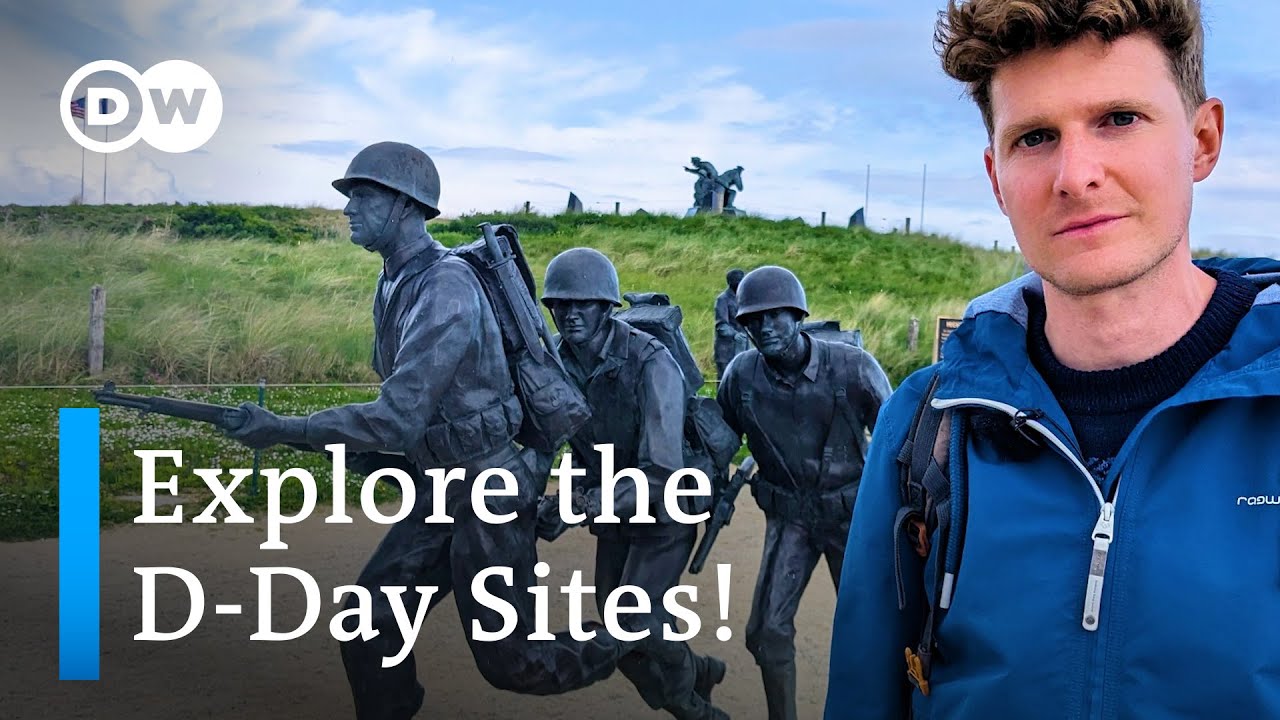
It was one of the most important events in World War II – and one of biggest military operations of all times: On June 6th 1944, thousands of Allied troops landed on the beaches of Normandy to fight back Hitler’s army and liberate Europe from the Nazis. 80 years later, you can visit the old battlefields, like “Omaha Beach,” memorials and museums in the French region. Lukas Stege takes you there and on a deep dive into history.
00:00 Intro
00:20 What happened on D-Day?
01:35 Map: Bayeux and the D-Day beaches
02:10 Jeep tour with @overlordtour5096Thierry Bidault from www.overlordtour.com/
03:30 Pointe du Hoc
05:06 Omaha Beach, resistance nest #60, German bunker
06:36 Omaha Beach, Omaha Beach Monument, Les Braves Memorial
09:03 Bayeux Cathedral, Old town, D-Day souvenirs
10:40 French cuisine
11:00 D-Day Experience Museum in Saint-Côme-du-Mont
13:47 La Cambe German war cemetery
14:11 Normandy American Cemetery and Memorial, Colleville-sur-Mer
16:13 Utah Beach
CREDITS:
Report: Kerstin Schmidt, Lukas Stege
Camera: Holm Weber
Editing: Klaus Hellmig
Supervising Editor: Christina Deicke
———————————————————————————————————————–
Subscribe to DW Travel
youtube.com/dwtravel
Would you like to find out more about DW Travel?
▸Website: dw.com/travel
▸Facebook: facebook.com/dw.travel
▸Instagram: instagram.com/dw_travel
DW Travel is showing you the captivating world of travel. Come along with us to regions and cities in Germany, throughout Europe and to far-away destinations.
#ddaytour #normandy #normandylanding #france #worldwar2 #traveling
This beach is beautiful, right? But things looked completely different here 80 years ago. This is exactly where thousands of Allied soldiers landed – to liberate Europe from the Nazis and to end the Second World War. I’m in France, on the Atlantic coast in Normandy. More precisely on Utah Beach. It was one of five beaches where one of the largest military operations of all time took place 80 years ago: The so-called D-Day. On June 6th, 1944, nearly 160,000 Allied troops landed in Normandy. They came from England by boat across the sea… or parachuted out of airplanes. Their goal was to fight the Nazis by opening a second front in the West in addition to the Soviet front in the East. There were many casualties, but they succeeded. 80 years on, many places, museums and memorials here in Normandy commemorate D-Day. We’re going to take a look at some of them. Including a crazy flight simulation. An old bunker complex. And a huge military cemetery. Follow me on this deep dive into European history! A good place to start is the small town of Bayeux. It is around 300 kilometers from Paris and can be reached by car in 3 hours or by train in 2,5 hours. You can easily get to the D-Day beaches from Bayeux. And they still bear their code names from back then: Utah, Omaha, Gold, Juno and Sword. The US, Great Britain, Canada and many other nations took part in the operation. Nice to meet you! I’m Thierry. Tours to the D-Day beaches are available everywhere. I decided to take a ride in a really cool vehicle. It’s an original one from 1943 that landed right here on June 6th. This one on the beach? Yes, this one here on the beach on June 6th with the 29th Infantry Division. Let’s go! Oh, no seat belt? No seat belts right here. It was not their most important thing at the time. So, okay let’s go back into 1944. Hundreds of thousands of these US Jeeps were used on the fronts of the Second World War. Robust, and seemingly indestructible. I’m amazed by how fast a Jeep like this can go. It’s a nice ride, but it’s very chilly. No windows, no doors – these jeeps were stripped down to the bare minimum. Is it easy? Oh yes. The Jeep is a real pleasure to drive. You can go everywhere with it. We’re approaching our first stop: This is the Pointe du Hoc, a rock tableau 30 meters high above the English Channel. Located right between Utah and Omaha Beach. It was a perfect location for the Germans to monitor both beaches. The Allies’ goal on D-Day was to capture this strategically important point as quickly as possible. That was the job of 225 US Rangers. They had to climb the steep walls – under German fire. From the bottom, they had some grappling hooks. Sent from the bottom, from rocket propellers, to the the top with ropes and small ladders. And the problem was that with the bad weather, the rope was wet and so it was heavier than expected. Only 50% of the grapplings arrived correctly on the top. Ruins of German bunkers can also be seen on the site. They were part of the so-called Atlantic Wall. It took two days until the Pointe du Hoc was completely in American hands. And were there many casualties here? So here, after two days of battle, out of 225 who landed here, only 90 soldiers were able to fight. I mean safe or likely wounded. Memorial plaques commemorate those who died at Pointe du Hoc. We’re back on the road. Our next destination is perhaps the most famous D-Day site: Omaha Beach. It stretches roughly 10 kilometers. What I really like about this guided tour is that you not only get to see the main spots, but also slightly more hidden places. So here is the resistance nest number 60 right here. One of the 15 German strong points on Omaha beach. So from here we have the whole view to the beach of Omaha. Can we access that bunker? Yes. It’s pretty narrow. There were three Germans soldiers sitting down here. And right there was the gun. But how could they shoot without seeing anything? So also right here, all around they had a kind of drawing here. It looks like a kind of pictures, a map. And this way they knew where to fire, to aim. It’s really peaceful here, I hear the birds, the sea is over there, the wind. It’s…I don’t know…a huge contrast. To the atrocities that happened here. Yes, it’s very impressive. And it’s also our duty, my main motivation, to explain what happened to not forget. Now we head down to the beach where everything took place. Here the fighting was particularly difficult. Thousands of people lost their lives on Omaha Beach. There’s a second monument right on the beach: It’s named "the braves." The middle represents the rising of freedom. Flanked by the wings of hope and wings of fraternity. The brave ones is a pretty accurate name. Because in the early hours of June 6th, 944, these men had to be brave. They left the boats on Omaha Beach in heavy seas and tried to get ashore. It’s hard for me to imagine how much courage it must have taken. If you’re in one of the first boats, you know. And they just ran into open gunfire. Yes, as we can see in this photo here. Right there, the soldiers were out of the ramp here. And they had water up to the middle of their bodies, but it was deeper after. And here they were more vulnerable. So here they were easy targets for the machine guns and the perfect distance. 34,000 allied troops landed on Omaha Beach – and 2,400 US soldiers died here. Where do you come from? Texas. Denmark. California. Why did you come to the Normandy? We came to Normandy to see the history of World War Two here. And it also makes us very proud that we were able to help the people of France. We just wanted to see this part of history and to experience that. To see the beaches and the cemetery and all the history. You know it’s my first time here and the sacrifice that people went through to liberate this area, it’s been something special. I’m back in Bayeux. The old town is really worth seeing. Here in Normandy you will always find small, pretty places like Bayeux, which have retained their Medieval charm. I just love those. Maybe I buy it. Here, too, you’ll encounter traces of D-Day on every corner. Bayeux was the first town to be liberated in France! By the British. One day after the Allies landed. There were no major battles, so Bayeux suffered little damage. The cathedral was also spared. It is almost a thousand years old. There are many products from Normandy in the shops: cider, which is essentially apple wine, and Calvados, which is an apple brandy. And other amazing things too… They have it all: D-Day wine, D-Day beer and they even have D-Day cookies! But that’s not enough for me. I need a real lunch. I’m looking forward to typical French dishes: Onion soup, mussels, french fries, mousse au chocolate and cider. Santé! After this break, I continue exploring the region with a rental car. That’s because the D-Day coast is long, 80 kilometers! And there is also a lot to see in the rural areas here. It feels like every place has its own monument, its own museum. I chose the interactive D-Day Experience Museum in Saint-Côme-du-Mont. Let’s see what kind of experience I can have there as a visitor. At first it looks like a normal museum. But then it’s time to take a seat! I’m going to be a young US paratrooper who is waiting for deployment with his unit. A film begins. Soldiers! I need your attention. If the weather forecast is confirmed, in 5 minutes you will be in the air heading for France. We will be the 16th and the last in our division to drop. This means by the time we hit the ground, the element of surprise will be long gone. So be ready for the welcoming committee. Then we get on the plane. In the simulation we start in southern England and fly across the English Channel to France. Now we’re boarding an original airplane from 1944. At first the flight goes quite normally. But the closer we get to France, the more unsettled it becomes. Believe it or not – it felt pretty real to me. Almost frightening. In the end we have to make an emergency landing. That was really intense. I don’t like flying anyway. That’s why I kept telling myself in the beginning: This is just a simulation. After this experience I have to take a deep breath. The subsequent exhibition impressively reports on the mission of the approximately 18,000 men who jumped into enemy territory on D-Day. The Battle of Normandy claimed tens of thousands of lives on both sides. There are many military cemeteries. One of the largest is in La Cambe. More than 21,000 German soldiers are buried here. At the end of my trip, I visit the American Cemetery in Colleville-sur-Mer, near Omaha Beach. I was here a couple of years ago and was deeply moved. So am I today. Graves – as far as the eye can see. 9,387 American soldiers rest here. I’m surprised that no one is close to the graves. Visitors must stay on the paths! I was here in 2016. You could still go to the graves then. Unfortunately it’s forbidden today, but still very impressive. Only those who visit a relative or lay flowers are allowed into the grave areas. Around 1.5 million people visit this cemetery every year. It is one of the most visited places in Normandy. Of course, many of them come from the US. Where do you come from? I’m stationed in the army at Fort Bragg, North Carolina. And why did you both come to this cemetery? Well, my father was in the 82nd Airborne and was a glider paratrooper with the 319th. And he fought here in Normandy. His glider crashed near Sainte-Mère-Église on June 6th. And many of his buddies are buried here. What is so special for you in this place? I mean it brought me to tears walking in here to think, I mean, to think about, you know, the sacrifice to liberate people and bring freedom to the world. It’s just very special to think about it on all sides, you know. It’d be nice to think that we wouldn’t have to do warfare again. But this here reminds you what the cost is. The beaches are so peaceful today but it was pure hell back then. Fortunately, the second front against Hitler was a success. It liberated Normandy, France and Western Europe – while the Soviet Army advanced from the East. A year later Germany surrendered. And on May 8th, 1945 the Second World War in Europe was over. Here in Normandy you can still see in a very immediate way what happened on D-Day 80 years ago. For me it was an exciting and actually very moving journey through time. Bye, bye, see you soon.
33 Comments
I only have one thing im not happy about. You calling it "Utah beach". Its just called Utah
Fascinating. I think few alive today can comprehend almost 5K Allied troops killed in action.
I can say Call of Duty WW2 did an amazing job recreating the landings in the cutscenes. All the location, boats look identical. Thanks for this informative video.
Though China was not a participant of Normandy landing, China plays an important role in East Asia against Japanese militarism. In the new century, China will together with USA, UK, Russia and France keep world war far away.
I assume it was temporary forbidden to get closer to the graves due to the new grass?
Wow,Not much mention of the 10s of Thousands of British and Canadian troops that landed on June 6th…Seems the Eu are airbrushing us out of History…
❤ How this balanced feature has DW's Mr. Lukas Stege and his team combine both the informative and serious D-Day topic in Normandy and the light touristy Bayeux activities.
Thank You for posting this experience.
People like myself who cannot travel get the opportunity to see this very special event.❤
Cheers
Amazing how far we've come, thank you DW 🇩🇪🇺🇲
I'm British born, but Deutschland is my heimat. Too much focus, especially by the French (noticeably absent between 1940 and 1944) and in the UK forgets the thousands of Germans who also became casualties as a result of Overlord.
Hello from California! Your video has inspired me to plan for 2025.
not the documentary germans in the 40s think germany public service produse 80 years later😅
Another video in which the British and Canadian contribution is marginal at best, yet they were a large majority of the troops on D-Day.
The preparation for D-Day was most secret and very effective – reminds me of the 1944 movie set in the town of Chillingbourne. 🎥🎥🎥
Thank you for this wonderful video. I believe the D-Day invasion was the cornerstone of the 20th Century. Thanks again folks at DW! 😊
Thank you DW! My grandfather landed at Utah Beach, 7th Army Unit, field artillery. I found this out posthumously, because grandpa only spoke about the war once.
Why do all these features always focus on US and not British or Canadian sites?
Honor🫡
Hi, what's D-Day?
Graphic at 2:04 shows the location of Utah beach incorrectly. Unlike the other landing beaches it is located on the Cotentin Peninsula, chosen because of its proximity to the port city of Cherbourg.
Nice vid, but you had utah beach pinned in the wrong place on your map @ 1:56, it's actually on the southeast side of the cherbourg peninsula across the canal/delta west of omaha beach. And Omaha is realistically where you pinned utah beach at lol
And the Italian soldiers at Normandy, Navvy guys.
why is walking in the grave area banned now?
Ah Germany……why you don't take any responsibelity of Holocaust ????.As comoensarion to the JWZ, Germany should spare some.LANDS in SOUTH to Israelites to create our BELOVED ❤ STATE OF ISRAEL!.!!! THATS THR BEST 2 STATE SOLUTION .
THANK YOU.😊
It was many years ago I visited the Beach with the artificial Mulberry Harbor, and the swimming Sherman tanks, set to sail far too far out, so most actually sank during the sailing in to the beach! I didn't manage to visit the Germans at La Campe, with the famous Tank Commander: Michael Wittmanns grave, which is always filled with flowers.
Loved your video Lukas. May I suggest a site by historian Robt C Valentine. Just Google his name. He has a hefty website with a plethora of audio-visuals, especially on 1944 that u will like 😊 honest
Hopefully i can visit in September, less crowds
I highly recommend any of you to visit D-Day landing beaches and sites at least once in your life time. It’s very moving and emotional visit for me. Though those places are beautiful today, the history of these places were very sad and eerie. The cemeteries of the Allies and Germans are very worth your visit too. I spent a whole week in Normady region. A truly once-in-a-life-time trip.
Great, but it's not the atlantic coast but the "English" Channel coast
Marxist are now at work in Washington to take America from the inside, through more government control and terrorist crossing a open border.
A really good vlog many thanks for posting
The government and people of France made this a landmark and historical sites of D-Day on Normandy and world war II monument for allied soldiers who fought and died for freedom and liberty.
I noticed that the Americans like to use words like "liberate", "freedom", etc. Kind of interesting.