
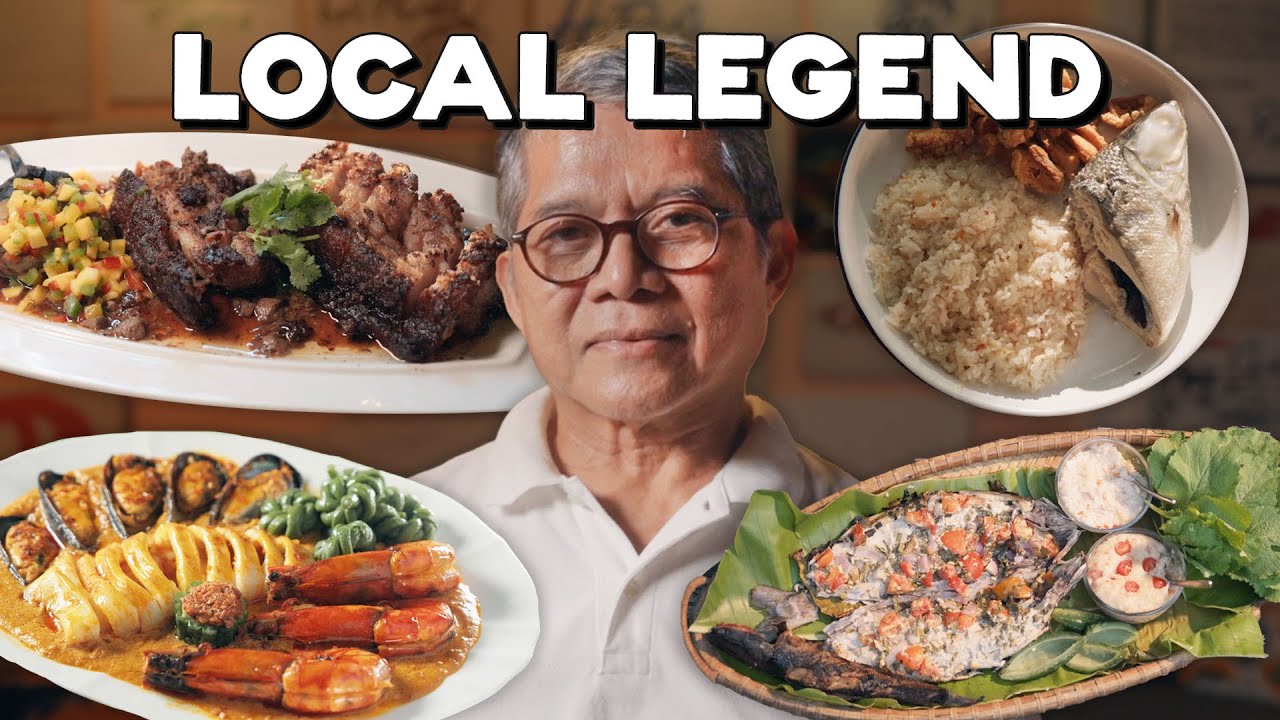
Claude Tayag is a renowned Kapampangan artist, restaurateur, and food writer, about the stories behind his favorite dishes. In this video, Claude talks about how personal and historical narratives shape Filipino cooking. If you’ve always been interested in the rich history of Filipino cooking, then this is the perfect video for you.
Claude’s artistry propelled him to great heights in his chosen crafts and his taste for flavor knows no bounds and sees no limits. From his timeless Seafood Kare-Kare (peanut stew) to the truly authentic Kapampangan Buro with Hito and Mustasa, this is going to be a spiritual culinary journey in Bale Dutung that you won’t forget.
Special thanks to:
Claude Tayag
Mary Ann Quioc-Tayag
Bale Dutung team
Shayne Asuncion
Abe Cruz picture source:
https://www.spot.ph/arts-culture/63719/national-museum-abe-aguilar-cruz-hall
Jump to:
(0:00) Intro
(1:22) Claude Tayag
(5:20) The Plate as a Canvas
(16:35) The Democratic Feast
(19:45) Kain, Kwento, Kwenta; Outro
——————————-
We are looking for collaborators, content producers, brands, and anyone who has a story to tell. Email us at hello@thefatkidinside.com
The Fat Kid Inside Studios
Erwan Heussaff – Founder
Kashka Gaddi – Content Producer
Eamonn Quizon – Cinematographer
Edel Cayetano – Story Producer
Harold Singzon – Story Producer
Mary Lournette Baligod – Story Producer
Kleo Balares – Supervising Producer
Hans Rivera – Multimedia Producer
Julius Rivera – Camera Operator
Steven Sune – Editor
Lorraine Santos – Editor
Dana Blaze – Editor
MK Tayona – Editor
Martin Narisma – Food Editor
Kathryna de Bustos – Content Manager
Chester Velasco – Production Assistant
Kevin Amponin – Production Assistant
Dustin Dagamac – Colorist
Sofia Paderes – Graphic Designer
Kim Manuel – Graphic Designer
Roanne Salvacion – Accountant
Donalyn Aranda – Accounting Assistant
Precious Vargas – Accounts Manager
Social Media:
http://www.instagram.com/featrmedia
Tweets by featrmedia
http://www.facebook.com/featrmedia
http://www.instagram.com/erwan
Tweets by erwanheussaff
– I think that’s the Kapampangan mindset, what I call the Kapampangan flair. You give him something whether it’s a dish or a recipe, and he thinks, "How can I make this even more delicious?" – If there’s something Pampanga’s best known for, it’s their rich culinary heritage. Kapampangans take their food seriously. It’s a form of art that is fully expressed in their everyday. The province has given us some of the most passionate artists, cultural advocates, and culinarians. Perhaps amongst the most influential of them is Claude Tayag. Claude is a chef, artist, writer, and Filipino culinary heritage advocate who continues to tell stories of the Kapampangans and Filipinos through his work. This is a glimpse into his mind told in chapters and why he thinks a person’s story is the key ingredient that can make a dish delicious. – I buy pan de sal here. By 8:00 a.m., it’s all gone, so you have to come early to get the freshly baked ones. Three packs of pan de sal. – Yes. – Three packs, ok? – So that’s 15 pieces each. – Yes, 15 pieces in each pack. I already had some Chocolate de Batirol made. This is the original pan de sal dunk. So you dip it in thick chocolate. This is the hometown flavors I’ve been saying that’s only here in Pampanga. My real name is Claudio. I am the 9th of 12 children. Since I was small, they called me Cloud Nine. So it’s Cloud, it’s not Claude. Is that your milkfish? Alright, I will get one. Is that any good? It doesn’t look good. Newly popped pititian. There are certain foods that bring back memories or why you like certain foods, or why you dislike certain foods. We eat by association. As early as I can remember, like weekends, my uncle would fetch us to play with his only child. So every morning, he’s at my outdoor spot, we’ll sit by the bench facing my grandma and she will handfeed us paksiw na bangus, a little sinangag, and a bit of pititian, then it’ll be dipped in soy sauce. We’ll eat it in one bite. The thing is, we were all like anticipating for that bangus belly, then we would play Jack ‘n Poy who would get the eyes of the bangus. So that is my fondest, most memorable… I would say it’s like foreseeing the future Claude as the… I will not say gourmet but a gourmand. We have a reputation here in Pampanga, I will not say gluttonous, but we love to eat and cook delicious food. I would say what makes us Kapampangan is there’s joie de vivre and the flair. All our elder siblings were already in UP Diliman. They would come home on weekends, and they would bring the entire fraternity, literally. That’s why my mother kept cooking and cooking. We got used to this exposure as children, like if we wanted something aside from what our mother cooked, she would say, "do it yourself." I think for me, that was the life lesson. As we grew older, we learned that if you want something, you work for it. I think, in a way, that formed me as an artist. Our mother provided us with this Guitar, a watercolor set, which at that time only cost around Php1. That was the cheapest thing. So I wasn’t afraid of using watercolor; I just kept painting on any paper. Growing up, I thought painting was child’s play. Until I was 12 years old, my father, whose best friend was the late Abe Cruz. Abe was a painter and a writer. One time, Uncle Abe brought his friends who were painters. They painted in the countryside. I was 12 years old, and for the first time in my life, I saw adults painting, which I had thought was just child’s play. That was my eureka moment, realizing that’s what I want to be when I grow up. For me, that defined me. When I was 12 years old, still in elementary school and then in high school, I was always assigned to draw charts or illustrations on the board. Several of my classmates would literally bribe me to do their projects for them. Do you know what the payment was? Their recess budget. I realized you could actually make money from this. So when I was in fourth-year high school, I wanted to take up fine arts. When my father learned of it, he said no, you have to take something more concrete, more professional. So I applied for architecture at UP, and luckily I was accepted. I studied architecture for about 3-4 years, but then I realized, especially with the engineering courses, that I wanted to drop out. My father said no, look at your older brothers— two are lawyers, one is a businessman, and so on. I had to finish something. He said, "Just show me, take up anything, show me a diploma, then you’re free to do whatever you want with your life." But he already knew that I could paint. On weekends, especially Saturdays, I used to visit Uncle Abe and show him my work. He would critique it, saying, "This should be like this," or he would do a demonstration. Then, when he saw the progress of my piece, he said, "Try consigning with Larry at ABC Galleries." So I consigned two watercolor paintings of Baguio scenes. Amazingly, they were sold within a week, even to a foreigner. It was very encouraging for a fledgling artist. Uncle Abe said, "Schedule Claude for a one-man show." So by November, just a few months later, I had an exhibit at ABC Galleries. So I was already doing the Santos Series at the time and Ati-Atihan, Philippine fiestas. So even from the start, my thematic focus was always on Philippine local culture, and that extended to my food. In 1988, Larry invited me as a guest cook at one of his restaurants called Ang Hang, and he titled it "Art Woks by Claude Tayag." The idea was that I interpreted my paintings into edible art. That was another event where I realized that cooking could be another art form. Don’t they call it culinary arts, cooking in the first place? At that time, I joined the Saturday artist group, where we would create still life and draw. I was lost in my thoughts, almost zoning out in the room, thinking, "How could I cook that? How would I plate it? What should I mix in?" That realization hit me that I am beyond the drawing. A series of invitations to do this and that followed, and I guess that’s how I earned my title as a chef. I became known as a cooking artist, and later on, when the term "chef" became more popular, I was called a chef. Then, in the year 2000, the lifestyle editor of the Philippine Star, Millet Mananquil, gave me a column. She gave me a Thursday column on food and travel. That year 2000 was my first time writing. By 2005, I compiled my articles, which were printed into a book in 2007 called "Food Tour" with my drawings and recipes. That was my first 3-in-1 book as a writer, a chef, and an artist with my drawings. I became known for my food writing, and I started getting invited to various food promotions by different hotels and restaurants. Simultaneously, in the year 2000, Intercon invited me to be a guest chef, the first Filipino to guest at Prince Albert, which is a French restaurant. That was the first time I introduced my seafood kare-kare to the public. And the sauce, because to recreate that rich peanut-based sauce without the collagen of the oxtail. The secret of the kare-kare sauce would be the broth of the meat. But this is seafood. I have to recreate that. So I used coconut milk, real peanuts, and of course, annatto, then I sautéed it with bagoong. And of course, I simplified the vegetables, the sides, string beans, the yardlong beans, but I braided it. I would like to think I started that. That year 2000 was very momentous. That was the first time we opened Bale Dutung for private dining. I envisioned Bale Dutung as my painting studio and workshop. That’s where I did my sculptures, my various artistic activities. And the Silong, as it is now, was basically a display area for my artwork. While I was a freshman at UP, during long weekends, my classmates would tease me, saying, "Claude, we’re going to Baguio this long weekend, we’ll pass by your place, so prepare for us." I’d say, "Sure." I’ll prepare some tocino, make sisig, and also burong hitong mustasa. Another realization hit me when they said, "You’re lucky to have something to go home to." They envied my lifestyle here. That’s when I realized how lucky I was to be born into this family, in Pampanga. It also made me realize that for them, Pampanga food, our everyday food, was special. It’s like affirming that culinary capital title; it’s not a self-crowned title. Non-Kapampangan writers have been writing about it since the 60s, 70s, and 80s. So I think that’s the Kapampangan mindset, what I call the Kapampangan flair. You give him something, whether it’s a dish or a recipe, and he thinks, "How can I make this even more delicious?" I think it’s what Br. Andrew Gonzales wrote, "It’s the confluence of affluence." For me, the quintessential Kapampangan dish would be the burong hitong mustasa. It’s a set. You cannot have one without the other. Starting with the fish, it’ll be freshwater fishes. So it could be the hito, or catfish, mudfish or dalag, bangus, tilapia. These are the most common freshwater fishes. Since Pampanga is basically landlocked, we have access to the sea. From the river, it flows out to the brooks and then streams, leading out to the Manila Bay. So we don’t really have a sea coast in the sense that we don’t get seafood, back in the day, which is why the Kapampangans lived off the immediate surroundings. Just going around, they could get frogs, catfish, mudfish. So in times of plenty, what do they do? Those fish are fermented with rice, either as burong isda, any of those fishes, or shrimp. And then, I don’t know how it became a set, why the mustard leaves, it’s only eaten here as a salad, meaning raw. Mustard leaves are also used in sinigang sa miso, but then they’re cooked, right? But this one, mustard leaves are eaten raw, and it could be served with boiled ampalaya and okra or eggplant, whatever is available. But for me, it’s really the mustard leaves because it has a bitter and spicy end to it, like a hint of wasabi. The Kapampangan burong mustasa. This is comfort food for us Kapampangans. That’s what we grew up with. If you’re Kapampangan, that’s what you’re always looking for. Why the Kapampangan taste? They have a strong palate, it has to be flavorful, it has to be tasty. There’s a saying that it’s like we were born with MSG in our tongues. I believe there’s a deeply rooted food culture in Pampanga. How did we earn the title of culinary capital of the Philippines? It’s been documented that during the Spanish times, the Spanish government in Intramuros depended on food supplied from Pampanga. In the 1960s, 70s, and 80s, writers from Manila would come here to shop in the PX black market from Clark Air Base, and then they would eat around the area and buy all these pasalubong back home. So Pampanga became known, and we’ve been written about as the gourmet province, the culinary capital, the food capital, the food heartland. Who are we to say no? Meaning, the title was given to us, but it’s not a bragging thing. They’re the ones who named us that. But I think again it’s the confluence of affluence, as I mentioned earlier with Br. Andrew Gonzales’ term. Because of all these factors put together, that’s what shaped Pampanga cuisine. Filipino cooking is the most democratic cooking in the world, in the sense that the maker is free to interpret it however they wish. At the same time, if you are presented with a dish, as a diner, I am even expected to adjust it to my taste, which means there’s a dipping sauce. We eat communally, always with a group. It’s joyful, full of conversation, right? And our cookbooks always mention servings good for six, good for ten. We don’t cook for one person. I’ve been asked many times, like how to define Filipino cuisine. So I think, for me, the best way to describe it is like a symphony of subtle, sweet, sour, salty, and maybe a bit bitter, but all in one bite. So when you take a mouthful, all the flavors are there. It’s a very nuanced cuisine, which means if you’re a foreigner and you’re not used to it, you’ll be like, "What is it? What hit me?" You don’t know what it is. But if you’re a Filipino and you’re accustomed to the taste, you’ll say, "Wow, it’s so flavorful, salty, sour," things like that. And our cuisine, you cannot about Filipino cuisine in general, meaning definitively, because it’s very regional. And that region, wherever you come from, will dictate or define the degree of those flavors. Like up north in the Ilocos region, the saltiness of fermented fish is stronger, while in southern Tagalog, meaning Manila and CALABARZON area, it’s the sourness. I think for me, that’s the advantage of why Filipino cuisine is now up there, because everybody is doing their interpretation of a classic dish. Most of our dishes are named after the manner they are cooked. Filipino adobo is basically a cooking method using vinegar as the primary source of liquid. So you can practically adobo anything. Again, we don’t have fixed recipes. There is no codified recipe for anything. The only fixed recipe is freedom, meaning you’re free to interpret. And again, we all know adobo is tastier the more you reheat it, right? It’s always best the next day. That’s because the acidity of the vinegar used in cooking has mellowed and seeped into the meat. There is no right or wrong kind of adobo. The best adobo, the only correct adobo, is the adobo that you grew up with. When we eat the adobo that your grandmother cooked, even if they’re no longer with us, we eat it in their presence. In spirit, we remember them, so in a way, when you serve it to your children, by the time they are grown up and married, they serve it to their children. The connection of generations is continuous. It’s like an unbroken chain. Generations are linked because of that dish, the stories behind that dish. That’s what I wrote in my adobo book. Food without a story is meaningless. Food without stories is just, well, food. When we eat together with friends, family, there’s always the story of the food. That is what binds us together, our shared experiences as children, as grandchildren. In a way, it warms the heart, but at the same time, it can make you feel homesick.
27 Comments
One of the best episodes this channel has produced.
"filipino food is combination of salty, sweet, sour and a bit bitter" 🩶
Featr is on a roll! Great pampanga series! Dacal a salamat!
Filipinos need to go back to their culinary roots. Bulalo, Sinigang, Adobo, Tinola etc… They need to stop eating fast food, fried foods and packaged processed foods and sugar. Look around, the obesity rate has increased dramatically in the last 10 years. Filipinos are getting fatter and fatter year after year. Diabetes, and heart desease rates will tripple plus in the next ten years. The Philippines is lush and fruitful land, get back to basics
Unbelievably sublime… All your features truly mark the hearts of many. How you feature Philippine cuisines, & culture elevates it to its proper place in the world map.
beautifully told.
Buru and mustasa wasabi comfort food
5:28 all great artists. Tropa pala ng tito ni Chef Claude si Malang and Vicente Manansala. Amazing! 🔥
Filipino food has been under rated for a long time ..I think it's great
I love an artist who can express himself with various medium. His atelier reflects his evolving artistry and creativity despite all of these Claude seemed humble and very relatable.
"Ang pagkaing walang kwento ay walang kwenta"-Chef Claude
Filipino food forward
Mabetsin ta mu pin pu dila, Sir Claude! Thank you for this, Featr. 🫶
Met the legend years back when me and my relatives enjoyed his many ways to eat lechon at Bale Datung. Such a humble person and down to earth who is passionate about Filipino food. The late Anthony Bourdain also enjoyed a feast when Chef Claude Tayag cooked traditional Kapampangan dishes. I hope I can meet Chef Tayag again so I can ask him to sign my Kulinarya cookbook (first edition) which was gifted to me by my late aunt.
I do appreciate much how Claude Tayag has defined Filipino Cuisine ….. as a food lover it is what we look for when eat as if it’s is exclusive to Filipinos but much to be shared with foreigners who are much appreciative of the different from their comfort food …. Congrats FEATR another vlog to be applauded …. Makes me proud in understanding our Filipino Cuisine!
I love when he said, "Pagkaing walang kwento, walang kwenta" because the essence of food anywhere in the world really, is shared, communal, stories be it by the maker (cook), the receiver (diner) and even for those whom you cook it for, from and about.
This is a man who has gained such profound wisdom by doing what he loves, internalizing his shared experiences and turning it to something edible that goes beyond the metaphysical sense of food.
Great job to you lot! Wonderfully made!
More of this please 🙏
This was such a nice episode.
Thumbs up to a Kapampangan artist, chef and writer!
Grabe ang knowledge niya. I can feel, see and hear the passion in him. The way he talks about the history and background of our local cuisine, about each food.
May lahing Italian si Sir Tayag?😅
When u know, u know😂
To the featr team that produces these works of art you guys are amazing 🙌🏼
This video is an art in itself. Salamat po sa lahat ng gumawa ng documentary na ito. ❤
One of the BEST!!! Thank you Sir Claude Tayag and congratulations on this Episode #featr
Such a great episode. I can feel how Mr. Claude's reminisce his past when it comes with food. Growing up, I guess food plays a big role on molding who we are. Families are really bonded with good food and good memories.
I also believe that our adobo is also going on a metamorphosis because with all the spices and other flavours and substitutes that are coming or are being rediscovered by enthusiasts. In the future, Adobo will never be just garlic, soy sauce, suka and pepercorns only.
Bitin po😢….Thank you for featuring this kind of topic.
Tito CLOUD! I love his energy!