
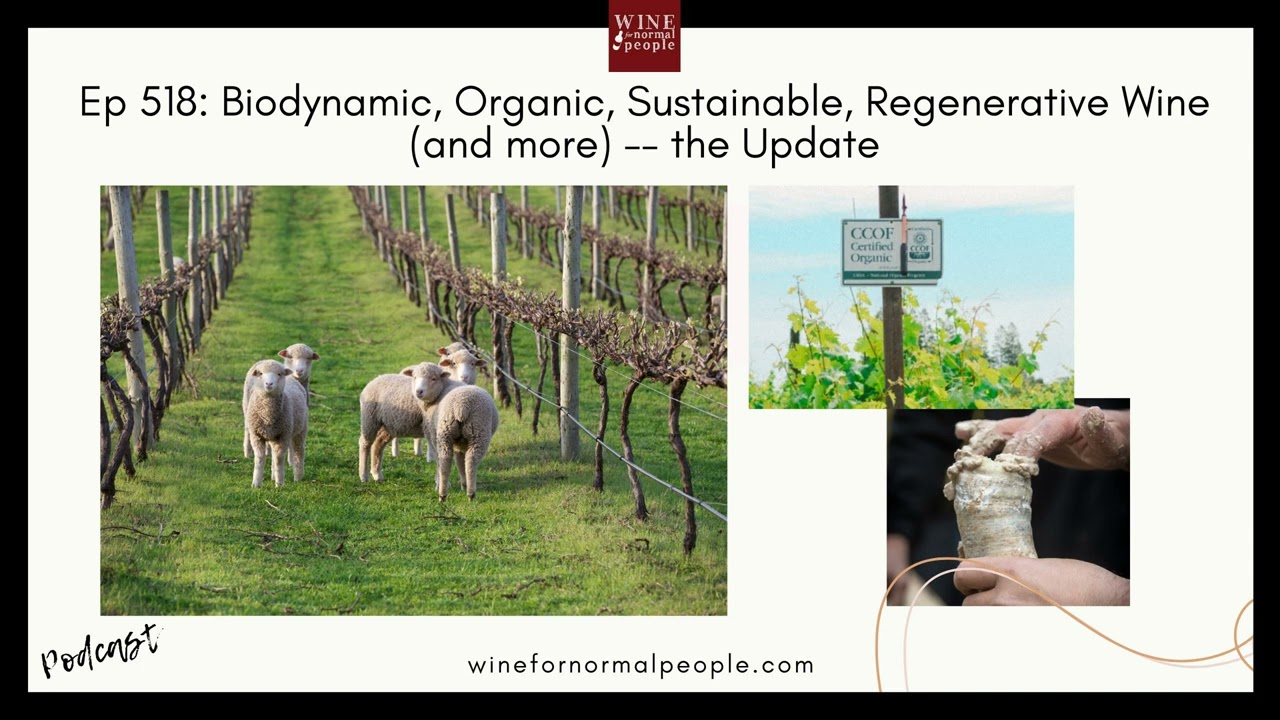
These categories of “better for the earth” wines are technical, tricky, and ever-evolving, so I felt that it was time to do a comprehensive update!
In this show, I do best to break it all down in as simple a way as possible…I cover:
Biodynamics Organics Sustainable farming Regenerative agriculture And then, quickly, the loose ends – vegan wine and natural wine
I start with an overview of the Pre- and Post- Industrial Revolution types of farming:
Traditional farming is original agriculture, by the industrial revolution introduced inorganic sprays, applications, etc — most of which were not well developed and had serious side effects. This type of farming is called Conventional farming. All current eco-methods of farming are reactions to conventional farming
______________________________________
Biodynamic Wine I discuss Rudolf Steiner’s philosophies and the main principles of biodynamic agriculture – essentially that the farm is a single, self-sustaining organism and the farmer must encourage and guide the vines, as well as protect the soil so it stays healthy and provides nourishment for the vines. The main certification for biodynamics is DEMETER. It was founded in 1928, and is the world’s oldest sustainable agriculture organization.
_________________________________
Organic Organic farming is traditional farming – this is how farming was always done until the industrial revolution. The new iteration grew out of the biodynamic movement in the 1920s and then experiences more growth in the 1970s. This method took off in the 1970s and 80s, especially in Europe.
Different countries have different definitions of organic…
European Union Organic Products/”Bio” in France: Organic wine prohibits most synthetic chemicals or GMOs and uses only certified organic oenological products in the cellar, including organic yeast. Sulfites are regulated. Organic wine has the EuroLeaf Logo with a code number of the certifying body or the French AGRICULTURE BIOLOGIQUE label (created in 1985, has been around for longer) United States. This is a program developed by the United States Department of Agriculture (USDA). There are prohibitions on the vineyard and the winery, with the biggest difference with European organics: Added sulfites are prohibited. Because of this last prohibition, certified organic vineyards go in and out of the organic certification To make it more flexible, they added the “Made with Organic Grapes” stipulation, which is looser _________________________________________________________
Regenerative Organic Agriculture
Although relatively new, this is likely the future of better for the earth initiatives. Regenerative starts out with the principles of organic but then adds a few other things. Watch this space…
_________________________________________________________
Sustainable Winegrowing This is the most popular way to do better for the earth viticulture but it’s squishy. Sustainable is a catchall term that has MANY definitions. It can refer to production, or it can talk about conserving energy. It can be about good relations with employees, or economic viability of the winery. Some of these certifications are better than others. Here are some examples:
France…
HVE: The French Ministry of Agriculture developed the Haute Valeur Environementale
Others…
Vignerons Engages
Viticulture Durable en Champagne
Terra Vitis
And in California… Certified California Sustainable Winegrowing
_________________________________________________________
I end with a quick tour of …Natural wine and Vegan wines
Full show notes and all back episodes are on Patreon. Become a member today!
www.patreon.com/winefornormalpeople
_______________________________________________________________
Check out my exclusive sponsor, Wine Access. They have an amazing selection — once you get hooked on their wines, they will be your go-to! Make sure you join the Wine Access-Wine For Normal People wine club for wines I select delivered to you four times a year!
To register for an AWESOME, LIVE WFNP class with Elizabeth or get a class gift certificate for the wine lover in your life go to: www.winefornormalpeople.com/classes
[Music]
welcome to wine for normal people the
podcast for people who like wine but not
the snobbery that goes with
[Music]
it I’m your host Elizabeth Schneider
author of the wine for normal people
book and certified wine
dork this podcast is sponsored by wine
access my exclusive sponsor if you’re
not currently a member of the wine
access wine for normal people wine club
you can join the club today and get $25
off your first two shipments by visiting
wine
access.com normal if you’re thinking
about it now is the time to join we have
an amazing shipment coming up and two
more great ones for the end of the year
join today wine access.com normal and
listen in the middle of the show for
more details on this limited time
offer so last week was a re-release of
the show with Jason hos from toas Creek
and it was around regenerative
agriculture and a bunch of other things
that have to do with the holistic health
of a Vineyard and of a farm and all that
kind of stuff and I was thinking about
that and then at the same time I am
currently working on a project where I
am uploading all of the podcasts onto
patreon because originally I had done it
through a third party and it’s not
working out as well as I had hoped so
we’re going to actually have all the
podcast live on patreon it’ll be
searchable it’ll be a lot easier so when
you join patreon you could just go in
and listen right away because all of the
old episodes of the podcast are now only
available to patrons so you have to be a
patron in order to gain access to them
and now they will actually just live on
patreon so you don’t have to do anything
you just have to search and they’re
categorized and all this kind of stuff
so it’s great but one of the things that
I noticed is that it has been a really
freaking long time since I have covered
organic biodynamic
regenerative of course now which is
wasn’t even in the first iteration of
this and then also some definitions
around vegan wine and natural wine and
all these other things sustainability
there are a lot of things to cover and
there’s a lot of new
certifications some of which are quite
important especially in Europe so I want
to take the opportunity to update what
is going on in the definitions and the
world of biodynamics
organic sustainable farming and now
regenerative farming so we’re going to
go over some of the history of
biodynamics we are going to talk about
sustainability and we are going to talk
about Organics that will be the bulk of
the show and then we’ll cover some of
the other stuff so before we get into
this very dork out topic a couple of
things first of all new classes are
posted the patrons have really gobbled a
lot of them up so if you are interested
there’s volcanic wines reasing is going
quickly we’ve got some other classes up
so that’s wine forn normal
people.com classes and I do want to give
shout outs as we do every week as I say
the attitude of gratitude we have to be
thankful to the people who make this
podcast possible hopefully if you are
not one of these people that you will
consider joining the community
patreon.com wine for normal people and
let me just give some shout outs now to
our new patrons welcome to the community
Daniel Tina s mcneel p Craig John F Joe
M Chris Cynthia C Nick Megan L Maddie a
Petra s Lauren o Lisa K Sylvio C Jeffrey
D Roy Leslie B JC Tim B Leslie C Andrew
e and Elizabeth H thank you all so much
we are really excited to have you in the
community and I’m excited to get to know
you feel free to direct message me
anytime also quick plug wine access is
having a big push and a big sale for you
to join the wine access wine forn normal
people wine club they’re giving you $25
off the first two shipments if you’re
interested in that go to Wine access.com
normal so let’s talk about organic
biodynamic sustainable blah blah blah
everything it is very confusing and very
technical I’m going to do my best to
break all of this down there is farming
and then there’s wine making and we
really need to be clear about what these
certifications are certifying are they
certifying farming are they certifying
wine making are they certifying part of
wine making the organic world has a
bunch of certifications but the practice
is largely the same regardless of which
one you get same with biodynamic
sustainability on the other hand varies
really really widely so all of those
certifications kind of need to be looked
at if that’s something that is important
to you because they don’t all
characterize or classify the same things
as being important there are two main
schools of thought if you’ve already
thought okay well it’s biodynamic and
organic you’re absolutely right those
are the major topics that I’m going to
concentrate on but I have to say that
the most widely used type of wine
certifications that are better for the
planet are sustainability and I am going
to be spending some time on that because
especially in Europe there are a lot of
really great certifications that have
some teeth and that do the job of trying
to reward people for doing better for
the Earth for people who work for them
and for the community okay so let’s dive
in I want to start out with this
traditional farming I like this term
traditional farming is the original
agriculture this is the thing that’s
been practic practi for tens of
thousands of years and because there
were no inorganic ways to do farming all
of it was organic and it was done since
prehistoric times as soon as humans
started to settle down and do crops and
stop being hunter gatherers traditional
farming is the way that they did it and
again there were no chemical inputs so
this is the longest stretch of farming
that we have and yes it is
organic then we have the Industrial
Revolution the Industrial Revolution
introduced inorganic methods and most
were not very welldeveloped the idea was
there but most of them had really
serious side effects there were chemical
sprays there were GMO you know
genetically modified organisms any means
necessary to get the crop out as long as
you don’t kill somebody that was really
the idea behind now what is called
called conventional farming as opposed
to traditional farming which is the OG
now everything else that comes after
these two definitions is a reaction to
Conventional farming so as soon as
conventional farming started to become
popularized there almost immediately
after came a group of people that
noticed that things were changing in
terms of the soil in terms of human
health in terms of how things looked it
was essentially poison for the land and
almost immediately you had people saying
this doesn’t seem like it’s right again
conventional farming has gotten a lot
better but still there is definitely a
difference and everything else
biodynamic organic regenerative
sustainable are all reactions to
Conventional farming enough said let’s
talk about biodynamic first why am I
going to talk about this first because
it came before any of the other ideas
that we are going to talk about
biodynamics history really is based off
of this idea of traditional farming
practices this school of thought was
inspired by Rudolph steina this guy was
a little bit weird I’m not going to lie
he was an Austrian philosopher an
educator he was also a scientist in the
first part of his career he was a very
well-respected scientist he was also
unfortunately kind of a racist and he
was a little anti-semitic although he
later renounced the anti-Semitism he did
not renounce the racism not the greatest
guy after he established himself as a
respected scientist he then felt free to
become the founder of a belief system
and a practice called anthroposophy and
also the Waldorf method of Education if
anybody is familiar with Waldorf schools
it’s a spiritual humanist movement and
the aim is to engage in
spiritual Discovery through the senses
Steiner said that he was a clairvoyant
he dabbled in the occult he was very
interested in marrying the occult with
science and there were lots of
unsupported ideas there was a lot of
exploring science through the spiritual
World pseudo science idealism it was
definitely a criticized school of
thought he believed that Western
civilization was going to bring
destruction to itself and to the Earth
if it did not somehow incorporate the
spiritual world into the physical world
how you do that well he had some methods
this was all going on in the early 1900s
so Steiner was alive at the end of the
1800s and the beginning of the 1900s
this is prime time for the Industrial
Revolution at this point in time we’ll
go back to agriculture you had
synthetically produced fertilizers and
pesticides the farmers started to notice
declines in the health and fertility of
the soil of the animals of the plants of
the people and the farmers actually went
to Steiner and said look in your idea
about connecting spirituality to the
physical world could you look in into
Agriculture and see how that all ties in
so in June
1924 Steiner held an agriculture course
with the farmers and cerates which is a
small village it was then Germany and
now it’s Poland this is my family’s
probably from there we’re part of that
little area right there um so eight
lectures five discussions in the book
agriculture lays out the concept of you
guess it
biodynamics it is a holistic approach to
agriculture so a quote that I found deer
ventner so demer is the certification
body demer venters do not produce wine
they accompany it it is looked on as a
shepherding process and what Steiner
said is that the farm is a single self-
sustaining organism so if we’re talking
about Vineyards we’re talking about
grapes and the soil and The Vineyards
and all of the buildings and everything
that’s there it’s all self- sustaining
the idea is to encourage the vines to
guide The Vines and then you’re going to
try to protect the soil so the layer of
humus which is the nutrient rich soil is
going to keep the land healthy and in
order to do that you need
biodiversity this is one of the very
important things because if the
ecosystem is going to survive you’ve got
to have lots of plants
and insects to pollinate you need the
full ecosystem you need livestock it has
to be a closed loop you’re using all the
inputs from the farm to get the output
natural inputs for soil treatment that’s
means manure and things like that and
for fertilization you’re going to keep
the soil alive now that sounds great
it’s totally spot-on and it makes sense
then there’s what I like to call the
Kookie part so the Kookie part is that
Steiner then said of course cuz he was
an occultist that there were Cosmic and
Earthly influences and this was a
rhythmic process that was and I’m
quoting it
astrologically informed you have the
lunar calendar and the lunar calendar is
going to determine root days which is
when you’re going to till the soil or do
what you need to do with the soil Leaf
days where you’ll prune and pick FL fler
days where you might plant and
definitely Harvest and fruit days where
germination will take place harvesting
again and then also in the winery
pressing racking filtering bottling also
opening the wine and drinking the wine
because they believe that the wine is
more aromatic on both flour and fruit
days this is all very defined when to
plant when to prune when to apply
preparations when a harvest as well as
the wine- making stages they claim that
it’s based on Ancient practices because
the lunar calendar has been observed for
a long time for instance what they might
say is the waxing moon as the moon goes
to fullness is going to pull up plant
sap and that is the reason why the
grapes are going to be more flavorful
during that waxing moon and when the
Moon is waning the sap is going to go
down and the grapes will be less flavor
also not a good day to pick homeopathic
preparations are used by biodynamic
Farmers on the soil compost great for
soil plants you’re going to help build
up that Farm’s immune system as they
call it the forces of the universe are
going to conspire for the farm this was
all laid out in 1924 by Rudolph Steiner
now the following year Steiner died of
cancer in 1925 but his idea was very
powerful and it spread among fruit and
vegetable farmers in Germany
unfortunately this was starting to take
hold but the momentum died because the
Nazis banned Steiner’s writings in 1930
what is ironic about the wine World
taking in this philosophy is that
Steiner and all of his followers were
tea tolers they felt that alcohol
muddied the mind and that it would
hinder Spiritual Development so they did
not drink and it is funny that it’s such
an important tenant now in wine because
Steiner wouldn’t have had any of it so
let’s move past the World War II era
this is when they decided look we are in
big trouble we’ve got to get these crops
moving again chemical fertilizers
fungicides pesticides the farmers really
wanted to get their crops going so they
could start making some money and
recovering
problem is some of the farmers noticed
this was very harmful to the land and
they wanted to see if there was a way to
fix the land and oppose these practices
but it really wasn’t until the 1960s
that we see the first wave in alzas in
France takeover so
1969 this is when Eugen mayor among the
first grape GS to take up biodynamics in
alzas the story goes that he was exposed
to a chemical spray on his Vineyard
and he suffered paralysis of his optic
nerve and he had a homeopathic doctor
who said read up on biodynamics so me
and his wife immediately began
converting their Vineyard in 1980 it
became the first Vineyard to be demer
certified this is domain Eugen mayor
followed very quickly by Jean Pierre
Frick domain Pier freak which was
certified organic in 1981 and then we
see in the lair Nicola joli owns Lai de
in saier very famous Vineyard he
experimented with biodynamics in 1980
and has been an enormous influencer in
the lir valley in biodynamics because he
saw that chemicals were killing the
vineyard in 2001 joli founded the
renissance de which is the return to
Tera that’s what that means it’s a
certification for biodynamic and organic
producers obviously based in the lir
valley I found a really interesting
quote from Sarah Wang of domain u in V
which is in the lair and she said that
after the second world war there was a
Harmony that was lost biodynamics
offered the possibility of reconnecting
with nature for us the philosophy is
really about balance and oua converted
in 1988 we also saw Germany really
adopting the practice early on and the
US also in the 19 1970s you had two
biodynamic Consultants who spread the
philosophy Alan Chadwick and his student
Alan York Chadwick was actually his
mother was a big fan of Rudolph Steiner
he was originally from the UK went to
San Francisco in 1967 and set up a
program around biodynamics Jonathan and
Katrina fry of fry Vineyards F re y
joined the program in
1976 so when they founded Frey Vineyards
four years later they decided that it
was going to be biodynamic and today
they’ve grown a lot only 10% is demer
certified the rest is made with organic
fruit that they source for their organic
wines after them you had benziger in
Sonoma you had bonterra up in Mendo
Cooper mountain in will Amit Oregon and
many others so the US was pretty early
to this movement as well we talk about
certifications there’s really one main
certification and that is the demer
certification named after the goddess of
the Harvest and agricultural plenty this
was founded in 1928 it is the world’s
oldest sustainable agriculture
organization demer is an international
certification it actually includes other
agricultural products Beyond wine it has
a bunch of certifications biodynamic
they actually do certify for organic and
fair trade and sustainable but they are
most known for the certification for
biodynamics and the criteria are that
you must use the preparations that you
must have the system be holistic there’s
a lot of check marks here we’re not
going to go into all of the criteria but
you must follow the principles of
biodynamic and everybody talks about the
cow horn you probably heard me talk
about it on the show before so they put
manure in a cow horn and this is going
to make a preparation that then you will
spr spray on the vines to help protect
them and there’s some principles behind
it basically it’s a perfect amount of
fertilizer does it have to be I think
Jason hos in last week’s show talks
about how does it have to be a cow horn
it doesn’t have to be a cow horn I mean
in real life if we were really practical
but that is part of biodynamics and part
of this philosophy regardless of what
you think about Rudolph Steiner he was
one of the first public figures to warn
that the use of chemical fertilizers was
going to be a problem for the land for
plants for animal health and that it was
going to be bad for food he was very
very precient in this out of the
biodynamic movement came the organic
movement another reaction to
Conventional farming organic is weird CU
it’s different in different countries
but it was Spawn from biodynamic
thinking this is traditional farming how
farming was always done until the
Industrial Revolution it had to be
rediscovered in the
1920s by the initiatives of agronomist
and doctors who were noticing human
health failing and farmers and consumers
who did not like the taste of the food
after it had been sprayed with chemical
pesticides organic abandons the whole
lunar calendar it abandons all of the
spiritual connection it abandons a lot
of the more for lack of a better word
woo woo stuff organic specifications are
based off of Agriculture that does not
use chemical or synthetic pesticides now
the specifications for organic were
established in the 1970s so in 1972 in
Europe you have some professional unions
that are already looking into this the
FNB this is the national Federation of
organic agriculture was created at the
end of the 1970s and GB grab is organic
agriculture research group similar
timing in France European governments
through the European commission started
to look at Agriculture and putting a
decree together so in July 1980 they
started this in March
1981 we see a little bit more
formalization by 1985 there was an
official term organic agriculture in the
EU at that time was the EC but the EU
the national governments could start to
authorize it based on a set of criteria
and by 1991 the European regulations
started to come pretty fast and furious
they expanded laws from a set of French
legislative texts because France was at
the Forefront of this and they started
to apply it to plant production organic
products now are certified in a European
Union country by a designated Authority
or a certifying body under that
Authority often it is echoer which I
will talk about in a second it is a long
and onerous process to become organic
you might think okay well if you’re
already farming organic why not become
organic you have to have a plan you have
to have a timeline for certification you
got to have cash because it costs money
and everything has to be addressed
tilling grazing if you have animals
harvesting transporting the wine
approved substances for growing you have
to have extensive record keeping systems
how you keep your Vineyards away from
prohibited substances is a big one
because if your neighbor is not organic
you can’t really be organic if you’re
very close then there’s implementation
you’re going to implement this you’re
going to get a review by the certifying
agent they’re going to make sure
everything meets the criteria and then
you are inspected the agents are going
to look at the field and the soil and
Pest Management and water management and
the winery standards and any additives
and they’ve got to report if there’s any
risk of contamination from prohibited
materials like I said if your neighbor
is not organic that’s going to be pretty
hard for you to become certified then
you got to get certified and that update
is a little different for everybody but
normally it is every year every couple
of years and if you go to Europe you
will see and actually even in the US you
will see an echoer sealed they’re a
certification agency they operate in 130
countries since the 1990s they are going
to audit organic agricultural practices
to make sure that you deserve that label
they have an environmental Charter so
echoer is really one of the most
respected and you may hear especially
the European producers mention that
echoer has certified
them I teased it at the beginning I’m
going to tell you again whine access is
offering a limited time deal if you want
to join the wine access wine forn normal
people Club they have sweetened the pot
the wine club discount is available for
anyone that is not a current member of
the wine access wine for normal people
wine club you’re going to join the club
today by going to Wine
access.com normal wiac
ces.com normal when you place your order
you get $25 off your first two shipments
we are giving you 50 bucks that means
$125 per shipment for six bottles that I
hand select I do a special letter for I
do videos for the shipments go out
quarterly next one is going to begin
shipping soon this is off the beaten
path wines oh my gosh I’m so excited I
love the valina it’s a nebula from
Lombardi which is where leomo and Milan
are and if you love The Armenian wine
podcast we we’ve got a vcot from Amy
from zulal so if you have an interest in
expanding your palette let me help you
four times a year by picking out the
wines for you this offer is not forever
get $25 off your first two shipments
when you sign up wine
access.com normal do it before the offer
goes away and also don’t forget join
patreon p a t
n.com for normal people to get access to
all of the old episodes of the podcast
discounts on classes to sign up for
those new classes wi for normal.com
classes now let’s get back to the
show I just want to talk about where
organic Vineyards are and why I’m
concentrating a lot on the US and
especially on Europe there are 10
countries that account for 91% of the
world total of organic farming the 10
that are important three are in Europe
and they make up an enormous percentage
Spain is
27% of all the organic Vineyards France
is 25% mostly in provance and the
langued a little bit in Bordeaux Italy
24% we are already above
75% 15% of all Italian Vineyards mainly
in Sicily Tuscany and Pua are organic
over 75% of the world’s C certified
organic Vineyard surface area is in
Spain France or Italy that is the lion
share with some of the other European
countries Germany at 2% Austria at 1%
Greece at 1% altogether Europe makes up
84% of all organic Vineyards that is why
we’re going to concentrate a lot on
Europe three non-european countries also
have a decent amount the US is 4% but
that’s production of wine grapes table
grapes and raisins turkey at 3% they
mostly table grapes and raisins and
China at
3% why is there so much organic
viticulture in the EU because it is the
second pillar of the common agricultural
policy this is a hugely important
document the cap is incredibly important
for the EU it has contributed to the
expansion of Europe’s organic surface
areas and the cap is followed by every
member State very closely because they
get access to research they get
subsidies they get National development
money so if you include Organics in your
plan chances are you’re going to get a
lot of help and that is why the EU is so
far ahead now the EU has some
definitions of organic again it was
framed in 1991 first main regulation was
2012 there was an update again in
2018 if there is a producer that you
hear on this show or you meet and they
call call organic bio that means organic
okay so bio in France means organic
organic wine according to the EU is wine
which takes the environment the
protection of the climate biodiversity
animal welfare and consumer health into
consideration most synthetic chemicals
most genetically modified organisms are
not allowed and you can only use
certified or organic products in the
seller also so it is not just in the
farm but also in the seller in Europe
organic products are subject to European
regulations that are applied universally
to all member states and certain
products the national governments also
have stricter specifications in some
cases but organic wine has to be made
with both organically grown grapes and
organic yeast at least 95% of the wines
ingredients have to be organically
produced to be organic they prohibit
lots of stuff but some examples are like
you can’t use sorbic acid to re acidify
your wines the level of sulfites in
organic wine has to be lower than
conventional wine this kind of depends
on residual sugar content it’s a little
squishy whites and Ros can have a higher
sulfite content than Reds and the EU
commission has really restricted
recently copper to fight mildew this is
the the Bordeaux spray starting in
February 2019 because they realized that
it can POS a danger to the land to small
animals to groundwater to soil to
earthworms to Vineyard workers and so
copper which had been a real tenant of
organic viticulture the one thing that
could still be their pesticide and
herbicide is now being severely
restricted and people are getting pretty
angry about this but it’s probably a
good idea because copper sulfate is not
great for the land if you get through
everything I’ve just said the wine can
say that it is organic or bio on the
label and it can have you’ll see this on
the back of European wines the Euro leaf
logo so it’s a little leaf on a green
sticker it has a code number of the
certifying body the French agriculture
biologic the ab label is their own
standards that’s the French Organic
agriculture label created in 1985 you
will still see the but it will say AB
again made from organically grown grapes
organic must the must is the juice of
the grapes that hasn’t been fermented
into wine that has to all be organic and
then you can call it agriculture
biologic the French AB label so that is
Europe organic viticulture in Australia
only 6% of the country’s Vineyard area
is certified organic in order to be
organic the entire wine making process
from from planting The Vines to bottling
has to be certified certification takes
years it’s a lot of effort there’s
yearly audits no chemical fertilizers
pesticides fungicides herbicides lots of
focus on increasing the health of soils
reintroducing organic matter to the
soils organic wines under Australian law
little different from Europe they can
have preservatives but the amount is
limited to half of what is available to
producers of conventional wines so it’s
just has to be half the amount the
barrier to organic in Australia is that
the government of Australia has done
heavy promotion of sustainable
viticulture so that’s restricted the
development of organic viticulture and
actually from 2014 to 2019 organic
viticulture has declined
18% per year on average because people
are choosing to do sustainability and
they are not as interested in Organics
not a great sign for Australian Organics
New Zealand same deal really a little
more organic Vineyards are going to
cover 4.3% of the total Vineyard area
but 98% of New Zealand’s Vineyards are
certified sustainable wine growing which
is the national initiative that began in
1995 this is for sustainable viticulture
organic regulations organic surface
areas really haven’t caught on because
people are happy with sustainable wine
growing and it’s supported by the
government in the US oh my gosh organic
is a pain so the national organic
program is a standalone certification
program that the USDA the US Department
of Agriculture set up it was started in
2002 and it was to regulate organic
production plus processing and marketing
of organic products after you finish
with the USDA you have to meet the
requirements of the Alcohol Tobacco tax
and trade Bureau and they have their own
requirements especially for sulfites the
USDA requires the growing of the grapes
and their conversion to Wine to be
certified organic so in the vineyard
this is standard no synthetic
fertilizers any agricultural inputs such
as yeast also have to be certified
organic all the ingredients have to be
CER ified except there is this thing
called the national list of allowed and
prohibited substances which they just
call the national list and you can put
some stuff in there but it can’t exceed
5% of the total product except salt and
water so you can put some additives in
organic wine just as an FYI however one
thing you can’t do is add sulfites this
has been an uphill battle for organic
wine in the US sulfites are naturally
occurring as a result of fermentation
but they also help keep wine shelf
stable and as long as you don’t use it
in big amounts it’s really perfectly
fine that prohibition of sulfites not
even a reduction but a Prohibition has
made certified organic very difficult
for people and as a result of that we
see fluctuation some Vineyards move in
and out of the organic system they look
at it more as okay this year we can do
it next year we can’t that’s kind of
problematic now there’s another certific
ation that you can get from the USDA in
the US made with organic grapes if you
see that the wine is labeled as such
because it is made with organic grapes
100% of the grapes have to be certified
organic but yeast and other stuff are
not required to be organic but they have
to be produced without GMO no genetic
engineering the ingredients have to be
specific Ally allowed on that National
list sulfites can be added but only up
to 100 parts per million which is really
standard for most organic wines no
matter where you are you do not get to
use the organic USDA logo if you have a
wine made from organic grapes big
barrier to becoming organic I’m not
really sure what the rationale there was
but that prohibition of sulfites makes
it really difficult for people in the US
to get Organic certification and also
for European wines to be certified
organic in the US is basically
impossible because their limitations on
their wines are much looser frankly I
think the question I do want to answer
is is organic wine better is it like
does it taste better is it Superior
here’s what I’ll say we are mainly
talking about a farming system and so
yes without those chemical inputs and
without all of the extra agricultural
ingredients
it’s going to be better for the planet
but there is zero guarantee that organic
wine is great wine all of that is
dependent on the Tera on the Vintage on
the wine maker and choices that are made
in the vineyard organic’s going to help
keep the soil healthy and viable it’s
going to give you a head start does it
mean that the wine is better no it does
not and there’s plenty of examples to
prove that so we tackled the two big
guys I do want to talk about
regenerative which again Jason hos
talked about it’s relatively new but it
is probably the future of where we’re
going what regenerative says is that
soil and environment and the cultural
elements around the farm have to be
improved by farming the land responsibly
organic and biodynamic wine growing are
the first step to this to regenerative
agriculture and you do have to be
certified ifed organic to then get into
the regenerative agricultural
certification program the idea here is
carbon
sequestration what the hell is that the
goal of regenerative agriculture is to
restore soil health and to get more
organic matter in that humus over time
and while that’s happening they have
found that you can grab some carbon both
below the ground and above the ground
and they’re calling this carbon farming
soil is one of the Earth’s Best carbon
storehouses if we are able to harness
this you can mitigate climate change so
this is a hugely important initiative if
it can work there’s a quote from one of
the scientists who has really forged
regenerative agriculture saying even at
low-end estimates there’s substantial
potential for soil building practices to
sequester enough carbon to make a real
difference if we can act over large
areas that means wine Growers can make a
huge difference according to the
international organization of Vine and
Wine the oiv there’s about
18.2 million Acres of Vineyards on Earth
if we could do all of this stuff
regeneratively and do that carbon
sequestration we’re going to improve the
soil The Vines the wine and the air
quality and we’re going to take down the
temperature with this carbon capture I
think this is where we’re all moving
this could be very interesting there is
a certification it’s the regenerative
Organic certification by the
regenerative organic Alliance and what
they say is with the USDA organic
certification as a baseline the RO
recognizes the strong work already
conducted by existing animal welfare and
social fairness standard bodies and
therefore leverages this work as part of
the journey to regenerative Organic
certification Beyond increasing organic
matter in the soil being kind to the
animals improving Animal Welfare it also
has an element which we will see in
sustainability providing economic
stability and fairness for the workers a
bit of the closed system but it’s not
based exactly on biodynamics let’s get
to sustainable farming I again the
biggest initiative we just heard that
sustainable farming has really taken
over in Australia and New Zealand making
it almost impossible for Organics to
really gain a Toe Hold here sustainable
wine growing is incredibly rational and
it is helpful right it’s a catchall term
it has different meaning for different
people it generally includes some
elements of environment social
conscience and economics economic
viability is actually always addressed
by sustainability which is why it is a
really good philosophy to follow so it
could be about conserving water and
energy it could be about protecting air
quality or water quality it could be
about having better relationships with
your employees or the outside community
and of course it’s about the economic
viability of your Vineyard all of those
things together are going to make
sustainable wine growing popular there
are a lot of certifications and Europe
has a t ton of them France especially
leads in terms of sustainable wine
growing the most popular and common one
in France is
hve OT valure environmental or the high
value environmental certification this
is really an ecological transition at
the farm level the French Ministry of
Agriculture developed this certification
in 2001 it’s a three tiered system for
improving environmental practices every
5 years producers have to be audited hve
does not consider the product these are
the criteria protection of biodiversity
reduction of chemical products managing
fertilization again no chemical products
for fertilization and managing water the
biggest group in support of hve is the
Von Independant def France the
independent wine Growers of France you
see the little label that calls out the
independent vigon this is a group of
small scale producers about a quarter of
them are organic they are very very
supportive of the HV certification it’s
less strict than organic so you can
still use chemical inputs in the
vineyard if you have to but it promotes
biodiversity it’s much more aligned with
sustainable agricultural systems three
levels for the HV certification you have
level one which is the assessment level
two which is including those four
pillars of biodiversity getting rid of
chemical products and bad fertilization
products and Water Resources so you have
to consider all of those and then you
have to be at level two for 4 years
before you get to level three level
three certifications are allowed to put
the HV label on their wines they can use
the logo at least 95% of the raw
materials has to be HV that’s a really
important one to know because a lot of
small producers talk about being HV
certified couple other ones you have
vinon and Gage which was implemented in
2010 eight different wine regions about
31,800 hectares or
78580 Acres of vines are covered by this
environmental social responsibility
economic viability the difference in the
vinon and Gage is that you have to have
traceability from Vine to Glass so you
have to be able to account for all all
of your inputs and they all have to be
following the environmental social and
economic model against sustainability
you also have to invest in France and
develop local resources and try to help
create jobs have a fair price for the
consumer very focused on the idea of
sustainability there’s also a separate
certification by the champagne Bureau
viic culture dur in Champagne the
certification this is the first French
wine region to do their own it requires
compliance on 60 standards 31 major
standards 34 minor standards takes three
years champagne houses are subject to
audits every 18 months there’s terius
which was created in boile and includes
about seven associations from different
regions very much about sustainability
if we move to California in 2010 we see
the certified California sustainable
wine growing which is a third-party
certification or verific
that a winery or Vineyard is sustainable
they have 200 best practices you have to
commit to continuous Improvement there
are 60 Vineyard and 41 Winery criteria a
lot is based on self assessment what
areas need to be improved how are you
going to do it you have to get certified
by a third party which happens annually
to maintain the certification status but
this certification has been criticized
because they allow a lot in those 41
Winery criteria like flushing the
toilets or not flushing the toilets or
turning off the lights or not using The
copier or whatever so there’s a lot of
squished here and California has a
number of sustainability programs but
this is just one of them so that is
sustainable so we’ve been through
biodynamic organic regenerative and now
sustainable and now we’ll just wrap here
with just two others that people kind of
say in the same breath with all these
one is pretty well defined vegan wine
not all wines are vegan I’ve talked
about this before on the show people use
egg whites as fining methods to get out
the gross particles that are suspended
in wine the egg whites will bond to them
it will pull them out and then the wine
will be clear they used to use blood for
that so we’ve certainly come a long way
now we use egg white
but you might also use fish bladders
that could be a problem as well those
practices used by the wine makers if
that bothers you if you don’t want to
have egg whites used for finding it is
not in the wine it is used to clean out
the wine and then it is taken out if
that’s a problem for you you should be
looking for the vegan wine label they
also have a for vegan wine an animal
requirement so horses and oxen can’t
pull any agricultural equipment
it’s considered animal abuse so that’s
vegan wine I’ve read that I’m not 100%
sure if that’s true but I did read that
somewhere and then we have my favorite
topic natural wine there is no legal
definition of natural wine we don’t know
what it is it’s different things to
different people they are supposed to
use not so many chemicals and Technology
during wine production it can include
organic and biodynamic but it doesn’t
have to so you might buy grapes or grow
grapes made in a conventional farm and
then not use any intervention or minimal
chemical intervention and you can call
yourself a natural wine producer
especially if the wine is funky and has
some quality that maybe you would not
find in a regular wine additives removal
of anything from the wine is not okay so
they’re just going to leave it all in
the clue closest we have to a
certification body is in France the vong
method natur is the closest
certification but basically natural
wines says no inputs and if they care
about the vineyard no synthetic
pesticides but it’s more about the wine
making frankly that’s what most of us in
the wine industry are saying that it’s
kind of more about the wine making side
although again many of them do use
biodynamically organically grown grapes
also no sulfur low to no sulfur because
that is considered an input all right so
that is a wrap on these wines that are
meant to be gentler on the environment
that are meant to be putting more good
into the world whether it be in the
communities whether it be supporting the
economic viability of the winery while
also doing better things for the land I
would say that although not all of them
are as strict as I would like anyone who
is engaged in these activities is
thinking about a better future for their
farm and for the land do I hope that
this is the future it is already here
people are already doing this people
understand that destroying the land by
using chemicals is not the way to go and
it will not be sustainable in the future
it is good that farmers have recognized
this are all of these methods created
equal no but not everybody has the money
or the time to be certified organic or
biodynamic or regenerative it really
takes a lot of dedication a lot of staff
and a lot of money to be able to do this
some people can do it some people can’t
but I think anybody that is embarking on
any of these programs with the exception
of natural wine to be quite honest but
these methods that help the farm are
doing good work so I think we should
applaud them all regard regardless of
whether you think biodynamics is cooky
it definitely does improve the health of
the soil and we do know that to be true
so that is all I have a big earful for
you hopefully you found it interesting
especially with all the new developments
and new certifications I think it’s
pretty fascinating how many different
certification bodies are well I could be
skeptical and say making money off of
this or I could say our providing
valuable resources to people we will let
you de
side and with that this has been another
episode of wine for normal people thank
you so much for listening and we will
catch you next time