
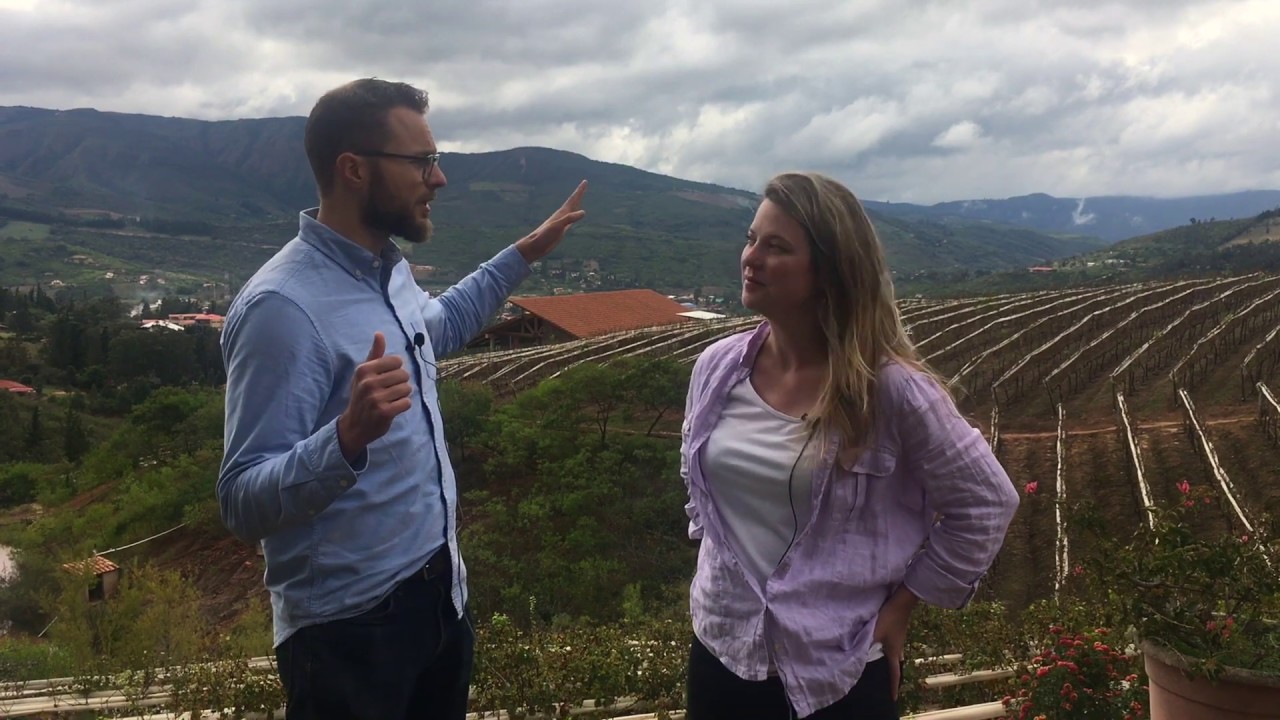
Learn about the Santa Cruz valleys and wine region in Bolivia with South America Wine Guide ‘s Amanda Barnes and Bolivian sommelier Darren Armstrong in this interview overlooking the vineyards of Samaipata and Uvairenda winery.
So Darren, can you tell us exactly where we are in Bolivia and a bit about this special valley?
We’re standing in Samaipata which is a mountain valley in what’s called the Valles Crucenos, or Santa Cruz Valleys. Right now we are standing at just about 1750 metres in the vineyard of Uvairenda, which makes a wine called 1750 with reference to its altitude. We’re at what you call the elbow of the Andes, where the Andes mountains create this sort of elbow shape at the centre of Bolivia. And we are just a bit towards the centre heading towards the eastern part of Bolivia going from the higher elevation to the lower elevation flat lands in the region of Santa Cruz. So this has traditionally been a valley that’s really been the mountain escape from the sweltering heat of the tropical lowlands and has long had a history of wine.
Super, and this is quite distinct from the other wine regions, or the main wine region of Bolivia – Tarija, which is very far south, and west. And also the Cinti Valley. We are the furthest east here you really can go for viticulture in Bolivia, and actually probably in the Americas really… Can you tell us a little bit about what is special about this microclimate and why viticulture works here. A bit about the climate, soils, the terroir… ?
So, altitude is a key factor for winemaking in this region. Some of the first vineyards of Bolivia were planted in Santa Cruz. But in far too low elevation, where there are far too warm nights and you don’t get that nice diurnal shift and temperature swing. So they then came up to this region and starting planting vines and you get this, nice, warm and yet relatively cool days during the summer and the growing season, and very much jacket weather at night! Right now it is winter time, or we are entering winter time, and there’s a lot of wind blowing. We get what you call the ‘surazos’, which are winds that come in from the south of the continent, up through Santa Cruz, and really cool things down. It helps to prevent any kind of disease or mildew, so it really makes a suitable landscape for wine.
Soil wise, there’s definitely a variety of different soils, you get some sandy soils, you get some clay, and especially in this vineyard you get large, sandstone (sort of flagstone) rocks. So very rocky soil which makes it ideal, it’s a challenge, which makes the soil ideal for vines. We’re definitely quite far north compared to the wine regions of Tarija and Cinti. The curious thing is that if you were to drive about 30 minutes on the other side of one of these valleys you’re going to find coffee plantations. And so it is very unique that you can have both, not literally in the same place but very close together, and those are going to some of the southernmost coffee plantations – and again, it’s altitude that really makes this place special and why you can do wine and coffee nearby.
Excellent, two great vices from Bolivia – wine and coffee!