
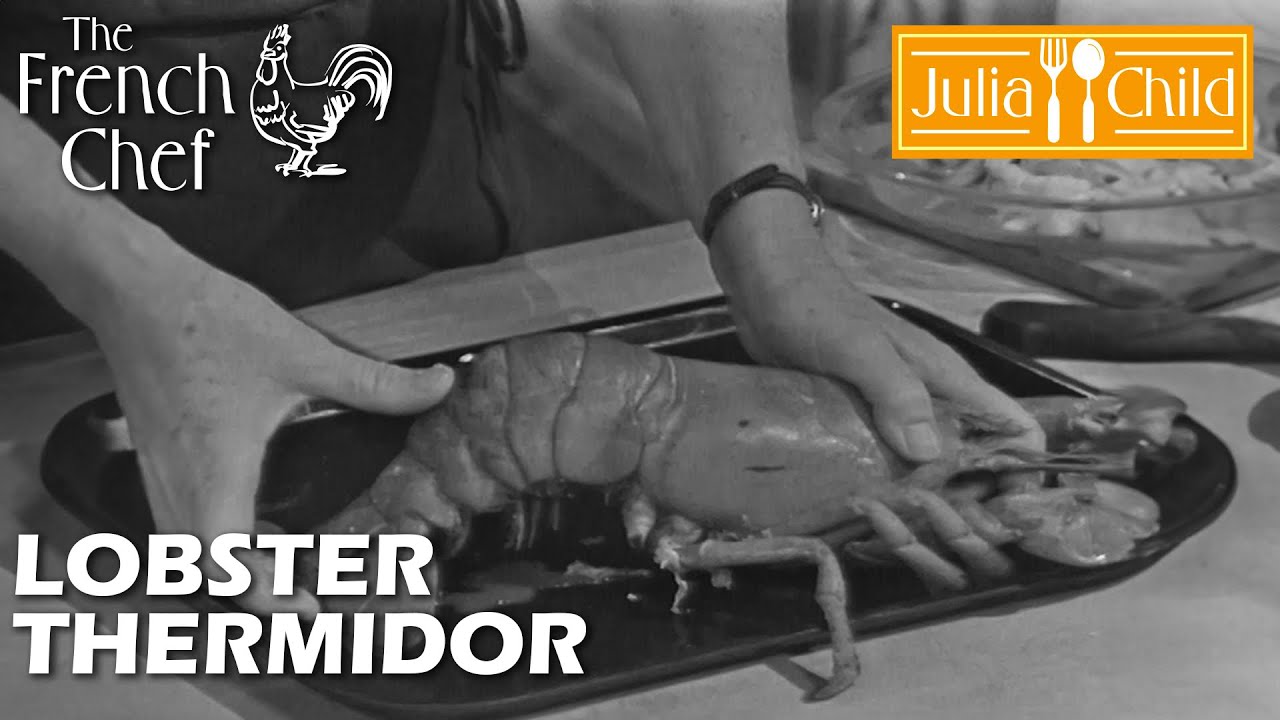
Julia Child shares an especially good recipe for this famous dish of lobster meat sauced and baked in its own shell, or in a reasonable facsimile.
About the French Chef:
Cooking legend and cultural icon Julia Child, along with her pioneering public television series from the 1960s, The French Chef, introduced French cuisine to American kitchens. In her signature passionate way, Julia forever changed the way we cook, eat and think about food.
About Julia Child on PBS:
Spark some culinary inspiration by revisiting Julia Child’s groundbreaking cooking series, including The French Chef, Baking with Julia, Julia Child: Cooking with Master Chefs and much more. These episodes are filled with classic French dishes, curious retro recipes, talented guest chefs, bloopers, and Julia’s signature wit and kitchen wisdom. Discover for yourself how this beloved cultural icon introduced Americans to French cuisine, and how her light-hearted approach to cooking forever changed how we prepare, eat and think about food. Bon appétit!
— Managed by PBS Distribution
Get More Julia Child on PBS:
Twitter: https://twitter.com/pbsdistribution
Facebook: https://www.facebook.com/PBSDistribution.org
-Here are three freshly boiled lobsters, one for each member of the family. And here’s a lazy way to eat them — lobster thermidor! See the cook do the work today on “The French Chef.” ♪♪ ♪♪ -“The French Chef” is made possible by a grant from Hills Bros. Coffee Incorporated
And by a grant from the Polaroid Corporation. -I’m having my in-laws for dinner tonight, and I decided I wanted to treat them like people. So I’m gonna give them lobster thermidor. As a matter of fact, it’s a dish I like very much myself, too.
Lobster thermidor is a marvelous kind of a party dish because what it is is just cooked lobster meat that’s put in a delicious sauce and then put back into the shells. You can put it just in a dish. And you can prepare it way ahead of time.
You can use a good quality of canned or frozen lobster meat or fresh lobster meat. Of course, I’m gonna use fresh ’cause I happen to have them today. And here it is! And this one has all been boiled. I’m doing it somewhat the lazy way,
But I’ve got a good fish market, and he boiled it for me. But one thing he told me — when you ever buy a live lobster, be sure that the shell — that the tail is tightly curled, and it springs right back. If it’s limp and flat out, it means
That the lobster was dead when it was put in the water, and it’s got to be fresh if it’s gonna taste good. And for this lobster thermidor, you can serve individual servings of 1 1/4 pounds, and I’m gonna do a big lobster of 2 1/2 pounds. Now I’ve got to clean it,
And one of the best things to use is one of these lobster shears, or you can use kitchen pointed shears. And the first thing to do is to take the legs and the claws off from the underside and take them off as close to the chest as you can.
These are wonderful — wonderfully big claws. But I find — some people say that the only tender lobsters are ones that are, oh, a pound and a quarter, but I find that these great big ones are just as tender. And now after you’ve got your claws off, you have to —
What you want to do, ’cause you’re gonna serve the lobster in the shell, is you want to keep the shell absolutely whole. And I like to take the — cut it out from either… cut the meat out, getting the… I can’t explain what I mean. Anyway, what I’m gonna do is to start
On the soft underbelly of the tail and cut along both sides between the edge of the tail, or stomach shell, up to… up to this scalloped edge which forms the back. Now, the tail meat is right under that, and I’m trying not to disturb the tail meat. And then here’s this underskin
That just peels right off the tail meat, right up to the chest meat, and then that gets cut off. And there it is. And be sure that you save all these trimmings ’cause you can make a nice lobster stock with them afterwards. Then just lift the tail up,
And then be very careful as you come up towards the chest because here’s your lobster shell, and there’s the tail meat and the chest meat, the chest shell, and it’s attached very delicately, and I want to keep it all together, so we’ll just gradually pull that tail out gently,
And then it just pulls out. And there it is. And then you have the chest meat to take out, but you see how very tenderly it’s hinged right here. So the whole point of that is just doing it very carefully indeed. And then when you come to the chest meat,
This you can lift out, but I think it’s a good idea to start it with a little bit of scissor snip at the very beginning, and then gently lift it up there. And if it catches, just cut it a little bit. Then as it comes up to the chin here,
You just bend it back. This is — all this gingerness is to keep it from the shell from breaking at all. See, it’s just bent right back there. Then you have — inside the shell, you notice you have your — this, what is called green matter, or tomalley,
And this is really part of the most delicious part of the lobsters. It’s soft and lovely and has a lovely flavor to it. So this you want to save and have a little bowl and a sieve and just scrape it out gently with a spoon.
And this is a female lobster, so besides green matter, it has some coral, so it’s pink and green and very pretty, And put that in a sieve. And then carefully, up toward the nose, we’re gonna find the sand sac, and that is inedible.
You want to take that out, just lift in with your fingers and gently pull it out. And you see, there it is. This is really the stomach. And it’s covered with a little filament. You want to get that out without breaking it, and there’s another bit of the coral. Those are lobster eggs.
You put those into your sieve. And this lady, or sand sac — I don’t know why they call it a lady — goes into a discard bowl ’cause that you can’t use for anything. Then take your spoon, and there’s some white matter. I don’t know what that is, but that’s awfully good, too.
And put that all into the sieve. The reason you want to sieve it out — because you’re going to use the… you’re going to use this green matter and white matter and red matter all for flavoring your sauce. And now you start getting the actual meat on,
And you notice the chest has these fuzzy things. I guess those are gills, and these you’ll just pull off. And those are inedible, so put those in your discard pile, and there’s some on each side. Then you have a lot of simply delicious meat in the chest.
It takes quite a while to get out. I’m not gonna take all of it out. I’m just gonna take a little bit out. But pull it apart lengthwise and then there’s sort of joints and segments, and these you’ll pull apart. And there are these delicious little nuggets of meat in there,
But it’s just a matter of just pulling with your fingers. I think this is some of the most delicious and delicate meat of the lobster. Definitely, if you go to a lobster factory, they’ll just give you these — the chest — ’cause it’s too much work.
And then save — after you’ve gotten all the meat out of the chest — save all of that because this is all part of your kitchen treasure, and then your bits of meat go into your plate. And be sure that, naturally, as with all fish dishes, that the lobster smells perfectly delicious.
And be sure, also, if you’re gonna use this tomalley, or green stuff, that that has a delicious flavor, too, and smell because sometimes, if you haven’t gotten a good-quality lobster, you’ll find that the tomalley part has — I don’t know — smells like diesel oil. That means that it was a harbor lobster
Rather than a deep-sea one. And now you’ve got your chest meat, and you’ve got to get the intestine out. So on the outside curve where it’s red, cut down about 1/4 inch right down the middle, and then pull that apart with your fingers. And this one, being a lady —
There’s still some more coral there, but you’re supposed to find a little intestinal tube, and sometimes it’s white, and sometimes it’s black, but it goes all the way down the top of the back. This is the top of the tail about 1/2 inch. Maybe I said this was the chest.
It’s the tail, obviously. There’s your little intestinal tube, and put that in your discard pile. Then you want to dice the meat, the tail meat, into pieces about, oh, 1/2 inch across ’cause you don’t want just a lot of little tiny bits of lobster in lobster thermidor. You want some nice big pieces,
And then these go into your pie plate. I’m doing two lobsters of this size. Now we have the claws, and usually they have some kind of a business that holds the two claws together. I mean, to hold the jaws together. You have the lower and the upper part,
And you want to get the claw meat out whole. Take the lower part and just bend it right back at right angles. And this didn’t happen. [ Laughing ] I’m gonna take the other claw. If you bend it back at right angles, there is — and do it slowly enough.
There. That’s what I’m looking for, is this piece of gristle, and that save and put in your bone pile, and then there’s a little piece of — lovely little piece of meat right in it, that one. And then you have the main part of the claw meat,
And take your scissors and cut out one side of it. And if you want to save the claws for decorations, cut up the other side, too, and then cut right across it, and then you can use part of this claw as your decoration and fill it with your meat.
And, see, there’s your piece of claw meat that has come out whole. And sometimes there’s some white stuff in the claw, and in that case, put it in your tomalley bowl. And then you do the next claw exactly the same way, and then you’ll have the joint meat.
And the joint, I must say, is one of my favorites, too, ’cause that seems — the joint meat, like the chest meat, is very delicate. And there, after you’ve opened that up, you’ll have that lovely amount of meat there, and there’s a little bit of white, which goes into the tomalley pile
And the shells into the shell bowl. And that’s slightly too big, so I’ll cut it up into two pieces. Then you have your other claw and your other joint, which you do in exactly the same way. And this claw I’m gonna save and use for something else. And you have your little legs,
And that also has delicious meat in it, and it’s a long time to get out, so either eat that yourself or save them for decoration. Then you have this tomalley in this sieve, and take tough spoon and just push it all the way through. I think I’ll have to have a tougher spoon.
And this is because there’s always some bits of shell in here, and these you have to get out. And then save all of this, and this is going to be for the sauce later. Then we have — I’ve got two of these lobsters, so we have two shells,
And we have all the meat out. And one of these 2-1/2-pound lobsters gives you about 2 1/2 to 3 cups of meat, so they’re really a good buy. And then I like, also, to mix with lobster thermidor some mushrooms. It sort of fills out a little bit.
And we have about 5 cups of meat, and I want about 2 cups of quartered fresh mushrooms, which means quartering. There’s your whole mushroom, and you take the stem and cut it in half lengthwise, and then cut it in bias pieces.
And if you have a large head like this, cut it in half and then cut it in thirds, which are called quarters. Mainly, it is that all the pieces are the same size. And then these are gonna be stewed mushrooms, so put 2 or 3 tablespoons of water in,
And then to keep the mushrooms white, oh, about a tablespoon of lemon juice squeezed through a clean towel so that you don’t get any seeds in it, and then some salt and some butter. Then those cook covered for just, oh, about 5 or 6 minutes.
About 1/2 a teaspoon of salt and a tablespoon of butter, and then toss them around to cover them with the liquid, and put the cover on and then set them off and let them cook. And now you have your lobster meat, which you want to flavor up.
And this is true if it’s either cooked lobster meat, or particularly if it’s canned or frozen meat, but this — a little butter treatment is gonna make it turn a lovely rosy color. I’m putting in about 3 tablespoons of butter there and about a tablespoon of shallots.
And then in goes the lobster meat. This is very much like making a New England lobster stew. You let that cook in the butter with some salt and pepper. Put in a little bit of salt and a little bit of white pepper. And then it should — and for this recipe,
It should have some tarragon — about 1/4 teaspoon of tarragon. Then after this has cooked for 2 or 3 minutes over moderate heat, and it has begun to turn pink and rosy, you then put some cognac in — about 1/4 cup of very good cognac. And if you don’t have very good cognac,
Just leave out the cognac. And then you want to let that cook until the cognac is completely evaporated. And then you’re now ready to make the sauce, and you want a delicious, creamy, lobstery sauce. And the base of it is — guess who — our old friend the velouté.
And to make the sauce absolutely delicious, you should really have a lobster stock if you’re using fresh lobster. And these are all the shells that you’ve saved here, and you simply simmer them for 30 minutes with a glass of about a cup of white wine or white vermouth and carrots —
A carrot and an onion sliced and a bay leaf and some more tarragon and water to cover. Let it simmer. Then strain it out and boil it down until it has a lovely flavor and it looks like that and tastes perfectly delicious. And then you’re ready to make our dear old friend,
And this is going to have — we want about 2 1/2 cups, so we want about 3 tablespoons of butter. I find this melted butter very useful to have. And then 1/4 cup of flour — just regular all-purpose flour. And that is to cook slowly to make a roux — r-o-u-x.
And then the… And then this delicious stock goes in, and it will be finally a velouté. And remember that this has to cook for about 2 minutes without coloring so that you cook the flour, and then in goes your lobster stock. And if you don’t have fresh lobster, use the same flavorings
But use a little bit of clam juice, or you may just have to leave it out altogether. And then after your roux has stopped bubbling, in goes your hot… your hot stock. Then you want it come up to the boil, and then you…
And then you add a little bit more liquid as necessary. If you run out of liquid, you could just use milk. But as this is kind of a French dish, the more flavor you have, the better. Now, that’s very, very thick, but I’m gonna allow it to be very thick.
But we also have our mushroom juices, which I almost forgot. And those go in. That’s another reason why it’s so nice to have the mushrooms. And now, after you’ve got your velouté, you’re ready to turn it into a thermidor. And we have here this sieved tomalley,
And into that you put two egg yolks. Beat that all up, and then you have, surprisingly enough, about a whole tablespoon of hot mustard — this powdered mustard. You think that’s an awful lot, and then you think, “This is gonna be an awful lot, too,” of putting in a good pinch of cayenne
Or several drops of this hot-pepper sauce, and then a little bit of cream. This is all part of this recipe, having all this flavor in. Then, very gradually, you beat in your hot… your hot velouté. That’s to heat the egg yolks gradually. And then this goes back into your velouté pan,
And then you simmer it. And there’s some little bits of coral that haven’t — that I didn’t sieve very well, but that also gives a little consistency to the sauce. But you can see, if you left any bones in your tomalley, it would be terrible.
Now, this has to come up to the boil, and the egg yolks don’t curdle because you have them in a flour-based sauce, and you’ve been very careful of heating them gradually by having the hot stock go in. And you want it to be thick. I think this is a little bit too thick,
So I want some heavy cream in. You see, the whole point is always adding the liquids gradually so that you end up with just the right consistency. The origin of thermidor is, presumably, it was invented in January 1894 in a restaurant in Paris to celebrate the opening of a play called “Thermidor.”
And this, “Thermidor,” was one of the months of the French Revolutionary calendar, and Thermidor was the month of July and August, which are very hot. And so that’s why you have the mustard and the cayenne in. But as always with these things, you don’t have so much mustard.
And you have just enough, and when you taste it, and if you find that it isn’t quite hot enough, you can put in a little bit more. And that seems a little bit thick, so I’m putting in a little more cream. You see, that’s come up nicely to the boil,
So it is all ready to go, and I’m gonna clean up my work table a little bit here. And we’re really now ready to sauce the meat — the lobster meat. You see, once you get the lobster all cleaned out, it isn’t too terribly much of a problem to do this recipe,
And it’s a nice thick sauce, and then you notice with your lobster meats, you want to have cooked it down until the cognac is almost completely disappeared. And I’ve left these big claw pieces whole. And the mushrooms now go in, which is always a good idea because that means
You don’t have to have quite as much lobster. There’s still a little sauce there, which I will leave. But now that makes quite a reasonable amount. Now, be very, very, very sure that you carefully taste your lobster sauce ’cause it has to be absolutely perfect. Very good.
I think I’m gonna put a little tiny bit of lemon juice in there. You often find that with creamy things, that they need some lemon juice. And then put enough lobster sauce in there just to enrobe the meat. And then you’re ready to fill your lobster shells. There they are.
Now, if you don’t have — if you don’t have live lobsters, you can use an attractive kind of a baking dish and just use exactly the same recipe and just put the meat in the baking dish. I’ve purposely left this large claw meat here so that people know what they’re getting.
Well, there’s a very large claw meat, which I’m gonna put right up in the top of the chest. See, if I hadn’t had some mushrooms, too, I don’t think these lobsters would look quite as full. But having these large lobsters, you really get more meat for your money.
I actually have a little bit left, which I can eat myself later on just to see if it’s really any good. Now, you’ve saved some of your sauce. So the sauce goes over the lobster meat. Really, having this sieved tomalley in the sauce makes it perfectly glorious.
And then having — and that little bit of cognac in the lobster meat does… Well, it just really is a lovely recipe. I don’t wonder it’s so famous. And then you put a little bit of cheese on. Now, the great thing about this recipe
Is that you can do all this part ahead of time. You could even — if you have very good fresh lobsters and a good refrigerator — you could all of this the day before. I’ve got to clean up that plate. Then put on a little bit of melted butter,
And that will let them brown nicely. Now, I do — you do have these claws. Now, these I could have filled and put them on either side. I sort of forgot about them. But you do want to brace them up nicely. And if you find that the lobsters aren’t braced,
You could even put the claws in upside down. And I can see that I missed — I moved it, so I missed one piece there. There. Now, just all of that can be done ahead of time. This really makes it a very nice company dish, and it has the most —
I think it has the most first-class taste of any lobster dish that I know. And so whenever you’re ready to bake them, then, you preheat your oven to 425 degrees, and in they go. And these should go into the upper third of the oven because they brown better. And this is preheated 425,
And they’ll take about 20 to 25 minutes until they’re all bubbling and the top is browned nicely. And then out they come. And you’re all ready to serve. And I think that… You know, you can time it for about 20 to 25 minutes. It’s best to serve them when they’re right done.
Now, this one — this is a giant lobster, 7 pounds, and it’ll serve six people, and it’s just as tender as it can be, and it’s just perfectly lovely. [ Laughing ] And I think it makes a tremendous effect, all hot and bubbly. Now, you’d never believe this magnificent creature
Was all stuffed and ready and just sort of waiting patiently for the doorbell. And that’s the nice thing about you, ’cause you, as the cook — you can relax, too, because once you finally fix the lobster this way, you know you’ve got it all made.
So that’s all for today on “The French Chef.” This is Julia Child. Bon appétit! -“The French Chef” has been made possible by a grant from the Polaroid Corporation and by a grant from Hills Bros. Coffee Incorporated. ♪♪ Julia Child is coauthor of the book “Mastering the Art of French Cooking.” ♪♪ ♪♪ ♪♪
20 Comments
What a perfect dish to serve for a New Year's Eve party! Cheers, Julia!
Good GOD that looks incredibly GOOD!! Out of this WORLD good, in fact! Only Julia Child could EVER make it look easy AND terribly delicious all at the same time!
26 minutes @425 sounds excessive. All the components are already cooked when it goes in the oven. Julia is the queen but recipes have changed since the 60s
Watched this and had lobster for New Year’s Eve. With champagne , baguettes, Caesar salad and edamame peas . Garlic butter melted over small side steaks. What a feast!
Boy that last one was gigantic.
Would be funny if it came to life.
#Happy2024🥃🥳🥂🎉🎆🍾🍺
Ever since playing The Sims 2, I've wondered what was in lobster thermidor. Now I know, and it looks wonderful!
7 lb lobster? Wow! Different times.
I can't watch this. Have to go find a dessert.
I don't know how she got through that recipe without snipping one of her fingers off. I know it's Julia Child but I winced every time she used the shears.
That was a lot of work.
Me watching this a day after broiling halved lobsters for NYE.
Seeing Julia Child prepare a classy dish makes me hungry. 😋
You can’t buy giant lobsters like that anymore.
And if you don’t have very good cognac, just leave out the cognac 😂
Absolutely LOVE this!!
Once got to eat 3 lobster thermidors.
Nobody else seemed to want to eat theirs.
Was one of the best 'cuisine' meals – only 44 years ago.
Sound volume is too low
7 lb lobster was probably 100 y/o. Been watching lobster fisherman on YouTube and I’m impressed just how big and old they can get. As a kid, we went out to a fancy restaurant once or twice a year. My dad always ordered lobster Thermidor and he would alway tell the waiter he wanted lobster Thermidor and not lobster Newburg
When did this in 1950’s?
I wonder how much a 7 lb. lobster cost back then – and how much now?