
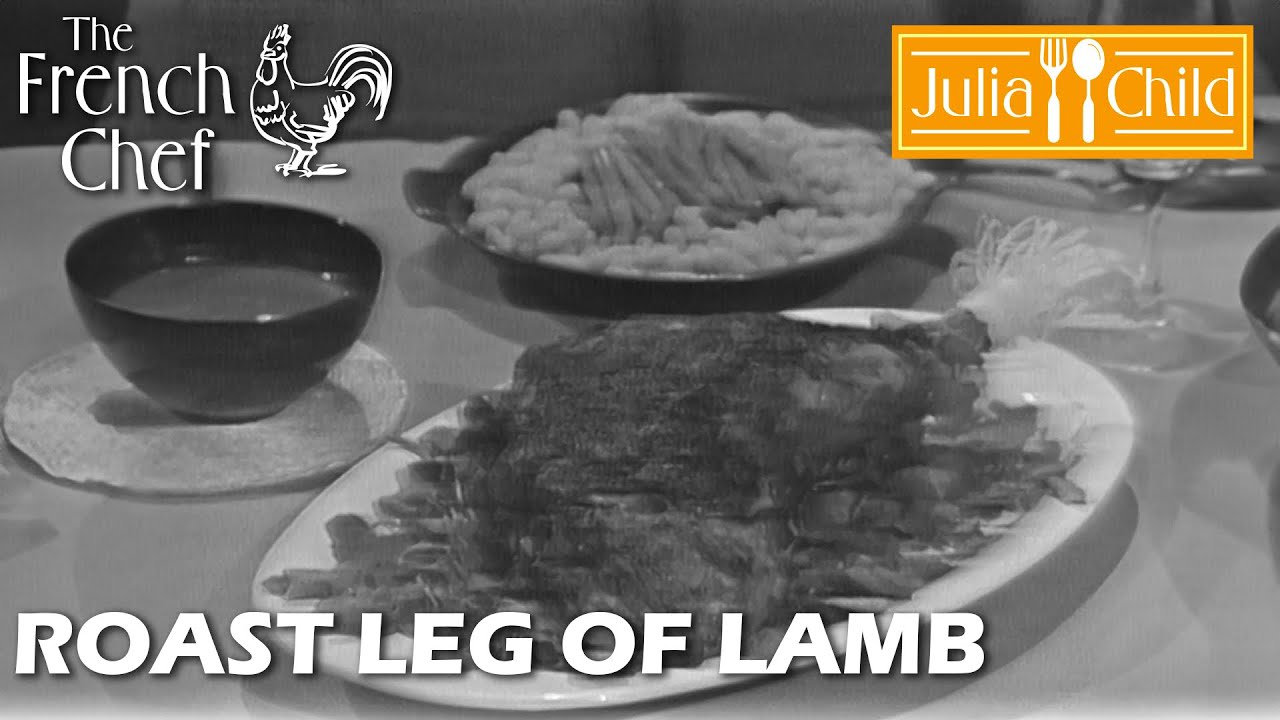
Julia Child demonstrates a sophisticated French twist that makes carving roast leg of lamb a pleasure — remove the leg bone from inside and replace it with a stuffing. Then slather on an herbal mustard coating and roast to a juicy pink.
About the French Chef:
Cooking legend and cultural icon Julia Child, along with her pioneering public television series from the 1960s, The French Chef, introduced French cuisine to American kitchens. In her signature passionate way, Julia forever changed the way we cook, eat and think about food.
About Julia Child on PBS:
Spark some culinary inspiration by revisiting Julia Child’s groundbreaking cooking series, including The French Chef, Baking with Julia, Julia Child: Cooking with Master Chefs and much more. These episodes are filled with classic French dishes, curious retro recipes, talented guest chefs, bloopers, and Julia’s signature wit and kitchen wisdom. Discover for yourself how this beloved cultural icon introduced Americans to French cuisine, and how her light-hearted approach to cooking forever changed how we prepare, eat and think about food. Bon appétit!
— Managed by PBS Distribution
Get More Julia Child on PBS:
Twitter: https://twitter.com/pbsdistribution
Facebook: https://www.facebook.com/PBSDistribution.org
-If I ever manage to get the bone out of this leg of lamb, I’m going to show you a marvelous recipe. It’s a French one called gigot farci. It’s roast leg of lamb, today on “The French Chef.” ♪♪ ♪♪ -“The French Chef” is made possible by a grant from the Polaroid Corporation,
And by a grant from Hills Bros. Coffee, Incorporated. ♪♪ -This is a leg of lamb, and I’m going to roast it, and I’m really torturing myself in a way trying to get the bone out from the inside. Of course, it isn’t necessary at all to bone it,
But I like at least to take some of the bones out because it makes carving so much easier. Now, if you get a whole roast, a whole leg of lamb to roast, I think carving is often a terrible problem. You can carve the fatty part off the leg,
And then when you get to second helpings, you run smack into this great big hip bone, and then unless you’re a real wiz at carving, it’s awfully difficult to do anything with. So at least I have the hip bone taken out. Then it makes it even easier to carve
If you take the leg bone out, which is right in the center of the meat which is attached onto the hip bone at one end and onto the knee at the other. Here’s the knee here, and this is what’s called the shank. This is from the knee to the ankle.
And this big bone, the big leg bone, or femur, is right on the inside. And if you take the hip bone and the leg bone out, you can just carve right straight down on the meat from one end down to the other,
And this little shank bone, which is the only one left in, doesn’t cause you any trouble, and it’s a very nice way to have a lamb! Now, it’s easy enough to get the butcher to take the hip bone out for you,
But to get the leg bone is a little bit more of a problem. And there are two ways of taking it out. That’s where it lies. You can loosen it from inside of the meat and scrape the meat down, and then when you get down to the knee joint inside,
You make a slit in the skin and then cut all around the bone there and cut out the tendons and then pull the bone out, but it makes a hole in the side, and I like the meat left whole with no tears in it. And so to get it out from inside,
You have your bone attached, and you cut all the meat away, and then you scrape all the way down and cut and cut and cut. Then you get down to the most difficult part, which is at the knee joint right here where the skin is very, very thin.
You see, there’s — I’ve gotten this far. You can see my finger wiggling in there, so you can see how thin the skin is, so you have to go very, very carefully all around, being sure that you’re just scraping against the bone. You can sometimes get a butcher to do this for you.
My butcher will do it, and he can do it in about 5 minutes. It takes me quite a bit longer than that, but it’s just this slow fillets all around there at that knuckle end, and then, when you’ve finally loosened it enough, you manage to twist and twist,
And then you have two tendons that attach the bone. There’s your bone again. I’ll put it on top. You have some tendons that attach the kneecap, and then there’s a little sort of a something that comes up over the kneecap, so you just have to twist and cut
And just get right down in there. And it’s a rather slow process, but you can do it. I think that it’s worth it. I’m not going to get this whole one out because I don’t want to take all of that time. I just wanted to show you how to do it.
Just be very careful when you get down to this and then start twisting, and gradually, you can twist, and the tendons are attached in there, and you have to saw it back and forth, and finally, it comes out. And this is — this — After you have the bone out,
Or whether or not you’re going to bone the lamb — I’m going to use this one that is already boned, you want to ask your butcher to take most of the fell off off the big end. That’s sort of that filament.
And then also whether — he may not cut all the fat off, but you take a little knife and slice off all the outside fat that you can. You know, a lot of people I think are not terribly fond of lamb because they feel it has a strong taste,
And I think most of the strong taste is in the fat, so if you just shave off as much as you can all over on the outside, and then there’s usually a big piece that’s on the fatty underside, and shave all that off, and be sure that you take off all the —
Any fatty layers inside. And the best kind of lamb to get is what is known in the trade as genuine spring, which seems to be all year round. But a leg weighs up to 7 pounds, a whole leg. It’s usually around 6 1/2, and that is from excellent quality — excellent quality lamb.
The fat should be lovely and white, and the lamb is only 6 to 9 months old. When it gets older than that, and particularly when it gets up to be a year old, it’s mutton, and that has quite a stronger taste.
And you want also to be sure — if you have a good butcher, the butcher will hang the meat. That means he’ll age it. If a leg of lamb isn’t aged properly, it’s very tough. And this whole leg weighed, when it had all of its bones in, 6 1/2 pounds.
And after you’ve gotten all — Let’s see if I’ve gotten all the fat off here. Just about. I’m using a Norwegian fish-filleting knife. Now, sometimes, you can buy a short leg. This is a short or French leg in which the hip, the whole hip has been taken off,
And the piece of meat where the hip bone was is called the sirloin. And the leg without the sirloin is called a Frenched leg, or a gigot raccourci in French. And for this recipe, in which we’re going to have taken the bone off from the inside,
I’m going to take off the heavy part of the sirloin. And this makes a very nice little steak for two. I’m taking off the heavy part on one side, but I’m leaving a flap on the other side. And you’ll see why later.
But this — You see, that’s a very nice piece of meat. You can either grind it up or you can broil it and use it as a steak. So I shall keep that aside. And you notice here you have a nice — You have a cavity in here where the bone was.
And that you can use for a stuffing, if you’d like. Now I’ll go over these weights again. The whole leg weighed 6 1/2 pounds, and then when you take all the bones out, it weighs 5 pounds, and when you’ve taken the sirloin, this nice piece of steak meat off,
It weighs about 4 pounds. And this 4 pounds of solid meat will serve six to eight people very nicely, and you’ll also have a nice little steak for two. And now you are ready to do the rest — the roasting of it, and fixing it up for roasting,
Now this — You can, after you’ve taken the bone out, you can… skewer the ends together and roast it just as it is, or you can put a stuffing in, and you can use a plain bread-crumb stuffing, or if you ground up some of the lamb, you can use a ground-lamb stuffing,
And that’s what I’m going to do, which is very good. I’ve got about a cup of lamb here, and we want about 2 cups of stuffing in all, and we’re going to have 3/4 of a cup of white bread crumbs — somewhat stale, not too fresh,
And then moisten them with a few tablespoons of milk. And the reason you want the bread crumbs is that they’re going to hold the stuffing together. You just want to moisten them enough so that they’re just dampened but that they aren’t drooling milk. And then let them sit for a moment.
We also — You also want some either chopped shallots or scallions into the stuffing. These are some shallots, and these should be finely diced. Now I’ll put some — a little butter in my frying pan first. Just about a tablespoon. And then I’m dicing these up.
This would be about a tablespoons and a half of shallots. As in so many of these recipes, the exact proportions don’t make very much difference. If you don’t have shallots or scallions, you can use very, very finely minced onion. And then these should always be sautéed in a little bit of butter first,
Because that brings out their flavor. But only for just about a minute. If you cook shallots or scallions too much, it turns them slightly bitter. So it just needs a very small amount of sautéing just to soften them. And then take a look at the bread crumbs.
And these should be somewhat mashed and soft. In many recipes, you’ll see that you soak the bread crumbs and then squeeze them through a towel, but this isn’t necessary if you just put your liquid in a little bit at a time and then mash it around.
And then when your bread crumbs are all right, in go your shallots. Then we want to have some herbs in, and I think rosemary goes extremely well with lamb. Rosemary always seems to come in these little long, needlelike things, so you’ll have to squash them up with something like with a spoon
Because you don’t want pieces of rosemary in things. That’s, oh, about an 1/8th of a teaspoon of rosemary. Then a clove of garlic. The nice thing, I think, as well as rosemary, garlic goes beautifully with lamb, and you often — You can just put little slivers of garlic in,
But I think if you’re going to have a stuffing, you don’t need the slivers. You’ll just have the garlic in the stuffing. And then we have one cup of ground lamb. And some salt, about 1/4 of a teaspoon of salt. And some freshly ground pepper.
That’s really all that you — all you need in the stuffing. It has to be stirred up nicely. You really have to beat it all up so that the bread crumbs and the lamb and the seasonings are all thoroughly mixed up. As a matter of fact, this would turn out to be
A very nice little lamb burger if you ever have any leftover raw lamb. Just grind it up and use this same mixture. That ought to be nicely fixed. I’m going to move some of these things out of the way now. I don’t need that anymore either. I don’t need this butter anymore.
And now you’re ready to stuff the lamb. Be sure I’ve gotten that perfectly well beaten up. Now, you’ll notice you have this big hole in here. And just put it in with your bare hands, pushing the stuffing all the way down to the knee.
I think lamb gains a great deal by being cooked with a stuffing or a flavoring. You could use — If you didn’t want a regular stuffing, you could just have some parsley and rosemary and garlic and put that in, but I think having a stuffing makes the lamb go a little farther,
And that’s always desirable. Now I can get rid of that bowl. Now you want to — you have to skewer it up in place. I better put on my glasses here. You can sew it or skewer it, but I think in this case, the skewering is easier.
Now, see, we have that little flap, which goes over there, and then have some skewers, and you want to be sure the lamb has two sides. This is the sort of fattier one, and you want to have the skewer eyes up. And just stick that right in,
And that will hold the stuffing in place. And the bread crumbs also make the stuffing mass together. And then this just gets laced… …in place, and with this, it’s very easy to remove them. Move the string and the skewers together, and I’m using, as usual, white string. There. That looks very neat.
What I think is nice about this is that the lamb retains its shape. Then it’s all ready for roasting, and I think it should always be roasted on a rack. And put it with this better side up because the lamb does not need to be turned while it’s roasted.
That skewer isn’t in as well as it could be. I’m going to put it back in again. Now, if you’re — You can roast the lamb perfectly plain, and in that case, you’ll just rub it with cooking oil, but you can also use what I think is absolutely delicious,
Which is a mustard coating, which roasts on the lamb and gives it a lovely — an additional lovely flavor and also turns it nice and brown. I’m going to use, again, some more rosemary — about, oh, 1/2 a teaspoon, and this time, I’m going to grind it up in a little mortar.
I got this at a medical supply house in Paris, and it’s very, very useful. Then you want 1/2 a cup, a whole 1/2 cup of very strong mustard, this Dijon type. You don’t want that hot dog mustard because it doesn’t have enough flavor. This seems like an awful lot, but you’ll find that
If you don’t have that much, you won’t have very much flavor. And then, again, some garlic, just one clove. This is delicious stuffing, a delicious coating also if you don’t have any stuffing in. But I think with a stuffing and a coating, you’ve just — it’s marvelous.
And now a little bit of soy sauce. Soy sauce is not a very French addition, but I think it’s a delicious addition because it browns the meat, and it also salts it. Just about a tablespoon. And mix that in rather slowly. And then you want to have some olive oil in.
I have a little, tiny whip. And you mix this just as though you were doing a mayonnaise, about 4 tablespoons in by driblets. And you want the olive oil in, or you could use cooking oil, because it bastes the meat automatically. See? This is just like making a mayonnaise.
It goes very slowly in by driblets because wet mustard acts like egg yolks. Then you paint the lamb with this marvelous mixture. And you paint the outside first. I mean, this fat end that’s been skewered. And if you have time to — if you have time,
You can do this all ahead of time. Put the painting on, and that will give the lamb even more flavor. This is the underside that I’m painting. I’m just doing it with a — spreading it on with a rubber spatula. And now this is the topside.
And then that gets the main amount of the mustard. The particularly nice thing about this besides the flavor and the wonderful odor, this aroma as it’s cooking, is that it browns automatically, so you’ll have a beautiful brown roast when you’re through. And then save a tablespoon or so extra of this mustard coating.
You add that to your sauce, which gives it an even more interesting flavor. And then, as always in roasting meat, I like to put in some, oh, a chopped carrot and onion, and that stays along in the pan, and it gives the juices more flavor. And then you want a thermometer in.
And if the thermometer — I’m putting in — in the — this end here, and it’s supposed to go into the thickest part of the meat, and try and remember where the bone came out so that it doesn’t go into the stuffing — because you want to get an accurate measurement of it.
Now, this you can do all ahead. But before you roast it, if you want to have the timing accurate, be sure that you take it out of the refrigerator a good 2 hours so that it really comes up to room temperature. Because you’ll find every once in a while,
You think, “Oh, the last time I did a lamb, it took so-and-so long, and this time it took longer.” It was probably because the meat was chilled, and it takes 15 or 20 minutes extra to roast it. And then your oven must be preheated to 350 degrees,
And put it in in the lower third. And with this mustard coating, you don’t need any basting. And this is about 4 pounds, but the end of it’s rather thick. And it’ll take between an hour and a half and 2 hours to come to medium rare, which is 140.
And a hundred and — If you haven’t done any roast lamb at — If you’ve always done it well-done, you will find that medium rare is absolutely marvelous because it’s pink and juicy, and it just tastes like an entirely different kind of meat. Now I’m going to put it on its platter.
And timing the lamb depends really almost entirely on its thickness, because a very — If you hadn’t boned this piece of lamb and just roasted it as is, it would take probably about an hour and a half in a 350 oven, but it was boned and rolled, so the meat was very thick.
It would take about 2 hours. And this one, see, the meat is rather thick, so it would take, well, almost 2 hours to a medium rare, and this is — these estimates are based on meat at room temperature… …going into a preheated 350-degree oven. And one — another sure indication
Of whether or not the meat is done is the juices in the pan. It is not at medium rare if you don’t see any juices. This is just one of those facts of meat, like when you’re — if you’re pan-frying a steak, the steak is medium rare
When you can just see the juices begin to come out on the meat, and that’s the same thing with beef or with lamb. If you don’t see any juices in the pan, then you haven’t gotten to the medium rare stage. I’m going to put on a little frill on the leg
To make it look pretty. And then after you’ve estimated the — I mean, after you’ve seen that the temperature is at 140 degrees, you take the meat right out of the oven, and let it rest for 20 minutes. Because it has to rest for 20 minutes.
Otherwise, when you carve it, the juices pour right out. And then you have some of the juices in the pan, and these you want to deglaze with a little meat stock. And if you’ve saved the bones of the lamb, you can make a meat stock by just browning the bones
And boiling them up with a little beef stock and carrots and onions for about two hours. I think I haven’t gotten the string off of that lamb. I just caught that on my eye. No, I didn’t. You see what a lovely color this mustard coating gives.
In this, when you’ve gotten your stock in, you want to let it simmer for a little while to ketchup the coagulated juices. Now, I’ve found in timing meat, I sometimes run into awful problems of having people for dinner, and I haven’t put the meat in in time, and it’s not done,
And we have to wait, and wait, and wait, and wait. So I’ve found that for any lamb around 6 1/2 pounds that I count a good 2 1/2 hours. I put it in 2 1/2 hours before I expect to serve it.
Because then if it takes an hour and a half to cook or 2 hours, I have to have that 20-minute rest period. And then if you have a good oven, you can just turn the oven off and put the — …take the lamb out for the 20 minutes,
And then set the oven to a hundred and — no more than 120, and you can let it stay for… stay for even an hour. But then at least you know that the lamb is done, which is the important thing. Now, after you’ve strained your juices out,
You can thicken them, put in a little bit of — I’m putting in a little bit of cornstarch into this leftover mustard and mixing that into a paste. Then pour in a little bit of the lamb juice, and beat it up, and then pour this back into the sauce.
And let that simmer, and that thickens it up nicely. And you have a very nice, simple sauce — or as some people call it a gravy. In French, you always call a gravy a sauce. You want to let this simmer for a moment or two to thicken,
And then be sure and taste it and see how it is. It ought to be delicious with all that garlic and herbs and the mustard and everything. It’s lovely, lovely. It’s that — the — Putting the — That deglazing part is always terribly important in roasting, because some of your best flavor
Is just in those coagulated meat juices. And some people throw that away, and that’s terrible, because they’re throwing away part of the best part of their — of their meat and their sauce. And then pour this into a warm sauce bowl. My husband always likes to serve meat on a board,
Because it’s — a carving board, because it’s much nicer and easier to carve. He hates carving on a slippery platter. And I’ve found that I like the carving board also if you have a good-looking one. And then as soon as you’re — Be sure that the sauce in your bowl is hot,
And then you’re ready to serve. Be sure also that you serve lamb on very hot plates. There. And I want to see you — I want you to see how wonderfully this boned leg of lamb carves. You just cut it right down. So you can start right at the end there.
You’ve got that little flap piece, but you have no bones in your way at all. And cooking it medium rare, you have this perfectly lovely pink, juicy meat. Some people like it rarer than 140. Then when you get a little farther down in, you get some of the stuffing…
…that all looks like lamb. Of course, it all is. I’m going to put some on the plate so you can see how it looks. And then a little bit of this delicious sauce on. And then for vegetables, you can do what the French have, which is haricots panachés,
Which are a mixture of white and green beans. And for wine, I would serve a red Bordeaux Saint-émilion, which is very good with this. Or you could serve a light burgundy. Now, whether or not you bone and stuff your lamb, I think you’re just going to love this mustard coating.
It gives a perfectly marvelous flavor. And if you’ve never roasted lamb medium rare before, it’s real eating meat. So that’s all for today on “The French Chef.” This is Julia Child. Bon appétit! ♪♪ -“The French Chef” has been made possible by a grant from Hills Bros. Coffee, Incorporated,
And by a grant from the Polaroid Corporation. ♪♪ Julia Child is coauthor of the book “Mastering the Art of French Cooking.” ♪♪ ♪♪ ♪♪
11 Comments
Normally, I can't stand leg of lamb, but WOW does that look G O O D !!!!
Why we eat certain things as we were raised on this.. some had Westerns, others Julia
Acknowledging Julia as the woman of the twentieth century.
I adore lamb
She is not just a legend but soooo much more basic: Julia is just plain ole fun to watch!!!
Lol anyone who eats lamb,but doesn't like the gamey taste, soak it or Dab it) instead) in vinegar,for few minutes. Not too long! No more than id say,3min. Then dab it off, and cook.same with moose deer meat.. just an fyi.
If cleaned and seasoned well, leg of lamb can be delicious. My grandfather taught me how to choose, cleanand prepare a leg of lamb. He always bought no bigger than. A five or six pound leg of lamb. He would soak it over night. It was delicious. Sadly I'm the only one who loved it as much as he did. I love lamb chops. Usually they be cleaned all i have to do is wash trim and prepare them. My grandfather was in the army, lived in New York. He learned a lot from the best chefs there. I miss my grandfather, but cherish what he taught me. Yes mediumn rare, love the mustard coating with bread and herbs.😁😋👍🥰. Love, respect and positivity always. Vee. 🙂👋👣
Proof that "fake it til' you make it" has efficacy in the world of making money.
All those tips . Brill. 🍽️💯🙏
Julia using a boning knife to make brunoise of those teeny shallots like a boss!
Yo can we get AI to improve this videos, add some color at least. How did people survive black/white videos 😢?