
Cab Franc Chronicles – Your source for all things Cabernet Franc!
——————–
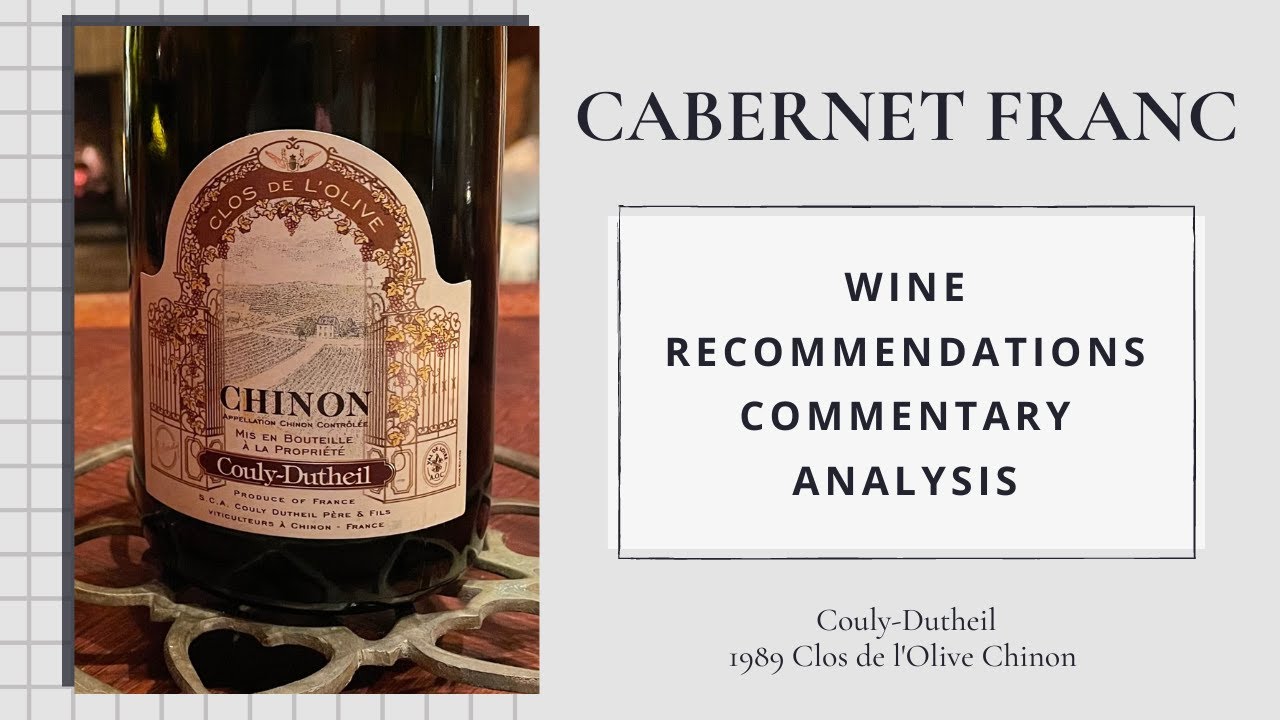
Analysis and commentary of the Couly-Dutheil, 1989 Clos de l’Olive Chinon, Loire Valley, France.
Couly-Duthiel is one of the Chinon appellation’s most important producers. Not only do their vineyards account for around 4% of the total area under vine in appellation, but among their holdings are possibly two of Chinon’s most prized sites, Clos de l’Echo and Clos de l’Olive, both of which are monopole holdings for Couly-Duthiel. Today, the domaine is being run 4th generation Arnaud Couly, the great-grandson of Baptiste Duthiel who founded the estate in 1921.
Clos de l’Olive, this lieu-dit was acquired by René Couly in 1951. It is said to be named after Baron Charles Leinard de l’Olive who was responsible for conquering Guadeloupe for the French in 1635, and was the island’s first governor. The lieu-dit is about 3ha in size, and while some parts of the vineyard were replanted in the 1970s, in the top portion of the vineyard some of the vines over 100 years of age.
The lieu-dit is located about 500m east of the eastern border of the Chinon village, and set back about 1.5km north of the Vienne River. It makes up what is sometimes referred to as Chinon’s ‘premier côte’, referring to this first in a series of several pockets of sloping vineyards that stretch from the eastern side of the Chinon commune all the way east across the communes of Cravant-Les-Côteaux and Panzoult.
The elevation ranges from 33m to about 61m above sea level. We’re on a full south-facing slope, of moderate steepness, so we have excellent sun exposure for ripening. As well, this is a true clos, surrounded by walls, which impacts the microclimate of the vineyard, making it a little warmer than if the walls had not been there.
The Chinon commune is one of the most complex in the appellation in terms of variability of terroirs. On the eastern side of the commune, the slopes between 40 and 60m above sea level are dominated exclusively by the Upper Turonian yellow tuffeau chalk. At higher elevations, we find the soils that date to the Senonian and Bartonian ages, which are various formations of sands and clays, as well as aeolian sands from the Quaternary period.
Clos de l’Olive is on two distinct terroirs. Towards the top of the vineyard, we have quite a shallow topsoil that is a sandy-silt texture, sitting atop the Upper Turonian yellow tuffeau bedrock. And in the lower portion of the vineyard, we find colluvium.
Colluvium is sediments that have formed through erosion, essentially through the gravitational movement of a parent material down a slope. Colluvium tends to be more heterogeneous in texture and less fertile than alluvium. The colluvium here at Clos de l’Olive is a clayey-sand texture.
These sites where we find colluvium, particularly that which is derived from calcareous materials like the Upper Turonian tuffeau chalk that we find here at Clos de l’Olive, these soils are capable of producing fruit that is better suited for making more structured, age-worthy styles of Chinon.
1989 is possibly the best of the 1980s, and was regarded alongside vintages like 1959 and 1964 for red wines from the Central Loire Valley. It was a long, warm vintage that allowed for full phenolic maturity while keeping balanced alcohols and acidities.
From a winemaking perspective, the approach in the cellar for this wine has evolved a bit since 1989. The fruit continues to be hand-harvested and destemmed. Fermentation is done in stainless steel, with approximately 30 days of skin maceration. Arnaud Couly’s approach in terms of élevage really shifted in 2003, from then on this wine, along with Clos de l’Echo, are aged exclusively in stainless steel. In 1989, this would’ve been aged in oak barrels.
Finally, this was a cellar release I purchased in 2021 via an online retailer in the US.
For more on Clos de l’Echo, please check out my video below:
0:00 Intro/Overview
0:47 Clos de l’Echo (in brief)
1:58 Clos de l’Olive – overview
2:32 Clos de l’Olive – location and growing environment
3:33 Soils of the Chinon commune (in brief)
4:32 Clos de l’Olive – soils
4:51 Alluvium vs colluvium
6:15 1989 vintages
6:50 Winemaking
7:57 Tasting notes
——————–
Website in progress with a full write up and tons more content.
Originally posted to Instagram October 10, 2022.
——————–
Key wine facts below:
Producer: Couly-Dutheil
Appellation: Chinon
Commune: Chinon
Lieu-Dit: Clos de l’Olive
Soil: Sandy-silt topsoil on the Upper Turonian tuffeau yellow tuffeau, colluvium that is a clayey-sand texture.
Alcohol: 12.5%
———————
FOLLOW ME: Instagram:
#cabfranc #cabernetfranc #cabfrancchronicles #cabfrancdujour #coulyduetheil #chinon #loirevalleywines