
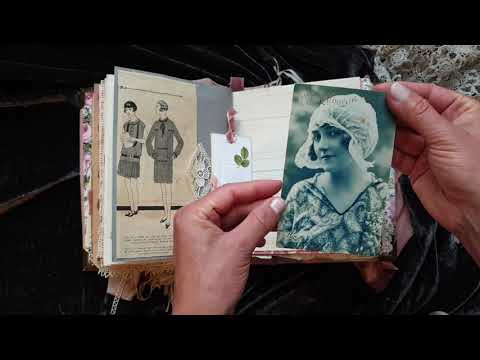
A quick flip through my newly-created junk journal, which I have just put for sale:
This exquisite handmade journal is focused on such ladies’ delights as shopping, fashion, laces, perfumes, roses and so on. This explains why I have decided to borrow the title for it from the book of Emile Zola, “Ladies delights” (“Au bonheur des dames” in French), dedicated to the emerging world of fashion department stores in France in the 19th century. The journal contains plenty of original cards, catalogues, letters, invoices, advertisements, diaries, order forms etc. issued by famous French fashion stores in the late 19th and the early 20th century (all details below). It is also lavishly embellished with antique French laces.
The journal has a hard cover (covered with soft lamb leather) and can be securely closed with a genuine silk velvet ribbon slid through two elegant metal rings fixed to the cover.
The spine is decorated with a removable handmade tassel, made of fire-polished bohemian glass beads, antique fine laces, silk ribbons and silk velvet ribbons. The small cotton decorative tassel dates back to the 19th century.
Cover: H – 23 cm; L – 16 cm; spine – 10 cm large.
Interior pages are of A5 format (21 cm X 15 cm).
8 signatures and about 200 pages (both sides counted).
Weight: 1,425 kg.
The signatures are sewn by a waxed linen thread to a hidden spine, so that the book lie flat and be easy to use.
The journal contains the following ORIGINAL ANTIQUE AND VINTAGE FRENCH EPHEMERA:
– notarial documents dated: 1747, 1810, 1847, and of an unspecified date between 1839 and 1845;
– extracts and pages from: (a) The « Hachette » almanac (Paris) for 1895, 1901, 1902 and 1930; (b) the 1904 diary of the « Maison du Petit St. Thomas » department store; (c) the 1895, 1896 and 1932 diaries of the department store “Grands magasins du Printemps”; (d) the 1913 diary of the department store “Au Grands Magasins du Louvre”; (e) the jewellery and watches’ catalogue « Fabriques Tribaudeau de Besançon» (1935); (f) the 1910 catalogue of the department store « Au Louvre »; (g) the catalogue of the department store « Au bon marché » for winter 1919-1920; (h) the magazine “La Mode Illustrée” of 1927; (i) the magazine “Nos loisirs” of 1907; (j) the 1947-1948 business address and telephone directory of France;
– numerous pages from the following ledgers: (a) a general ledger (“Le Grand Livre”) of 1930s; (b) a commercial ledger printed in 1919 and stamped on each page by the Haute Garonne commercial tribunal in 1929; (c) a household ledger book « Dépenses journalières » (“Daily expenses”) of the 19th-early 20th century;
– 2 original blank order forms from the Paris store “Maison de la belle jardiniere” of 1890s;
– 10 vintage perfume and other cosmetics’ labels;
– 13 French wine and champagne labels;
– 9 advertising cards of fashion stores, including 4 19th-century chromolithographic trade cards;
– 21 post cards (notably, of 1902, 1903, 1909, 1912, 1914, 1922, 1924), including 1 embroidered card;
– 4 bills of exchange issued by French dressmaking / tissues/ leathers’ merchants (two – in 1920s; and the other two – in 1960s);
– an invoice from the “Grands magasins du Louvre” department store of 1889;
– 3 invoices issued by French tanneries and leather fabricants in 1918, 1920 and 1926;
– a bearer share of a French gold mine company of 1907;
– a bank cheque of 1930s;
– a 1896 small calendar;
– a lottery ticket of 1946;
– a handwritten menu of 1920;
– 3 photographs of the late 19th or early 20th century;
– 8 envelopes/ letters sent by French shoe-making companies, tailors, fabrics’ manufacturers and leather stores in 1919, 1921, 1922, 1946, 1948 and 1950;
– 2 envelopes sent by the famous French department store “Galleries Lafayette” in 1948;
– the used blotting paper from the 1932 diary “Grands magasins du Printemps”, with its original metal clip and ribbon; and
– a letter from a Paris-based manufacturer of umbrellas and sunshades of 1939.
The journal is embellished with about 10 m in total of antique French laces, as well as 5 antique hand-made lace doilies and a 19th century fine embroidered muslin handkerchief.
The numerous images of roses are taken from : (a) the book « Roses – L’histoire de la fleur la plus admirée à travers 40 rosiers majeurs, avec un luxe de détails et de données et 40 superbes gravures» (Elliott Brent, HEREDIUM, 2017) ; (b) the book « Pierre-Joseph Redouté. The book of flowers” (H. Walter Lack, TASCHEN, 2017); as well as various Tassotti and other gift-wrapping paper.
The scrapbooking paper used is predominantly from the “Elegance” collection of “Graphic 45” (an award-winning USA scrapbook and paper crafting company).
Lastly, the journal also contains a few blank pages from a vintage notebook printed in Porto in 1950s.
Your support would matter a world to me. Show it if you like what I do