
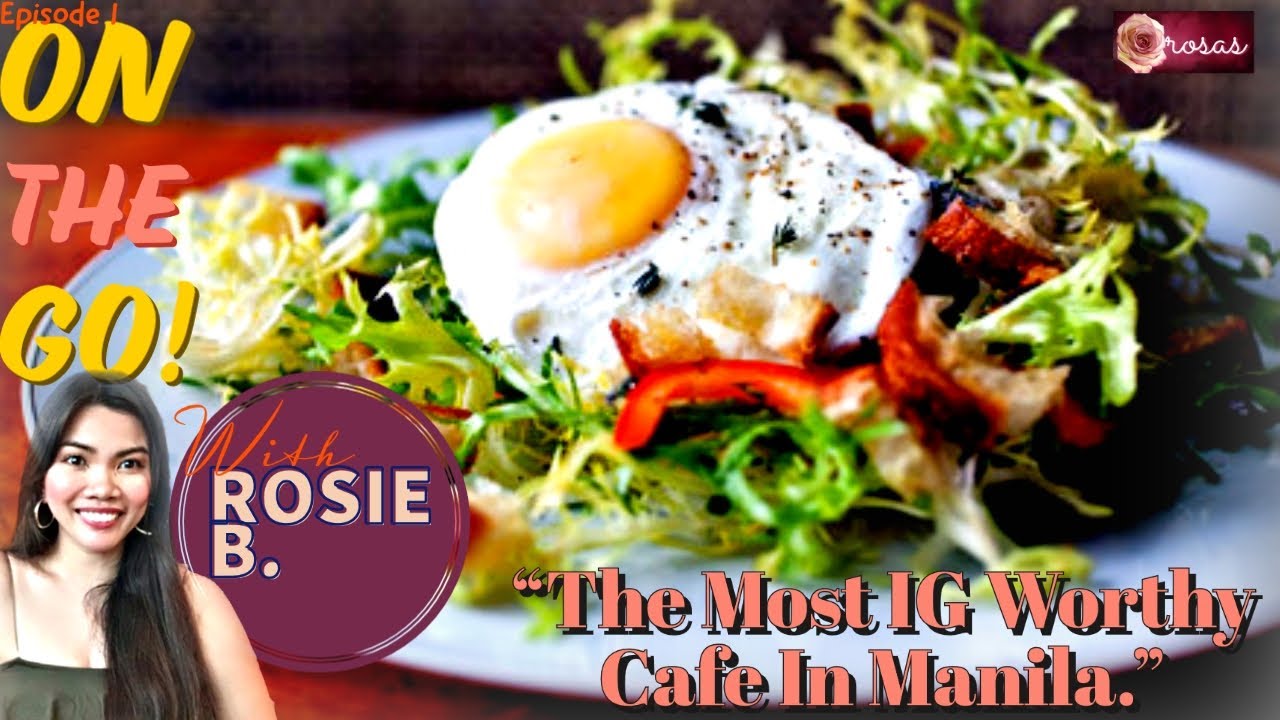
Thanks for checking out Episode 1 of On The Go With Rosie B.! Today’s Episode features a unique French/Japanese restaurant in Century City Mall that will give you a new perspective on comfort food. Le Petit Soufflé delivers some of the most ascetically pleasing dishes that Ive seen to date. You can see why they hold the title of “The Most Instagram Worthy Cafe In Manila.” Place A Order Today! What are you having today? Order your Le Petit Souffle favorites via Foodpanda, bit.ly/LPSOrderForm, or simply call us at 0918 841 8032, (02)718 5681, or (02)887 3056. ✨
History of The Fusion of Japanese/French Cuisine
he early history of the interplay between Japanese and French cuisine is so muddled that some of fine dining’s most famous chefs — even ones with restaurants in France and Japan — don’t always agree on their place within it. At a conference held last winter in Tokyo by Relais & Châteaux, a global alliance of independently owned luxury hotels and restaurants, Jean-Robert Pitte, a professor of geography focused on foodways, gave a presentation on the mutual cross-pollination between Japan and Europe, especially France. After a familiar review of the historical record, he invited the audience, packed with influential restaurateurs, hoteliers, and chefs, to consider the greatest hits of fine dining over the past 30 years.
Pitte introduced key aspects of kaiseki, then flicked through a slideshow of elaborate small plates from European restaurants and catalogued how un-European they were. The precise cutting and humble vegetables that lend beauty to Michel Bras’s legendary Gargouillou of Young Vegetables, according to Pitte, was “one of the first entries of Japanese aesthetics in French cuisine.” In another slide, Pitte pointed to the spray of color and flowers in a recent dish by Pierre Gagnaire as a far cry from monochromatic French food — but very close to the rainbow of kaiseki. Traditional French cuisine, he argued, was focused on a harmony of flavors and presentation — a balanced “symphony.” Now, European chefs were cooking in a deconstructed, hyper-colorful, raw, visual style that Pitte feared was in danger of becoming soulless, either from losing its own cultural roots, or from not incorporating the specific celebration of terroir and change in the Japanese cuisine it borrowed from.
Later in the day, Bras and Gagnaire, two of France’s current culinary eminences grises, took the stage as part of another panel about Japan’s influence on French cooking. They complicated Pitte’s argument that they were deeply influenced by, and indebted to, Japanese cuisine from the start of their careers. The pair claimed that their food came first, and that their discovery of Japan came second. Gagnaire said that when he traveled to Japan after starting out as a chef, he discovered they were “soul mates,” in an improvised speech that seemed to imply the country spoke to values or qualities he already had, rather than imparting new ones.
Bras emphasized, both at the conference and over email, his deep love and respect for Japanese cuisine, and how its traditions had deepened his own cooking considerably. Perhaps because Japanese aesthetics travel outside the country primarily in terms of visuals and ingredients, rather than training in specific kitchens, he suggested, the influence is omnipresent but difficult to pin down, an issue not confined to French cooking. “That’s a global phenomenon,” he wrote.
In contrast to Bras’s and Gagnaire’s late introductions to Japan proper, the chef David Kinch, who is a generation younger and a pillar of California fine dining best known for his restaurant Manresa, readily catalogued the myriad ways Japan had influenced him as a young chef, starting with the moment of “wonder” when he tried sushi for the first time. At the conference, Kinch described the many instances he learned from Japanese chefs and writers, from the hard work — and sharp knives — of the Japanese stages he worked alongside in Europe, to the revelations that Tsuji’s Japanese Cooking presented to him as a young cook in the 1980s.
The complete portrait painted by Kinch, Bras, and Gagnaire is not a single moment of disruption but a constant stream of influence. In a culinary culture where greatness — not to mention money — flows toward chefs trained in specific European lineages, it can be a source of discomfort to acknowledge the omnipresent and complex influence of an Asian culture, one often gleaned through consumption. Kinch emphasized his own struggle not to create a surface-level fusion of California and Japanese cooking, but to instead truly and deeply incorporate the values he admired into his own work.
#food #review #restaurant #cuisine #onthego #rosieb