
When microorganisms were known to exist, most scientists believed that such simple life forms could surely arise through spontaneous generation. That is to say life was thought to spring spontaneously from mud and lakes or anywhere with sufficient nutrients. This concept was so compelling that it persisted until late into the 19th century.
The main aspects were to solve the controversy over spontaneous generation which includes experimentations mainly of Francesco Redi, John Needham, Lazzaro Spallanzani and Nicolas Appert etc and to know the disease transmission which mainly includes the work of Ignaz Semmelweis and John Snow.
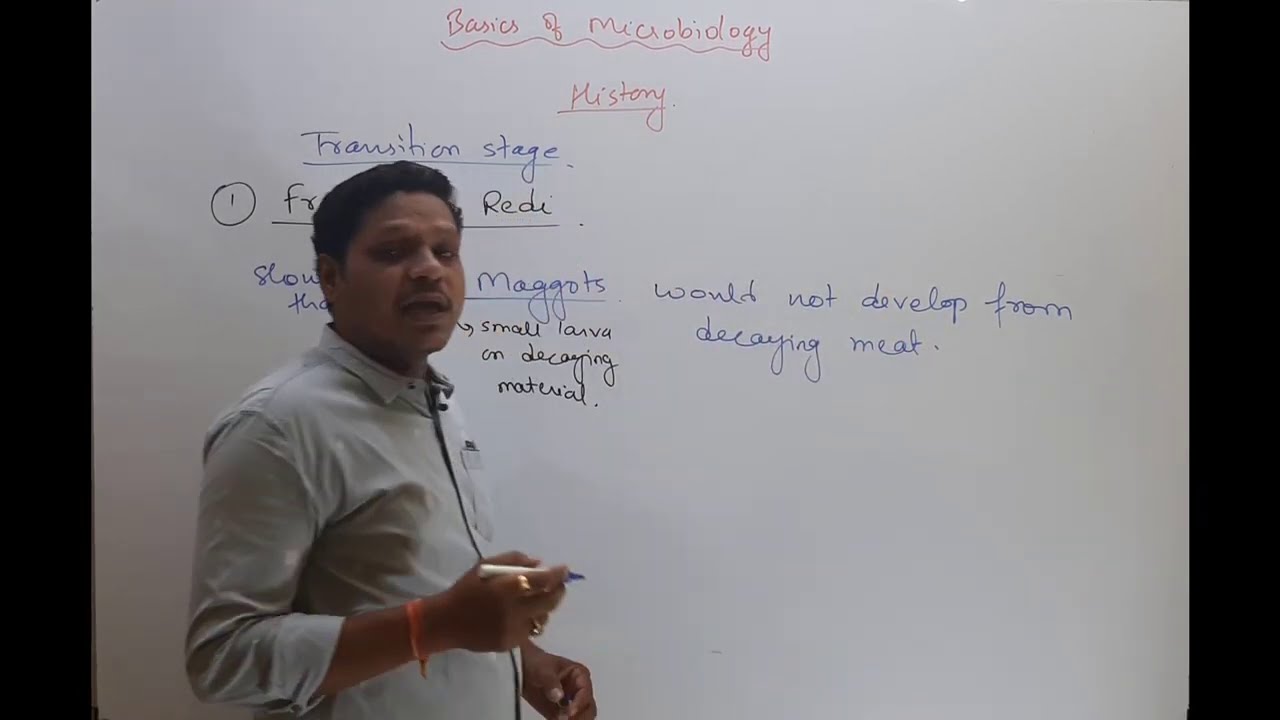
Francesco Redi (1626-1697): The ancient belief in spontaneous generation was first of all challenged by Redi, an Italian physician, who carried out a series of experiments on decaying meat and its ability to produce maggots spontaneously.
John Needham (1713-1781): He was probably the greatest supporter of the theory of spontaneous generation. He proposed that tiny organisms the animalcules arose spontaneously on his mutton gravy. He covered the flasks with cork as done by Redi and even heated some flasks. Still the microbes appeared on mutton broth.
Lazzaro Spallanzani (1729-1799): He was an Italian Naturalist who attempted to refute Needham’s experiment. He boiled beef broth for longer period, removed the air from the flask and then sealed the container. Followed incubation no growth was observed by him in these flasks. He showed that the heated nutrients could still grow animalcules when exposed to air by simply making a small crack in the neck. Thus Spallanzani disproved the doctrine of spontaneous generation.
Nicolas Appert followed the idea of Spallanzani’s work. He was a French wine maker who showed that soups and liquids can be preserved by heating them extensively in thick champagine bottles.
Ignaz Semmelweis and John Snow were the two persons who showed a growing awareness of the mode of disease transmission.
Two German scholars Schulze (1815-1873) and Theodor Schwan (1810-1882) viewed that air was the source of microbes and sought to prove this by passing air through hot glass tubes or strong chemicals into boiled infusions in flasks. The infusion in both the cases remained free from the microbes.
George Schroeder and Theodor Von Dusch (1854) were the first to introduce the idea of using cotton plugs for plugging microbial culture tubes.
Darwin (1859) in his book, ‘Origin of the Species’ showed that the human body could be conceived as a creature susceptible to the laws of nature. He was of the opinion that disease may be a biological phenomenon, rather than any magic.
Telegram Group Link
Bhushan Science EXAM PREP