
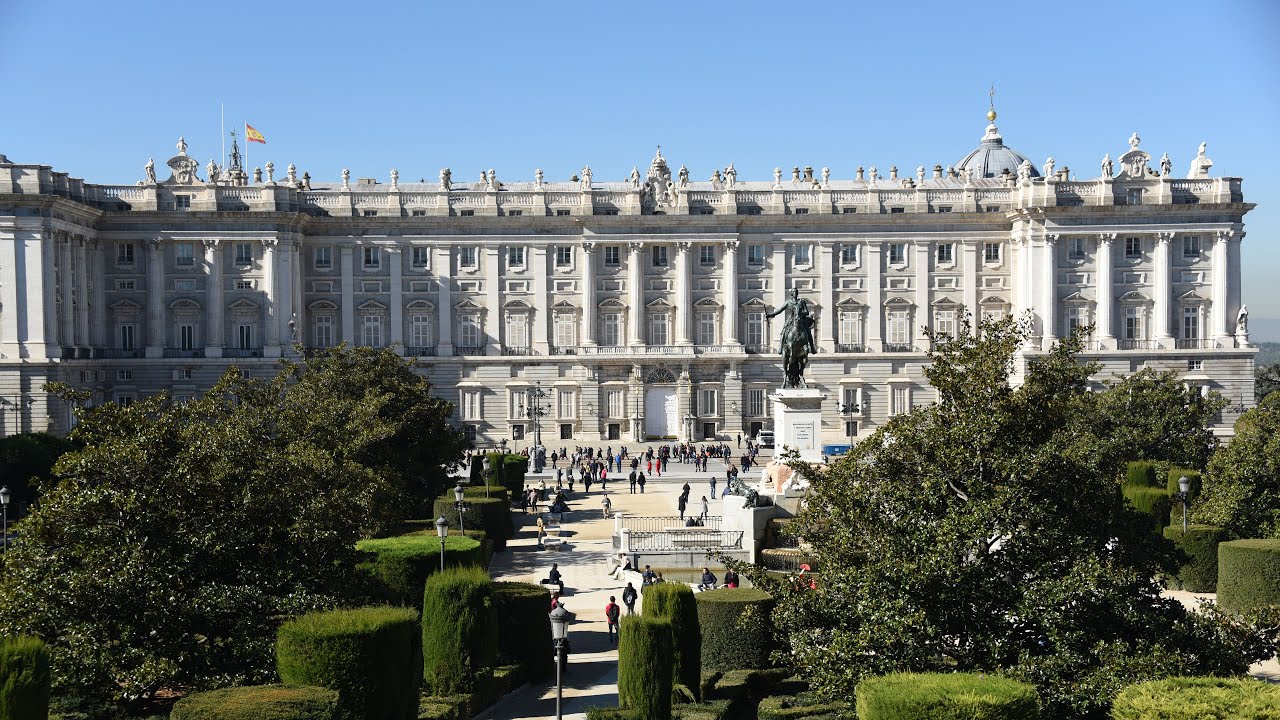
Royal Palace Madrid Spain
Madrid’s Royal Palace was built by Phillip V in the 1700s. He was born in Versailles, and while he ruled Spain for 40 years, he stayed very French. The palace was designed to be Phillip’s Versailles — to help establish a new dynasty…the Bourbons. And it’s big — over 2,000 rooms…
The Palace sports the French-Italian Baroque architecture – heavy columns, classical-looking statues, a balustrade roofline, and false-front entrance. The entire building is made of gray-and-white stone.
We admired the Royal Palace from the outside in Plaza de la Armería while we waited for it to open. We gazed up at the bells that date from 1637 and 1761 with the royal coat of arms flanked by angels below, and the clock flanked by statues of Philip V and Fernando VI, Barbara de Breganza and Maria Luisa de Saboya statues below that. We noticed statues of Moctezuma sovereign of the Aztec Empire of Mexico 1502-1520 by Juan Pascual de Mena and Atahualpa, the last Inca emperor 1502- 1533 by Domingo Martínez.
As we entered the palace, we could see the inner courtyard with statues of Roman emperor Theodosius I and Byzantine emperor Arcadio. There was a statue of Charles III In A Roman toga. We walked up the Grand Staircase, built by Sabatini in 1789, and came out into an expansive area with a frescoed ceiling Religion protected by Spain by Corrado Giaquinto 1750s, Charles IV Coat Of Arms,, Charles IV Statue, and the current king Philip VI Coat Of Arms.
The tour now begins as we walk from room to room. No photography is allowed so I used some photos from Patrimonio Nacional.
The Hall of Columns has a ceiling fresco by Jaquinto Giaquinto, representing The Sun before Which All the Forces of Nature Awaken and Rejoice, an allegory of the king as Apollo. It depicts a radiant young Apollo driving the chariot of the sun, while Bacchus enjoys wine, women and song with a convivial gang.
The Gasparini Room is designed as a single gold-green-rose ensemble and has the biggest chandelier in the palace.
The Porcelain Room is paneled with green-white-gold porcelain and has a clock with Atlas supporting the world on his shoulders by Abraham-Louis Breguet (around 1800)
The Gala Dining Room was created in 1879 by Alfonzo XII. The room is lined with golden vases from China and fine tapestries. The whole place glitters with 15 chandeliers.
The Royal Chapel is a huge domed chapel best known as the place for royal funerals. The ceiling fresco by Corrado Giaquinto shows Apostle Santiago Helpings the Christian Army in the Battle of Clavijo.
The Stradivarius room features the Palatine Quartet made up of two violins 1709-10, a viola 1696 and a cello 1697.
The Crown Room displays the precious objects related to the long tradition of crowning a new monarch. In the middle of the room is a crown and throne dating back to Charles III and a sceptre from Charles II.
The Antechamber of Charles III has four royal family portraits by Goya.
We then walked along a hallway between rooms featuring five tapestries on Don Quixote (1721-1746), commissioned by Philip V.
Next and last is the highlight of the tour – the Throne Room. The Throne Room dates from Charles III in 1772, and features Tiepolo’s ceiling fresco, The Apotheosis of the Spanish Monarchy. There are dual thrones, bronze sculptures and four bronze Medici lions by Matteo Bonicelli (1651).
We exited the palace and admired the Almudena Cathedral, the seat of the Roman Catholic Archdiocese of Madrid. Even though the first stone wad laid in 1883, the cathedral was only finished when it was consecrated by Pope John Paul II in 1993.
We walked to the edge of the palace and looked down at the vast palace backyard which was once the king’s hunting ground, and is now a city park dotted with fountains.
Behind the palace, and a good place for quiet strolls, are the Sabatini Gardens, formal beds and hedges laid out in the geometric neoclassical style, with fountains, statues, and a pool.
The Plaza de Oriente was designed in 1844 by the architect Narciso Pascual Colomer under the orders of King José I who demolished the medieval houses in the area. In the centre of the square there is a bronze of Philip IV on horseback produced by the Italian sculptor Pietro Tacca in 17C. This was the first equestrian statue in the world supported on the back legs of a horse (the tail provides inconspicuous additional support). Sculpture of Spanish kings dot the paths in the plaza.
You can get another beautiful side view of the palace from the relaxing Sabatini Gardens.