
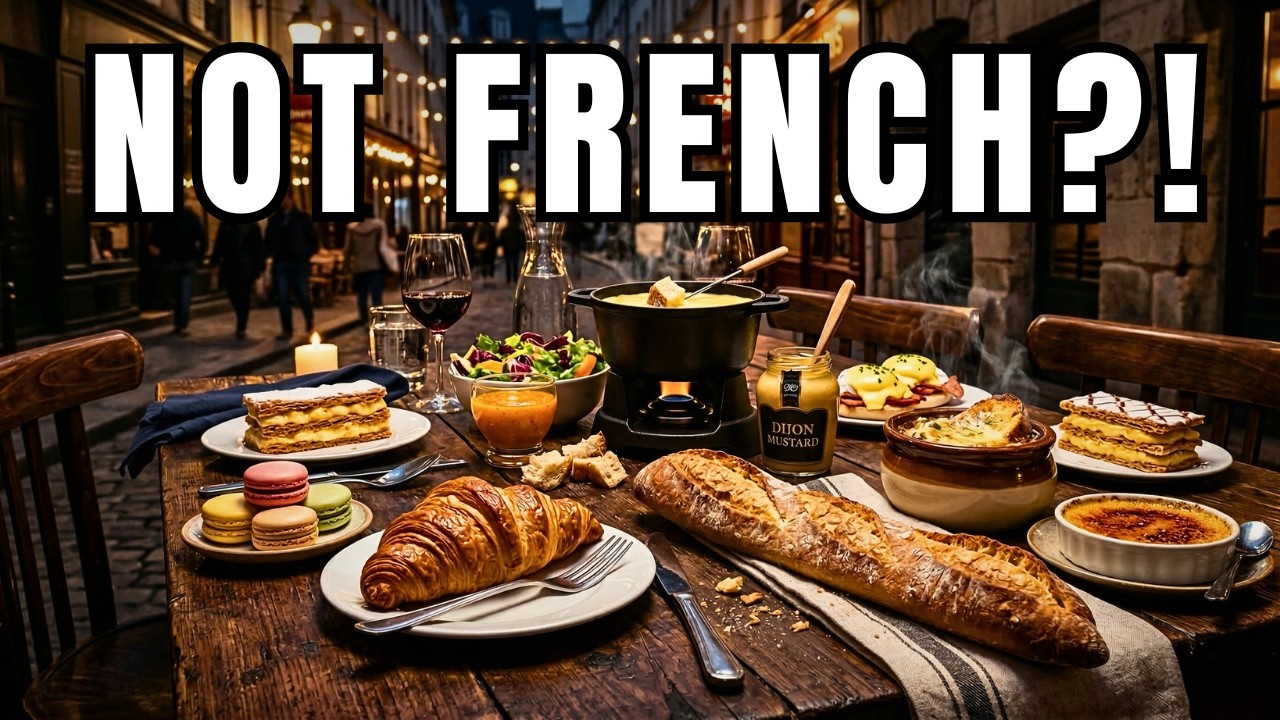
What if everything you thought you knew about French cuisine was actually… borrowed? In this video, we’re pulling back the curtain on 10 of the most iconic “French” foods in the world — and revealing where they actually came from. The answers might just ruin your next trip to a Parisian café. (In the best possible way.)
From the croissant (spoiler: thank Austria) to the macaron (merci, Renaissance Italy), from crème brûlée to hollandaise sauce, these beloved dishes have fascinating, globe-spanning origin stories that France would very much prefer you didn’t Google. We’re talking Viking-era roots, royal Italian wedding gifts, Ottoman war trophies, and even a labor law loophole that accidentally created one of the most recognized foods on Earth.
Whether you’re a food history nerd, a passionate home cook, or just someone who’s always wondered why so much of the world eats French food without questioning it — this one is for you.
France didn’t always invent the food. France invented the feeling around it — and honestly? That might be the most impressive culinary flex in human history.
If you love food history, surprising origin stories, and having your assumptions completely flipped upside down, subscribe to Where Food Began and hit the bell so you never miss a story like this one.
21 Comments
Mustard seed oil is as old as man’s occupation of Himalayan valleys 15:41
THESE FOODS ARE NOT FRENCH :
@00:39 : CROISSANT ( FROM VIENNA , AUSTRIA , 17TH CENTURY )
@02:00 : MACARON ( FROM RENAISSANCE ITALY )
@03:33 : FRENCH ONION SOUP ( FROM ANCIENT ROME )
@05:05 : CREME BRULEE ( FROM ENGLISH COOKBOOK )
@06:40 : BAGUETTE ( FROM AUSTRIA )
@08:17 : HOLLANDAISE SAUCE ( FROM NETHERLANDS , 17TH CENTURY ) )
@09:51 : FRENCH DRESSING ( FROM UNITED STATES )
@11:29 : FONDUE ( FROM SWITZERLAND )
@13:09 : DIJON MUSTARD ( FROM CANADA )
@14:53 : NAPOLEON PASTRY ( FROM NAPLES , ITALY )
I never thought fondue was French. Always knew it was Swiss.
Let us know which cities, countries, or any places for that matter you'd like us to dive into next!!
A lot of this mistake are american alone. A lot of it was never taught by us french people. For the croissant, we respect it's origin, we call this type of pastry viennoiseries, for the technique that comes from Vienna. For the cheese fondue, we know it's Swiss but we have our own, the bourguignonne fondue who is a beef fondue in aromatic herb oil, we have a food dispute with the Swiss but it's about the raclette, an other winter cheese base dish. But France and Switzerland have their own ways of preparing and enjoying raclette, and the appliances used to prepare it differ. However, the Swiss raclette grill remains the standard in raclette restaurants. The French raclette grill is more commonly sold for family meals. However, I'm really surprised to learn that you call it Napoleon's pastry in the United States, that's not its name at all in France. It's called "mille-feuille" or "thousand leaves" in English. It's completely different from the Italian Napolitan cake that the French also eat in our supermarkets, which is made up of several layers of sponge cake. The mille-feuille is made up of layers of cream separated by puff pastry. Perhaps you gave it that name because of its resemblance to Neapolitan cakes, and you called it Napoleon because of its French similarity, but that's not its French name at all.
For the onion soup we see it like a peasant dish who was register in the french cultural cuisine and reinvented by Michelin-starred chefs and incorporated into top French restaurants, like many traditional French dishes that have humble origins. France has a huge number of traditional dishes, each recognized by its region of origin. And I believe that the United States, like the rest of the world, doesn't even know 10% of all the dishes that exist in France and continue to be created here.
Just a fun fact, french cuisine culture come from Louis XIV who want the world to look at France at the country of culture, he develop art, architecture, music, theatre and also the french culinary culture. He spent enormous sums of money developing French cuisine to impress his guests at banquets but also foreign emissaries so that France would become the world capital of culture, art, and cuisine.
Les hollandais ne connaissent pas et n'ont jamais connu la sauce hollandaise
L'idée d'une identité culinaire est l'idée de ceux qui n'ont pas d'identité réelle
You forgot omelette (from Roma)
The French don't necessarily claim croissants, I mean every boulangerie lists them as viennoiseries.
# 11..FRENCH FRIES
Originated in Belgium around 1850 as cheap and easy to make finger food for farmers and labourers.
Since 1856 the fries were sold at fairs and carnivals as an easy snack and spread that way very fast over the country and later over France.That's why in Belgium and Northern France you can find mobile chip shops BARRAQUES Á FRIETES. In the beginning they used sheep fat but since sheep fat stinks the Fries (frietes) were made in open air.
During WW1 British and US soldiers tasted for the first time Fried potato sticks, they called it FRENCH Fries for the people in the region of the FRIET BARRACKS spoke French.
* Macarons *
A la Renaissance, l'Italie N'EXISTAIT PAS. L'Italie n'existe que depuis 1861.
On fabrique des macarons à Cormery, depuis 781, sous Charlemagne (c'etait alors le Royaume des Francs).
* Soupe a l'oignon *
Les français adorent les oignons.
L'Armee Française est la seule armée au Monde qui a une chanson de l'oignon. Elle date des Guerres Révolutionnaires et des Guerres Napoléoniennes.
"J'aime l'oignon frit à l'huile,
J'aime l'oignon quand il est bon.
J'aime l'oignon frit à l'huile,
J'aime l'oignon, j'aime l'oignon.
[Refrain :
Au pas camarades, au pas camarades,
Au pas, au pas, au pas,
Au pas camarades, au pas camarades,
Au pas, au pas, au pas.]
Un seul oignon frit à l'huile,
Un seul oignon nous change en lion,
Un seul oignon frit à l'huile,
Un seul oignon nous change en lion.
[Refrain]
Mais pas d'oignons aux Autrichiens,
Non pas d'oignons à tous ces chiens,
Mais pas d'oignons aux Autrichiens,
Non pas d'oignons, non pas d'oignons.
[Refrain]
Aimons l'oignon frit à l'huile,
Aimons l'oignon car il est bon,
Aimons l'oignon frit à l'huile,
Aimons l'oignon, aimons l'oignon.
[Refrain]
"
It's the first thing i do before i start eating when i'm hungry and that's wondering who invented it and where it came from. 🙂
You don't have a croissant with a tiny cup of coffee but usually rather a bowl of cafe au lait.
The fact that cheese fondue uses gruyere, a Swiss-type Alpine cheese from Switzerland is a huge clue that cheese fondue is Swiss in origin. I thought that was common knowledge.
The French always shock me but it's OK.
The croissant and the baguette surprised me the most.
Hollandaise sauce was created during french king Louis XIV because of the war vs Holland in 1672 !! IT'S FRENCH !!!
THIS IS FRENCH BASHING !!!
This is not typical to france, but, i would say, every countries. Cooking, baking have always been born somewhere and exchanged, improved, modified.