#parisstreetfood #RueMontorgueil #streetfoodparis #pariswalk #parisfood #parisfoodtour
Rue Montorgueil is one of the oldest, liveliest, and most beautiful streets in Paris. It is a place where history, gastronomy, and everyday city life have intertwined for centuries. The street lies on the border between the 1st and 2nd arrondissements and is considered one of the oldest in the French capital. According to historians, its origins date back to the Middle Ages, even before the 13th century.
The origin of the name remains uncertain. The most widely accepted theory links it to a nearby hill called Mont Orgueil — the “Proud Hill.” Ironically, between the 10th and 15th centuries, this hill was nothing more than a massive pile of waste. Parisians humorously referred to it as the “Proud Hill,” and over time, the name became attached to the street itself.
From the 17th century onward, Rue Montorgueil has always been noisy and crowded. Fishermen from northern France passed through here, bringing fresh catches into the city via the Porte Poissonnière — the Fish Gate of Paris. The street was lively, dirty, filled with strong smells, vendors’ cries, and the constant movement of carts. Because of its proximity to the infamous Court of Miracles, the area was long considered unsafe, especially at night. Yet it was this chaotic energy that shaped the street’s character — a character still felt today.
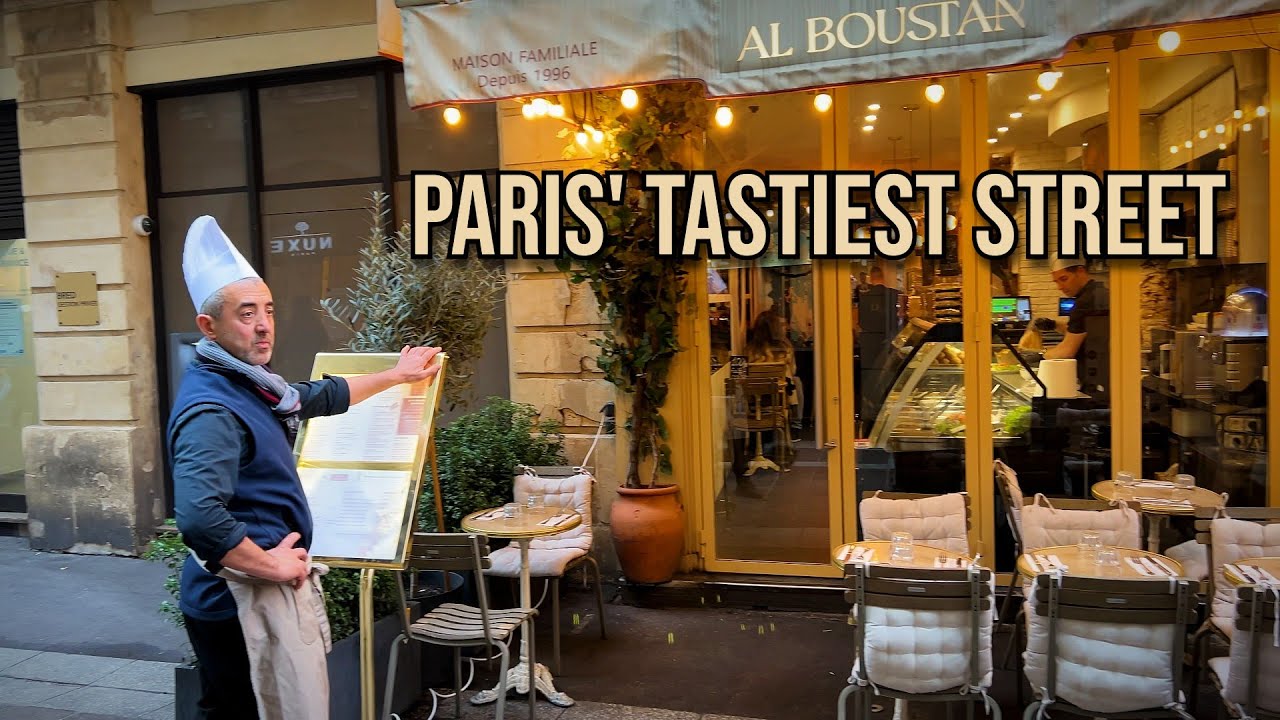
Over time, Rue Montorgueil became a gastronomic heart of Paris. For centuries, food has been traded, prepared, and shared here. Today, the street is famous for its street food: fresh baguettes and croissants, oysters, cheeses, grilled meats, crêpes, falafel, and dishes from all over the world. The aromas of cooking blend with the sound of conversation, while café terraces remain full from morning until late evening. People eat on the go, standing by food counters, or slowly enjoy a glass of wine at a small table.
One of the most iconic places on the street is the legendary Stohrer pastry shop — the oldest in Paris. It was founded in the 18th century by Nicolas Stohrer, the personal pastry chef of Marie Leszczyńska, the future wife of King Louis XV. It was here that the famous rum baba was created, inspired by a Polish dessert. According to legend, King Stanisław I, after tasting the cake, named it Ali Baba, after the tale from One Thousand and One Nights.
Rue Montorgueil is also known for its historic restaurants. L’Escargot de Montorgueil, opened in 1832, specializes in Burgundy cuisine and snail dishes. Its façade, adorned with a large golden snail, has become one of the street’s symbols. Over nearly two centuries, it has welcomed guests such as Marcel Proust, Pablo Picasso, Charlie Chaplin, and Sarah Bernhardt. Another notable establishment was Au Rocher de Cancale, opened in 1804 and immortalized by Honoré de Balzac in La Comédie Humaine. Over the years, it hosted figures like Alexandre Dumas and Théophile Gautier, becoming part of Paris’s literary history.
Rue Montorgueil has inspired many writers and artists. It was mentioned by Victor Hugo in Les Misérables and by Émile Zola in The Belly of Paris. In 1878, Claude Monet depicted the street in his famous painting, showing it adorned with thousands of flags during a national celebration.
Today, Rue Montorgueil remains a living street of flavor and movement, where past and present exist side by side. It is still noisy, delicious, and unmistakably Parisian. This is Paris not only to be seen, but tasted.

2 Comments
Rue Montorgueil is one of the oldest, liveliest, and most beautiful streets in Paris. It is a place where history, gastronomy, and everyday city life have intertwined for centuries. The street lies on the border between the 1st and 2nd arrondissements and is considered one of the oldest in the French capital. According to historians, its origins date back to the Middle Ages, even before the 13th century.
The origin of the name remains uncertain. The most widely accepted theory links it to a nearby hill called Mont Orgueil — the “Proud Hill.” Ironically, between the 10th and 15th centuries, this hill was nothing more than a massive pile of waste. Parisians humorously referred to it as the “Proud Hill,” and over time, the name became attached to the street itself.
Another awesome vlog! Thanks!