
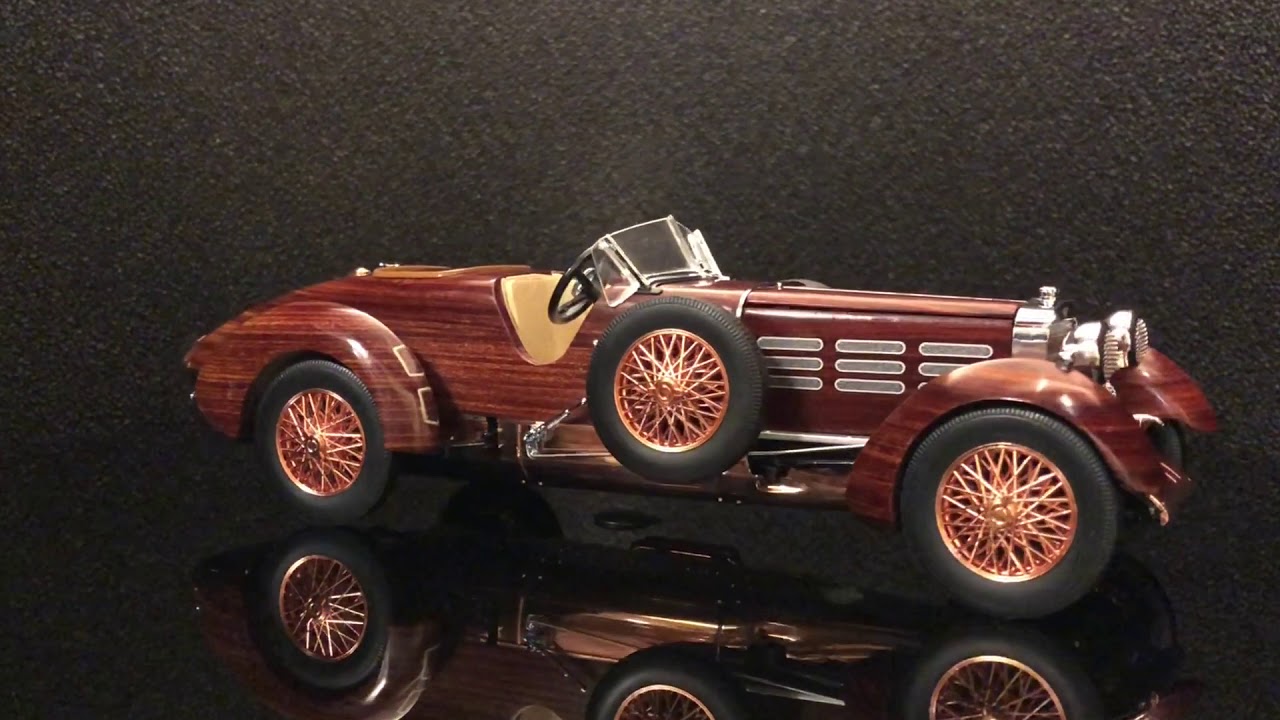
Franklin Mint 1:24 1924 Hispano-Suiza Type H6C Speedster
While preparing for the Targa Florio race in 1924, French aviator and racer Andre Dubbonet ordered Hispano-Suiza H6C chassis with a lower than standard radiator and a 175-liter fuel tank. The engine with the raw power of 8-liter, six cylinders and 200 hp weighed less than the engines of other manufacturers because its block was made of the aluminium alloy. The car body was produced by the French aviation factory Nieuport Astra Aviation. Teak wood frame was covered with aviation oilcloth (plywood), and the mahogany stripes of different length and width were secured on the top as a finish. According to the other version prevailing in a number of sources, tulip-tree (rosewood) was employed for the finish. However, this wonderfully coloured and hard wood is difficult to work and fracture very easily; as a result, it could not be suitable for the body of the intensely vibrating race car. Which wood was originally used for the finish of this excellent car body, may become obvious after the response from the Blackhawk Museum in Danville, California, where in 1924, Hispano-Suiza H6C Tulip Wood Torpedo was exhibited.
After seven grueling hours, Andre Dubbonet finished the Targa Florio race sixth, although he drove in the second position before the end of the first round when the tire of his car got punctured. In order to test the strength of the car Diubone went home to France immediately after the race and using the contemporary poor roads of Italy drove from Naples to Rome in five hours. There exists the legend that Andre was noticed dining in the restaurant of Milan an hour before the arrival of the express with the next participants for the Targa Florio race. Later, with this car he participated in the Coppa Florio race in Brescia, where he won the fifth place in the general classification and the first in his class.
In 1925, Andre Dubbonet sold this Hispano-Suiza to the British. Hispano-Suiza UK H6C Tulip Wood Torpedo stayed in the Britain until the 70s when it was acquired by the above-mentioned Blackhawk Museum. Before the display of the car at the exhibition, the museum workers wanted to emphasize the aesthetics of its wooden body. French painter and illustrator Pierre Dumont has created a sketch, according to which with the help of the manufacturing technology of “Skiff” boats, new wooden wings have been made in the shipyard.
Original text by Artūras Kupstas.