
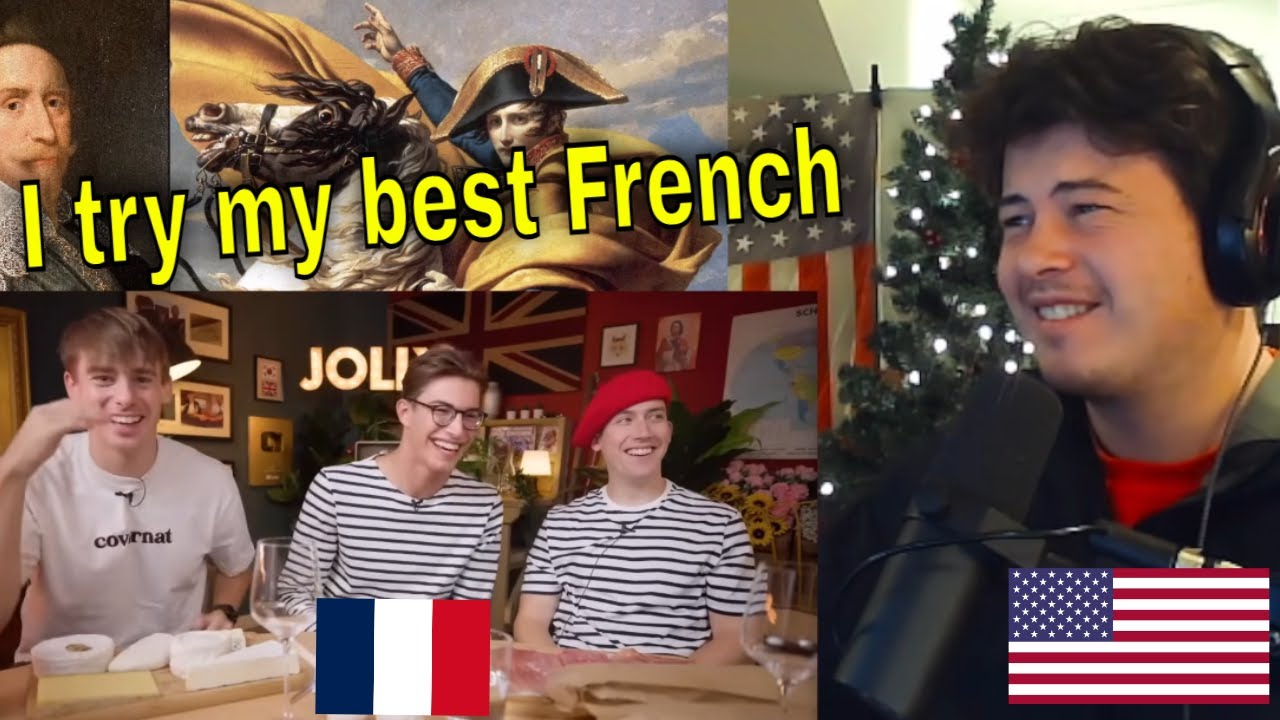
👉Original Video: https://www.youtube.com/watch?v=0NjQ5GkJ1X8
👉Discord: https://discord.gg/NZVfmWCjUT
👉 Patreon: https://www.patreon.com/mcjibbin
☕Buy me a coffee!: https://www.buymeacoffee.com/Mcjibbin
📦P.O. Box info (NOT accepting ANY perishable items)
For any clothing: l’m a Men’s size large
McJibbin
P.O. Box 447
Bristol, Rhode Island 02809
USA
Hi everyone! I’m an American from the Northeast (New England). I want to create a watering hole for people who want to discuss, learn and teach about history through YouTube videos which you guys recommend to me through the comment section or over on Discord. Let’s be respectful but, just as importantly, not be afraid to question any and everything about historical records in order to give us the most accurate representation of the history of our species and of our planet!
Having a diverse perspective is crucial to what I want to achieve here so please don’t hold back! I want to learn about all I can! Keep recommending and PLEAESE join my Discord 🙂 ( https://discord.gg/ejxUtD2X )
#american
#mcjibbin
#americanreacts
#reaction
Copyright Disclaimer Under Section 107 of the Copyright Act 1976, allowance is made for “fair use” for purposes such as criticism, comment, news reporting, teaching, scholarship, and research. Fair use is a use permitted by copyright statute that might otherwise be infringing. Non-profit, educational or personal use tips the balance in favor of fair use.
37 Comments
… Les petites fromages … Trop mignon ! Le pull rayé s'appelle une marinière et était portée par tous les marins bretons, donc originaire de Bretagne et plus précisément du Finistère (pointe de la Bretagne). Par contre, le béret c'est basque (région Pyrénées Béarn) …
4:30 Ouh lala_, _Oh lala and Ah, lala – the three exist and mean "Oh my God." 🙂
5:28 The pronunciation of French is based on syllabes. In a speech unit, the stress always falls on its last syllable. In the other languages you mention, a speech unit is divided into feet and each foot has its own stress pattern.
6:45 pamplemousse [pã-ple-'mus] = grapefruit
7:54 prout [prut] is the noise made by a fart.
9:01 bof is hard to translate. We use it to express that it is not as good / important / serious / etc. as presented. It dismisses a claim. | comme ci, comme ça = so so, more or less
Hi. Although most comments are correct about the striped t-shirt (worn by French sailors, made popular again by fashion designer Jean-Paul Gauthier in thé 1980’s), the reason why it’s associated with French people in the American culture (and British to a lesser extent) is much more specific and is the same as why French people are often portrayed as mimes: it comes from Marcel Marceau, a worldwide famous French mime best known as « le mime Marceau » (1923-2007).
After WWII he created a character named Blip, wearing such a striped t-shirt, whose poetic adventures made Marceau famous all around the world and turned him into an icon of postwar French culture.
Nowadays though, 20 years after his death, very little of him is remembered by the French public, and younger generations just don’t have a clue who he was (that’s the fate of living arts). Hence he was even considered in comments as a possible explanation for the stripe thing,
11:41 abracadabra = mumbo-jumbo. From this he derived an adjective: abracadabrantesque = mambo-jamboesque, using the end of _grotesque_.
Dunno if i'm right, but i've seen many americans scared to look dumb by trying speak another language. On contrary in every countries , it's appreciated if you try to speak their language. It's an effective ice breaker.
Abracadabrantesque était un néologisme inventé par Arthur Rimbaud dans une lettre à Paul Demeny . Dans cette lettre, Rimbaud utilise le terme pour décrire des visions poétiques et un style exagéré, extravagant et presque irréel. Cependant, le mot dérive du terme plus ancien "abracadabra" , une formule magique utilisée depuis l'Antiquité pour ses supposés pouvoirs mystiques. Rimbaud l'a transformé en adjectif pour exprimer une idée démesurée, excessive et surprenante. Le mot a été remis en lumière par l'ancien président français Jacques Chirac en 2000 , lorsqu'il a qualifié un programme politique de son adversaire comme étant "abracadabrantesque" , ce qui a contribué à redonner de la visibilité au terme dans le langage courant.
French have been influenced by Germanic languages in the way it's pronounced, more than the other romances languages. So it's different.
don't cheat, you'll not be traumatized… 😉
yes, "Abracadabrandesque" come from the "magic" phrase "Abracadabra", used by "magician".
French is the meeting of roman and germanic language. The first francs who came were speaking the same langage that gave the Dutch in the Netherlands.
French is not just from Latin origin, it is initially a mix a Latin, Germanic, Franconian and Celt
I am French, Oh la la, "Oh là là," "ouh là là," and "ah là là" are French interjections expressing surprise, emotion, worry, weariness, or exasperation depending on the context and tone. All three are equally used. 😊
Be careful with the pronunciation of "prout." If you can't pronounce the French "R," which might be misunderstood as an insult ("pute" = "wh*re").
There's absolutely a point to learning Latin. It is the base for many European languages so it gives you the ability to understand languages you cannot speak.
The stripped “T-shirt” are originally from Britanny and the French Navy
French has this distinctive pronounciation for a roman language comes originally from Germanic/Celtic people speaking the Latin with their accent.
The “r” is like in German.
Romanian is a romance language, too. The striped sweaters come from Britanny, mostly.
The striped shirt originally came from sailors as far as I know in Bretagne.
The marinière (sailor shirt) was a jersey that French fishermen had worn since the 17th century as well as the French Navy since the 19th century. It allowed a better view of the sailors who had fallen into the water. Coco Chanel popularized it in 1913 with the sailor style, followed by other great couturiers (Yves Saint Laurent, Jean Paul Gauthier and others.). It has been worn by well-known people such as the mime Marceau, Picasso, Brigitte Bardot, Jean Seberg, Jean Cocteau etc. Now, it's a fashion accessory. It exists in other colors, e.g. navy blue background and white lines, white background, red lines and vice versa and many other colors, etc. There are also sweaters with buttons decorated with sea anchors. The models made in France are of very good quality, warm and comfortable (Le Minor etc.)
french is a mix between roman and celtic languages, so we sound different
10:05 it's in 7th grade in the USA, that explains a lot.
In France we have English in 2nd or 3rd grade, and then in 7th grade we choose the 2nd foreign language, most often Spanish (72%) and German (16%).
The tee-shirt with vertical stripes is called a marinière. It comes from "marin" (marine). It is the traditional style of fishermen and marine soldiers. Those marinières are made by textile companies based in Britany and Normandy. As french fishermen used to sell their fish and also garlic in England, the image of french men is a man wearing a marinière, a beret and a garlic necklace. The french adopted this english representation because it is funny.
the "scud missile" had me on the floor
Indeed "sacrebleu" is no longer used nowadays as it definitely is an outdated French word marking surprise, astonishment, anger, …
Listen to the awesome song by Georges Brassens, listing many more of these words that are no longer used, here: "Georges Brassens – La ronde des jurons" – georgesbrassens
It's such a shame that today's French vocabulary has become so poor and lame!
The striped shirt called "marinière" was – and still is – worn by sailors, and has become some "standard" outfit in Brittany. Not ALL French people wear them, though you'd see many people wear them in the summer.
The "béret" was widely popular among the French – particularly the country folks – but again, today, not so much anymore. It emanates from the Basque country, and some Army Corps (les "Chasseurs Alpins") still wear it as part of their uniform.
It was not worn by many city dwellers, just as cowboy hats aren't worn by New Yorkers …
I – a woman – love them and often wear one in winter … and a marinière in the summer. But never both at once, as the stereotype would like you to believe!
The striped shirt design became synonymous with the French due to French sailors back in the day. They would wear black and blue striped shirts so it would be easier to spot someone in case they fell overboard.
Also FYI, the Beret is not even French. It's from the Basque region. I guess ignorant WWII soldiers in that area would see Basque people wearing them but it didn't occur to them that even though they were still technically in France, the Basque was a different culture with their own language and customs. So they just lumped it in with the French.
Latin isn't really all that useful in terms of being a lawyer or a doctor, as it's just nomenclature. If you're in a Latin class, you don't sit there learning that the "apertura aqueductus mesencephali" is the opening of the midbrain aqueduct, etc. However, Latin is a highly "synthetic" as opposed to an "analytic" language like English, which means that what you do learn is the nuts and bolts of grammar, and it also means you can often understand words in, and learn fairly quickly, the modern languages that came from it and resemble it most closely, i.e. Italian, Spanish, Portuguese. Plus you get a history lesson as part of the bargain.
The only French you need to know is the French they speak in the British TV sitcom Allo Allo
I love Armand! He’s a British University student with French parents and he’s been associated with Josh Korean Englishman) since he was a senior in high school, along with several of his classmates and their teacher, when Josh took them on a journey into Korean foods and then to Korea – twice!
The French language can be divided into 4 categories:
– The ancient Gallo-Roman (from 600s to 900s). A Latin dialect that evolved from the Vulgar Latin spoken in the territories conquered by the Roman Empire. It developed all around the western Mediterranean. Greco-Roman evovled all around easter Mediterranean.
– The Old French (from late 700s to middle of 1300s). Which was a group of mutually intelligible Romance dialects known as "Oïl languages". With Germanic-Frankish, Celtic-Norman and Gallo-Roman roots. Opposed to the Occitan-Romance group, known as "Oc languages" like Occitan or Catalan.
– The Middle French (from middle 1300s to early 1600s). It's the beginig of modern french. French become the official language of the kingdom instead of Latin. We cut the bridge with the other Oïl languages. We developped our own grammar, our own vocabulary, based of course on what we already knew to unified Oc and Oïl languages.
– The Modern French (from early 1600s to nowadays) that evolved several times from all around the world in different ways. From the early 1600s until the Second World War, French was the universal language, just as English is today. Parisian French established its dominance over all other French dialects around 1800. Eradicating much of the foreign roots in the regional dialects. Essentially keeping the Latin roots of French, Greek etymologies for all scientific fields, and Celtic roots for agriculture.
I learned French and Latin at school, neither of them to a high standard, but I do appreciate the value of Latin in recognising the etymology of words I'm unfamiliar with in English. Currently dabbling in learning Italian I find a lot of crossover from my previous linguistic education.
"sacrebleu" is a swearword from the middle ages, it translates roughly to "god's blood" or "holy blood"
It would be some very very antiquated and not used at all anymore version of "bloody hell"
And no, no french person uses that nowadays
You don't look dumb in any way because you're interested and you're trying. Great video as always!
Sacrebleu, formule utilisée au moins par les grands parents du début du sciecle.
Oh la la est encore utilisé.
Never apologize for trying to speak another language than your native one. Even if you butcher it, making the effort is and always will be appreciated by the ones you're talking to.
Fun fact, the people criticizing my English the most are not native English speakers but some who learned it in the same school system I did…