
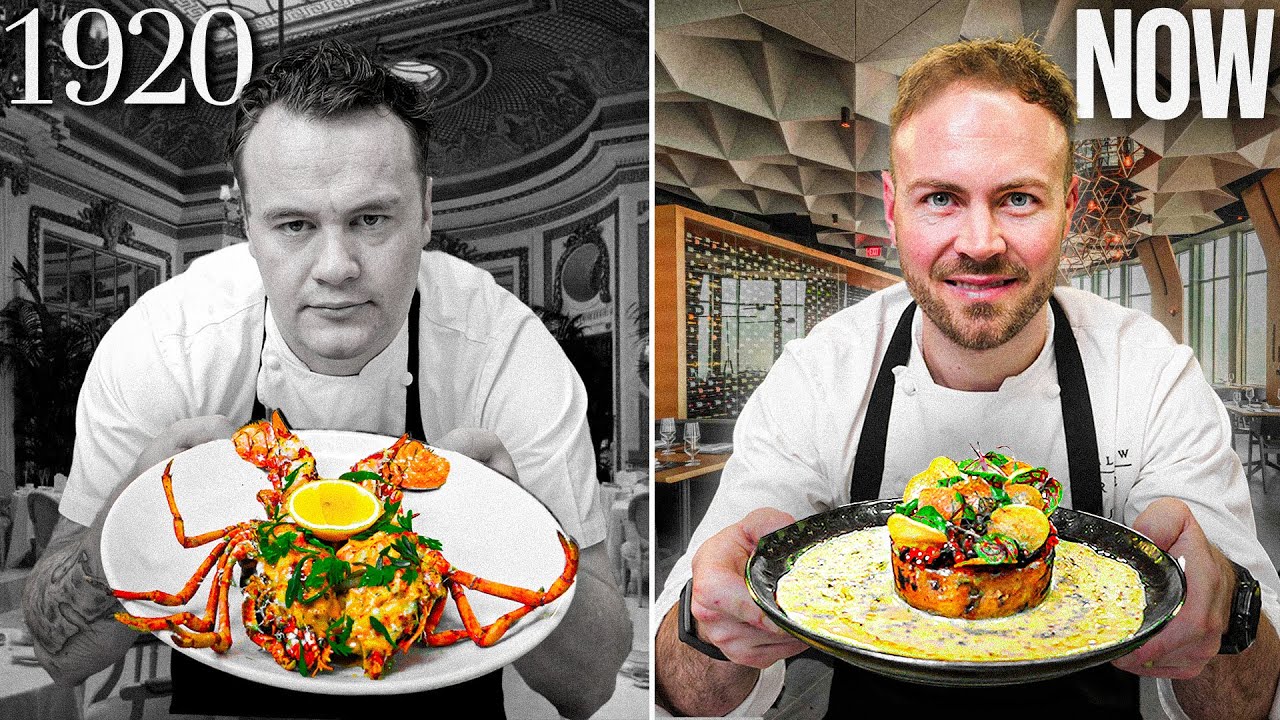
Jack and Will recreate some of the most iconic dishes ever crafted. From timeless French classics to the groundbreaking creations of Marco Pierre White, Gordon Ramsay, and Heston Blumenthal, this video is a journey through the evolution of fine dining.
Learn the history of the Michelin Guide, the stories behind these legendary chefs, and the techniques that define Michelin Star cuisine. With stunning recreations of dishes that revolutionised the culinary world, this is more than a cooking video—it’s a celebration of culinary artistry.
Whether you’re a foodie, a fan of Michelin Stars, or just love learning about iconic recipes, this video is packed with history, flavour, and chef-level cooking tips. Hit play to join Jack and Will as they bring 100 years of Michelin Star excellence to life!
VIDEO CHAPTERS
00:00 – 1920s
04:45 – 1930s
08:16 – 1940s
11:55 – 1950s
14:43 – 1960s
17:30 – 1970s
20:17 – 1980s
23:35 – 1990s
26:41 – 2000s
29:28 – 2010s
33:11 – 2020s
43 Comments
"Well, they were f***ing great guys. And this is a f***ing a**hole of a day." -MacGruber 32:55
These two guys are straight beast in the kitchen!
This video is fucking awesome. Great concept. Thank you! Merry Christmas boys!
Love the classics
Do more!!!
Thomas Keller deserves to be on this list, his work is pivotal and without compare.
love your videos
Reynold Poernomo
the 2020s aren't over yet, and Clare Smyth is already declared the winner…. i smell bias haha XD
The more modern it gets, the less food there is
9:08 “cohost?”
This video is fucking class. Thank you guys for doing what you’re doing. Coming from a chef.
Sorry, no. I would not eat that 1930s chicken. I'd tell them that the flies will enjoy it more that I will.
escofiers best? bress pollo? proximo por favor
Excellent video but that last recipe has to be taking the piss. Taking 50p of potato and adding 50P of roe, really?
ps your only getting 5% likes per view give me a holler if you want more besitos
LOL, they got harder and harder as the decades went by, and more and more expensive!
I've eaten at a few Michelin Star restaurants. One was sushi, the others were Continental European. This was a nice walk.
I do a wicked beans on toast after 18 cans of Kingfisher Strong. No its not good but I can still cook after 18 cans.
I will say though I did not enjoy all of the flabby chicken skin. Glad those tastes have changed.
The AI Syncro ( German) is a pain in the Ass… I would've preffered the Original Voice. Thank you.
I flippin out if you bring me a chicken with its feet still attached
3:46 on first dish 1926 and I'm to believe Lobster was a Michelin dish. Sorry but back in that time Lobster was considered garbage food and given to prisoners etc… wasn't until later that it gained steam as a delicious food. Soo there's that…
The chefs that work under you guys are very lucky. Goooood stuff here. Please more old school dishes and please hit America.
I am loving this. Awesome Video Chefs.
Fantastic video, but I personally disagree with the 2010s. It makes a ton of sense that you'd pick Hester, both as Brits and Brits of your history (and no ill will or judgement), but as an American the 2010s course for me is 11 Madison's Celery Root cooked in a pigs bladder with truffle sauce.
I have my own biases, it was a part of the first Michelin Star meal I ever had with my now spouse, but it's something so special. You can draw a line between Fernand's chicken and this dish, while also drawing a line forward to 11 Madison's plant based menu.
If you're headed to the states next, I highly recommend looking at this dish. It is to this day, like 15 years later, probably the best thing I've ever eaten. It was just holistically so special and complete and really speaks to what stars are at their best.
I take issue with the term “molecular gastronomy”, because it implies that there’s a scientific approach to cooking in contrast to the standard approach, there isn’t. The term is applicable to literally all cooked food. Food IS science, even if a recipe just tells you to cook something at a specific temperature for a specific time, the reason that time and temperature matters is because there’s chemical reactions occurring in the food and the end product will change depending on those factors, this is a science. All “molecular gastronomy” is just acknowledging the fact that cooking is a science and using that fact to a greater extent, but that simple acknowledgment of reality doesn’t change said reality.
Cooking has always been a science. As far as making food goes, I use two different terms; one is “cooking” and one is “preparing.” Cooking is a science, preparing isn’t. For example, just putting a simple cold sandwich together is preparing food and there’s no science involved. Cooking a steak, however, is a science. Whenever chemical reactions are purposely occurring, then the practice becomes a science. “Molecular gastronomy” is just a name for employing a more mindful consideration of the scientific process that we recognize as cooking, but it’s not like it was anything other than a science in the first place.
People like to say that cooking is “an art and a science”, this isn’t true. Plating is an art, but cooking is 100% a science alone. What impacts the flavor, texture, and all other aspects of the eating experience is only science and absolutely nothing else. Yes, plating affects the diner’s perception and thus, the eating experience is also affected, but that’s not the actual taste and texture itself.
Put simply; if everyone ate food in pitch black darkness such that they couldn’t see the food at all, the ONLY thing that would affect the experience of those diners is science. Whether or not the chef considers that science when creating their food is irrelevant to the fact that it’s a science, just in the same way that people might engage in all manner of things governed by scientific principles without consciously understanding said principles.
Molecular gastronomy is a pretentious term, but more than anything, it cheapens the accomplishment of the chefs that pioneered it. They didn’t come up with some new discovery for how to cook, they just took the science of cooking to the next level and elevated it to such amazing heights in such a creative and novel way, which is more impressive than just acting like they were the first to use science in cooking.
Do an aussie episode of recipes ..
Peter gilmore
dan hunter
Christine manfield .
Shannon bennett
tetsuya
signature recipes
and ya got a bloody episode !
This was really great to watch! I love history and cooking, you guys really put some effort into this one, cheers
love this but why don't you not use the foil gras in the future considering the valid ethical objections!
Pls no Ai translation
Love how you guys are just eating every dish full on
What a stunning video. Thank you very much. Formidable skill. Yes please show us Pierre Koffmann’s stuffed pig’s trotter.
That's a nice video but I'm really disappointed on the fact that you didn't name the chef that invented molecular FERRAN ADRIA, and for 2020 you choose another British when you have DAVIZ MUÑOZ best chec of the world in 2021,2022 and 2023, again like always British making Spanish down
awesome vid, but lol Michelin and all they do is overrate bland European food lol.
that poached chicken with foi gras sauce looked incredible! kinda thing you really dont see anymore in the west
Thanks for making it clear that that naughty little angry guy was Austrian and not German 😂 (Kindly, a German)
Daniel Boulud’s Egg has to rank super highly for me in terms of decade defining dishes. Grant Achatz and Rene Redzepi are titans of our current generation too. Noma has quite literally changed the food world. God… Eric Ripert and Le Bernardin too… Part 2 video?
My favourite chef is the cunt who invented beercan chicken.
Top Notch as always.
Great video guys, I would love to see an example of Alain Ducasse's famous Cockpot and/or Koffmans stuffed pigs trotter
Ratatouille is based on Bernard Loiseau not Paul Bocuse
baschimal ??? xddd