
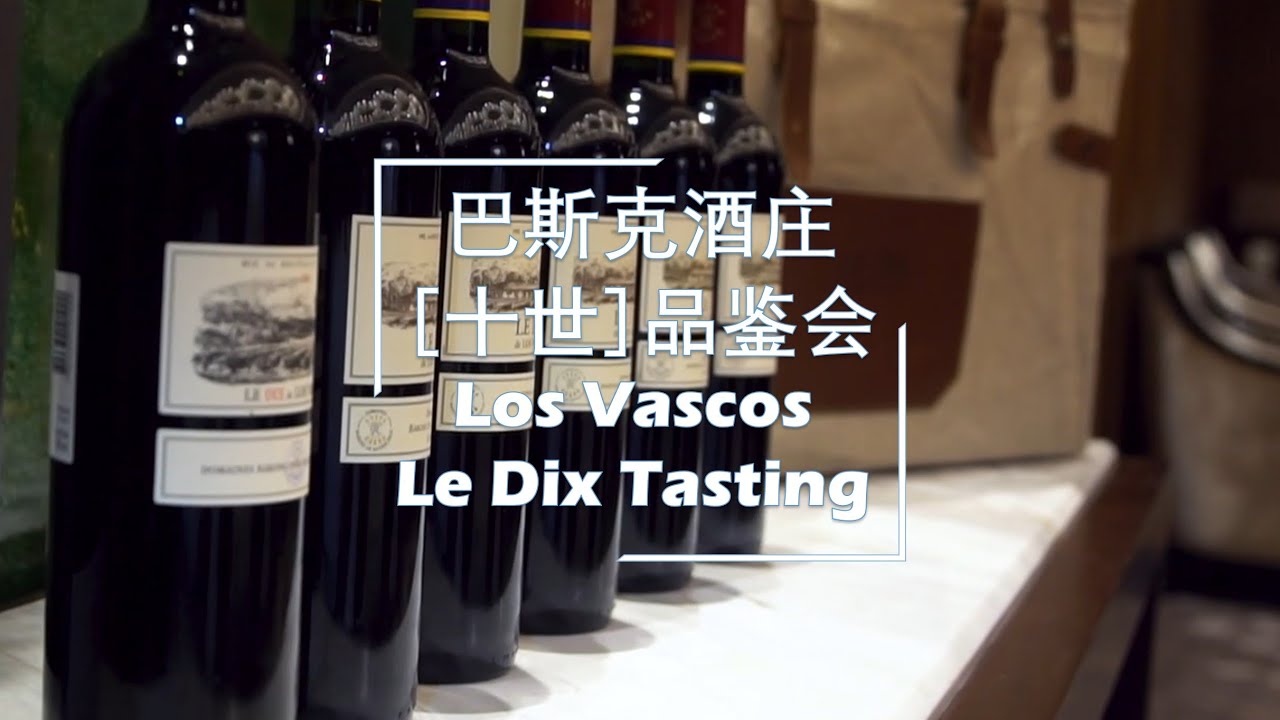
Last month, I was invited by Domaines Barons de Rothschild (DBR) to lead a vertical tasting of Le Dix, the flagship wine of their Chilean estate: Los Vascos.
It was really interesting to learn about the evolution of Le Dix, from its first vintage in 1996 to the more recent 2014.
After sending their Technical Director Gilbert Rokvam to survey the Colchagua valley, DBR bought 50% shares of the property from the Echenique family in 1988. The first members of the Echenique family came to Chile in the 18th Century from the Basque Country, thus the name “Los Vascos” which means “The Basques” in Spanish.
Although Le Dix’s first vintage was 1996, it was only released in 1998 to celebrate DBR’s tenth anniversary in Chile. “Le Dix” means “the tenth” in French.
The grapes used for this wine mainly come from their oldest plot which was planted with Cabernet Sauvignon in 1947 by Fernando Echenique.
Here are a few facts about the various vintages we tasted:
As mentioned above, 1996 was the first official vintage of Le Dix (although experiments to produce a “super wine” were already carried as early as 1991). This is a wine made entirely of Cabernet Sauvignon hailing from “El Fraile” vineyard. El Fraile means “The Monk”. According to Marcelo Gallardo, a Jesuit monk used to live close to the vineyard, hence the name. The vineyard is planted with a massal selection of Cabernet Sauvignon planted in 1947 at 160 to 200 metres of altitude, in the West part of Colchagua, 3 kilometres west of the township of Peralillo. The 1996 vintage was made under the supervision of Gilbert Rokvam and was aged in second-year barrels shipped from Chateau Lafite.
The wine has been aged in 100% New French barrels since 1999 onwards (no wine was produced in 1998 due to heavy rains), and 2004 wasn’t an exception. Production was then headed by Christian Le Sommer who previously worked at Chateau Latour. This was the last vintage featuring 100% Cabernet Sauvignon. 2004 was marked by spring frost which reduced yields considerably. However, the few berries remaining on the vines got very concentrated, further enhanced by the hot and dry summer that followed. This led to an early harvest (two weeks in advance).
A long cool growing season resulted in a late harvest (three weeks later than 2006) marked by relatively low yields in 2007. These cooler than usual conditions allowed the grapes to ripen more slowly, and therefore to accumulate more aromas and flavours while keeping a refreshing acidity. Le Dix wasn’t produced in 2005. Since 2006 on, the winemaking team decided to blend-in some Syrah to soften Cabernet Sauvignon’s tough tannins and some Carmenere to bring a Chilean spiciness to the wine. This is a more modern style, made with less extraction, enhancing the fruit rather than the structure.
Eric Kohler, who joined the estate in 2007, continued this quest for riper fruit and shorter maceration. In 2009, many vineyards in the Colchagua valley suffered from dehydration due to extremely hot and dry conditions during summertime. Fortunately for Los Vascos, a drip irrigation system was set up two years earlier. When they used flood irrigation, they had to stop bringing water to the vineyard as early as three to four weeks before the harvest to avoid dilution of the grapes. In case of severe drought, the grapes would grow very thick skins to protect themselves, often ending with rustic tannins in the wine. Drip irrigation allowed them to provide the water needed by the vines to get through the summer’s scorching heat, without risking to dilute the flavours.
In 2012, another hot and dry year, the winery started to include grapes from vineyards planted on the hills. Finally, in 2014, Eric Kohler was joined by Olivier Trégoat who had to deal with a devastating frost on September 18th. For the anecdote, September 18th is Chile’s National Day (Fiestas Patrias), and thus everybody was on holidays on that day! Los Vascos lost 30% of its production in Colchagua and up to 70% of their Chardonnay in Casablanca. That said, just like 2004, this led to more concentrated fruit, and thus quality is relatively high.