
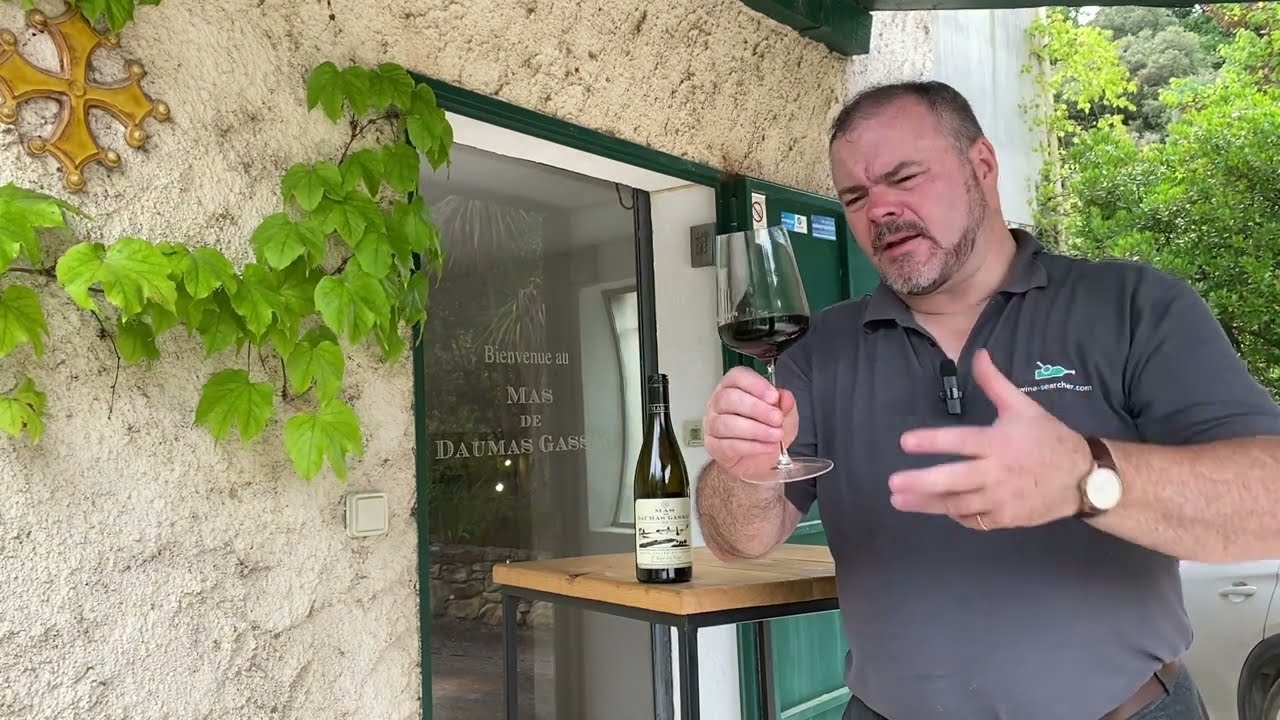
For today’s Wine-Searcher tasting our Wine Director, David Allen Master of Wine is in southern France – in the Herault – visiting leading producer called Mas de Daumas Gassa. Here he is tasting their current releases in preparation for a full-scale vertical tasting. In this video he tastes the 2021 vintage of Mas de Daumas Gassac Rouge.
The estate also makes a white wine from Petit Manseng, Viognier, Chardonnay and Chenin Blanc. Mas de Daumas Gassac is a wine producer in the Languedoc region of France, around 40 kilometers (25 miles) west of Montpellier, near the town of Gignac. It is well-known for the high quality of its Cabernet Sauvignon-predominant flagship wine, earning the estate the nickname “the Lafite of the Languedoc”. The winery is built in the foundations of a Gallo-Roman mill and on the site of its former pond. Sited away from established, well-known appellations, the wine has been produced as a Vin de Pays, with recent vintages being classified as IGP St. Guilhem-le-Désert – Cité d’Aniane.
The first vines at Mas de Daumas Gassac were planted in 1972. Véronique and Aimé Guibert had found the property two years earlier while searching for a new rural home; in 1971 their friend, Professor Henri Enjalbert, a geologist with specialism in vineyards told them that they could make Grand Cru quality wines here. The renowned oenologist Emile Peynaud consulted on the first vintage in 1978. Aimé Guibert, who died in 2016 aged 91, was a champion of the Languedoc who became well known for his battles with the Robert Mondavi company. The estate remains family-owned and is run by four of Aimé and Véronique’s five children.
Wines are vinified in stainless steel vats with natural air conditioning provided by two springs running under the cellars. This slows down ferments, allowing complex flavor development.
The Mas de Daumas Gassac red is an aromatic, full-bodied wine made from around 70 to 80 percent Cabernet Sauvignon with a mix of 17 other indigenous and international varieties such as Merlot, Malbec, Pinot Noir, and Tannat. The wine is fermented in stainless steel tanks, aged for 12-15 months in oak barrels, and bottled unfiltered. It can be laid down for several decades, but is also approachable when young.
In exceptional vintages the estate has produced a limited-production wine made with 100 percent Cabernet Sauvignon called Cuvée Émile Peynaud. The estate also makes a white wine from Petit Manseng, Viognier, Chardonnay and Chenin Blanc, a Rosé ‘Frizant’ sparkling wine and a sweet wine called Vin de Laurence.
Discover more about this wine, see its pricing and find out where to by it on the Wine-Searcher website by following this link: https://www.wine-searcher.com/find/mas+de+daumas+gassac+igp+st+guilhem+le+dessert+pays+france/2021
#masdedaumasgassac #daumasgassac #languedoc #stguilhemledesert #masterofwine #winesearcher #winelovers #tastingredwine #winetasting #winesoffrance #frenchwine
hello there I’m lucky enough to be here in the eral in southern France in the gasak valley at maduma gasak arguably the leading Winery of Southern France and the wine I’m tasting today is the 2021 vintage of M marasa and this is the wine with the designation of an igp from San gulim leer formerly these wines were made as a vaner Herald but actually when the gar family first came here and may gar and his wife fonque they weren’t necessarily looking to set up a Vineyard they were looking for a home um she was a lecturer at the University in monel he was a leather worker and they found the beautiful site here in the the gasak valley a very old house just just across the way behind me here that was largely run down was was owned by an elderly man who lived here with his two sisters and where of the three stories the animals lived on the bottom story and there was food for the animals on the top story and the family lived in the middle there was no electricity there was no running water so this was the early’ 70s and at that stage southern France the longood do was not a region for growing quality wine it was a region that produced High volumes of everyday vanderaa but possibly because they had no experience the gbear family were interested in GR growing vines here and at one stage a visitor a friend of of amigu bear hry angelar who was a soil scientist took a look at some of the the soil on the lower part of the property where a new road had just been cut and identified it as being a a form of Glacier deposited Limestone soil very broken fractured Limestone the red sedimentary deposit between it that he he he felt was a sort of soil that was really only seen elsewhere in the world burgundy’s Cod door but despite this comparison with with burgundy actually amigu chose to make a wine in the style of a crud class from Bordeaux and as a result on these beautiful Red Soils the majority of what he planted were Old Vine cuttings of cabinet sovon that he he sourced from a nursery that had sourced the vine material pre the loxer from class growth Vineyards in Bordeaux and very much the M making style here follows that style of early’ 70s crew class for instance the the fermentation here is all in stainless steel that was the new vogan in Bordeaux at the time that the the first growths oel had just started using stainless steel tanks the wine ages in Oak although there is a a lower proportion of new Oak being used here they’ll use a proportion of Oak that’s up to 7 years old through the Aging of of this wine so as I say this wine the blend is predominantly cabinet soval about 84% with 5% of Pon Noir it’s an Eclectic grouping of grape varieties let’s put it that way there’s 2% of Merlo 2% of Pau 2% of tannant 2% of cabet Fran and 3% of other varieties now those varieties could include nebiolo could include sir they have all sorts of varieties planted here in quite small amounts the other impressive thing about this wonderful property is the biodiversity that’s been allowed to prosper here evidently when they first started Vineyards veronique gber decreed that she didn’t want any trees being cut down now it wasn’t an area that was particularly forested the the area was mostly gig sort of sort of meter high Scrub but she wanted to maintain the the natural character of the landscape here so all this happened starting from about 1970 their first vintage of the first vintage of this wine was the 1978 vintage and as a result it’s now that some of the Vine that were planted back in 1972 are just over 50 years old and in the next 5 or 10 years those will probably be replaced and so now the estate is being owned by the second and third generation of the family and we see it progressing as I say with the biodiversity is wonderfully impressive and you’re probably seeing insects flying by as I make the video you can certainly hear birds singing in the background and it’s just a beautiful tranquil place a real Garden of Eden in southern France so let’s let’s try the wine and see what we make of it shall looking at it there’s a medium to deep intensity of a really beautifully vibrant ruby red there’s a slight purple hint to it it’s certainly not opaque the wine has 133% alcohol and yet it’s got a wonderful viscosity that’s causing tears or legs to form on the glass very easily there the Aromas have a wonderful perfume it’s just lifted by by slight delicate notes of of Cedar but it really has a perfume that starts like the plumming notes of Merlo and yet we know there’s only 2% of Merlo in here and then opens up to be wonderfully ciss and black current it’s not for nothing that this wine has the reputation of being the lefit of the longer do so let’s have a taste shall we [Music] on the palette it’s a wonderfully fresh midweight wine and the freshness is bringing out that sort of ciss note there’s an underlying sort of slightly chalky texture it’s certainly not unpleasant plumy smoothness in terms of flavor and in terms of of texture it’s almost becoming slightly chocolate there’s a richness and a ripeness the alcohol is beautifully imbalance the freshness is is following on to the finish and there really is that sort of very elegant cess right to the end there ciss and Plum the two are are beautifully sitting there together so yes I I think a wonderful wine certainly still very youthful this wine has a reputation of Aging for up to 20 years I should imagine that there would be no no trouble in this achieving that but it’s doing it through balance and elegance rather than power and I think that’s why it’s seen as being sort of in the style of leit thank you so much for joining us I do hope you’ve enjoyed the tasting if you have do please press the like button if you’d like to watch more do please subscribe to our YouTube channel if you have friends you think might like to watch the video do please pass it on to them that would be fantastic if you have any comments please leave those in the comments box below we’d love to hear what you think about the wines the tastings we’re doing or anything else that’s related to that I’ll of course leave a link to the wine Searcher website page for this vintage of this wine so you can find out more about it where it’s available it pricing is what the critics think and any more detail that we have beyond that once again thank you for joining us and I do hope you’ll be able to take some time to come and join us for another tasting in the very near future bye for now
2 Comments
Seen the red around. Looks like the hype is justified.
Hello David. Many Thanks for time effort (while traveling) to share insights on a very interest wine: little explored region, unique blend, "diamond in the rough" quality. Will try it.