
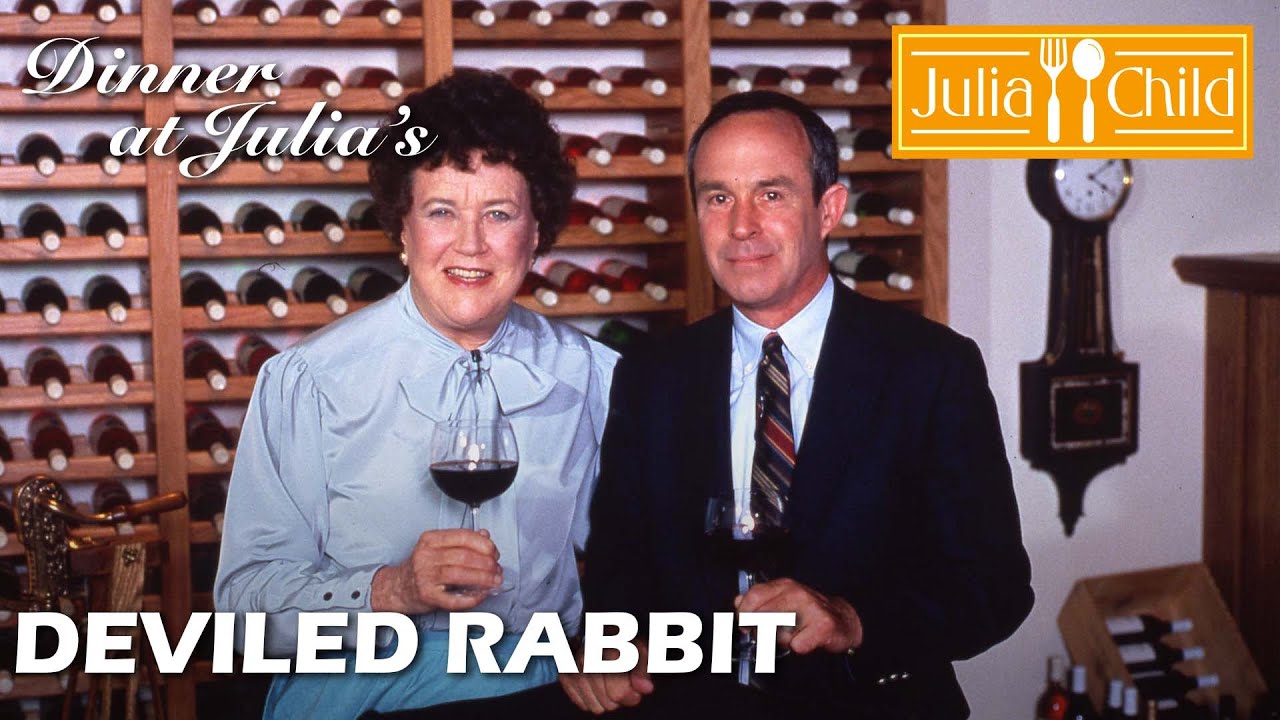
For a dinner honoring James Beard, the menu includes Kentucky Ham Puffs, Seattle Smoked Salmon, Roast Deviled Rabbit and Orange Souffle with Apricot Sauce. With chef Jean-Pierre Goyenvalle of Le Lion D’or in Washington, DC and wine expert Richard Maher of Beringer Vineyards in St. Helena, CA.
About Dinner at Julia’s:
Julia Child sources fresh ingredients then prepares a special menu with a distinctly American accent. Centered around a weekly dinner party for 10 hosted in a mansion just outside Santa Barbara, Julia is joined by chefs from premiere restaurants around the country who share their techniques and specialties, plus California vintners who offer selections to pair with the evening’s dinner.
About Julia Child on PBS:
Spark some culinary inspiration by revisiting Julia Child’s groundbreaking cooking series, including The French Chef, Baking with Julia, Julia Child: Cooking with Master Chefs and much more. These episodes are filled with classic French dishes, curious retro recipes, talented guest chefs, bloopers, and Julia’s signature wit and kitchen wisdom. Discover for yourself how this beloved cultural icon introduced Americans to French cuisine, and how her light-hearted approach to cooking forever changed how we prepare, eat and think about food. Bon appétit!
— Managed by PBS Distribution
Get More Julia Child on PBS:
Twitter: https://twitter.com/pbsdistribution
Facebook: https://www.facebook.com/PBSDistribution.org
Viewers like you make this program possible Support your local PBS station. ♪ ♪ (indistinct chatter) Welcome to a really gala evening, where… most of us are really dressed to the nines and we’re sipping this beautiful chardonnay brought to us by Dick Maher, president of the Beringer Vineyards in Napa Valley, California. He’s brought all of the wines for the dinner. We have a great guest chef, Jean-Pierre Goyenvalle, chef/owner of Le Lion d’or in Washington, D.C. He has promised to astound us with a flaming dessert. And we have as a guest of honor, James A. Beard, author of many, many books, authority on American cooking and a very dear friend. We have a great first course of Alaskan king salmon smoked in Seattle. We were up there just the other day, and I learned every one of their trade secrets. How much does one like that weigh? It’s enormous. BOB: A salmon like this, this is about 30 pounds. -JULIA: Wow. How old would it be? -Beautiful. BOB: Well, Chinook salmon mature anywhere from three to five years old. So, three to five years old, you get that great big fish? -Mm-hmm. -That’s beautiful. Then what happens -after you get them all defrozen? -Okay. At this point, they’re put onto the table here where they’re scored. -Fins are removed. -JULIA: Oh, why is that? -BOB: I’ll show you all about that later. -Okay. Yeah. -Okay, the fins are removed. -JULIA: And then… Okay. -BOB: And then Jim splits them. -Ah. Yeah. BOB: Does a beautiful job, too. JULIA: Ooh, look at that. I see– you can’t waste any meat on that. -There’s quite an art to this. -Yeah. -Okay. -That’s beautiful. This particular fish, as I was saying before, -is from the Kuk River in Alaska. -JULIA: Yeah. -Beautiful… -BOB: We choose these -for their natural oil contents… -Yeah. …and the thickness in their bellies. JULIA: Yeah, this-this thick, that’s beautiful fish. -BOB: Mm-hmm. -Then what happens? BOB: Okay. Over here, Scott is curing the fish. JULIA: Oh, I can see why you have those razor slits. -BOB: Right. -And what’s the cure made out of? BOB: It’s a mixture of salt and brown sugar. JULIA: And why do, why do they have sugar in it? BOB: Okay, the sugar’s used for a flavoring. -We don’t use too much… -Mm-hmm. -…so as not to get it sweet. -Mm-hmm. Yeah. John is rinsing off -the excess salt and sugar. -Yeah. Mm-hmm. -Oh. -BOB: And he puts it again into a tub… -Mm-hmm. -…where he uses a salt brine solution -to soak the fish in. -Oh, how long does that take? -BOB: It takes a couple of days. -Yeah. BOB: And this process actually reconstitutes the fish… -Uh-huh. -…and draws more salt out of it. JULIA: Mm-hmm. Then what? We put them over here in these soaking tanks… Oh, I see. Yes. -…to remove more of this salt from it. -Mm-hmm. JULIA: Oh, and that feels really soft again. -BOB: Yes, it is, although it is… -How long does this go on? BOB: Anywhere from three to five hours. -JULIA: How can you tell when it’s done? -By taste. -JULIA: Oh, you mean cut a little piece off and eat it? -Mm-hmm. JULIA (laughs): I see. That makes very good sense. -Okay, when the soaking process is done… -Yeah. -…we remove it from the water… -Yeah. -…and put it into our smokehouse. -Uh-huh. Well, that’s not really so complicated, is it? -Actually, it isn’t. -No, no. -And this is our smokehouse. -JULIA: The stygian caves. -You can see the bl… -The walls are all black. They’re all black. This probably represents about 30 years smoking in here. Wow, those are so beautiful. This is a finished product. They’ve been in here overnight. It’s so beautiful, isn’t it? All that lovely shiny look to it. BOB: Been smoking anywhere from, oh, 18 to 20 hours. JULIA: It smells awfully good. -What do you smoke it in? -BOB: Alder. -We use alder wood chips. -Oh. How– why alder? -Well, alder is a hardwood. -Mm-hmm. -It’s traditional of the Northwest. -Yeah. -The abundance of alder is great. -Yeah. What-what does it look like? Well, here’s some alder wood chips right here. Oh. -Gosh, can I taste some? -BOB: Oh, smell it. -It’s so nice. -I mean, I don’t mean– I don’t want to taste… taste that, but I mean, I’d love to taste -a little bit of the smoked fish. -And we have a little piece -out here for you to try. -Good. Good. BOB: Most of the smoked salmon, Julia, is sold by the whole side. A fish market or a restaurant -where they like to slice it themselves… -Mm-hmm. …will buy it this way. When a customer comes into a fish market, they can slice it for them on an angle like this. Or if the customer prefers to slice it themselves, they’ll buy just a piece of fish, -however much they want, and slice it. -Yeah. JULIA: I like it that way. Let’s see. BOB: The, um, hotels and restaurants, where they have a large banquet or a party, buy it all presliced like this. -JULIA: That’s very pretty, isn’t it? Yeah. -We do all the work for them, and all they have to do is open it up and present it on the table. Here’s some of the slices. Go ahead and try a piece. JULIA: I’d love to. Thank you. I’d love to see how you do this. Well, over here, Margaret is slicing. She has skinned the fish, and now she is slicing it and reassembling the fish -right back on the skin over here. -Uh-huh. Oh, that’s very clever. -Goes on just the way it came off. -BOB: Mm-hmm. JULIA: You’d never know that it had been sliced at all. That’s beautiful. -Oh, thanks so much. -Well, thank you, Julia. Well, it’s been a great pleasure, and we’ll look forward and think of you with every bite. -Oh, wonderful. -Thank you. Well, after our guests have enjoyed a first course of that marvelous smoked salmon, we’re gonna serve deviled rabbit as our main course. And rabbit, if you’ve not eaten it before, tastes very much like the dark meat of chicken but has a little more texture to it. It’s very easy to cook, and I guess it’s easy to raise, too, because over half the rabbits that you see in the markets have been grown by backyard farmers under special conditions. And when you buy it in the supermarket, all the rabbits have been raised just for their meat, just like chickens. And when you buy it, it’ll be in a tray like this, and sometimes it’s cut up and sometimes it’s whole. I like to buy mine whole ’cause I like to do my own cutting. And here’s how I like to do it. You have the back leg thighs– very much like chicken– and I just take a hammer and a cleaver and I just cut right where they end. It’s always useful to have a… hammer and a big cleaver in the kitchen. Then I turn it over and the beautiful– the best part, really, is the loin, that’s the back. There’s a tenderloin here, and where it ends, and I’ve got two little kidneys there, which I’m gonna keep. Just whack that off. And now, after it’s cut up, I’m gonna give it a marinade. I think rabbits need a marinade. It gives them more flavor and tenderness. I’m starting out with the grated rind of a lemon. I really like lemon better than wine in a lot of these marinades. Then I’m gonna have a nice clove of garlic. And then to mash that garlic with the lemon– I think that gives added flavor– I’m just gonna mash it a little bit with my spoon, and then start adding the rest of the ingredients. There’s some ground rosemary leaves, which give a good flavor– about a few drops of hot pepper sauce, a little bit of soy sauce, and I think that gives a very nice flavor. That’s about a tablespoon there. Then some lemon juice– that’ll be about two tablespoons of lemon juice– and about four tablespoons of good oil. I always use olive oil, but you could use any other kind. And now, a bit of regular pepper, and then in goes the rabbit. You want to turn the rabbit all around in the marinade, and it should have several hours– I really think it’s better overnight if you can do that– and put plastic wrap on it, and into the refrigerator. Now, my rabbit’s been marinating for four or five hours, and that ought to be pretty nice by now. And if you’re gonna go to all the trouble of making a marinade, do give it plenty of time. I’m gonna take it out and we’re gonna brown it under the broiler. I’m gonna baste this with a little bit of the marinade. Then, as it broils, it should be basted two or three times because it’s gonna brown it. It should, it should broil for about four minutes. There. Exactly four minutes. Now it needs another basting. And the basting helps it to brown and also seals in the juices, so do that. That’s as rapidly as possible so your broiler doesn’t turn off. And in it goes again for another four to five minutes, or until it is nicely browned on that side. Then turn it, baste it again, and it’ll take 20 minutes in all. Now, look at this, nicely browned on both sides. Now, I’ve got some juices here in the pan. I’m just gonna save those in a little bowl ’cause I’m gonna need them for my mustard coating. There are four tablespoons of strong Dijon mustard, and I’m gonna put about half a teaspoon of fragrant rosemary in there, and then I’m gonna beat in these juices. Now paint it onto the rabbit, and then it’s gonna get its final cooking. Now it has some breadcrumbs that go on. And this is fresh white breadcrumbs, and be sure that you get… get it from non-sweet, homemade-type bread. And it’s always fresh. If you use the dried breadcrumbs, it just doesn’t give the same effect at all. Now I’m gonna drizzle on a little oil, and I think it drizzles better when you use a paintbrush. Or pastry brush, I should say. You see, that’s a nice little drizzle. And that will help the crumbs to brown. And now it should go into a 400-degree oven, and it’s gonna bake until it’s tender. It’ll need, oh, probably ten to 15 minutes. And you press it, and when it’s tender– and the crumbs should also be browned at the same time– it’s done. I’m gonna set the clock for 12 minutes there. Now to go with my deviled rabbit, I have chosen a great recipe called the tomatoes of the three kernels. And this is not an Italian opera, and it’s not a World War II movie with Peter Ustinov, these kernels are wheat kernels. Berries, these are– this is wheat, you know, the same kind of wheat that you grind up and turn into flour. Second kernel is barley, and the third is just plain brown rice, all natural. This sounds so natural and healthy, you’ll think it’s not gonna taste good, but wait till you see, it’s gonna be absolutely delicious. Now, I’m gonna start with the wheat kernels ’cause they take the longest to cook. I’ve got one cup of them, in they go to my pan. And I want three cups of water. This is just like rice or beans. You always add for every one cup of… one cup of rice or beans or kernels, you add three cups of water. And then I’m not gonna add the other two kernels yet. And then I’m gonna cook these in a pressure cooker, this trusty machine I got for my wedding. It came from a friend Bertha, so I’ve had it a long time. On goes the top. Now I’m gonna put it on the stove. See that little black knob there that’s raised up? -(hissing) -And you can hear it hissing. So set the timer for exactly three minutes, and then you take it off heat. There, the pressure is down, there’s no steam coming out, so I can take the top off, open it up and there you are. Now these need about half an hour more of cooking, and at this point, I’m gonna add in the other two kernels. There’s the brown rice and the barley, ’cause these cook much faster, and they don’t even need to cook under pressure. I’m gonna put in another cup of liquid, in this case, some chicken stock and a bay leaf. Then I’m just gonna let this simmer in the normal manner. About-about 30 or 40 minutes, and that’s all it needs. Now, while my kernels have been cooking, I’ve been sautéing some bacon. I had a cup full of raw bacon diced and I’ve just sautéed it to render its fat and brown it a little bit. And the kernels are now done. And I’m gonna ladle them into this bacon. (sizzling) They’re awfully good just as they are, but I find they need a little extra something, and the bacon is just, is very, very good with them, ’cause it gives them a little extra flavor and then, it, also, that little bit of bacon fat fattens them up. And we want to taste it for seasoning. It’s very important that it be exactly right, as with everything, so give it a little taste. I think that could use a little salt and pepper. Not too much, just a little bit ’cause you got a little salt in the bacon. And when you’re sure it’s exactly right, you’re ready to assemble your tomatoes of the three kernels. This is really a delicious combination. Wait till you try it. Well, I’m gonna use some of it to stuff my tomatoes, with about half of it. I’m gonna put in a little bit of either Swiss or mozzarella cheese, finely grated, about a good handful, mix that all-all up. The reason for the cheese is it holds the stuffing together when it goes into the tomatoes. And there… in it goes. These tomatoes have been nicely hollowed out as you can see, and they were lightly salted and then drained upside down, so they wouldn’t be watery. And I think it’s important to have the stuffing warm and stuff the tomatoes just about before you’re gonna bake them. ‘Cause, if the stuffing is cold, by the time it warms up in the tomato, the tomato might’ve totally collapsed. Now, these will go into a 350 degree oven and bake for about 20 minutes, just until the stuffing is nicely heated through. And they have a little pinch of cheese on top. And then you’d want to serve them right away ’cause it’s important with these things. That’s a little oil going on top. Now, these should be baked as soon as they’re filled and then served as soon as they’re baked. So, here they go. And now, to my broccoli, we’re gonna have hashed broccoli with lemon sauce. And this is broccoli that has been peeled and blanched. And you see how nicely that’s diced. And just before serving, I’m gonna heat it with a little bit of butter and salt and pepper. Then over here is a garnish. I have the little broccoli florets, which have been cooked exactly the way, the same way, and they’ll also be heated up. And then here I have the makings of my lemon butter sauce. And this was a third of a cup of lemon juice and two tablespoons of chicken stock and about a quarter teaspoon of salt and some pepper, boiled down until it’s almost a syrup like that. And this sauce you have to make just at the last minute, get it really boiling and start beating it in. Now, I’m putting in about two sticks of butter in there, cut into tablespoon bits. And if you notice they’re going right into the boiling center there. Then, as soon as it’s all in, you want to taste it very carefully for seasoning. And look at that. See, that’s a lovely sauce. It’s just like a hollandaise. That’s gonna be beautiful with our broccoli. And have a little taste. Mmm. That is good. Now, let’s see. We have beautiful smoked salmon. We have deviled rabbit and tomatoes of the three kernels, hashed broccoli with lemon butter sauce. Wait till you see our dessert. Okay, Julia. What about nice, uh, very nice orange soufflé that we’re gonna make for your dinner tonight. And, uh, this is a favorite dessert that we have at Le Lion d’Or restaurant in Washington. And we’re gonna prepare that orange soufflé. And, of course, to start to make that soufflé, we’re gonna make a French pastry cream and we gonna have some milk. We’re gonna boil it. So, here we have the eggs. And first, you mix the sugar because the sugar is melting with the eggs. And so that’s the order of things to do. So, you melt the sugar with the eggs, and you whip it up, mix it real well. And you add the flour. And you mix it real well until it’s smooth. And so, this way, you don’t have any lumps in your pastry cream. See, now it’s very smooth, and there’s no lumps whatsoever. So, you pour the milk, and you mix all the time while you add the milk. Here we are. Okay, mix it well. And you put it back in the casserole because we gonna cook the pastry cream. You put back everything in the casserole, and you have to cook it for about two or three minute boiling. So, mixing all the time, otherwise, your pastry cream will stick at the bottom of the pan, and you don’t want that to happen. It’s almost ready. And now you have the real nice French pastry cream that we gonna take out in a bowl. And with that we’re gonna make the soufflé. The egg yolk in your cream are the ingredients that will help your soufflé to rise with the egg white, of course. The egg white will make it airy, but the whole egg yolk like this will help your soufflé to rise. Okay, I just add the fourth egg yolk into cream and now we have the nice mousse cream. And now we have to add a little orange rind. The orange rind is what you obtain when you peel the top of an orange like this. And this you can run it in a food processor, not to have a paste, you must– it must be still coarse. And once you have that, you will cook it in sugar and water until you have something like this. You know, it’s like a paste, but, uh, you still have the coarse orange rind into it. And this will give the flavor to your orange soufflé, the real orange. So, you put about a tablespoon of it. Okay, and now, we gonna add the orange liquor, which is made in France. It’s a Cointreau liquor, and this will really give a delicate taste to your orange soufflé. So you just pour. And the quantity is not really important. Don’t put too much, but just put enough so you have a nice flavor in your orange soufflé. Okay, now I’m going to add the egg white, which I already whip up and to which I have add a little sugar to help them to stay smooth because, otherwise, they will, they will get grainy. So, you add about a quart of the egg white in your mixture. And this, mix it slowly, so you have something very smooth and light, so it will be easier to mix the rest of the egg white into it. And you see like this, don’t overdo it, but mix it quite well. And now, we’re going to add the rest of the egg white. And this time it has to be little more careful because you must fold in the egg white, so your soufflé will be light, light and airy. And you see, you mix it until you don’t see any more egg white, lump of egg white into it. And… that’s it. Your soufflé is ready to put in the mold. You pour it a little bit at the bottom of the mold like this, spread it around like this, and you will add a few orange section at the bottom. So you can just place them around like this. You have preheat your oven already, at 375 to 400 degree. And now, I’m going to put this in here for about 25 minute. And remember, all oven are not the same, so keep watching your soufflé. Don’t be afraid to open the door. While we are waiting for the soufflé, we’re gonna prepare the sauce. And here we are in a bowl, a little pres– apricot preserve, which I have cooked with a little water and strain it and reduced it. So, this is what we’re gonna flavor the sauce with. To that, I’m gonna add some apricot liquor to dilute it somewhat. You can add the whipped cream like this. Just mix the whole thing together. And now, you whip the two ingredient together. And see, take a nice apricot color. And don’t add any sugar because the apricot is very sweet. So, that’s it for the sauce. This is what we’re gonna serve with the soufflé. And let’s check if it’s ready now. And look at that. (sniffs) Mmm. My, that smell good. Okay, just to finish it, we’re gonna sprinkle a little sugar on top of it, just like this very delicately. Like this to cover it up all. And we’re gonna put a little oranges for the decor, like this, all around it, so it make a nice decoration. And on top of that, now we’re gonna use the orange rind, just to give a little crunchiness to the soufflé. Where is my Cointreau? -Need this to flambé. -JULIA: Chef. Chef. -Oh, Julia. -There you are. -Thank you very much. -You’re very welcome. Okay, now we gonna flambé the soufflé. -JULIA: Oh, lovely. -JEAN-PIERRE: Just pour a little Cointreau on top of it, and it’s gonna warm up -with the soufflé. -JULIA: Oh, keep the soufflé warm. -Oh, look at that. -Yeah. JULIA: Chef, I’ve never seen a flaming soufflé before. That’s absolutely beautiful. And wait till you see the wine you’re gonna have with that. The Beringer Vineyards are located in the Napa Valley, and were founded way back in 1876. The president of the company is Dick Maher. He’s brought us quite a collection of unusual wines. Well, what are they, Dick? -Well, I think it might be good to review the menu. -Yes. First of all, with the ham puffs and the l-liver, this Fumé Blanc should be particularly nice. Oh, is that sort of a nice dry wine? DICK: Oh, it’s a very nice dry wine. It’s crisp with a high acid that should compliment -the food very well. -Good. And then we have smoked salmon. Well, I recommend the Genova Chardonnay, it is the queen of the white wine. Now, rabbit. What are you gonna serve with that? Well, you know, the rabbit’s gonna be with mustard, and when you think of mustard, you think of Dijon. When you think of Dijon, you think of burgundy. -Yeah. -So, this is gonna be a pinot noir, wild yeast. A very, very small lot. Well, now, tell-tell us about wild yeast. We let the wild yeast that grows naturally on the grape ferment this, so there’s no yeast is added at all. Could we have a little taste of that? DICK: Oh, I’d love to give you that. JULIA: ‘Cause I don’t think I’ve ever tasted a– knowingly tasted a wild yeast wine. It’s a nice color, I must say. -Notice how it sparkles. -Mm. I guess– And the pinot noir is one of the more difficult wines to raise, isn’t it? Oh, it certainly is that we in California have been trying to chase the holy grail, I think, with pinot noir, and I think we’re coming close, particularly with something like this. (sniffs) That will certainly compliment the rabbit. I think it has a nice spicy taste. I think you should put that in a private reserve, too. It’s very… Why doesn’t it have a label on it? Well, that is just brand-new. It’s 1980, and we don’t think it’s quite ready to release and… Oh, I see. Besides, we don’t have that much of it. We’re probably drinking up about one half -the supply right here. -(laughs) Well, what are we gonna have with the orange soufflé? We have something very special here. This, too, does not have a label, but this is Myron Nightingale, who, as you know, is our premier winemaker on Beringer. -Yes. Yes. -Has made something in this tradition of the great Sauternes of France. And how does he do it? He takes the Samoan grape, and he’s artificially in… uh… induced this with Botrytis cinerea, the noble rot, which gives a particular wonderful honey-like taste to it. JULIA: This has that, you know that nice deep, deep yellow color, doesn’t it? Thank you, Dick. These wines will complement our meal beautifully. It is with great pleasure I announce that dinner is served. Are you ready for dinner? Got from Seattle, and we went up there and saw it all smoked. ♪ ♪ (laughter) (overlapping chatter) Oh. JULIA: Oh! Look at that. -(applause) -MAN: Bravo. Well, for a really formal dinner, that was loads of fun. The food was superb. Gosh, we had such lovely wines. That final wine, that Sauternes type, with the soufflé was just out of this world. I wish you had time to join us for coffee and cigars, but we’ve not got another minute left. So, join us again next time. This is Julia Child. Bon appétit. ♪ ♪ ♪ ♪
14 Comments
Fume Blanc nice smokey wine. I miss fancy dinner parties 😊
Please put this show on the PBS create channel would love to start watching more episodes I also wish PBS create channel would also add French chef. Because I already seen the two shows they play at least 20 times each episode. We need more Julia Child on PBS create channel but a variety.
Coffee and cigars. Imagine that?
Good GOD that souffle looks incredibly GOOD!!!!
Julia tasted that sauce and pit the spoon with her spit on it right back into the pan.
Brings tears to my eyes remembering my time at the James Beard Fdtn. during the early 90s.
“Dinner at Julia’s” foreshadowed what she would do in the later “Master Chefs & Baking” series
Rabbits ARE devils.
I'd love to try that deviled rabbit ensemble. I don't think I've ever seen rabbit in a supermarket in my neck of the woods.
I’d love to start a spoof if this.
Hyacinth Bucket candlelight dinner
1980. Wow. The Year of Mt.St. Helens, Reagan, Iran Contra falling, and Me.
This is so white, i just cant. Love Julia though
My favorite aunt had the same hairdo as Julia. ♥️