
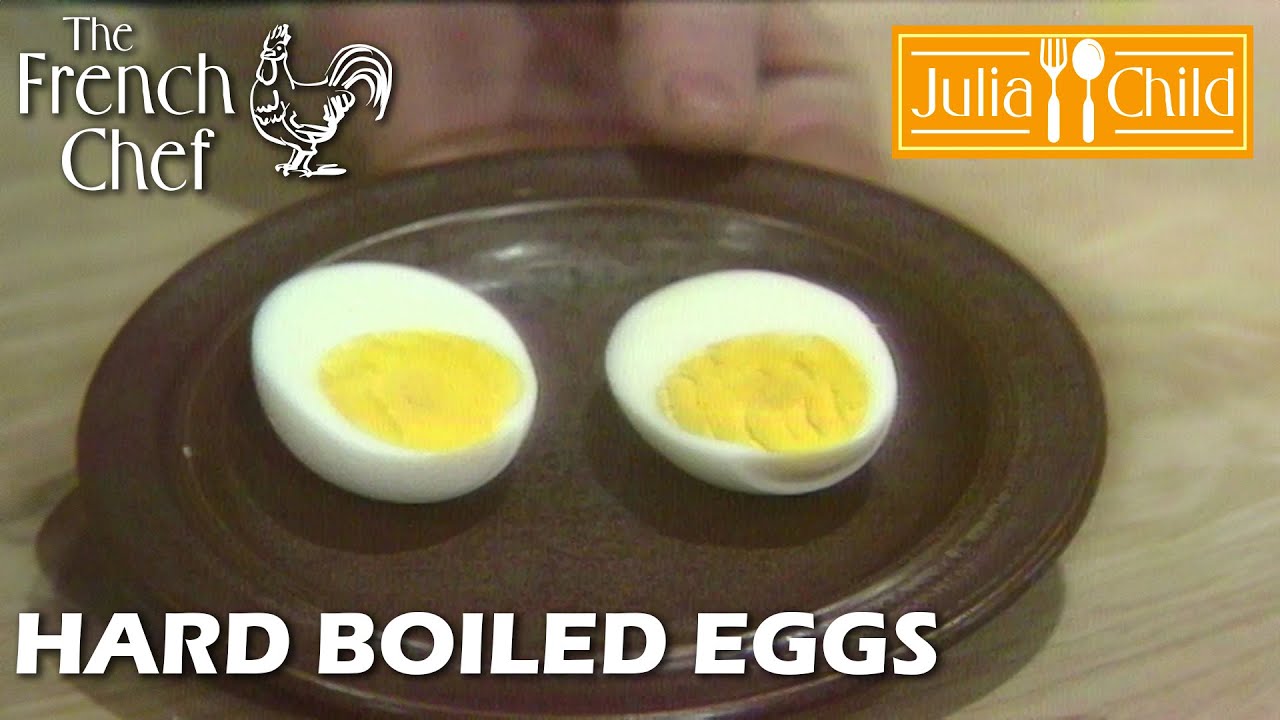
Julia Child has the hard-boiled answers to your unasked questions about cooking, peeling and keeping eggs and some ingenious French ideas for stuffing and serving them.
About the French Chef:
Cooking legend and cultural icon Julia Child, along with her pioneering public television series from the 1960s, The French Chef, introduced French cuisine to American kitchens. In her signature passionate way, Julia forever changed the way we cook, eat and think about food.
About Julia Child on PBS:
Spark some culinary inspiration by revisiting Julia Child’s groundbreaking cooking series, including The French Chef, Baking with Julia, Julia Child: Cooking with Master Chefs and much more. These episodes are filled with classic French dishes, curious retro recipes, talented guest chefs, bloopers, and Julia’s signature wit and kitchen wisdom. Discover for yourself how this beloved cultural icon introduced Americans to French cuisine, and how her light-hearted approach to cooking forever changed how we prepare, eat and think about food. Bon appétit!
— Managed by PBS Distribution
Get More Julia Child on PBS:
Twitter: https://twitter.com/pbsdistribution
Facebook: https://www.facebook.com/PBSDistribution.org
-One, two, three, four, five pots all boiling away, and I’m all steamed up too because we’re doing HB eggs today on "The French Chef." ♪♪ ♪♪ ♪♪ -"The French Chef" is made possible by a grant from the Polaroid Corporation. ♪♪ -Welcome to "The French Chef." I’m Julia Child. Hard-boiling eggs is certainly, one would think, one of the most simple of the cooking processes, but there are — There’s a right way to do it and a wrong way to do it, and a great many of us have found the wrong way when we have hard-boiled eggs that look like this, and certainly any egg — Anyone looking — I mean, any egg looking at an egg like that would say, "Well, that person certainly doesn’t even know how to boil an egg," because you’ve got a big dark, ugly passage all around between the white and the yolk, and the yolk is rubbery, and it’s a disgusting kind of an egg, and this is the kind of egg we would like to avoid, and I shall just throw them out. And this is a good egg. As you can see, you have — The white is nice and tender, and the yolk is beautifully yellow and perfectly cooked all the way through. And the thing that you want to make sure, the first thing that you want to do is when you are boiling an egg is to be sure that they aren’t cracked. Now here is how you can sometimes tell. If you can’t see the crack, you can hear it sometimes. Now… [ Tapping ] Can you hear that? It has a full sound. Now here is an egg that is cracked. [ Dull tapping ] It’s a dead sound, so if you have a good ear, you can sometimes tell that, and everyone knows what happens when a cracked egg goes into the water. It begins to exude a lot of white, which this one hasn’t done. I’ll crack it a little more. Well, anyway, you know what happens. It’s a great white streak that goes out, and also, water comes in, and it makes a very mussy and nasty egg, and so when you’re going to do eggs, you want to make sure that they aren’t cracked, if you can help it, and then gently let them into the water, and I think a French solid basket is a very nice method because you can put them in gently, and you can take them out when they’re done. And you start timing when the water begins to simmer, and even though you call them hard-boiled eggs, they don’t boil hard, and that’s why some people call them hard-cooked eggs, but I can’t see that they’ve gained anything. If you cook it hard, it’s the same as if you boil it hard. Set the timer, and for small and medium sizes, 10 minutes, and for large sizes, 11, and for extra large, 12, and for jumbo, 13, and if you have chilled eggs, add an extra minute, and just let the water simmer very, very slowly all the time, so you know what that means — that you have to watch them a bit. I’m going to turn off a little bit of this heat here. And there are quite a number of ways of boiling eggs, and I’ve — This is the one that I’ve always used and that I learned in France, and I like it because it isn’t any trouble, and it always works, but some people have other ideas such as putting the eggs in cold water and letting it come up to the boil and then simmering it very slowly for 10 minutes or so, and then other people put the eggs in boiling water and let it come to the boil, and they take the pot off the pan, and they cover it, and then they let it sit for about 15 or 20 minutes. Do anything that you like that works. I just like something that is no fuss and bother, and so I prefer this way of knowing exactly that when the water is going to come up to the simmer and then just letting it remain at the simmer and timing it, and I’ve found that the eggs always work, and I think that’s what one wants. Of course, the French have avoided this whole matter of hard-cooked and hard-boiled. They just call a hard-boiled egg a hard egg, meaning an oeuf dur, D-U-R, meaning hard, which is very sensible. So do whatever you want, but the main thing is to have an egg that comes out every time looking like this with the yolk beautifully yellow and the white just set. And now we have another ghost that I’m going to slaughter, and that is, some people are convinced that if you take eggs out of the refrigerator and put them into boiling water, they crack every time, and this is an old wives’ tale, which I think we should immediately kill. Now here I’ve got — These are some eggs that have not only been in the icebox in the refrigerator, but they’re surrounded by ice, so I don’t know how you could get a more chilled egg than that, and here we have a pan of rapidly boiling water, and I trust this isn’t a cracked egg. In it goes. Nothing has happened, so in other words, that ghost is now laid to rest. It is not true at all that a chilled egg will crack. The thing is that a cracked egg will crack, so I think that’s useful to know so that you won’t be taken in by a lot of these old wives’ tales. But now when the eggs are done, you take them to the sink and drain them out. And the very important thing here is that you want to crack them first. So each one, you take a little wooden spoon and just crack very lightly, and this is because you’re immediately going to put them in cold water, and having cracked them, the cold water will quickly penetrate, and that will — The steam from the hot inside of the egg will push the shell apart as you let them run in the cold water for… And let them sit until they’re cold enough to handle, and then I want to show you how to peel them. I have some. They have already cooled. Now you want to crack it very lightly all over on the side of the sink. My husband can always tell this funny little noise. "I know what you’re doing," he says, and then under a very thin stream of water, start at the large end. Because there’s usually a little air pocket there, and that starts the shell moving. And then the little stream of water catches the little film. Okay, I was a little rough with that. There’s all film between the white and the shell, and the water get into that, and this really peels very nicely. Every once in a while, you get an egg that won’t peel, and some people say that’s because it’s too fresh, and some people say that there is — that some of the eggs are oiled on the outside, and the outside when it’s oiled clings. I don’t really know why, but I just know that no matter what you’ve done, sometimes you run into a nonpeeler. I’m just doing this again so you remember to start at the large end because of the air pocket. And sometimes I’m going to show you an egg in which you have A, an egg that is stale, and the air pocket is so large that you have an ugly-looking egg. Yeah, that one, see, that one peeled very nicely and easily, so here is one that had a large stale air pocket, and you have this ugly, ugly hole in it, and then, after you have done your eggs, keep them in a bowl of cold water and so that other people will know if they haven’t been peeled. Mark them HB for hard-boiled so that you’ll remember yourself as well as they. HB. And then nobody can get into the problem that thinking that that’s going to be a soft-boiled egg. And I have found the best way to keep them is in a bowl covered with cold water in the refrigerator, and then don’t cover the bowl. They seem to keep much better. I think it must be a chemical type of thing. They keep much better if they aren’t covered, and they’ll keep perfectly well for 4 to 5 days, and you can always tell if they’ve gone bad because they’ll smell bad. They should smell nice and eggy. And although they will keep perfectly well for 4 to 5 days, you will find that gradually this dark — Gradually, there will be a dark line that forms around the outside of the yolk. Now these are freshly boiled, so I’m just going to open that up, and when you’re cutting an egg, always dip your knife in cold water and open it up, and there you are, a perfectly nice egg, but I think also that eggs are a little more complicated than we think. There are probably other chemical properties, that sometimes maybe they might have been somewhat stale, or the hens ate something different, or your water is hard, and sometimes, no matter what you do, you may run into some troubles, but you run into the least of all if you follow this system of boiling them and, when they’re done, cracking them and then putting them in cold water. Now what’s wonderful about French cooking, I think, is that they do so many beautiful things with eggs. Now here we have some very simple ones, which are just with mayonnaise with some little designs on them. And then they do a great deal with stuffing eggs, and they do also, though we’re not going to do them today, they do a great many hard-boiled eggs — I mean, hot eggs. Well, I’m going to do a very fast egg dish. This is going to take you 30 seconds, and you want to start out with a little lettuce, and this goes very nicely as a little first course. There you have two eggs and mayonnaise, and that should always be homemade mayonnaise and then just something on top like an anchovy, and this is a very French type of a way to begin a meal because you always begin with something so an [foreign] oeuf dur mayonnaise or hard egg with mayonnaise on it and then anything else that you would like. There, and that couldn’t be more simple as a little first course, but it is really very nice and is really all that one needs as a first course. And we have here — These are some other things on this same idea of the most simple thing. These are some black olives, and there are green olives, little strips of pimento and some green olives cut the other way, shrimps, and then again we have some anchovies. So there’s very — It’s always very simple, and they’re also good, and I think they go — As a first course, they’re extremely nice, and you can have them as a luncheon and, of course, taking on a picnic, but we want to get into something slightly more complicated, which is the stuffed egg, and this, of course, you have to save the egg yolks because the egg yolks are going to be flavored up and then put back into the whites, and I find that these French food mills I like very much. They come apart, and you have three different kind of cutting wheels. This is for rough stuff, and this is for a very fine purée, and this is the medium blade, which is just right for eggs. It fits in, and then your blade goes in, and you have to push it down under, and it also has little feet, so that’s a very nice instrument, and you can use it for all kinds of things, and then the little feet hold it on top of a bowl. So now we’re going to do some stuffed eggs, and I want to show you two or three little tricks. You’re going to — To make the egg stand up, you can shave a little, tiny bit off the bottom, and then when you put the egg there, you see it. It is good and solid, so that’s a nice trick. Put that little shaving in and then just take the [Indistinct]. This isn’t anything very difficult, but I’m going to shave off each one of these. It’s harder. See, if you shave it off afterwards, you may cut a hole in the egg, so it’s best to shave it off first. There. Now they’re to be sieved. [ Timer dings ] So you can see how easily that goes. That was my clock for the eggs. Take them, but I don’t have to go right away. I can wait for a minute or two. I’m going to now take these eggs out, which are done. And with this, I don’t have to do anything but just take the eggs off in their basket, letting them drip a little bit on the floor, and I have this cold water already here. In they go. [ Eggs tapping ] And each one gets cracked a little bit. There. Now back to the sieved yolks. Now how to stuff them, and you can make, of course, all kinds of additions, the usual deviled egg with mustard and pickles and what not or shrimp or sardines. And what I’m going to use today is asparagus because a purée of asparagus is very nice in the eggs, and with this, you cut the points off and use that for decoration, and then all the tender parts you use for the purée, and this happens to be fresh asparagus that’s nicely peeled, which you can perfectly well use frozen asparagus and just boil it until it’s just tender, and usually it hasn’t been peeled, but that doesn’t make any difference because you can just cut off the tips there, or if you buy tips and stems, you save the tips for decoration and then purée the stems. So I’m going to just cut this across here, and then this tender part here I’m going to purée. And these bottoms, which are still good, I can use for a soup, or I can cut them up and use them in a salad. And these just go right into the food mill. See, there’s this beautiful green under here. And what’s very nice about this food mill as you see is that all the asparagus strings have remained in the mill. That’s why it’s a good thing to have. There. And now when you’re doing anything like a purée, you always put the purée into the egg yolks first. If you flavored up the yolks with cream and mayonnaise and other things that we were going to do, it might have softened the egg yolks too much. Then you want to mash it around. As you will see, that’s a very pretty color. People don’t know what it is, and they wonder, "How nice and how delicious." And we’re also need another little bit of flavor. You could put in some chives, or you could put in some shallot, and I’m going to put in some shallot, and I don’t think we’ve cut up a shallot for a long time, so I’m going — We’re going to do that. I just want — because all this little dog-work stuff you should do very quickly. This is here several shallots. You remember what they look like. It’s just like a little, tiny onion, but it’s somewhat purplish, and they’re awfully expensive. I don’t know why because they’re evidently very easy to grow, and they come with several bulbs. And if you can get — As they get older, the bulbs divide more, and they’re more difficult to cut. Now for the cutting, you have a very sharp little knife, and you cut down in strips, and then you cut flat parallel to the table in strips, keeping it attached at one end, and then cut across, and you’ve minced it. And do the same with the other. I’ll just go through that movement again, which is cutting down and then cutting across and then cutting horizontally, so you’ve made little minces. And then for this because these are going to go in raw is you want to chop it up very, very fine. If you can’t get shallots or if they’re out of season, use green onions, scallions. These should be almost into a purée. If you wanted to, you could sauté them very briefly in butter, but I really don’t think it’s necessary. And as always with fine mince like this, it just takes a little while to chop, chop, chop, chop, chop. If you have a sharp little knife, it’ll go very quickly. I mean, it never does go very quickly, but it’ll go well, and then this is going to — These go right into the asparagus. You always need a little bit of onion, I think, but then I’m a very pro-onion type. Clean up. And we’re now ready to flavor the flavor of the puréed egg white — egg yolk, and all this now has, of course, is only the shallots and the egg yolk and the asparagus, and we have to have salt and pepper. And you don’t want to put in herbs because the herbs would be too strong. Just a little bit of salt and some pepper. And then you can use mayonnaise, sour cream, butter. I think I’m going to put a little bit of mayonnaise in, probably about — We have about six yolks, about 2 tablespoons of mayonnaise, but you want to be very careful that you don’t soften it too much, so just put it in gradually, and I think I’m going to put in a little butter. I’m not going to put in any sour cream because I don’t think it’s necessary. I’ve got enough. The butter gives what the French call a [speaks French] or a lovely sort of velvety and delicious, rich taste. Now you want to be sure and taste it because it wouldn’t be any good if you didn’t. I mean, how would you ever know if it was any good if you didn’t? Little more salt. Oh, it leaked a bit, but I trust I didn’t get too much in. Mm, that is very good. That little bit of onion is just lovely in it — I mean, shallot. And now you can fill these with a spoon, but you’re going to get much the best result if you do it with a regular professional chef’s pastry bag, which you can buy anywhere. This is a canvas bag, and they come in all sizes. This is about 10 inches long, and you can get all manner of tubes, which these are called, and this is a cannulated or toothed tube. They’re very inexpensive, and most good department stores sell them, and it’s — I don’t know why people seem to resist something. They think it’s too complicated and professional and so forth, and they have to wash the bag, but it’s very easy to wash the bag. You just rinse it out and let it sit for a little while or boil it up if you want, and then stick it in the washing machine, and it washes out perfectly, but I think if — Why do things in a messy way when you have some inexpensive and professional equipment that works so beautifully? So in this beautiful green, greenish yellow goes into the bag. And you’ll just see how easy it is, or maybe people think that they’re not going to get all the egg out. That’s very true. You’re going to lose a little bit, probably one half of one egg yolk, but that’s not going to hurt you if you’re going to have something very attractive to look at. Now… twist the bag around, and you’ll see because don’t have a great deal of — [ Grunting ] Push a little bit till you see it appear, and then goop. You can see how quickly that goes. And jiggle a little bit. [ Chuckles ] Then as you get down to the end, you have to push a little bit. Now there’s going to be decoration on, so a little bit of muss is not going to hurt. But you can see if you’re gonna do a whole lot of eggs for a big party that you would certainly want to do it with a pastry bag because it’s so much quicker, and you wouldn’t be able to take all that time of doing it with a spoon. And if you had a whole lot in your pastry bag, it would go very quickly. Now — And here to show that this is asparagus, put this little asparagus spear on, and this was fresh asparagus. It was cooked in the French manner, which means that it was cooked peeled and then very, very briefly. It was so fresh, it was really very briefly branched or boiled and then immediately taken out of the water and laid out so that its beautiful, fresh quality. I mean, it’s about as beautiful as a green as you would ever see, and that’s just because it is the French manner of doing it. We’ve done asparagus before like that, and I don’t know. As for green eggs, I think probably asparagus is one of the most attractive, which you could also do artichoke hearts, and there are all kinds of other things, and it’s a matter of imagination, so I’m going to take you in so you can see everything that we have. There. Now this is a little lunch that we’re having, and you see these beautiful stuffed eggs with other designs, and so I’m going to give each person an asparagus egg and another egg, and we have a little bit of green salad to go with it and then some very nice cold chicken that was poached in white wine with… And that makes a perfectly lovely summer lunch. I shall just put this one over here and serve another one. You know, some people say that wine and eggs don’t go well together, but I just don’t like a meal that doesn’t have wine at all, so I would suggest a nice chilled Riesling or a Traminer or a Chablis or a Sancerre. I think you have to have a cold, dry wine with a little bit of body to it, but I think it wouldn’t be any fun if you didn’t. So as you can see these eggs are really very simple to do, and all we’ve done today is the ABC of HB eggs, but I think they’re so attractive. Look at that platter. They’re really just lovely, and knowing just the fundamentals, you can improvise yourself, and just — Well, so that’s all for today on "The French Chef." This is Julia Child. Bon appétit! ♪♪ ♪♪ ♪♪ – This program was made possible by a grant from Polaroid Corporation. ♪♪ ♪♪ Julia Child is the author of "From Julia Child’s Kitchen," which includes the recipes from this program. ♪♪
22 Comments
Eggs that don't peel well, turn them into egg salad.
I drain the hot water, rinse eggs in cold for couple minutes, crack the hard-boiled eggs in the cold water, they peel nicely every time
Not that it matters, I really miss Julia 👍🏼
There she is, drinking wine with lunch. I often wondered had anyone introduced Julia to Iced Tea ever?
The 18th (of 23) episode of Season 7, first aired February 3, 1971. Season 7-10 episode recipies can be found in the book "From Julia Child's Kitchen".
Julia is still the greatest
Julia was inspired to do this show by a conversation with a fan who was having trouble making HB eggs; she set out to make this basic task clear and easy, and to show what you can do with them.
An entire show dedicated to hard boiled eggs. I love that. Simple times.
I love hard-boiled eggs so much that i can eat 6 or 7 in a row so i dont make them lol the sparagus addition is a wonderful idea.
I do mine in the air fryer!
17:46 I love it when she tosses the food mill into who-knows-what thing is next the counter.
FIX THE SOUND
She cracks me up. No, I am not an egg 🥚
wasting food.
I wonder what Julia would think about all the modern gadgets that we have available to use today? Food Processors, Air Fryers, etc. Lol Julia was the best! I'm sure she's showing the Angels in heaven how to make a Souffle'.
Mise en place, Julia. Mise en place.
No script. And no annoying editing. She just plowed on through the show. A genius.
I would love to sit down with Julia for that lunch.
I think I first watched this episode in the mid-70's on WTTW Chicago. It is just as good now as it was the first time. Julia Child was a Treasure.
wonderful!
I love my eggs cooked 8 mins. If they’re small 7 mins is enough. I like a slightly runny egg.
She tossed the egg, with the plate! 😅 the stream of water method is another myth, a harder to peel egg is just more fresh, all you do is break the skin under the shell and your egg will always peel easy, no water needed.