
*My apologies for the delay in getting this one up. A two week hiatus was certainly not in the plans, but life does sometimes happen to us and at us rather than happening in accordance with our plans. Thank you for your understanding.*
Alsace is such a wild place with a crazy history and some really amazing wines. If you’ve never had Alsatian wine, I highly encourage you to track some down and give it a go. Today we’re discussing one of two not-necessarily-standard blended wine options in Alsace: Edelzwicker. If you can find one, great, and if not grab a glass of whatever and join me as we discuss: where is Alsace, what country is it in, the various grapes of Alsace, and miscellaneous other fun wine facts.
I am also quite certain that I promised at least one thing in the video description, and in a wonderfully neurospicy moment, as soon as I closed the recording session, I promptly forgot anything and everything I promised. So here are the sources cited, and when I have a chance to go back and watch the video again, I’ll take notes so I can include any promised information in the comments.
Don’t forget to like and subscribe so we can grow the NerdVine family!
SOURCES
Wikipedia (only for the picture!)
Visit French Wine
Google maps
maphill
Climate Data
Snippets of Paris
Unsplash
Clémence Bergougnoux
Emilien Muller
The Wine Bible
Grape Escapes
Wine and Spirits Education Trust (WSET)
Commonwealth Wine School
My study partner Lis
Allison Saeng
all right nerds welcome back to our
world tour uh as promised today we are
heading off to elas so let’s pull up our
PowerPoints so um we are headed off to
alluce we will of course talk about
where that is and then there’s this cool
picture you can see um there’s a barrel
of musat there’s one of Pino gree then
rling and then I actually can’t see that
far so just a neat picture of you know
big barrels holding
wine all right so of course we will talk
about where even is alla because it’s
not a country it’s a region um the
climate there a brief history because it
has a really fascinating history The
Grapes of all sauce how they classify
their wines and then of course a summary
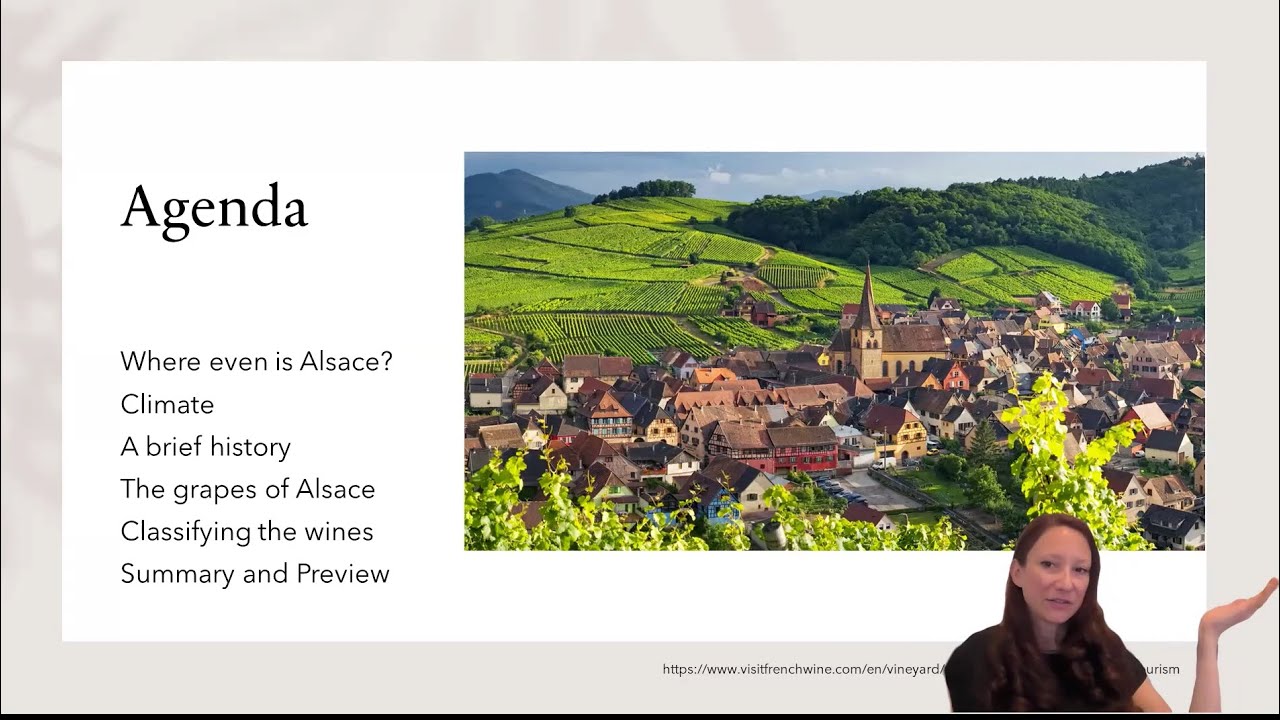
and a preview and here’s a beautiful
picture of some of the Vineyards in
alluce all right so maps of course we
love Maps um I’m G to give you a break
from Maps next time but let’s look at
some maps so because alas is not a
country it is just a region I don’t want
to say just a region it’s a region it
doesn’t it doesn’t have like the black
border on the maps and you can’t really
just look up alluce so I outlined it
here you can see there’s like France
Belgium Germany Switzerland and then
allas is in between France and Germany
outlined in red we’re going to zoom in
of
course yep here we go again so this
outline is a little bit more accurate
because um there’s like a dotted line on
Google Maps that I just sort of traced
so you can see it is this northeast
corner of France bordering right up
against Germany
we’re obviously going to zoom in again
um so here we are very accurate and one
thing I want to point out on here that
star is not that wouldn’t be there if
you just looked at Google Maps I added
that star because colar is
where is from from when it’s from where
the wine that we are drinking today
comes man that’s just got a very
complicated sentence anyway just
remember um towards the southern third
of the region that’s where today’s wine
is
from and then of course we have to look
at some top topography and this is where
I’ve realized you can’t see my mouse
when I screen share at least I can’t see
it when I post the videos so it’s hard
to kind of F I wonder if I can move can
I move me oh uh yes all right so I am
now oops I am now against this white oh
my gosh this is hard this white
line that is that was rough that is the
Border of France and Germany um and you
can see like sturg colmart mle house
those are all the cities within alsas
that kind of border right up against the
vog mountain that we’ll talk about in
just a
moment all right so Topography of course
um I think sometimes when I look at the
maps I think if it’s green it’s the
valley and if it’s less green then it’s
the mountains uh in fact it’s the
reverse in this case so you can see on
this cool map Hill map um where the
where the mountains are those are the
the vog mountains and on the zoomed in
Google map that’s where the green is so
alluce really is protected by those
mountains and we’re going to get to that
in just a
second like right now okay so the
climate of alas is a cool to moderate
Continental you can see here I’ve given
you the ranges for cool and moderate um
and then Continental is just that uh
large difference between the hottest and
the coldest months so typically summer
and winter and typically the summers are
relatively short um and that temperature
drop in Autumn is is rapid and can
actually be a little bit jarring so a
tough tough call for um wine makers
sometimes to know exactly when to pick
the grapes like will it get too cold but
uh specific to allas the nice thing is
super cool those voge mountains are
great so if those weren’t there these
kind of like Westerly rain Laden winds
would just come in and like not drown
but drench The Vineyards whereas inad
said I mean it’s kind of just how nature
works so you’ve got the mountains and
the clouds coming in and the clouds hit
those mountains and they they don’t keep
going like they stop so that’s really
neat um and then of course it also
creates a barrier to the well no it’s
still creating that same barrier to the
clouds which means there’s a little bit
less shade and you get a lot of like
nice sunny weather in these dry Autumns
and the only catch is that um if it gets
too dry and sunny of course that is
drought and we don’t like drought so a
fine line but typically great great
growing climate great growing climate
woohoo all right this is the history I
wanted to talk about that’s so cool so I
hope you are a history nerd because this
is so fun um I used to hate history and
now of course I love it because there’s
so much about wine that’s history
related anyway I digress all right going
back to
12,000 BC is that Neo lithic era I don’t
remember um that’s the approximate date
of artifacts that they have found in
Strasburg which you may remember from
the map um and that’s the that City on
the Ryan River so they are they are
dating archaeologists whoever they are
dating these artifacts all the way back
to 12,000 BC crazy so there were people
that’s what we know right now then in 58
BC Julius Caesar who I kind of hope you
have some idea of who that is and his
Roman Empire conquer alsas so I guess
now it belongs to the
Romans 496 ad is where we start to like
do this back and forth between France
and Germany so King Clovis and the franx
which is what the Frankish is what the
French people were called back then
conquer alsas so alsas now belongs to
France um in the
700s Charlamagne unites Germany France
and alsas into kind of like one big
Empire and now I mean I guess they
belong to Germany and France because
those countries don’t exist it’s all
just one big thing anyway when
Charlemagne dies his sons are bickering
about how they’re going to divide up his
land and Germany ends up with alas I
can’t it was like Louie the German or
something I think with his son’s title
that’s 842 is AD so I we’re we’re
talking a long time ago um finally oh I
forgot I stopped putting ads whatever in
1262 strawber declared itself a free
republic everybody was like sure yeah
whatever um and it just starts thriving
because it’s a central stop on the trade
route of Paris Vienna Orient so great I
mean they are
flourishing um but then of course
there’s the 30 Years War so in 1646 uh
the hapsburg Empire sells alluce to
France so we’re back to France now
alluce belongs to France 1870 to 1944
was nuts so obviously we had the world
wars um and so alas belonged to Germany
and then to France and then to Germany
and then in like a show of peacekeeping
I guess Germany gave it back to France
and that’s that whole span so we
flip-flopped a lot but today strawber is
one of the three capitals of the
European Union and Os is still within
French borders
I don’t really even want to say that
it’s French it’s just within the French
borders um ALS is its own language and
it’s kind of this like French German
blend it’s a very independent region
regardless of if it technically belongs
to France and I’m sure if French people
are watching this video they’re like no
that’s stupid alluce is French and I’m
hoping that if any Alti ever watches
this video they’re like yeah alluce
anyway moving on cool history right
really wild um independent people who
got kind of you know taken over a lot
all right the noble Grapes of alluce uh
so we’ve got reeling it’s the
predominantly planted grape you’re going
to get dry wines with medium alcohol
high acid medium to full body Citrus and
stone fruit um and some of them are
actually being made with residual sugar
now so obviously those wouldn’t be dry
but the vast majority of them are dry
convert tramer or convert Stromer if you
are pronouncing it the UK way also dry
but a low to medium acidity with high
alcohol and a full whole body and
sometimes just like um the GT ters are
growing all around the world you get
like a rich oily texture on it then it’s
got that pungent very unique nose of
baking spices lyy roses um that’s always
like a good tell for G streer the Peno
gree also going to be dry uh medium
acidity high alcohol full body you’re
going to let a lot of fresh and dried
fruits and then if it’s it’s a really
nice expression or it has aged at all
you might get some honey notes and it
this will also have a rich texture which
is hard to explain like yes it’s full
body but also just has a good texture um
a nice mouth feel but not oily like the
G virer and then finally I just move
myself again this is so convenient all
right finally we’re going to talk about
muskat so there’s two varieties of
Muscat I hope this blue box isn’t
showing up there we go uh Muscat Blanc a
and I’m messing up my pronunciation and
then muskat tinel the tinel is less
aromatic so it’s not as like nice of
wines I guess but it’s a lot harder for
your fruiting like it just fruits better
and it is way less prone to rot so it is
important whatever anyway it matters but
we’re going to mostly talk about the um
what I’m calling the
mvpg that one has a light to medium body
low to medium acidity um overall just
like a nice fresh wine and it’s going to
have orange blossom notes Rose notes and
when I say grape notes you’re like
obviously these are grapes but it’s like
the grapey grape notes like when you
think about rape that’s that’s these
notes so hopefully that kind of helps
clarify what I mean by grape notes all
right just roll with me that was a lot
of text so I just wanted to give you
some pictures um so I oh the far one is
storg the middle one is also strawberg
and then these are the voge mountains so
cool pretty beautiful I feel like wine
country is always beautiful like I think
it’s a prerequisite are you going to
grow a Vineyard here it’s got to be
beautiful
all right now the laws and appellations
and
classifications um we’ve talked about
French laws we’ve talked about Italian
laws I think and Spanish laws it’s like
a little bit different in alluce but
somehow also stricter I anyway there are
two principal levels you’ll see and that
is just all sauce which is most of the
country’s production it will normally be
single varietal and the grape variety if
there is a grape variety on the label it
is 100% that grape there is no lenient
see here um and they there are some
Blends made but it’s typically only from
the noble four varieties that we listed
on the last slide um we will get to ones
that don’t have the noble
varieties almost always I think there’s
there’s always exceptions to rules right
but like 99.9% of the time it’s going to
be those four grapes now the allas gr
crew it’s about it’s just a little bit
over 50 Vineyards have merited this
label um they must be made from a single
variety and it must be one of the four
noble grapes I’m sure again that there’s
a rare exception but by and large if it
says gr creu it’s one grape and it’s one
of those four uh they also must be
properly labeled so it must include the
vineyard the Vintage and the variety
that is chosen now the other
classifications that aren’t so much
levels they’re just telling you what
you’re getting which is kind of like a
weird thing to wrap your head around is
um vend which I’m calling VT and that
literally means late Harvest this again
is only from those four noble varieties
there must be a minimum sugar ripeness
and you’re you might be thinking like
how how do you know that um there are
machines I don’t know exactly how they
work I should probably like do some
YouTube digging and see if I can see one
of them but it’s a literal machine that
you can pull out some of the grape juice
and it will tell you how much sugar is
in there must weight all that kind of
jazz um the best examples of this will
undergone will have undergone something
called page and I will probably talk
about that in a vinification video so
that we don’t get to distract right here
some of the VTS undergo Noble Rot your
next choice
is and that’s sgn oops um this is also
only from the four varieties the just
gonna move me again this is so
convenient um the minimum sugar ripeness
is higher than that of the VTS and
typically it gets that level through
Noble Rot because that’s that’s just the
easiest way to really concentrate those
sugars um because these require such
like an intensive sugar weight and
because they have to have the right
conditions for the Noble Rot these are
not produced every year and when they
are produced it’s in smaller quantities
so rare find delicious
obviously but wait there’s more um which
I also if you can see the bottom of this
slide I debated calling this slide will
it blend because this is also about
Blends so two classifications for your
Blends that aren’t made of only those
four grapes your first one is a little
more stripped so the JY must meet those
alluce standard
it must be 50% of 50 of the four 50% of
those four noble grapes now you can
blend them but 50% must be those four
grapes the other 50% can be Sil svor
chasela and orino Blanc um again
proportions not as long as 50% are those
four whatever for the other
50% now they can’t be Blended before
vinification every wine must be made
individually and then Blended after
making sure they meet the requirements
for the alluce label so very strict
processes here um you basically have an
awesome line ready and then you blend it
now why you would do that I have a lot
of theories like maybe you didn’t have
enough um like you didn’t have enough uh
what’s it called yield to just put out a
single variety and so now you’re just
going to undergo the blending and
there’s probably a lot of reasons I’ll
look at up for our next Els video that
I’m sure we’ll have um and then on these
you must include the Vintage on the
label now ‘s which is what we’re
drinking today way more chill uh you can
blend any of the white grapes that are
grown in all sauce and you don’t have to
indicate the percentage so honestly like
unless you look it up looking on the
back of the bottle yeah no idea what’s
in this I should probably look that up
so that I know what I’m drinking it’s
going to be the grapes that are grown in
all sauce it’s going to be a white wine
that’s what I’ve got um and now for
these you can make them separately and
then blend them or you can blend them
and then finish the fermentation and
vinification process totally up to the
wine maker you don’t have to include the
Vintage on the label
uh mine does it’s a 2019 but it’s not
required um and again this is what we
are drinking today as evidenced by the
fact I’m holding a bottle of
it and then you know I like to include
quotes and pictures so that you don’t
get too overwhelmed by all the texts
this one comes again from the wine Bible
um Karen mcneel so a single passionate
philosophy pervades Elsas wine making to
create wines with pure fruit flavors so
we’re not looking at a lot of oaking
we’re not looking at a lot of like extra
uh probably not a ton of secondary or
tertiary flavors we’re just looking at
very fruit driven high quality wines
fascinating wild I just all sauce is so
cool all right in summary and this
picture doesn’t get a credit because
it’s literally the bottle we’re about to
drink um I got this quote from wine
simple which I also love for just kind
of like conceptualizing Wines in the
broader picture a little bit French in
their traditions a little bit German in
their comfort all station wines have a
food friendly richness that’s easy to
love and I would hands down drink drink
I would hands down agree with that uh so
we are drinking the leoline well I guess
I literally have a picture of it right
here uh leoline from doen Lees which you
saw was in the southern third of
alas um it is M which means it was put
into the bottle in the same place that
it was grown uh it was bottled in August
of 2020 by some bunch of people who work
there yeah that’s pretty much it um I
was on French so that’s why it took me a
minute we’ve got this okay there we go
um I should probably start wearing white
for these videos it is a nice it’s not
necessarily
gold actually would say it’s gold it’s
more gold than it is like straw or
lemon it’s got a nice nose very fruity
I’m getting like every tropical fruit we
got some mango some melons some
pineapple some
papaya this is going to be really
nice that’s beautiful I mean it just
oh this is so nice it’s fruity without
being cloying which can sometimes be an
issue for fruit forward wines I just get
nice clean crisp fruits not a lot of
stewing not a lot of jamess actually
none um I don’t get dried which I know
is a possibility but I’m just getting
very very crisp very clean very fresh
maybe a hint of the baking
spices I could see a tiny bit of lechy
not getting a ton of fruit or I’m
getting a ton of fruit I’m not getting a
ton of Rose so I’m thinking not maybe
high on the G stre meter but I could I
mean I could be wrong I’ll look it up if
I can find it I’ll put it in the um
video description as you guys know um
yeah I’m going to have to say allas
wines I didn’t know a ton about them
before I started studying wine and they
are going just going up up and up on my
list of like just pick an all station
wine and you’re probably going to be
good to go uh I also don’t have any idea
how much I paid for this I can’t
remember if this was a Splash wine if I
can find the price range no I will find
the price range and I’ll put it in the
video description again so I’m going to
go enjoy this I hope you are enjoying
any wine or if you’re on a dry streak I
hope you’re enjoying your water or your
mocktail or your non-alcoholic wine
whatever you’re doing I hope you’re
enjoying yourself
um next time like I said we’re not going
to do so much Maps but I have um a
reposo so we are going to talk about
Italy but not about the geography or the
climate we’re just going to talk about a
couple wine making techniques that are
somewhat unique to ital it’ll be a
shorter video so that you uh can kind of
get a break from these longer ones um
and then last but not least of course
thank you so Wikipedia I do not look up
information on Wikipedia please these or
like double check the sources but I did
get that first picture from there so
awesome thank you the visit French wine
site Google Maps map Hill climate data
Snippets of Paris and then a bunch of
pictures from unsplashed that’s where I
got the Clos bouro picture Emon muler of
course the wine Bible grap es scrape
grape es scrapes grape escapes uh the
wine and spirits education Trust of you
said obviously because that’s where I’m
learning all of my classes the
Commonwealth wine school which is where
I take my w set classes my study partner
Liz um for the last exam because we did
a lot on all sauce like we we studied a
lot on this one and then um Allison
saying who did this picture and this
final picture is because I do hope that
you will like And subscribe to the
channel so that you don’t miss any
videos so that if I’m posting off
schedule you still get notified um you
can make comments we can really build
this community of just people who line
and not the pretention just the
nerdiness of it so
cheers here’s somewhere cheers and I
will see you next next
time that’s great cuz the wine glass
disappears and I’m just like drinking
this like silouette that has gone away
ghost wine all right bye