
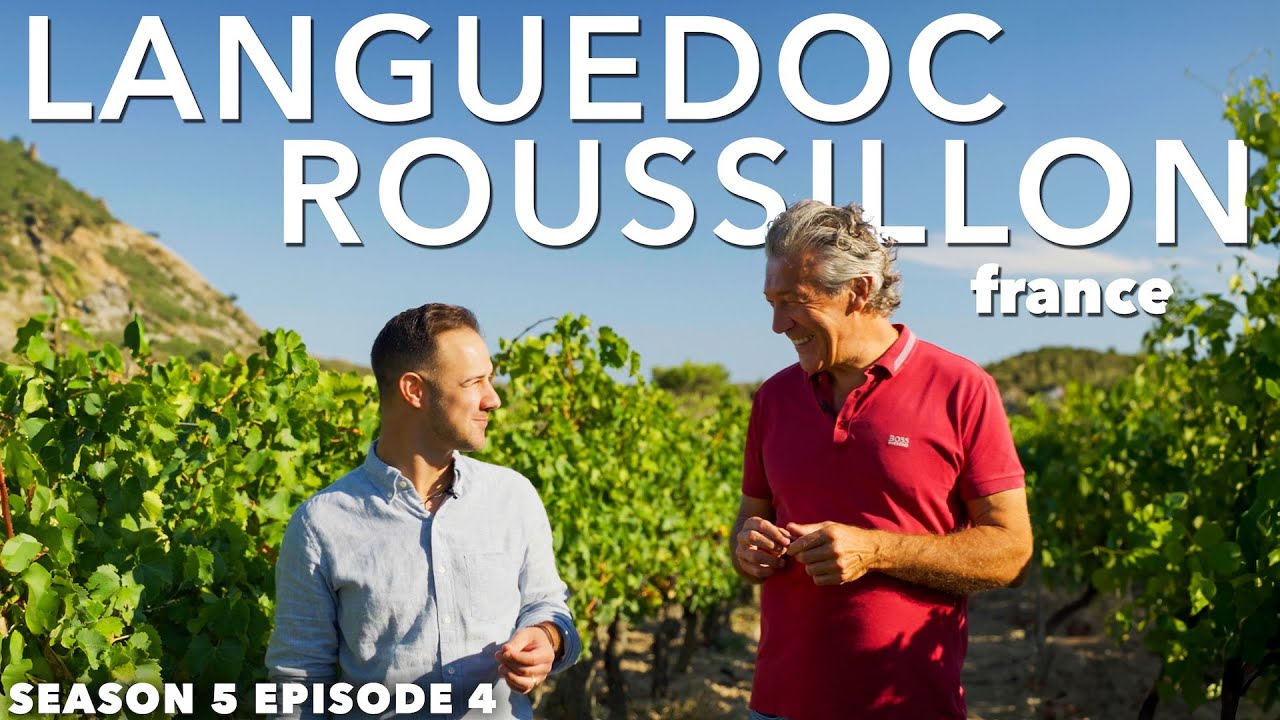
Languedoc-Roussillon is France’s largest wine region and has more organic vineyard land than anywhere else on the planet! Its sheer size means it can produce an enormous variety of wine styles, from sparkling wines to rich whites, spicy reds, and even luscious dessert wines. Biodynamic winemaking pioneer Gérard Bertrand takes center stage, highlighting why caring for the planet and producing incredible wines aren’t mutually exclusive. Explore the largest, oldest, and sunniest wine region in France on this episode of V is for Vino!
Enjoy the show? We’re independently owned and produced and would LOVE your support! You can also watch ad-free! Join Vino VIP: https://www.visforvino.com/vip
All locations, wines, and wineries are listed at: https://visforvino.com/languedoc-roussillon/
DESCRIPTION: Languedoc-Roussillon, France, is the largest wine-producing region in the entire world! Crazy right? It’s also one of the most historic. The Greeks explored this area, and the Romans used the city of Narbonne as a Port and trading hub, as it was at the intersection of some of their major roadways. The Romans would plant vines all along the roads and also use them to transport wines from Languedoc-Roussillon across the Roman Empire. Today, Languedoc-Roussilon produces more wine than any other region in France. However, until the last few decades, much of it was unmemorable bulk wine. But more recently, there’s been a focus on establishing AOCs and producing wines with a sense of terroir and quality. Plus, many of the producers here are organic or biodynamic, like our featured producer in the episode @Gerardbertrandofficial Not only has the quality of the wine increased, but because the region is so large, you can literally find every style of wine here! Sparkling, white, rosé, orange, red, dessert, and sweet wines are all common. While there are dozens of grape varieties allowed, there is a grape that Languedoc-Roussillon can claim as its own, and that’s Carignan. This is a “medium” grape: medium-bodied, medium acid, medium tannin. It’s known for its juicy red fruits (cranberry, raspberry) and spice. In this episode, we’ll also go hunting for the best bread in the area, visit Carcassonne, the medieval town famous for its Cassoulet, and have an exquisite meal in the Moon Room complete with an audio/visual light show, as well as food and wine pairings. We end the episode at Gruissan’s mysterious pink salt farms. I hope you get to visit Languedoc-Roussillon in the South of France, it’s such a gem!
WINES FEATURED (GÉRARD BERTRAND) IN ORDER:
Cote des Roses Rosé
Orange Gold
Château L’Hospitalet “Grand Vins”
L’Hospitalitas
Château de l’Hospitalet “Art Collection”
Gris Blanc Rosé
Hérésie
La Forge
Cuvée 100 Les Arbousiers
Castellum
Clos du Temple
Villa Soleilla
Clos d’Ora
Cigalus
Castellum Blanc
Aigle Royal Pinot Noir
Legend Vintage Maury 1929
CHAPTERS:
00:00 Introduction
00:59 Narbonne/Geography and History
06:04 The Best Bread Ever
07:45 Meet Gérard at L’Hospitalet Beach
14:17 Grapes of Languedoc-Roussillon
18:37 Vino VIP
20:02 Chateau L’Hospitalet Resort
24:49 Narbonne Market
27:09 Château Villamajou w/Emma
31:47 Visit Our Website
32:09 Carcassonne and Cassoulet
34:32 Biodynamics
37:09 “Icone” Wines
43:53 The Moon Room Restaurant
48:46 Outro/Salt Farms of Gruissan
50:28 Credits
___________________
ABOUT V IS FOR VINO:
Wish learning about wine was easier? It’s fun AND easy with your personal sommelier, travel guide, and host, Vince! Join him as he travels the world of wine – eating, drinking, and breaking down wine topics for you up close and personal! Want to know more? On each episode of V is for Vino, you’ll:
– Meet a winemaker and learn their story. One of the best parts of drinking wine is getting to know the place where it came from and the people who made it!
– Learn about the grapes. Vince breaks down wine topics easily, making them fun and easy to understand!
– Visit the region. Not everyone gets to travel to wine country as much as they’d like, so experience the beauty and culture firsthand with Vince. Travel the world and sip along from the comfort of your couch!
– Cook dishes that pair at a local restaurant because what’s good wine without good food? Luckily, the world of wine is full of amazing chefs and restaurants ready to serve up something delicious to pair with the wine you just learned about.
___________________
And just because an episode ends doesn’t mean the fun stops there. Next, you can:
SUBSCRIBE to our YouTube channel! https://bit.ly/3xxH7eT
JOIN VINO VIP to watch episodes ad-free, get early access to new videos, exclusive VIP members-only content, virtual zoom wine tastings with Vince, and fun giveaways! https://www.visforvino.com/vino-vip
Follow us on Instagram!
https://www.instagram.com/visforvino
Let’s be friends on Facebook!
https://www.facebook.com/visforvino
© 2023 V IS FOR VINO ALL RIGHTS RESERVED
– Welcome to Languedoc-Roussillon! This may be the most underrated French wine region around. It’s the largest wine region in France, it’s the oldest wine region in France, and you’re not gonna believe this, it produces more wine than any other region in the world. And yet, so many have never even heard of it.
But I’m here to change that because what was once a hub for unmemorable, mass-produced wine, is now an area that attracts investment in talented wine makers, all looking for one thing. Freedom. Languedoc-Roussillon is a hub for innovation, experimentation, and creativity, that’s hard to come by in the rest of France.
Oh, and it looks beautiful too. Welcome to Languedoc-Roussillon, and welcome to “V is for Vino.” ♪ It feels like home ♪ While we flew into the largest city of the area, Montpellier, I’ve opted to make our home base in Narbonne, which is a little more quaint. It’s an old Roman port town, and was the first Roman colony established in France, way back in 118 BC. And here we are, Narbonne, one of the half dozen or so mid-size cities located in Languedoc-Roussillon. You’ll find that this city, as well as most of this region, isn’t quite the major tourist hub the way its neighbor to the east, Provence, is. While Provence may have cachet, Languedoc-Roussillon has authenticity.
You get everything this part of the country is known for, large open beaches, lots of sunshine, lifestyle, wildlife and birds, great food and wine, all without the hassle of touristy crowds. Pretty good deal. The history of vine planting in this area is rich, starting with the Greeks in fifth century BC. – Hello.
– [Vince] But it was the Romans who really expanded vine growing. – Hey! – [Vince] They built a cobblestone road in 122 BC, called Via Domitia, that connected what is now known as France to Spain and Italy. Add to this that another Roman road, Via Aquitania, went from Bordeaux through Toulouse, into Narbonne,
And that the city also has a port. And you can see why this was such a crucial Roman trading hub. Vines were planted along both sides of these roads and wine from Languedoc-Roussillon was transported all over the Roman Empire using both land and sea.
The city was known as the “first daughter of Roma,” and the capital of the region they called Narbonensis. What I’m walking on now is a portion of the Via Domitia that was uncovered here in Narbonne. Wild to think that the ancient Romans walked along this very same path. Do as the Romans do, am I right? Since those days of wine transportation via cobblestone roads,
Wine production in Languedoc-Roussillon has come a long way. So much so, that over a third, that’s one in every three bottles of French wine, is produced here. Even crazier, this area is the largest wine-producing area in France, with three times as much vineyard land as Bordeaux.
In fact, it’s the single largest wine-producing region in the world! So why haven’t you heard more about it? Well, because for most of the 20th century, the region was known for undistinguished, characterless wine that sold for cheaper than water. It wasn’t until the 1980s when the region began to turn its reputation around.
Up until this point, most wine from this area was made in the lower two levels of the French wine classification hierarchy, Vin de France, or IGP. But the region restructured, and created AOC guidelines based on location, soil makeup, yields, winemaking methods, and grapes used. Today you’ll mostly see two types of wine
Coming from the area. The majority of wine is still made under IGPs, Pays d’Oc being the largest, and is also where most of the experimentation takes place in Languedoc-Roussillon. Many of these wines are labeled by the grape variety instead of the place,
One of the only areas in France where this is commonly done. The grapes can come from almost anywhere in the region, and many are great bang for the buck. But you now also have many AOC wines being produced, which is the top tier of French wine. Quality is more tightly controlled,
The wines represent specific terroir, and they range from solid, affordable weeknight wines to magnificent, pricey showstoppers for special occasions. The region itself stretches in a semicircle facing the Mediterranean Sea, from the Spanish border and the Pyrenees Mountains to Nimes and the base of the Rhone Valley.
This region gets tons of sunshine each year, cool ocean breezes to keep the vineyard dry, and soils ranging from alluvial near the coast, to chalk, gravel, limestone, and riverstone more inland. Quite frankly, you couldn’t ask for more dependable wine growing conditions. In fact, grapes grow so easily here
That many of the best winemakers keep their yields low in order to bring more concentration and character to the fruit. Now, we’ve been calling this region Languedoc-Roussillon, which is how you’ll see it described in most wine textbooks. However, you may also see the term, “Sud de France,” or south of France.
This change happened in 2006, when the Languedoc-Roussillon board decided to rebrand and add to their umbrella some appellations near the Rhône and Southwest France. But in 2023, the federal government ruled to ban the term “Sud de France” on wine labels starting in 2025, leaving a big question mark on that branding.
Plus, there’s even a third contender, “Wines of Occitanie”, which includes Languedoc-Roussillon, as well as South West France. Confusing, I know, but what I’m trying to say is that you’ll likely see these other terms out there, but just know they’re all more or less referring to the same place, Languedoc-Roussillon. All right, so one of the hosts at our hotel told us that this little town near us has some of the best bread they’ve ever had in their life, and that’s coming from a French person. And as someone who has been known to pack bread in their suitcase
And fly it across the country, you had me at “bread,” so I had to find it. But the small little towns, the problem is that they’re all windy roads and there’s no street names, and so, we’re just on a mission, I guess. I think it’s coming up around the corner maybe?
Bonjour. – Bonjour. – I think it curves this way, and then we get there. Kitty! Oh. Rio! I see bread! I found it. Let’s do one of each, please. Can we do a half of each of those? We could try ’em? – Yeah, of course. So you will see the inside is nice and really fluffy. – Ah, it looks so good. Yeah, yeah, – And then the- – More dense. – Yeah. – So excited, I can’t even tell you. You’re being very kind. – Okay. – All right, here we go.
Here is what you get when you get really good bread. That crust, Oh my god, it smells amazing. Listen to that! Like, that crust that you get on the outside of good bread, It’s so good. And even though you get the crust on the outside, it’s so moist on the inside, you know, it’s not dry at all. Every trip that I come to France, I eat bread at every single meal of the day. This is your classic sourdough, it’s kinda light, this is more dense,
And has almost like, that funky, yeasty character a little more. Yeah, that’s good too. (chuckles) About a 20-minute drive from Narbonne is the Mediterranean Sea, and on the edge of that sea, L’Hospitalet Beach, a restaurant owned by winery, Gérard Bertrand. And waiting for me at that restaurant, the man himself, Gérard Bertrand. Gérard used to be a professional rugby player, but has now created
One of the world’s most dynamic wineries, which has 17 estates throughout Languedoc-Roussillon, all of which are certified biodynamic. And like the region itself, the winery is diverse, dozens of wines in all different styles and price points. Him and his wines are the perfect lens to explore the region through.
How do you go from rugby to wine? – My father was involved in the wine industry and I share my time between wine and rugby rugby and wine, because even if I play at the top level, I had enough time. And because my father passed away when I was only 22,
I had to manage my rugby career and the family estate in the same time. – Wow. – It was tough. And then when I stopped to play, when I turned 30, I start to develop the south of France estates, and we move from one estate to 17 now.
– Wow. – In the region, yes. Now we pour with you the Cote des Roses, and welcome in the south. – Red cherry fruit. Good minerality still, though, that beautiful freshness that we look for from rosé, but some creaminess, some length that maybe you don’t always get.
– Yeah, that’s why, you know, the wine is so successful. As well as because the name, Cote des Roses, is also the name of the coast here, and you see- – Oh yeah, on the bottom you have the flower. – Yeah, the flower. I mean, we promote like a bunch of roses.
– I would rather have this than a bunch of roses. – This is the largest area in term of wine production in the world. Two times more than California, 1.5 times more than Australia. We make wine for 24 centuries, and the Greek came here with their boat in Narbonne beach. – But there has been a shift in the last, what, 20 years,
To maybe move more to quality versus quantity? – I mean, now we can compete with all the best region in the world and the chance of the south of France is that we have diversity of terroir, diversity of climate, diversity of grape varieties. – Course one was seared tuna
On fresh vegetables picked from their own garden, in citrus, topped with basil and sesame sauce. This was a great match with our rosé, whose acidity cut through the creamy sauce, matched the acidic citrus, and the medium-bodied rosé stood up to the medium-bodied dish. – The name of the wine is Orange Gold,
You know, to celebrate the sunset. It was important for me to create an orange wine and to pay a tribute for people from Georgia, because they were the first to make it 8,000 year ago. Different kind of orange wine, more accessible, with more fruit, more complexity, and less tannin.
– You know, right now orange wine’s very popular, it’s very trendy. I think a lot of people don’t know that it’s one of the oldest winemaking styles on the planet. The nose on this is unbelievable, so you get this beautiful, flower-honeyed component, – The complexity of a red
And the freshness of a white in the same wine. You know, so light bitterness, and we have a quality of tannin. Very good tannin. – What’s fun about these wines, they bridge that gap between white and red where you get some savory notes, like, this isn’t all fruit and mineral,
There’s some, like, white pepper. If they’ve never had an orange wine, it’s gonna blow their mind. This is a six grape blend. There’s some regions in the world where they’re only allowed to have two grapes, period. Here you can pick from dozens of grapes. You have all these different styles.
There’s a lot of freedom here. – Yeah, you know, freedom, you know, I think it’s important, yes? I can sing a song, but- – The French and the Americans, that’s one thing we have in common. We both like freedom. (laughs) – Yeah. – [Vince] To pair was crispy prawns with basil aioli,
Crunchy and delicious. The acid in the orange wine matched the salty fried shrimp, and cut through the creamy aioli. The medium-bodied wine matched the heaviness of the prawns and from a flavor standpoint, the savory shrimp and basil paired with some of the peppery, savory flavors of the wine,
While the fruity floral notes contrasted the dish. These orange wines are seriously fun to have in your pairing arsenal. – [Gérard] This is a Chateau L’Hospitalet white. – So this wine, like all your estates, is biodynamic, which isn’t a small feat. Why was that important to you?
– Can you know it was important for me because, when I was 22, I had a liver issue, and nobody could fix it. For a French man is difficult, but for a winemaker is a tragedy, yes? I use myself homeopathy pills for 35 year, this medicine changed my life
And biodynamic farming is like homeopathic medicine, but for the plants. After two years I have seen the difference in the vineyard and in the cellar with more freshness, more minerality, to a better potential of aging. – Wow. – Biodynamic farming is like a reborn in my career.
– [Vince] It’s that oxymoron of creamy and fresh, right? – [Gérard] Yeah, it’s on the edge. – Yep, it’s right, splits the middle, got great minerality. This has that sense of soil. – And the good thing also with a blend of four grapes is that, you know, you can create really unique wine
And the combination between the complexity coming from the different grapes and also the mineralities coming from the limestone. – The richness of what you might like from a good burgundy, but it’s got the freshness that I like from southern Rhône blends, some savory notes that I don’t get from that.
It really is very unique. We ended the meal with whole grilled Turbo, ratatouille, and tropical relish. In addition to matching the weight of the dish, the ripe tropical fruit notes in the wine matched the relish, and this was a grows together, goes together match for sure.
We finished lunch and left to head to the estate where this wine was grown, but first, lets chat about the grapes of Languedoc-Roussillon. Before we get started, know this. Languedoc-Roussillon is huge, with all sorts of sub regions, grape varieties, and wine styles. There’s no way I can cover everything in the next three minutes. That’s the bad news. The good news is that whatever wine you’re into, you can find it here.
And because this region is not as regulated as other French wine regions, it’s one of the only places in France with true freedom for experimentation. If you add to that huge variations of climate and soils, and the insane quantity of wine produced here, you end up with wine styles and price points
Suited for all tastes, and an endless well of new wines to choose from. Red wines represent a little more than half of the wines produced here, with the remainder being a mix between white, rosé, sparkling, and sweet. As far as grape varieties go, reds are fairly straightforward, compared to the whites, anyway. They’re usually blends of the traditional Rhone grapes of Grenache, Syrah, and Mourvédre,
As well as Carignan and Cinsault. Most of the reds are juicy, a little spicy, rustic, herbal, and medium-to-full-bodied. But this is by no means an exhaustive list. International grapes like Merlot and Cabernet Sauvignon are also common and so are some more obscure ones, like Picpoul Noir and Côt, the local name for Malbec.
White wines are a cocktail of grapes, Grenache Blanc, Clairette, Bourboulenc, Picpoul, Mauzac for sparkling, Chenin Blanc, Chardonnay, Roussanne, Marsanne, Vermentino, Viognier, Muscat Blanc à Petits Grains for sweet wines, the list goes on. And white wine styles heavily depend on the individual winemaker and the place.
Languedoc and Roussillon used to be two separate areas, but are now considered part of the same region, even though Languedoc produces about 90% of the region’s wine. There are over 30 appellations in this area, and a few are worth some special attention. Corbières and Minervois are two of the largest appellations
Known for their reds, and are the two AOCs you’re most likely to find exported. The smaller appellations of Saint-Chinian and Faugères are known for making a good blend of red, white, and rosé wines, and the reds are softer and ready to drink sooner than other areas.
Limoux is known for its traditional method sparkling wines, Blanquette de Limoux, made from the local variety Mauzac, or Crémant de Limoux, which is primarily Chardonnay and Chenin Blanc. Both are tremendous alternatives to Champagne. Picpoul de Pinet has gained an international reputation for their dry, crisp whites from the Picpoul grape,
Which are perfect summer sippers. Also, we can’t talk about Languedoc-Roussillon without talking about Vin Doux Naturel, which are sweet, fortified wines, usually white, from the Muscat family of grapes produced in a few different AOCs. These are either fresh and fruity, think stone fruit, honey, and flowers, or oxidative and nutty, think dried fruit and almonds. However, there’s an AOC, Banyuls, that makes red Vin Doux Naturel from Grenache, and that has flavors of coffee, mocha, and tea, but it’s surprisingly still light on its feet.
These wines are super traditional, dating back to the 13th century, and are great dessert wines worthy of your time. Finally, there are a handful of Grand Cru in this region, which, in theory, are the crème de la crème of the area. If there’s one grape that Languedoc-Roussillon can claim as their own, I’d say it’s Carignan. Though it likely originated in Spain, about two thirds of the world’s supply of this grape has actually grown here. For a while, in the 1980s, Carignan was France’s most planted grape,
Because, well, you can make a lot of it. A Carignan vine produces about four times the amount of grapes a Cabernet vine can. But when grown this way, it becomes overly bitter and flabby. However, when harvested at lower yields, and sometimes from older vines, Carignan has great character.
It’s full of juicy, red fruits like cranberry, raspberry, as well as meaty tobacco spice. It has medium body, medium tannins, and medium-plus-to-high acidity. And it’s this combo of acidity, red fruit, and spice, that winemakers look for from the grape to add to the blend. Hey everybody, I hope you’re enjoying the episode. I wanted to talk to you briefly about Vino VIP, which is our members-only club. You see we’re a small team, and we’re completely independently produced, which means we can only keep making episodes with your support. So if the show has helped you,
Or helped you pass a wine exam, or if you’re just enjoying it, please consider supporting the small business that provided it, and join Vino VIP, which is full of a ton of benefits anyway. You get full episodes, ad-free, and you also get early access to all our episodes, including our YouTube videos.
Plus, you get members-only videos, like behind the scenes, and commentaries, and full-length interviews, in our members section on our website. Once a quarter, we do a Zoom session where we get to hang out and taste together and talk. We do raffles once a month for our members,
And we do a big yearly raffle. Plus, if you’re a gold or platinum member, you get your name in the credits of an episode, and all our members get access to our members-only Facebook group, which is a great community. Membership starts at just $5 a month,
Which is less than the price of a Starbucks coffee. Everybody thinks somebody else will step up and support and their support won’t matter, but I promise you it does. So please consider joining if you have the means, and thank you so much to our existing Vino VIP members. Now, back to the episode. In order to get the full Bertrand experience, we stayed on property at Chateau L’Hospitalet, right up the road from the beach. You have everything here. You have restaurants, spa, hotel, pool, – And the beach. – And the beach. – Yeah. You know, this is really an amazing place, Chateau L’Hospitalet, and we have also 2000 acres of nature, 300 acres of vineyard, and now we move the hotel to five star.
It’s a very good experience, because people, they can enjoy three different restaurants, walk in the nature, in the vineyard, it’s really a destination winery. It’s also the expression of the south of France experience. – You have a big jazz fest every year. – Yes. Start with my wife, Ingrid, in 2004,
Because I am a jazz fan. Every year, you know, we do something bigger, and now we host 10,000 people, and we have dinners before. It’s really the best week of the year. – The wines from L’Hospitalet are located in La Clape AOC, one of the elite Languedoc Cru.
This region is known for reds, I think, more than anything else. These are two reds, and they’re from here, right? They’re from this estate. – Yes. We are going to, side by side, to taste two different cuvée. This is Chateau L’Hospitalet limited edition. We will have L’Hospitalitas, and this is a single vineyard.
– So we’ll taste first and talk later. – Yes. – I like your style. – I like to make the interview. What do you think? – Both good. – Good or great? – Everything’s great. – Thank you. (laughs) – You know that, listen. My job is great, so everything else is a bonus. The first wine, which is the Art Collection, to me, fresher, in my opinion,
And a little more fruit-driven. And from a structure standpoint, tannin structure lower. This one, higher tannin structure, more red fruit. From a color perspective, you can see a little more rim variation on this. I don’t know if there’s oak on it. – Yeah, you know, I think I am going to hire you
For staying there and doing the harvest with us. Because you are very good. Excellent. Yeah, you know, the limited edition on the left is more or less 60% Syrah, 30% Grenache, and 10% Mourvédre. The second wine is 97% Syrah and 3% Mourvédre. I fully agree with you, L’Hospitalitas has a strong structure, full body, and this wine is more smooth,
Maybe more elegant now, because you have more Grenache there. – I’m not saying that I like that better, so don’t take it that way, I think both have their place. I like how this one looks, maybe, in a couple more years. I like this one today.
– For me, both of them are great, but I do recommend to have the limited edition with lamb, and I do recommend to have this one, you know, with a steak, because the second wine is more spicy, you know, it’s more structural, more complex, and the first one, it’s more balanced.
Two different wine coming from the same estate, the same terroir, but the taste profile is really different. That’s the magic of the blend. – That’s the myth. – That’s why, you know, I like to make blend, because, you know, with the same grapes very close to each other, you make two different wines.
– I always tell people, more complex wines, put it with simple food and let the wine show off. This guy is more elegant. This guy needs your attention a bit more, let’s not distract it with the food. The art on the bottle. – Yes. – Can you explain that? – Yes.
You know, this is a painting of Robert Combas, and Robert Combas is one of the most popular painter in France and in Europe. This is a painting dedicated for Dionysus, the god of wine. – Both the bottles are from the La Clape appellation, which is a Cru, right? – Yes. – In Languedoc.
– [Gérard] It’s a Cru from Languedoc, yes. – And the Cru, is that a recent thing? – Five years now. – The Cru were selected because, distinct soil? Distinct terroir, distinct- – You know, it’s a combination between the soil, grape variety, climate, and people.
– [Vince] These Cru wines were indeed a far cry from the bulk wine this region used to be known for. And I challenge anyone to put these side by side with the top wines from the Rhône or Bordeaux. – Welcome to the market! – I love a good market. Gérard’s passion for wine doesn’t end with him. His daughter, Emma, works as creative director for the brand. The next morning before, heading to another tasting, she took me to the Narbonne market. Because if you watch this show, you must know by now that every episode in France contains an obligatory market scene.
Wow, look at these! I wanna buy all these things. – [Emma] You have been elected as the best market in France. Best in the world. – To me, best in France is best in the world, because I think France has the best markets anyway. – And I used to go every Sunday with my father. – Oh, nice.
– When I was a child. – When you were growing up? – [Emma] Yeah. – Our lunch spot happened to be owned by one of Gérard’s old rugby buddies. Oh, that looks really good. – Yeah, yeah. – What is that, the tartar? And their specialty is steak tartar.
It is the place to be, it’s busy. Oh, don’t forget to order for the crew. You like raw? Do you want tartar? What do you want, grilled or raw? Once your order’s in, it’s called out. And watch your head for flying meat. We had some Grenache rosé to start, which they call their Gris Blanc. – Very fresh, good acidity.
– And made some new friends. You ready for your closeup? You’re gonna be famous. Hey, cheers. – Cheers, yes. Absolutely, cheers. – Santé! – I have to do your father’s move. He listens to the wine. Yeah, when your- – Is he doing that? – Yeah, every time we’d cheers,
He’d go and he’d listen to it, and he goes, “You have to hear the terroir” – Like the sound of the sea. – Yeah. In preparation for the beef, we switched wines. – This is Hérésie, this is a red blend, from Corbiéres. – Oh, this is good.
– Spicy, full body. – Spicy, juicy. – Juicy. – Yeah. Perfect for this. – I love it. – Yeah! Vegetarians, look away. In fact, all of you look away, because you’re not getting any of this. A half pound of raw ground beef with a raw egg on top, and french fries with mayo.
This is one those once-a-year meals that cuts deep into that caveman part of the brain. Comfort food at its most primal. Mix it, right? – Yeah, you need to mix it. You need to mix everything. – Look at that. – Peppers and onions and the egg yolk.
– [Vince] This is so much meat! – Yeah, yeah, that was a lot of meat. – It’s like a pound! I’m not complaining. Oh, yeah. And with the wine, this is like, perfect. – Bon appétit! – Hey, bon appétit, thank you for taking me here. Emma lives in the Corbiéres AOC, near the Villemajou estate, a place that means a lot to their family. Where we are right now, this was the first estate of Gérard Bertrand, correct? – It was actually my grandfather’s estate, and he bought it in 1973,
Because he believed in the potential of the Corbiéres area because of the soil and because of the Carignan, you know? Then, that’s where, as well, my father started doing the harvest and learning about wine when he was 10 years old. So my grandfather has told him,
“Gérard, you’re lucky, because when you’ll be 50, you will have 40 years of experience.” My grandfather believed in the potential of the Corbiéres area. He saw that the soil was special, the place was special, the energy was special as well, and especially, too, there is the Carignan,
Which is very local to the Corbiéres area. – If there’s a claim to fame to this region, I think Carignan is kind of the grape that is used very, very often, in almost all the blends. – In the Corbiéres, yes. And we have hundred-years-old Carignan here.
– [Vince] So this is the Carignan you were talking about? – Yes, this is La Forge, so my grandfather’s favorite parcel. – First of all, you can see how old they are. A lot of Americans are familiar with old vine Zinfandel, and they have a little bit of that character,
Like, you can see the age on ’em. What else is interesting is how rocky the soil is. – It’s a very dry terroir with very low yields, and it’s a terroir made from galet roulés, – Okay. – And limestone. – So limestone, and then the stones, and what that does, probably,
Well-draining soils, I would imagine. And then, the other thing I’ve noticed is that it is super windy here. – [Emma] Always, it’s always windy here. – Okay. – I’m living here, so I tell you. There is wind all the time. But it’s good, too, because, you know,
When it rains a lot, it helps dry as well, and we don’t have any disease on the vines. – You know, when you practice biodynamics, that means you can’t use pesticides. – No. – And so, it’s nice that you can keep that from just the wind and the breeze,
And basically keeping it nice and fresh. We head inside to taste two wines that help continue this family story. – So the cool fact is, the building is like orange terracotta, and it’s because we used the soil to paint the building, so it perfectly matched the environment and the nature,
And it represent the soil. – Part of the estate, quite literally. – Yes. – Both these wines are from this estate, but they both have different significance, right? – So they are both important and very special to my heart, because we have La Forge, that was my grandfather’s favorite plot. – [Vince] Okay.
– And it’s a hundred-years-old Carignan. And this is the plot that has been planted by my great grandmother in 1920. – Okay. – So you can imagine that at that time, women were not very much involved in wine, so it was something very special, too. – Wow, wildly different colors. And then, which one has more oak? – [Emma] The Cuvée 100 has 18 months. – And you can see that because you can see on the color, too, that’s a little more transparent. You see the oxygen coming in. – Absolutely. Evolved color with some reflection, a little orange,
You know, and brown. – Yeah. – The fun thing about Carignan is it’s kind of a down-the-middle wine, medium body, medium acid, medium tannin, and so it gives you such a nice space to then do what you want. – Because the Carignan brings the freshness and the fruitiness, and the explosion of fruit,
And the Syrah brings, as well, all of the spices, and the more toasty notes, as well, that when it will evolve in the time. – The Syrah-based one has almost a serious character to it. The Grenache-based one is just this bright, fun wine. Garrigue, that green herbal,
Both have this great core of red fruit and spice, but they have completely different characters. – You know, that’s funny, because I think they both represent, pretty well, my grandfather and my great-grandmother. My grandfather was a very, like, serious man, a very deep and intense person, and my great-grandmother was very generous
With her children, and, you know, – Yeah. – Very round, in a way. – Most of the wines, they have these great spice notes, whether it’s, like, an herbal spice, or it’s a pepper spice, or it’s a tobacco spice, like, all of them seem to have that.
To me, when wine is pure fruit, that’s kind of boring. I like that extra. I know this estate is important to you and these wines are important to you, so I’m honored to sit down and taste them. – Thank you for coming, it’s my pleasure. – Talking to Gérard off-camera,
He told me how proud he was of Emma. She travels with him to markets across the world to help promote the wine, and has her learn every aspect of the winery, because behind every family business, there’s a family keeping it afloat. Did you know that on our website, each episode has a page where you can find listed all the wines we had, as well as the places we visited. And while you’re there, you can join Vino VIP and visit our members-only section, with a ton of behind the scenes videos and bonus content.
Just thought I’d let you know. All right, it’s a windy day in Carcassonne. Carcassonne is the classic, like, medieval castle town, 4 million tourists per year. It’s a UNESCO world heritage site. It is what you think of when you think of a medieval castle. It has the turrets, it’s got the cobblestones,
It’s got the towers, and it’s got the kinda windy streets. Obviously there’s no cars in here. It’s super busy, super crowded. It’s worth your time, regardless of the what this is, Because there is a dish here that you have to get when you come to this part of France, and we’re going to the place that apparently makes the best version of this dish. So that’s where we’re going. The place? Comte Roger. And the dish? Cassoulet. Would I like some? Oui sil vout plait.
Cassoulet is a traditional peasant stew of white beans, cured meats, and sausage with garlic and herbs. Comte Roger uses all local ingredients. Duck leg, pork sausage, pork fat, and white beans. They marry everything together for 48 hours and broil it to finish for a glorious crust.
A little vinegar and black pepper to serve. All right, now I give you a hug. That’s what- (laughs) Look at that crisp. The flavor of good beans. They’re not mushy, they still have texture, they take up all the liquid that’s around them. All right, let’s get in on the duck,
Which I’m most excited for. Look at the duck. Shreds, falls apart. Crispy duck skin may be one of life’s top five pleasures for me. And he put a little vinegar too. The acid brightens it up a bit. Little sausage, very perfect. It’s the consistency between like a stew and a soup,
And then with the wine, Juicy, spicy, medium-plus body, matches really well. Cool thing about this wine, it’s from the hills overlooking the city, so this is Castellum, and you can see it says, “Cité de Carcassonne,” right on the label. So you can see this place from these vineyards. Grows together, goes together, quite literally.
I didn’t tell the crew this yet, but this is all for me. I’m gonna put them at the table over there. Back at L’Hospitalet, I met again with Gérard to learn more about the vineyard practices they employ. So we talked a little at lunch about biodynamics and how important it is to you. What do you do in the vineyard to do that? – First thing is important is to find the connection
Between mankind and nature. When you see the beauty of the place here, it’s important to capture this essence. And then, of course, when we have stopped to use chemical products, it was the beginning of the change. And to go further, biodynamic preparation, we use, you know, Silicum, also some metals, some chamomile,
To spray these ingredients into the water. You send an information to the vineyard from the pruning to the harvest, you reinforce the vines, and you develop, you know, the energy into the system, and also you take care about the soil and the subsoil. It’s a full ecosystem,
And it’s a connection between the cosmos and the soil, and in between you have the vineyard. We have to respect the moon calendar and the astral calendars. That means sometime we have a window of two or three hours early in the morning to spray some ingredients.
– [Vince] What is your philosophy in the cellar? – We are minimalist. We just control the fermentation process and the temperature during the fermentation process. And for blending, we use also the lunar calendar, in order to do it during fruit or flower days, because the taste is different.
The most important word in the wine industry is balance. When you find the balance, you know, in the vineyard, you can be sure that you will find the perfect balance during the blending session, and then you will deliver harmony. – [Vince] I know it’s coming. People sayin’, “Vince,
You can’t possibly believe in all this hippie stuff.” A few years ago, you might have been right. I used to laugh at people who spent double the price to buy organic blueberries. But as I’ve gotten older, I’ve started to be more judicious about what I put in my body.
I’ve seen cancer rates and ailments skyrocket during my lifetime, and affect too many people that I love. So my general thought on all this is that it can’t possibly hurt to simultaneously take care of the planet and provide a cleaner product to your consumers. And more than likely, it makes a difference. In my final tasting with Gérard, he wanted to show me what he calls his “Icon” wines, three wines that are the pinnacle of his and his father’s work, starting with what has been hailed by critics as the best rosé in the world. – The idea was to create a rosé
With a full expression of fruit, with a length, and with the potential of aging. We have five grapes, and we age the wine like white in oak for nine months, in order to develop also the complexity. And we have done also a special bottle, and the bottle looks like a temple.
You see the square here? And we use a golden ratio in order also to pay a tribute for Egyptian civilization, because the Clos du Temple is like a stone, a limestone, and inside we use only the golden ratio, and in the middle we have vats with the shape of pyramid.
When you arrive in the Clos du Temple, can imagine Socrates or Plato explaining to you why the, you know, human being are very important. How do we have to take care of the planet? And also to enjoy wine and to enjoy life. My father teach me that the wine industry is 1001 detail,
And I think for this wine I have used 1002 details. – Right off the bat, not what I was expecting at all. Different than every other rosé I’ve had. I mean, I think it’s supposed to be. You can taste the oak influence, and I love that richness it brings to it. I sipped it now a minute ago, still there.
The mix of mineral mixed with fruit, and then the balance is the other thing that I noticed. – You know, I think it’s a multidimensional experience. – If I closed my eyes and didn’t know it was had the extraction and it was a rosé,
I might say it has a lot of characteristics of burgundy, but then I get some red fruit, and that kind of changes it a little bit. – You can feel also the energy, because the energy is coming from the terroir. The schist provides the texture and the complexity,
And the limestone, the freshness and the minerality. I mean, I am excited, because I will be able to drink this wine maybe for the next 20 years. – Yeah, we have two more wines, and I don’t know how you’re gonna top this, if I’m being honest. Next, the orange wine, Villa Soleilla.
– It’s made only with local grapes, and very low-yield old vines. And my idea was to develop the freshness, the complexity, to reduce the tanning, and to reduce also the bitterness, in order to have a wine with a beautiful aromas on the palette. And also to have a beautiful length,
And to pair with amusing dishes. Of course, the best is a cheese plate, because you can have a goat cheese, a camembert, and blue cheese with the same wine, which is very difficult to do. And then, also with a curry sauce- – Slightly spiced things. – With spicy. The beautiful orange color,
You don’t have any oxidation. It’s very clear, it’s pure, and the smell is really unique, because you have some honey, you have some apricot, some white flowers. – Wow, is that clean. There’s spice notes, an incense spice. Normally, when I say a wine is honeyed, it feels sweet.
This is honeyed without any feeling of sweetness. The way I would describe it is how dark chocolate tastes like chocolate, but it doesn’t taste sweet. – And because of the tannin and the structure, you will be able to drink this wine in the next 40 to 50 years.
– Finally, a wine that took him 15 years of planning, replanting, and development, to make, Clos D’ora. – La Livinière is the terroir in the Minervois, and this is really the kingdom for Syrah in the south of France. My idea was to create a Grand Vin red,
And to use the four main grapes of the south. My expectation was really to develop the complexity and the finesse, because it’s very easy to make a full-body wine. Is very complicated to have the complexity and the finesse in the same glass. I spent hours and hours with my team
In order to capture the essence of the terroir, yes. – I do smell more fruit on the nose, but then I get on the palate, it’s spicy, it does have that earth character. The leather, the tobacco all comes through, and it is rich, but again, still fresh, still lift.
– You know, it’s very important to see if the bottle is empty at the end of the dinner. At the end, we don’t make wine for tasting, we make wine for drinking. – Here’s where I usually write some flowery voiceover to wrap us up. But when I asked Gérard
Where he sees the future of this place going, he did my job for me. – I am proud to have put the south of France in a map. And I think now, for the next decade, I think we have to continue to promote the different terroir from the region, the different appellations,
And in the same time, we have also a message for the new generations, because we want also to explain to them that they have to continue to protect the planet, and the nature is stronger and more intelligent than us. Take care of the planet, take care of people, and enjoy wine,
Because when you start to drink wine, you stop to fight, and you start to talk. – That’s the truth. Amen to that. Thank you for a tremendous week. – Cheer. – [Vince] Laurent Chabert is the head chef of the Moon Room, part of the Chateau L’Hospitalet property. You see, Gérard and his team wanted to create a culinary adventure that encapsulates everything they stand for. A full, multisensory experience where the food and wine works together with the music, light,
And the representation of biodynamics. – Welcome. – Seven courses, each correlating to an entity of the solar system that guides their mission. My steward through the galaxy? Sommelier Pierre-Alexis Mengual. What happens now? – [Vince] And guide me, he did. – [Vince] Little did I know, our journey was just beginning. – The green vegetal wine with the earthy, crunchy green dish. Next up… – [Vince] The earth in the dish helped bring out the fruitiness in the wine. Okay, back aboard our ship. – Oh wow. – What a nose. – [Vince] The best course so far. It tastes like the color red, if that’s at all possible. – [Vince] A good dish alone, a better dish with the wine. A spiced, herbal Carignan and a red wine sauce, perfect. – Wow. – You’re a tremendous guide, and I mean that. – Thank you. – The juxtaposition of raisin-y, pruny fruit and figs with a miraculous freshness. A remarkable wine to end a remarkable journey through the solar system. More than anything, I was blown away by the thought and care put into the experience.
The connection between the physical, the metaphysical, and the cosmic, somehow encapsulated in a meal. This is one I’ll remember for a long time. These are the salt farms of Gruissan, slightly south of Narbonne. The algae from the waters of the Mediterranean give it this pink glow, almost beckoning you into the liquid fields. Salt. Necessary, but ubiquitous. Ancient, but taken for granted. It’s in every kitchen in the world. It graces most tables,
And is important for every meal we eat. We don’t think about where it came from, how it’s harvested, and we don’t expect much from it. For a long time, this was also the story of Languedoc-Roussillon wine. Made in large quantities, cheap, the winemakers, its history,
And the art of producing it taken for granted. The wine as forgettable as the salt on the table it sat next to. But not all salt is created equal, and the same, we know, is true for wine. The wines Gérard and the other winemakers of Languedoc-Roussillon are producing today
Are changing the perception of this wine region tomorrow. It’s history being recognized. It’s quality being revered. It’s diversity appreciated more and more each year. This happened because winemakers like Gérard decided to turn Languedoc-Roussillon wine from a game of numbers to a product of passion.
When no one is expecting more than the status quo, it’s your duty to show ’em what they’re missing. I hope you enjoyed Languedoc-Roussillon, and we’ll see you next time on “V is for Vino.” This cat looks like Ed Sheeran. (laughs) Hey, Vince here. Hope you enjoyed the episode. If you have a moment, follow us on Instagram. And if you really want to support, please consider joining Vino VIP on www.visforvino.com It’s our members-only club with a ton of benefits. Thanks for watching, and see you soon.
32 Comments
Thanks everyone for watching! Please leave a comment, I love to hear what you all think of our episodes! And as a reminder, all the wines and locations visited are listed on our website, http://www.visforvino.com/languedoc-roussillon
Amazingly covered, as always…Cheers..
You have taken this episode to another league with such passionate viticulturists…. wow! I must visit this region during my next visit! Truly amazing!
A little disappointed… We are from Languedoc Roousillon, and we expected a little more than just wines from Gérard Bertrand!
Very Nice Video … just a Bit sad that you only talked about Gerard Bertrand and didn‘t mention other wine makers Like in the other Videos! Maybe think of a Part two? Including wineries Like La Grange des Pères, Mas des Armes or smaller domaines Like MAISON Ventenac
I really enjoyed this video. Will try to pick up some of Bertrand's wines. We have had the Cotes de Roses and it is fantastic.
I was the US business manager for a French company based in Toulouse back in the early 2000's. Travelled there a lot and tried cassoulet at many restaurants in town, each night sampling a different cassoulet. Loved the Victor Hugo market in Toulouse as well. You are correct about the markets in France. I need to return to that region!
this is funny because it’s a prime example of the intersection between Normie wine nerds and And the ancient idealist philosophies that biodynamicbiodynamic wine making comes out of.
Hi Vince – follower from down under here. I love your shows and the warmth and respect you show to all people. I learn a lot about wines and regions and places I would love to visit if the opportunity arises. I appreciate the diversity you normally explore, with a mix of smaller labels as well as more recognised brands. I also love the range of foods you highlight too. This episode felt different to your other shows in that it focused solely on one winemaker. With such a big region and a large range of winemakers and styles, I missed the variety that is surely on offer. I recognise how expensive to must be to produce such a high standard show on a limited budget but as the show progressed I became a little uncomfortable as it began to feel more like a promo for Gerard Bertrand. The super, high-end accommodation and 7-course meal would be out of the range of most viewers. I'll hunt down the cassoulet if I get the chance and I would love to try some of Bertrand's wines but I will get out and dip my toe in a lot more experiences on offer in such a beautiful region. I look forward to you next episode. Good luck in all you do and thank you for your work.
Vincent I love your show. Thank you.
I have to say, this one left me very disappointed. While the scenic shots were stunning and the production quality was top-notch, it felt like more of a promotional video than an informative piece.
As someone eager to learn more about the wine, I was hoping for some insightful content about its culture, history, or unique features. Instead, the episode focused primarily on promoting Gerard's ventures without offering much substance.
Considering this is the largest region covered so far, I expected to come away with a deeper understanding and appreciation. Unfortunately, I feel like I learned very little.
Overall, it was my least favorite episode so far, and I hope future episodes will strike a better balance between promotion and education.
Cheers,
You're living my dream life Vince. I appreciate this channel so much.
I think this is my favorite of all the regional videos you’ve done. Extremely enjoyable to watch, great editing, beautiful scenes and what an amazing family. I have many wines from the region in my cellar including some VDNs(including rancio versions), of which, while they are all beautiful, my 75 Maury from Thunevin-Calvet is a stunner. You’ve certainly peaked my interest for an extended trip there. Cheers.
Carignan, also know as Cariñena (also an area in Spain) in Spanish 🥂🍾🍷
I went through college drinking Gerard Bertrand reds–great memories and great wines!
Superb👌🍇🍷
Gerard and Vincent Cassel are fantastically similar, just like siblings. Amazing ad for a wine farm. Going to buy a rose one.
This was phenomenal! Probably your best video yet.
Excellent episode! Loved it! Thank you for this!
😍😍
Love your videos! Helped me a lot with my wine exams.
At my workplace we sell a whole bunch of Gerard Betrands wines and I absolutely love them. Awesome to learn some more about the area and the wines!
Absolute love this video! We passed through Narbonne last September and I wish we had watched this video beforehand. I learned so much. Btw did you go to the famous buffet in Narbonne? Anyway keep up the great videos coming! Merci!!
Can’t get enough of these documentaries especially European episodes that makes one want to go and enjoy the wines and regions. AMAZING video. Thank you. Great camerawork and as always you are a great story teller.
Amazing! Great episode and so happy you came to my neck of the woods! Once again think you should be on one of the streaming platforms. Best series since No reservations. Understand you had time constraints. But there are so many small interesting wine producers around Narbonne. Keep up the great work!
The worst thing about this show, is that they don't do these more often 😅 !!! So good, so insightful, so fun. Great work
This video is some of the best wine-content out there on Youtube. Continue doing what you're doing, Vince. This channel is without a doubt going to blow up!
That's great. The Languedoc-Roussillon is a confusing region, and it's nice to get a map and some tips.
All of those Bertrand wines are available here.
Cracking episode Vince! I have been to the Languedoc many times and recommended Gerard Bertrand to you a few months back so really happy you visited him. I hope to get down there later this year so thanks for tips!
shush, keep it quiet. I like the prices for these wines where they are.
Nice video but resuming Languedoc-Rousillon to Gerard Bertrand's wines is rather disappointing. There are so many very good small wine producers in this region that would deserve more publicity.
heard this for at least 20 years, what's changed
What a fantastic video, I've had the opportunity of having GB's wines on my lists for a while, but this is the first time I learn so much about their winemaking processes and their story. You guys are fantastic!
Love love love!!! Amazing show, thank you for the work and passion you all put in, to tell this story and bring the show together. . Gerard, his daughter, and their philosophies – a vision executed to perfection, we need more of these wonderful people on our beautiful planet. Thanks so much for the work you do, and for the eye opening journey to this beautiful region, I can't wait to visit it myself!