
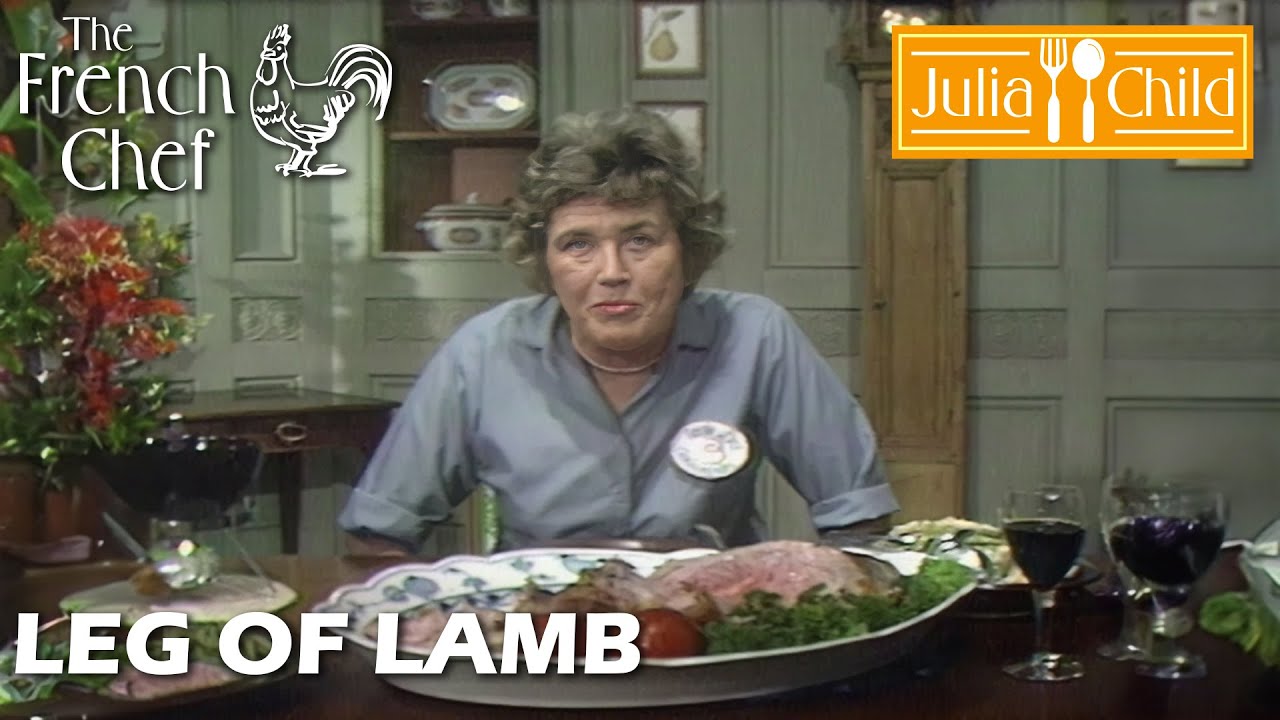
On a sunny terrace in Provence, an expert maitre d’hotel gives Julia Child a private lesson on leg of lamb.
About the French Chef:
Cooking legend and cultural icon Julia Child, along with her pioneering public television series from the 1960s, The French Chef, introduced French cuisine to American kitchens. In her signature passionate way, Julia forever changed the way we cook, eat and think about food.
About Julia Child on PBS:
Spark some culinary inspiration by revisiting Julia Child’s groundbreaking cooking series, including The French Chef, Baking with Julia, Julia Child: Cooking with Master Chefs and much more. These episodes are filled with classic French dishes, curious retro recipes, talented guest chefs, bloopers, and Julia’s signature wit and kitchen wisdom. Discover for yourself how this beloved cultural icon introduced Americans to French cuisine, and how her light-hearted approach to cooking forever changed how we prepare, eat and think about food. Bon appétit!
— Managed by PBS Distribution
Get More Julia Child on PBS:
Twitter: https://twitter.com/pbsdistribution
Facebook: https://www.facebook.com/PBSDistribution.org
[ Sizzling ] This is a gigot, a leg of lamb, browning and cooking and turning on a string in front of a wood fire on a flowered terrace in Provence. We’re waiting for gigot, today, on “The French Chef”! ♪♪ ♪♪ -“The French Chef” is made possible by a grant from the Polaroid Corporation.
♪♪ Welcome to “The French Chef”! I’m Julia Child! That was the leg of lamb we photographed in Provence, at a charming restaurant near Saint-Paul-de-Vence. I don’t know whether a leg of lamb tastes better roasted in front of a wood fire than it does well-cooked in your own oven, but there’s something wonderfully romantic
And appetizing about it. In any case, the preparation is the same, no matter where you cook it. Here is a very fine leg of lamb. And, when you buy one, look for the inspection stamp. This says, “USDA…” US Department of Agriculture, that means. “…Choice,” and, if you get
Government-inspected meat with the seal on it, you know that you’re going to get good quality. And the weight of a leg of lamb. Nowadays, a 5-pound leg of lamb isn’t any more tender than a 7-pound leg of lamb, if it’s a really fine one, to begin with.
Now look at this one. It has a beautifully well-rounded, full — All of this part of it is full and well-rounded. And then, you look at the chopped section. This is the sirloin and, as you notice, that has a lovely bloom on it and it humps up,
Which means, in old age, evidently, it gets flatter. And then, look also at the fat, which is a lovely, firm, white, creamy fat, and that always means a great deal. It means that the lamb has been properly fed and correctly brought up. And also, another indication:
If you see the butcher cut the lamb, this point here is where the ankle bone is taken off. It’s called the stifle joint. And, if you look, the bones are pink and that means that the lamb is still young and also, if, when he’s breaking the stifle joint, he goes —
It goes, “Crack!” and the whole thing breaks off, that means that it is a young lamb. If you can’t break it, then it ain’t young anymore. [ Thudding] And be sure, for this recipe, that you buy a whole leg of lamb and that means that you have the whole bone here,
From ankle to knee; and then there’s a big leg bone in there; and then, on the other side, you have the tail section and the hip. You want to have everything in it. And, sometimes, you will find, I think, very often, because of people’s ovens are small,
You’ll have the lamb cut at the knee. And, for the way that we’re gonna to do this lamb, in a special way, that it’s carved, you don’t want no knee cut. If it is cut, you can always — you can put a skewer up through it so that you can manage, somehow.
But get the whole leg, just like this. And there, that’s the way she looks. And this is called a whole leg, rather than a Frenched leg, which means they’ve cut the hip off. And, now, your butcher will probably have cut the fat off,
But, if not — And you never know that they’re really — they’re gonna cut it off or not. I think it depends on the price of meat. If they can leave quite a bit of fat on, that’ll mean they can charge a little more for it.
And you just have a very sharp knife and you just cut the fat off every place you see it ’cause the fat is a little — has a rather strong taste and lamb fat isn’t very much good, anyway. There’s that fat on that piece of skirt,
And then there’s always some fat right in here. And then, after you’ve gotten it all trimmed, it’ll look like this and it doesn’t make any difference if you’ve trimmed some of the — if some of the meat is exposed because you’re gonna — because that’s quite all right.
You see — And the inspection stamps, you can shave off, or not, depending on how you feel. There’s a little bit left there, but they disappear in the cooking and it’s edible inspection. Now, you can, and I always like to, put a little — some garlic slivers. There’s a clove of garlic
And just peel a clove and take — I like to take one big one or two or three little ones and cut them into slivers and then insert them in the lamb. And, if you don’t like a great deal of garlic, you can just insert them into this part here,
Near the shank, and that is — In French, it’s called le souris, “the mouse.” You can just insert them in either side. And, if people don’t like garlic at all, you can put a little bit in the sauce. But I like to just insert a little garlic all over
And it doesn’t hurt the lamb at all to make little holes in it because you — because these will close up as soon as it gets into the oven, so I just put them a little bit all over. If people come to my house and they don’t like garlic, it’s too bad!
I think often — Usually, when it’s cooked, you can’t taste it, anyway. I mean, you wouldn’t — It loses its wild flavor. Then on the other side, put some in, just put them in all over, as much as you have. Tsk. And then, I like to —
Because I like to take the fat off, I also like to oil the lamb. For one reason, one thing, oiling helps it to baste and then, if you’re gonna prepare it ahead of time, which you can, the oil will keep it from drying out.
And I just use a very nice, French olive oil. And be careful, when you’re rubbing on that side because sometimes the bones are rough. You could cut your fingers. Then, another thing I like to do, which salts it and also browns it a little bit, is
To rub a little soy sauce onto it. That’s a trick from our days in China. I’m very fond of soy sauce. And it does — I think it adds a great deal and then, also, you don’t have to worry about the lamb not browning.
Now, that is, frankly, all that you have to do to the lamb. That’s certainly easy preparation, indeed, isn’t it? And, particularly, as you know, you don’t — for this recipe, you don’t have to take off any of the bones. In other recipes, as you remember, we’ve done boning and all kinds of things
And it’s been, really, very much of a chore. And, in this one, this is all there is to it and you can get this all done ahead of time and wrap it up in, tsk, foil or something and put it in the refrigerator. And then, this is ready, now,
Either for roasting outside or for in the oven and I’m gonna do it in the oven because I don’t happen to have one of those wonderful, outside barbecues. Now, ideally, this is the size pan, about 19 inches long, that will hold this leg of lamb, which is about 7 to 7.5 pounds.
But, this pan won’t fit into my oven and I’m furious! Because I have a new model of the same oven I used to have and the new oven is shorter! So, if you’re going to buy an oven, measure it! And I think it certainly should be 18 inches deep or 19 inches deep.
So I’m gonna have to use this pan, which will fit it in, but we have stickies-over here, so the only thing to do with that — This works out perfectly well. We’ve done it with suckling pig, when the pig jaw stuck over the pan, is to put some aluminum foil around, like that,
And that will pretend. I mean, not pretend. It will prevent drippies-over. There. Now, that, actually, you could go as far as that, if you wanted and then put it in a large, plastic bag and just refrigerate it and it certainly would keep for a day or so.
But I think it’s very important, if you want to be safe on how long to cook the lamb, I think it’s a very wise thing to take the lamb out of the refrigerator for at least an hour or 2 hours and let it come to room temperature
Because, in the French method of cooking, it is cooked pink and so that means that it cooks rather fast. I mean, it doesn’t take very long to cook and, if it’s cooked at room — and if it’s at room temperature, you can judge the time much better.
Now, also, you want to prepare some vegetables for the pan, for the roasting juices: a nice, big onion and here is a scrubbed carrot. And this will give some flavor to the roasting sauces. And then, also, some garlic. And, this, you don’t even need to peel.
Just open it up and I think this is such a measly, little head of garlic, not like the kind you can get in the Italian markets, for instance, that I’m gonna use a whole half one. And then, just leave that in the pan and you are ready to go.
And even that, you could get done ahead of time and put in a plastic bag, also. And, now, we are ready to roast. And this is going to go into a 450° oven, in the middle, and then you leave it at 450° for 15 minutes. Then, you turn the heat down to 350°
And in you put the vegetables. If you put the vegetables in too soon, they might brown and burn. So they just go right around the lamb after the lamb has been in 15 minutes. And I like to baste it with olive oil. Here’s a lo-o-ng-handled baster.
Baste it two or three times during its cooking, just so that you can see how it’s doing. See that? That’s awfully convenient. You don’t burn your hands with it. And this will take only about an hour to an hour and 15 minutes and you want your meat thermometer reading
To be only 125 to 130 and that’s gonna give you a lovely, pinky, rare meat. And, if you haven’t ever had lamb that is pink, like this, at a temperature of 125°, you’ll find that it’s absolutely delicious. It makes another meat. Now, here we have a ready roasted lamb
And I’m gonna show you how it looks. There you are, with its foil on. And you want to take its temperature. This is an extremely good thermometer, a professional one that’s used by air-conditioning people, as well as by cooks. And you take it and put it right in
To the thickest part of the meat. And this is the kind of thermometer that you can’t leave in the meat. You just put it in, take its temperature — and it says 125° — take it out — or whatever it does — and then put the lamb back into the oven.
In other words, you can’t roast with it. You just put it in and the dial goes very quickly. And then, after the meat is done, you have to let it rest for 20 minutes outside of the oven, and that’s so that the meat juices will —
Which are bursting out as you roast it, that they will retreat back into the flesh, so that, when you carve the lamb, you’re not — all the juices are not running out. And this is really very important. Be sure and let it rest 20 minutes before you’re going to cook it.
And then, if you’re gonna do it ahead, you take it out of your oven, open the oven off, turn it off, and leave the lamb out of the oven for 20 minutes. Then, set the oven at 120. Mine only goes to 140, so I set it just below 140
And I also keep a thermometer in the oven, so I can be sure, and then, after it’s rested 20 minutes, you put it back in the oven and close the door and keep — And look at the thermometer. Make sure that it’s at the right temperature.
And you can really leave a roast of lamb for an hour or 2 hours because it can’t overcook because the oven is not over 120 and, actually, I think the meat is even better when it’s cooked that — when it’s rested, allowed to rest ahead.
So, remember, with this, it was a 7- to a 7.5-pound lamb. It was about an hour to an hour and a quarter, or two… …to a temperature of 125°. Tsk. Now, this is done and ready. And we have all of these nice juices here, which can be turned into a sauce.
And these, I’m just gonna put these into a pan and then deglaze the roasting pan with a little white wine or a little white vermouth, whichever you have… …and scrape it up. Now, this is over heat, so that they will loosen nicely. And that goes into your pan.
And then you allow that to simmer, along with a little bit of stock. This is a lamb stock or beef stock, whichever you prefer. And that should — When you get your lamb done, you can allow it to — you’ll allow it to rest and this should simmer for,
Oh, 20 or 30 minutes. And see? That looks very nice. And the lamb is now ready, ready to carve because it has rested. And, with these juices, as you remember, this was an addition on with — I mean, an addition to the juices in the pan
With some bouillon and some white wine or vermouth. And then, you will boil them down and taste them and you’re ready. You’ll just have a little of what they call jus de rôti. And, now, if you’ve got a marvelous fireplace set up, you can roast the lamb vertically
And it will revolve around the flame, just as it did when we saw it in Provence. And, for this, you get yourself a very stout piece of string, tie it double. And that’s tied at this joint here so that can’t slip off ’cause it bulbs out a little bit.
And then tie a strong knot in the other end of it and then hang it on a hook. And turn it around like that and it winds up and then, it unwinds and it revolves in front of the fire, just as it did when we saw it cooking
At that outdoor restaurant in Provence. There’s Alex, the maître d’hôtel. [ Sizzling ] And there’s the lamb, hanging in front. And this is a marvelous system here because there’s a great, big iron plaque in back of the fireplace which is about an inch thick, at least, and 3 feet square,
And that acts as a reflector and all the heat comes out. And here and it just goes round and round and round. And there it goes. And Alex cooked his lamb only 45 minutes ’cause they like it very rare. They like it pink in the middle.
And then, after he had finished cooking it, he showed me the very best way of carving lamb I’ve ever seen in my life. [ Thud ] Now, this lamb on a string is called gigot à la ficelle. [ Clanging ] Now, the juices and the garlic. Oh, that looks wonderful,
Just those juices having dripped off that lamb. Ah, voilà, le gigot! -Voilà, le gigot. [ Conversing in French ] [ Conversing in French ] [ Conversing in French ] [ Conversing in French ] [ Conversing in French ] -Vous parle anglais, Monsieur Alex. -Why, I say yes, a little, yes. -Yes.
-I talk in English, too. -Yes. But you worked in London, too? -Oh, yes. I spent two years in London, [indistinct] and, you know. I think you appreciate the leg of a baby lamb, too. [ Laughter ] -But what I find very interesting
Is that you can keep cutting right around the leg of lamb and it doesn’t — and the [speaking French] remain just the same. Voilà. -Then, we turn the leg on the other side and we start again the other side, you know? -Just continue along the same way. [ Gasp ]
And you have done nothing. You’ve left the tail on and the hip bone and everything that — [ Speaking French ] -It’s a piece — -[Speaking French] -It’s one of a best piece of the leg, you know, the baby lamb. We call [speaking French]. -Oui. -It’s very, very good
And very tender. -That’s the hip, or the sirloin. -Like as a sirloin, yes. -[Both speaking French] Voilà. -[Conversing in French] -[Conversing in French] -Ja. -Voilà. -[Conversing in French] [ Birds tweeting ] [ Clang ] -Voilà. -Voilà. -[Speaking French] -Voilà. -[Speaking French] -Merci.
Merci infiniment. -Bon appétit. Bon appétit. -Merci. -[Laughs] -Since I’ve seen Alex carving his way, I’ve adopted it and I’ve got exactly the same knife. There it is. That’s a great knife. It’s a Sheffield one, hollow ground, with these little —
I don’t know what you call those, but, anyway, it’s just — It cuts beautifully. They use it for cutting ham and it keeps itself nice and sharp. [ Scraping ] Now, here is our lamb, all ready to cut, and, as you remember, as he said, that the important part of this,
If you’re gonna do it in the dining room, you have a napkin. I shall use my impeccably clean, ubiquitous towel and I shall get out — Let me get out me platter here. The important thing is, with this — This is the top side of the lamb. There’s the underside, there.
And you start with, in the middle of the lamb, cutting towards you, just like this. And remember that you’ve got — if this is gonna work, you have to have a very, very sharp knife. And the nice way about — a nice thing about having the lamb done this way,
The outside, the outside, I say tranches… I should say “slices.” Tranche is French for “slices.” …are a little more well-done than the inside. As you see, if you get to the inside, it becomes pinker. And look at how lovely and juicy that is. And this, I had sitting
In a 120° oven for about an hour and it’s just about as tender as anyone could and juicy as anyone could want. But you see how nice those slices are. And you’re always cutting right towards you. And, actually, if I cut as many legs of lambs as Alex had —
There’s that little tail, which you can get off. And then you go around to the — As you can see, there’s a little bit of the bone there, so, then, you begin going around to the other side of the bone. But look at that. Look at that lovely juiciness of it.
Now, I’ve got still a little over on the other side. I don’t know why I never — This is such a sensible carving system. That’s not the most beautiful slice. Then, when you — then, you — when you finish that side, then you start again on the other side,
Again cutting towards you in exactly the same way. And a big leg of lamb like this, with these wonderful, thin slices, will serve, certainly, 10 to 12 people and you’ll have some left over, too. You just go on and on and on and on and then, as you saw,
When you come up to the more complicated hip part, which is up here, you just cut around. And I’m gonna put this back. I’m gonna put this on the platter ’cause I think it’s more attractive. And, not to be outdone by Alex, I shall also put
Some great, big tomatoes around, just for color. And that’s how she looks. That’s really — I think that’s — It’s so much sensibler and easier a system than the old-fashioned one, of cutting down like this and then cutting across that way. I’m gonna rearrange things,
To make sure everything is as pretty as possible. But this also, I think, makes a very nice cutting system for in the dining room ’cause you can cut it just as well on the platter, if it’s lying on the platter like this, as you can if it’s not.
Now, go into the dining room and see how it looks when it’s served. [ Clattering ] There. [ Mumbles ] And one thing that, as you noticed, when they cut the lamb like this, that they spread the thin slices quite a bit out on the plate,
So it makes it look like a great deal of lamb. And with this, I’m gonna do the — a favorite French vegetable garniture is haricot panaché, which means “white beans and green beans,” which makes a very nice combination, and you don’t have to have any potatoes
’cause your white beans are very helpfully starchy. And here is the little sauce that is made out of our juice. And I don’t like to put the sauce on top of the meat. I’d rather put it to the side, so that you can see the full glory of the meat. And, for wine,
A red Hermitage is an extremely nice wine to serve. That would go very well with it, or you could serve a Bordeaux. Now, I think — A lot of people, I think, are terrified of leg of lamb and it think it’s mainly because they don’t know how to carve it,
But, as you’ve seen, it couldn’t be easier to prepare, nor easier to carve, and when it’s cooked pink, like this, it’s wonderful eating, and all you need is the sharp knife and the gigot. So, that’s all for today on “The French Chef.” This is Julia Child. Bon appétit! ♪♪ ♪♪
-“The French Chef” has been made possible by a grant from the Polaroid Corporation. ♪♪ ♪♪ Julia Child is coauthor of “Mastering the Art of French Cooking” Volumes One and Two.
15 Comments
I absolutely love every Sunday‼️‼️‼️ thank you for posting new videos every week. I grew up watching Miss Julia with my mom on Saturday afternoons. Great memories.
I love Julia Child
I"f you can break it, it ain't young anymore" -Julia Child – 2:44
Season 7 Episode 9 – First broadcast on December 2, 1970. Recipes from Seasons 7 through 10 (1970-1973) were collected in the book "From Julia Child's Kitchen" first published in 1975. Recipes from Seasons 1-6 (1963-1966) were collected in the book "The French Chef Cookbook" first published in 1968.
What, all of a sudden, after 7 season, is Julia Child using bad grammar?
You tell ‘em Julia! Too bad if you come to her house and don’t like garlic, lol.
❤
Your videos = happiness!
I was brought up that if you didn't like what mom served, you went hungry. I totally agree with Julia: if you come to my house and don't like garlic, too bad!
19:05–19:58 I wish we had the English translation of Julia's conversation with Alex in French (then, after being prompted, he started speaking in English until drifting again into French at 21:01–21:43).
She awesome, one correction, 02:31 the stifle joint is the ‘knee’ joint. She is pointing at the hock joint. the joint below the stifle.
Hilarious title.
Clever title. 😊
Dear Julia. Her voice and instructions are exactly like my old cookery teacher at school.
Unfortunately I have to eat something unsuitable while I’m watching……….
sorry, Julia. LA souris. It's feminine.